The Pie, The Pearls, And The Deed
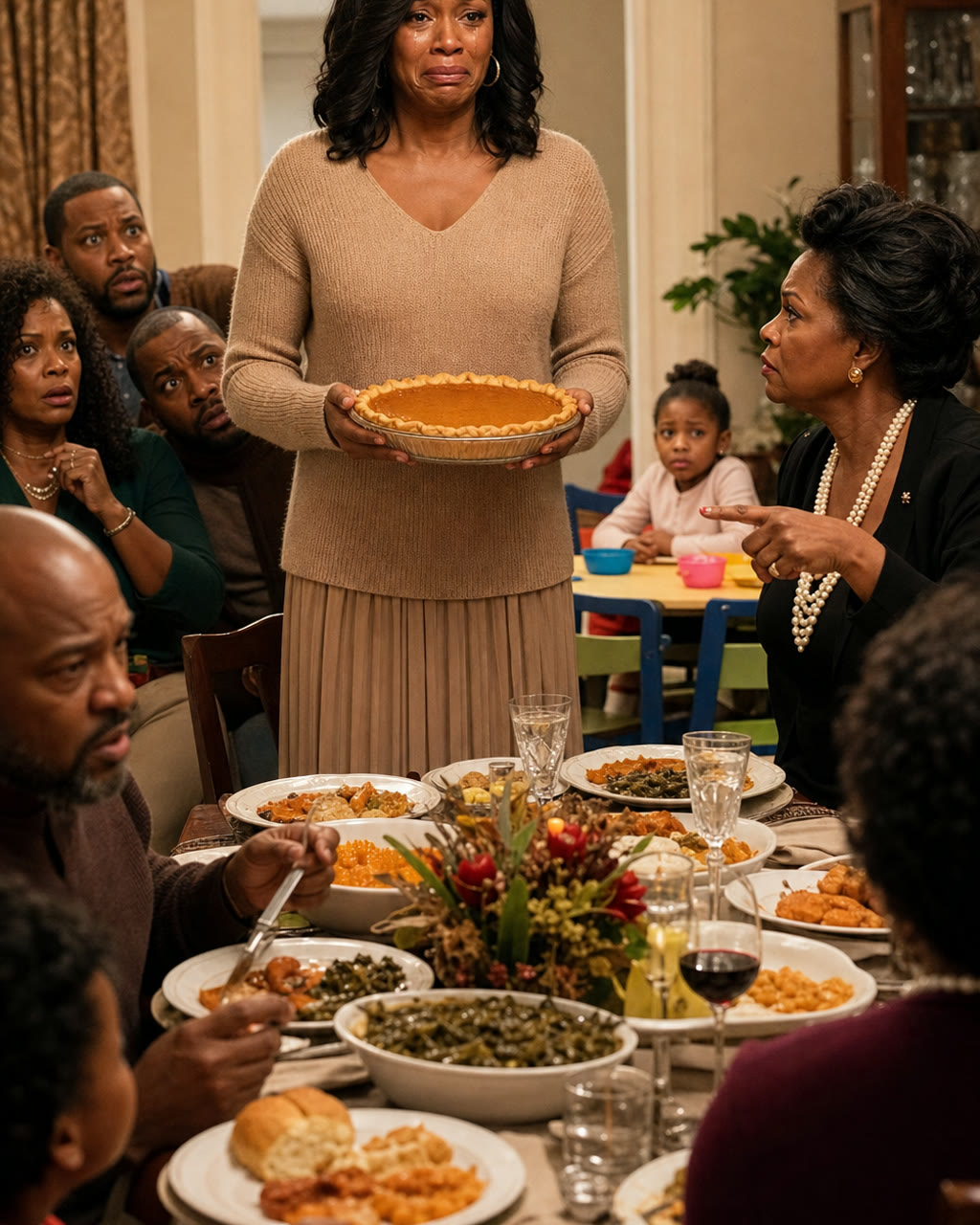
"Real family sits at the adults' table," my mother-in-law said, and pointed one manicured finger toward the folding table where her grandkids ate off paper plates. I was 41. I had cooked half of that dinner.
Chapter 1
The pie was still warm in my hands when Loretta said it.
"Real family sits at the adults' table."
She smiled when she said it. That was the part that got me. A soft, church-lady smile, the kind she used on ushers and on the pastor's wife.
Then she pointed one finger, nails done in that dusty rose she'd worn since 1998, toward the corner of her dining room where the folding table sat with the grandbabies.
Paper plates. Plastic cups. A booster seat with a wobbly leg.
"There's a spot right there, sweetheart," she said. "Let the grown folks talk."
She said it into a lull, right when the room was quiet enough to carry. Loretta always knew exactly when to speak so the whole table would hear.
I was 41 years old.
I had a mortgage, two degrees, and a daughter who had just turned nine and was sitting at that very table watching me.
I felt every eye in the room slide toward me and then, real quick, slide away. That's the thing people do when they don't want to be witnesses.
My husband, Marcus, was sitting three chairs down. His fork did not stop. He lifted a bite of collards to his mouth and chewed like his mother had commented on the weather.
I want to tell you I said something sharp. I didn't.
I stood there holding a sweet potato pie in a glass dish, and I felt the heat of it come up through the towel and into my palms.
Grandma Odessa's recipe. Marcus's grandmother, who raised him when his daddy went to Chicago and didn't come back.
Odessa taught me that recipe herself, sitting in a wheelchair in a kitchen that smelled like nutmeg, three months before she passed. She held my wrist while I whisked so I'd feel the right thickness.
She told me, "This is yours now, baby. You keep it in the family."
I remember the sun coming through her kitchen window that afternoon, catching the flour dust in the air. I remember she wouldn't let the recipe be written down.
"You feel it in your hands or you don't have it at all," she said. "Recipes on paper get lost. Recipes in your hands get passed."
I'd cried in that kitchen too. Odessa was the only one in the whole Grimes family who never once made me feel like a guest.
Loretta had spent two years telling everybody that recipe was "lost."
And here it was, warm in my hands, and I was being pointed to the children's corner like I'd come in off the street.
"Aunt Vivian, you can sit by me," my daughter Naomi said. Her voice was too bright. She was trying to fix it.
She patted the folding chair beside her with her little hand, like she was inviting me somewhere special.
That undid me more than Loretta ever could.
Because Naomi had already read the room. Nine years old, and she already knew her mother had just been put in her place, and she was trying to make it soft.
I looked at my girl. I looked at the empty seat at the big table where the good china was, the seat that had a name card on it that read "Family."
And I made a choice I've turned over a hundred times since.
I set the pie down on the sideboard, gentle, so it wouldn't crack.
I walked to the kids' corner, and I sat down in a folding chair built for a person half my size.
"Scoot over, baby," I told Naomi. "Save me the good cup."
She laughed. A real laugh, relieved, because Mama was okay. Mama was making a joke.
I smiled at her.
Inside, something in me had gone quiet and cold, the way a house gets quiet right before the power comes back on.
Let me back up, because you need to understand who Loretta Grimes is, and who I was to her, before you can understand what came next.
I married Marcus Grimes eleven years ago in a small church in North City with forty guests and a rented sound system.
My own mother had passed the winter before. Ovarian cancer, fast, the kind that doesn't give you time to say the long things.
So when Loretta pulled me aside at the reception and said, "You call me Mama now, you hear me? You don't have to be motherless in this family," I cried into her shoulder in front of everyone.
I meant it. God help me, I meant every bit of it.
For eleven years I was the daughter-in-law who showed up.
I was the one who remembered which cousin didn't eat pork and which one needed a ride from the airport. I was the one who wrote the thank-you cards Loretta took credit for.
When Loretta's knee went bad, I drove her to physical therapy twice a week for four months, and I never once let her pay for gas.
I'd sit in that waiting room reading work emails on my phone, rescheduling my own clients around her appointments, and when she came out I'd have her water and her crossword ready.
When her sister Berneice was in the hospital in Kansas City, I made the three-hour drive with a cooler of food so Loretta wouldn't have to eat vending machine dinners.
When Grandma Odessa was dying, it was me in that room. Loretta came on Sundays after church, in her good clothes, and left before the hospice nurse came to change anything.
I don't say that to make myself a saint. I say it because I want you to know I earned my seat.
And the whole time, Loretta had a way of loving me that felt like a hand on your back that's really checking whether you're standing up straight.
"Vivian, that's a bold color on you." "Vivian, you sure you want that second helping, baby?" "Vivian, my Marcus had his pick of girls, you know. He surprised us all."
Little cuts. So little you'd feel crazy naming them.
Say one out loud and everybody looks at you like you're the one with the problem.
That's the trick of a woman like Loretta. She never once raised her voice at me in eleven years.
She didn't have to.
So there I was, at the kids' table, forty-one years old, eating Thanksgiving dinner off a paper plate with a Spider-Man napkin.
The napkin had a cartoon printed on it. I kept staring at it because it was easier than looking up.
My knees didn't fit under the little table. I had to sit sideways, angled toward my daughter, my good slacks bunching up.
Across the room, at the big table, my husband laughed at something his cousin said.
His mother sat at the head, in her pearls, presiding. She caught my eye once. She gave me a little nod, like she'd done me a kindness.
Like she'd shown me my proper size and expected me to be grateful for the fitting.
I chewed my food. I helped Naomi cut her ham. I asked my nephew Little D about his football team.
And under the table, where nobody could see, my hand found the strap of my purse.
Because in my purse was a folder.
I hadn't planned to bring it out that day. It was supposed to be a surprise for Marcus, a good one, for after the holiday.
But Loretta's finger, pointing at that folding table, had changed the temperature of the whole afternoon.
And I was starting to think about the deed to the house we were all sitting in.
I want you to understand — I hadn't decided anything yet, even then. My hand was on my purse, not in it. There was still a version of that afternoon where I ate my ham off a paper plate, went home, and told Marcus the gentle way, weeks later, and let his mother keep her crown.
That version died somewhere between the sweet tea and the second time she called me "sugar."
The house on Delmar. Loretta's pride. Five bedrooms, a wraparound porch, the house she hosted every holiday in and never let anybody forget it.
The house she was two years behind on.
The house that, eight months ago, was three weeks from the auction block.
The house I had walked into that afternoon with a grocery bag over my head to keep the rain off, not knowing I was about to find red envelopes stacked on the good dining table.
Nobody at that table knew that but me.
Nobody knew what I'd done about it, either.
I looked up from Naomi's plate, straight down the length of the room, past the good china and the turkey and the centerpiece Loretta had ordered special.
Loretta was watching me. Still smiling.
"You comfortable back there, sugar?" she called out, sweet as pie, so the whole table could hear.
I set down my plastic fork.
"Comfortable as I need to be, Mama," I said.
And I smiled right back.
She held my eyes a second longer than was friendly. Then she turned to her guests and lifted her tea, satisfied, a woman who thought she'd just won something.
She had no idea she'd just started the clock on the only afternoon of her life she'd want back.
I looked down at Naomi, cutting her ham into careful little squares, and I made myself a promise right there at that Spider-Man napkin.
Whatever I did next, my daughter was going to remember her mother standing up. Not standing down.
Chapter 2
To tell you about the house, I have to take you back eight months, to a Tuesday in March.
It was raining. I remember because I had to run from the car to the front porch of the Delmar house with a grocery bag over my head.
Loretta had called me that morning. Not Marcus. Me.
"Vivian, baby, can you come by? I got a little situation I need a smart head on."
I went. I always went.
She sat me down at that same dining room table, the big one, and she slid a stack of envelopes across to me.
Red ones. The kind that don't stack quietly.
She'd tied them with a rubber band, like that made them less real.
"I don't understand these papers," she said. "You're good with papers."
Her hands smoothed the tablecloth over and over while I opened them. That was the tell. Loretta only fidgets when she's terrified.
I understood them just fine.
Loretta was twenty-two months behind on the mortgage. The bank had filed. There was a date on the letter, a sale date, a courthouse, a time.
Twenty-six days out.
I looked at that letter and then I looked at Loretta, and for the first time in eleven years I saw her scared.
Her hands were folded on the table to keep them from shaking. Her chin, the one she held so high, had a little tremble in it.
"Does Marcus know?" I asked.
"No." Fast. Sharp. "And he's not going to. You hear me? None of them are going to know."
She grabbed my wrist when she said it. Her grip surprised me — strong for a woman that scared.
"Promise me, Vivian. On everything. Not my son. Not Reggie. Nobody. I would rather lose this house than have my children see me like this."
I promised. Right there, I promised. And keeping that promise is the thing that let her build her whole lie later.
Pride. That woman had more pride than the county had roads.
Her husband, Marcus's father, had left thirty years back. She'd held that house alone through everything, and the idea of her children knowing she was losing it — that was worse to her than losing it.
"How'd it get this far, Mama?" I asked her, gentle.
The story came out slow. A roof repair she'd put on a home equity line. A refinance a "nice young man" from a company that doesn't exist anymore had talked her into. A payment that ballooned. Then Berneice's medical bills, because Loretta had quietly been sending her sister money for two years.
That last part got me. For all her sharpness, Loretta had bankrupted herself keeping her baby sister alive.
She told it looking at her hands, not at me. Ashamed, I think, that she'd been caught being human.
"Berneice would've done it for me," she said. "That's what sisters do."
I thought about my own mother, gone, with no sister left to do anything for anybody. And I felt something in me soften toward this hard woman that I would later wish I'd guarded better.
I didn't say any of that out loud. I just started making a list.
I sat at that table for four hours in the rain. I called the bank's loss-mitigation line and sat on hold with my own phone. I read every page of every red envelope.
The hold music looped the same eight bars until I could have hummed it in my sleep. Loretta made coffee and set a cup by my elbow and hovered like a girl waiting on a report card.
And here is the part I have thought about every single day since Thanksgiving.
I could have made Loretta ask her son.
I could have called Marcus right then, put the phone on speaker, and let her pride crash into the truth.
I didn't.
I looked at that frightened old woman and I thought about my own mother, gone before her time, and how there was nobody to save her from anything.
And I decided I would save Loretta from this. Quietly. The way she never once did anything for me.
I had money. Not rich money. But I'd been careful my whole life. I sold medical devices to hospital systems, a job I was very good at and never once got credit for at that dinner table, and I'd banked my commissions for fifteen years.
I'd driven the same paid-off Camry for nine years so that money could just sit and grow. I'd packed my lunch. I'd said no to things.
Marcus never fully understood the savings. He'd tease me about being tight. He didn't know I was building a wall around us for exactly the kind of storm that had just walked in the door in a red envelope.
I had enough to stop the sale. Barely. But enough.
The bank told me they couldn't take a large lump payment from a third party to reinstate the loan and just hand it back the way it was. Not without a mess.
I sat with that a few days. I did the math a dozen times, at my kitchen table after Marcus went to sleep, calculator glowing in the dark.
This was almost everything. Fifteen years of no-Camry-payments and packed lunches and saying no, spent in one wire transfer to a bank that had never heard my name.
I could have kept it. I could have made Loretta go to her son with her hat in her hand. Nobody would have blamed me.
So my lawyer — my friend Renata, who I'd known since college — found me a cleaner way.
I paid off the entire remaining balance. All of it. And the deed transferred.
To me.
Not to me-and-Marcus. To me. Vivian Grimes, sole owner, free and clear, recorded at the city.
I want to be honest about why.
Part of it was practical. Renata said if my name alone was on it, there'd be no question, no probate mess, no way for it to get tangled if anything happened to Marcus or to me.
But part of it, the part I'm less proud of, was this:
For eleven years, that house had been the throne room where I was told I was almost enough.
And some quiet, tired part of me wanted, just once, to be standing on solid ground of my own.
I told Loretta what I'd done. I sat her down and I told her plain.
"The house is saved, Mama. It's paid. Nobody's ever taking it from you. You'll live here as long as you draw breath, and it won't cost you a dime."
She cried. Real tears, the first I'd ever seen from her.
Not the pretty church cry. The ugly kind, where the face gives up and you see the girl the woman used to be.
She held my hands across that table and she said, "Vivian, I don't deserve you. You're a better daughter to me than I've been a mother to you."
I believed she meant it. In that moment, she did.
And I want to be honest — hearing her say it fixed something in me that had been aching for eleven years. Finally. Finally she saw me.
That's the dangerous thing about a woman like me. Feed me one honest sentence and I'll forgive a decade of little cuts.
"The deed's in my name for legal reasons," I told her. "Renata set it up clean. But this is your home. That never changes. And Mama — nobody needs to know the details. Not Marcus, not anybody. This stays between us."
I did that for her pride. I want you to understand that. I kept her secret to protect her.
She squeezed my hands and swore it on Grandma Odessa's grave.
"You saved me, baby," she said. "I'll never forget it."
We agreed I'd tell Marcus eventually, some soft way, some day when it wouldn't wound his mother.
I drove home in the rain feeling, for the first time in a long time, like I finally had a real place in that family.
I didn't tell Marcus that night. I lay next to him and looked at the ceiling and thought, I'll tell him when the time is soft. When it won't shame his mother.
I felt good about it. I felt like a woman who'd done the quiet right thing and asked for nothing back.
That's the part that still catches in my throat when I think about it. How good I felt. How safe.
Eight months later, she pointed me to the kids' table.
Now. Here's what I didn't know that rainy Tuesday.
Loretta had a plan for the secret too. Her own plan.
Because a woman who'll bankrupt herself for her sister, and then let her daughter-in-law bankrupt herself to save her, and then thank God on her knees for it —
that same woman had already started telling a different story.
I found this out slow, over those eight months, in pieces.
At Easter, Loretta's friend Miss Carolyn pulled me aside by the deviled eggs and said, "Girl, I heard you all had a scare with the house! But Loretta told me Marcus stepped up and took care of his mama. That boy is something."
Marcus. Who didn't know a thing about it.
I laughed it off. I figured Miss Carolyn had it twisted. Old church ladies mix things up.
I told myself Loretta had probably just said "the family" and Carolyn filled in the rest. I gave her the benefit of the doubt because I wanted to.
In June, at the church picnic, Loretta's brother-in-law shook Marcus's hand hard and said, "Proud of you, nephew. A man takes care of his people."
Marcus, confused, said thank you. He thought it was general. A man being told he was a good man; who questions that.
I watched from across the picnic table with a plate of ribs going cold in front of me. And this time I couldn't tell myself it was a mix-up.
I'd caught the shape of it now. Somebody was feeding these people a story, over and over, until it set like concrete.
I stood there with a paper plate of potato salad and I felt something turn over in my stomach.
She was giving my rescue to her son.
Not to spite me, I told myself. Just her pride. Just her wanting the family to think a Grimes man had done it, not the daughter-in-law from North City with the dry cornbread.
I let it go. Lord, I let so much go.
Then came October.
I was at the Delmar house dropping off Naomi's forgotten jacket, and I overheard Loretta on the phone in the kitchen. She didn't know I'd let myself in.
"...well, once we get it back in Marcus's name, it'll be like it should've always been," she was saying. "Vivian did us a favor, sure, but a house like this needs to stay with blood. She'll understand. She's a sensible girl."
Back in Marcus's name.
Get it back.
I stood in that hallway holding my daughter's jacket, Naomi's little denim jacket with the patch on the elbow, and something cold moved down my spine.
I put the jacket on the banister. I let myself back out the front door as quiet as I came in.
I sat in my paid-off Camry in the driveway for a long time before I could turn the key.
Because I understood, all at once, what was being built around me.
It wasn't just her pride wanting the family to think a Grimes man had saved the day.
It was a plan. Get the story straight first — Marcus saved it, blood keeps the homeplace — and then, once everyone believed it, come to me and ask me to make the paperwork match the story.
The folding table on Thanksgiving, when it came, wasn't just cruelty.
It was a woman reminding me where I ranked, so that when she asked me to sign my saved house over to her son, I'd be too small to say no.
Chapter 3
I didn't say anything in October.
That was hard for me. I am not a woman who sits on things. But my mother, before she passed, told me one time, "Baby, don't ever throw the first punch. But if you have to throw the last one, make it count."
So I watched. I listened. I let Loretta think I was the sensible girl.
It cost me something to stay quiet. I'm not built for it. I lost sleep. I'd lie awake next to Marcus at two in the morning running conversations in my head, all the things I could say, all the ways they could go wrong.
I lost weight I didn't need to lose. My blouses started hanging off me. At work my numbers were still good — they were always good — but I'd catch myself staring at a spreadsheet not seeing it.
Between October and Thanksgiving, the pattern came clear.
Loretta started including me less and telling the family more.
"Marcus saved the homeplace," became the settled story. People I barely knew thanked my husband at the grocery store.
And Marcus — this is the part that hurt in a different way — Marcus started to believe he'd done something.
Not on purpose. He's not a cruel man. But when enough people tell you you're a hero, you start standing a little taller in the shape of it.
One night in November he said to me, "You know, Mama's been through a lot with that house. I'm glad we've got her looked after."
We.
He said it while he was rinsing a plate, casual, not even turning around. Like it was settled. Like it was his.
I stood there with a dish towel in my hand and I felt eleven years press down on my shoulders.
I looked at my husband across our own kitchen and I asked him, careful, "Marcus, what do you actually know about the house? About what happened in the spring?"
He shrugged. "I know it got handled. Mama said it got handled and to let it lie."
I studied my husband's face for a long moment. He wasn't lying to me. That was the thing that hurt.
He genuinely didn't know. He'd been told a story by the woman who raised him, and he'd believed her, because why wouldn't he. She was his mama.
And I realized then that Loretta hadn't just fooled the church ladies. She'd fooled her own son so completely that he'd started to feel proud of a thing he never did.
Let it lie.
That's the phrase Loretta had trained the whole family to use for me.
I could have told him everything right then. Part of me wanted to.
But I'd promised Loretta secrecy to protect her pride, and now that same secrecy was being used to write me out of my own story.
If I broke it, I'd look like the bitter wife making up a wild claim. And she knew it.
Picture how it would sound at a dinner table. "Actually, I paid off the house. It's in my name." Out of nowhere, with no proof in hand, against a story the whole family had already accepted.
They'd look at me the way families look at the in-law who "caused drama." Loretta would sit there wounded and dignified, and I'd be the one who ruined the holiday.
That was the trap. The kindness I'd done in secret had become the weapon held to my own throat.
And the beauty of it, from her side, was that she never had to lie outright. She just let people assume, and corrected nobody, and smiled.
So I made two phone calls.
The first was to Renata, my lawyer. I asked her one question. "The deed. It's clean, right? Sole owner, recorded, no clouds?"
"Vivian," she said, "you own that house the way you own your own two hands. There is no question. Why?"
I told her a little of it. The Easter comments. The picnic. What I'd overheard in October.
Renata was quiet a second. She's known me since we were nineteen, sharing ramen in a dorm.
"Viv," she said finally, "you didn't do anything wrong. You saved that woman. Don't let anybody rewrite you into the villain of a story where you're the only one who acted right."
"Just checking my footing," I told her.
"Your footing is solid," she said. "The question is whether you're gonna keep standing quiet on it."
I sat with that after we hung up. Renata had known me twenty years. She knew that quiet was both my discipline and my prison.
My whole life I'd been the woman who kept the peace. Who absorbed the little cuts so nobody had to feel awkward. Who made things smooth.
I'd learned it young, watching my own mother swallow things to keep a roof over us. I thought it was strength. I thought that was what a good woman was.
And I was starting to understand that being that woman was exactly how a person ends up at the kids' table at forty-one.
The second call was to the city recorder's office. I paid nine dollars for a certified copy of the deed, current as of that week.
My name. Only my name. Recorded and stamped.
I put it in a folder. Blue folder, the kind Naomi uses for school. I'd grabbed it off her desk without thinking, and later that felt right somehow — my proof of who I was, carried in my daughter's folder.
I kept it in the zip pocket of my purse for two weeks before Thanksgiving. Some nights I'd take it out just to look at the stamp. Vivian Grimes. Sole owner.
Nobody had ever handed me proof I belonged before. I'd had to buy it with fifteen years of savings and record it at a government office.
I did not plan to bring it to Thanksgiving to start a war. I want that on the record.
I brought it because I'd decided that after the holiday, I was finally going to tell Marcus the whole truth, gently, with the paperwork in front of him so it couldn't be twisted.
The folder was insurance against Loretta's version of events.
Then his mother pointed her dusty rose fingernail at the children's table, and something in my timeline moved up.
The morning of Thanksgiving, I got up before everyone and made the sweet potato pie in my own kitchen.
I let Naomi hold the whisk. I put my hand on her wrist so she'd feel the thickness, the way Odessa had done for me.
"Feel that pull?" I told her. "That's when you know it's ready. Not before."
She scrunched her face, concentrating, and I loved her so hard in that second it scared me.
I didn't know yet that by dinnertime I'd be teaching her a different lesson entirely — one I hadn't planned, about what a grown woman does when she's pushed too far in front of her child.
Let me tell you about that Thanksgiving dinner properly, because you deserve to see the whole table.
There was Marcus. My husband. A good provider, a soft laugh, a man who loved his mother the way you love a hurricane you grew up inside — with total loyalty and no ability to see it clearly.
His weakness was simple: he could not, would not, choose between his mama and me, so he just never looked directly at the choice.
There was Loretta. Pearls, pride, and a spine of iron rebar. Sixty-eight years old and still the smartest person in most rooms.
Her strength was that she'd survived everything. Her weakness was that she'd decided survival gave her the right to arrange everyone else's dignity to suit her own.
There was Aunt Berneice, the sister Loretta had gone broke to save. Frail now, sharp-eyed, missing nothing.
Berneice had come up from Kansas City for the holiday. She sat at the big table, but she watched everything from behind her glasses like a woman keeping accounts.
Her strength was that she owed the whole family nothing but the truth, and at seventy she'd stopped being scared of it. Her weakness was her body — she moved slow now, with a cane, and she hated needing help. She'd been the one Loretta's money kept alive, and she carried that knowledge quietly.
There was Cousin Reggie, loud, kind, the family peacemaker who filled silences with jokes. His strength was that he could make anybody laugh. His weakness was that he'd do it to avoid ever taking a side, so trouble slid right off him and onto somebody else.
And there was Little D, my nephew, fifteen and glued to his phone, who I'd been slipping twenty dollars to since he was a baby.
And there was my Naomi. Nine years old, watching her mother get sent to the corner and trying to make it into a game.
So. The pie was on the sideboard. I was in the folding chair. My purse strap was in my hand.
And Loretta, feeling generous in her victory, decided to press.
"You know," she announced to the big table, swirling her sweet tea, "I always say, this house has good bones because it's got good blood in it. Been in the Grimes family a long time. And it's gonna stay that way."
She looked at Marcus when she said it. "My son's gonna make sure of that. Aren't you, baby?"
Marcus, not knowing what he was agreeing to, said, "Course, Mama."
Then Loretta looked at me. Just a flick of the eyes. A little smile.
"Vivian understands. Blood keeps the homeplace."
The words landed on me like a hand on the back of my neck. Gentle. Steering.
I looked around the table and I saw it working. Reggie nodding along. Miss Carolyn, who'd come by for dessert, smiling at Marcus like he hung the moon. The story was set. The room believed it.
And there it was, out loud, in front of everyone. The setup for the ask. The pressure, applied in public so I'd cave in private.
She'd sat me at the children's table and now she was telling me, sweetly, to hand over the deed to the grown folks.
I felt the whole eight months rise up in me. The rain. The red envelopes. The four hours on hold. The commissions from fifteen years of a job nobody at that table respected.
I thought about Odessa's hand on my wrist. I thought about all the mornings I showed up early and stayed late. I thought about my dead mother, who never got saved from a single thing.
And I thought about Naomi, in the corner, watching.
Something in me finished making its decision.
I stood up from the folding chair.
Naomi's hand shot out and grabbed my sleeve. "Mama?"
"It's okay, baby," I told her. "Mama's just gonna get her some of that pie she made."
I walked to the sideboard. I picked up Grandma Odessa's sweet potato pie.
My hands were steady. That surprised me. Eight months of losing sleep, and now that the moment was here, my hands were as steady as they'd been whisking that morning.
And I carried it, slow, to the big table.
The room got interested. You could feel it. Reggie stopped mid-joke. Even Little D looked up from his phone.
I set the pie down in the center of the good china, right in front of Loretta.
"Grandma Odessa's recipe," I said, loud enough for everyone. "The one you told the whole family was lost, Mama. It wasn't lost. She gave it to me. In her kitchen. Three months before she passed."
The silence that came then wasn't the room going quiet. It was something else. It was a room leaning in.
Loretta's smile flickered. Just barely. "Well, isn't that nice."
"It is nice," I said. "You know what else is nice?"
I reached into my purse.
I took out the blue folder.
And Loretta Grimes, sitting at the head of her table in her pearls, went the color of ash.
Chapter 4
I did not open the folder right away.
I held it. I stood at the head of the table with my hand flat on top of it, and I looked at Loretta, and I let the moment sit.
Berneice, behind her glasses, set down her fork. She knew. Somehow that old woman already knew.
She and I looked at each other for one second across that table, and something passed between us. Two women who'd both been kept alive or kept small by Loretta's pride, recognizing each other.
"Vivian," Loretta said, and her voice had lost its sugar, "sit down, baby. You're making a scene."
"I sat down already, Mama," I said. "At the kids' table. You saw to that."
The word "Mama" came out of me strange. Eleven years I'd said it like a gift. Now it sat in the air like a question nobody wanted to answer.
Marcus finally looked at me. Really looked. "Viv, what's going on?"
I turned to my husband.
"Marcus, in March, your mother's house was twenty-two months behind on the mortgage. The bank had a sale date. Twenty-six days out. It was going to auction."
The table did not breathe.
Marcus's face moved through three things at once — confusion, then hurt, then a slow dawning fear.
"That's not — Mama, that's not true," he said. But he was looking at Loretta, not at me. And Loretta wasn't saying it wasn't true.
"It's true," I said. "She called me. Not you. Me. Because she was too proud to let her son know she was losing the homeplace. And I understood that. So I helped her."
Reggie tried to lighten it. "Now hold on, this is a lot for after turkey—"
Nobody laughed. For once, his joke found no floor to land on. He sat back down slow.
"We helped her," Loretta cut in, fast, grabbing for the story. "The family came together—"
"No, Mama."
I said it soft. That was the thing. I didn't yell. Not once that whole day.
"I paid it. All of it. Every dollar of the balance, out of the money I saved from fifteen years of a job y'all like to pretend isn't real work."
I opened the folder.
I laid the certified deed on the good china, next to the pie.
"And I want to be real clear, because I hear there's been some confusion at the grocery store and at church. This house is not in Marcus's name. It never was."
I slid the deed toward the center of the table so everyone could see the stamp.
"It's in mine. Vivian Grimes. Sole owner. Recorded at the city. Free and clear. I own this house."
I have played this scene in my head a hundred times, and every time, the thing I remember most is how still Marcus got.
He picked up the deed. He read it. His mouth moved over my name.
He read it twice. I watched him read it twice, like the second time might change the letters.
Then he looked at his mother, and something broke in his face that I don't think ever fully healed.
"You let people thank me," he said to her, quiet. "At church. You let them shake my hand. And you knew Vivian did it. You knew, and you sat my wife at the kids' table."
His voice didn't rise. That was the worst of it. My husband is a loud man, a laughing man, and he'd gone dead quiet.
"Mama," he said. "Look at me and tell me you didn't know what she did."
Loretta looked at the centerpiece. She looked at the good china. She looked everywhere but at her son.
Loretta's chin came up. That iron rebar. Even now.
"I did what I had to do to keep this family's dignity," she said. "A house like this ought to stay with—"
"With blood," I finished for her. "I know. I heard you on the phone in October, Mama. 'Once we get it back in Marcus's name.' 'She's a sensible girl.'"
Berneice made a small sound. A tired one.
"Loretta," she said. And that was all. Just her sister's name, the way you say a name when you've run out of patience for someone you love.
Then Berneice turned to the rest of the table, and she said the thing that ended it.
"That child's money paid my hospital bills too," she said. "You want to know why your mama fell behind? She was keeping me breathing in Kansas City. And Vivian caught the both of us when we fell. So everybody at this table can put their forks down and be grateful, or they can go on home."
Nobody moved. Nobody went home.
Loretta's face, when her own sister said it, is the thing I'll carry. Not triumph for me. Just a proud woman watching the last of her story get taken out of her hands by the one person she'd bled for.
Here is where I could have burned it all down.
I had them. Every eye at that table had shifted. The story Loretta had spent eight months building had come apart in ninety seconds, and I was the one holding the match.
I could have listed every little cut. The cornbread. The bold colors. Eleven years of "bless your heart." I could have made that whole room see her.
I looked at Naomi.
My daughter had come to the doorway between the tables. Nine years old, watching her mother stand at the head of the family with a deed and a pie and the power to humiliate her grandmother in front of everyone.
Learning, right then, what a woman does with power when she finally gets it.
So I made my last choice.
I picked the deed back up. I closed the blue folder.
"I'm not taking anybody's home," I said. My voice was steady. "Mama, you'll live here till the good Lord calls you. That was true in March and it's true right now. I never once threatened that. I never would."
Loretta blinked at me.
"But I'm done pretending," I said. "I'm done being told I'm almost family. I'm done being pointed to the corner. I saved this house because I loved this family more than this family ever decided to love me back. That's the truth, and now it's out loud, and I'm not going to be the only one in this room who has to carry it quietly anymore."
I turned to my husband.
"Marcus, I love you. But you never once looked at the choice between your mama and me. Today you're gonna have to."
Then I did the thing I'd wanted to do since the pie was warm in my hands.
I cut a slice of Grandma Odessa's sweet potato pie. I put it on a good china plate. And I carried it back to the kids' table, and I set it down in front of my daughter.
"Eat up, baby," I told Naomi. "It's yours now. She gave it to me, and I'm giving it to you. That's how it's supposed to work."
I sat down in the folding chair on purpose. Head high. On my own terms this time.
The dinner did not recover. Those things don't.
But some things did.
Marcus got up from the big table. In front of his mother, in front of everyone, he crossed the room, pulled a folding chair from the wall, and sat down at the kids' table next to me and Naomi.
The scrape of that chair leg on the floor was the loudest sound in the house.
He didn't say anything grand. He just took my hand under the table, the way he should have the first time. His hand was shaking a little. I held it steady for both of us.
Berneice came over too, slow, with her cane, and lowered herself into the last little chair.
"This the grown folks' table now," she said, and gave me a look that was almost a smile. "Y'all don't mind if an old woman joins the real family, do you."
Loretta sat alone at the head of the big table, in her pearls, with her good china and her centerpiece she'd ordered special.
Nobody joined her.
That was the reckoning. Not me taking her house. Not me shaming her with a list.
Just an empty table, and the sound of us laughing quietly in the corner, and her finally understanding that the seat that matters isn't the one at the head. It's the one people choose to sit next to.
Marcus and I had our own reckoning at home, later that night, and it was harder than the table.
Because he had to sit with the fact that he'd never looked. That his mother could rewrite his own wife out of the family's story and he'd let it happen by not paying attention.
"You should have told me in March," he said.
"I promised your mother I'd protect her pride," I said. "I kept a secret to keep her whole. And she used it to make me small. That's on her, Marcus. But you not seeing me for eleven years — some of that's on you."
He didn't argue. He sat on the edge of our bed with his head in his hands for a long time.
Then he said, "I see you now."
It wasn't everything. But it was true, and true was a start.
We talked, later. Loretta and me. Months later, on the wraparound porch of the house I own and she lives in.
She never fully said sorry. Women like Loretta don't have those exact words in them.
She got smaller after that Thanksgiving. Quieter. She stopped hosting like a queen and started asking, actual asking, before she assumed. "Vivian, would it be all right if—" became a thing she said.
Some folks in the family cooled toward her a while. Some cooled toward me too, the ones who liked the old story better. Family's like that. Not everybody wants the truth on the table with the turkey.
We sat on that porch with sweet tea, the two of us, watching Naomi ride her bike up and down the block.
"I was so scared that spring," Loretta said, out of nowhere. "Scared my children would see me fail. I spent my whole life making sure they saw me strong."
"I know, Mama," I said.
"And you saw me at my weakest." She turned her glass in her hands. "And I couldn't forgive you for it. That's the ugly truth. You held my shame, and I couldn't stand you knowing it."
It was the most honest thing she'd ever said to me.
I didn't gloat. There was nothing to win. Sitting there, I mostly felt tired, and a little sorry for us both — two proud women who'd hurt each other over a house neither of us needed to fight for.
But one Sunday, weeks after that, she made cornbread and set a piece in front of me and said, "Tell me if it's dry."
And that was as close to an apology as sixty-eight years of pride could carry.
I took a bite. It was a little dry, honestly.
"It's perfect, Mama," I said.
And her shoulders came down half an inch, the way a person relaxes when they've finally been let off a hook they hung themselves on.
Because I could afford to be kind. That's what she never understood about power. It's not the pointing finger. It's the open hand you choose not to close.
My daughter is twelve now. She still asks for that pie every Thanksgiving.
And every year I make it, and I let her hold the whisk, and I put my hand on her wrist so she can feel the right thickness.
"This is yours now, baby," I tell her. "You keep it in the family."
She always asks me which family I mean.
I tell her the truth: the one you build with your own two hands, at whatever table they try to seat you at.
You may also like
The Silent Truth Behind My Daughter's Accident
The call came at 11:47 at night.…
Read the full story →The Night Evelyn Harper Took Back Her Power
My husband's mistress openly mocked me while my husband smiled… While they laughed at my pain, they never realized that I was the one in control. The moment I whispered, "Everythin…
Read the full story →He Fired the "Cleaning Lady" in Front of the Whole Office — Nine Minutes Before the Board Handed Her the Company
My name is Eleanor Reyes, and for eighteen months the people at Meridian Textiles thought my name was "hey" or "the cleaning lady" or, on a good day, "Ellie, could you get the brea…
Read the full story →