The Table By The Trash And The Man Who Knelt
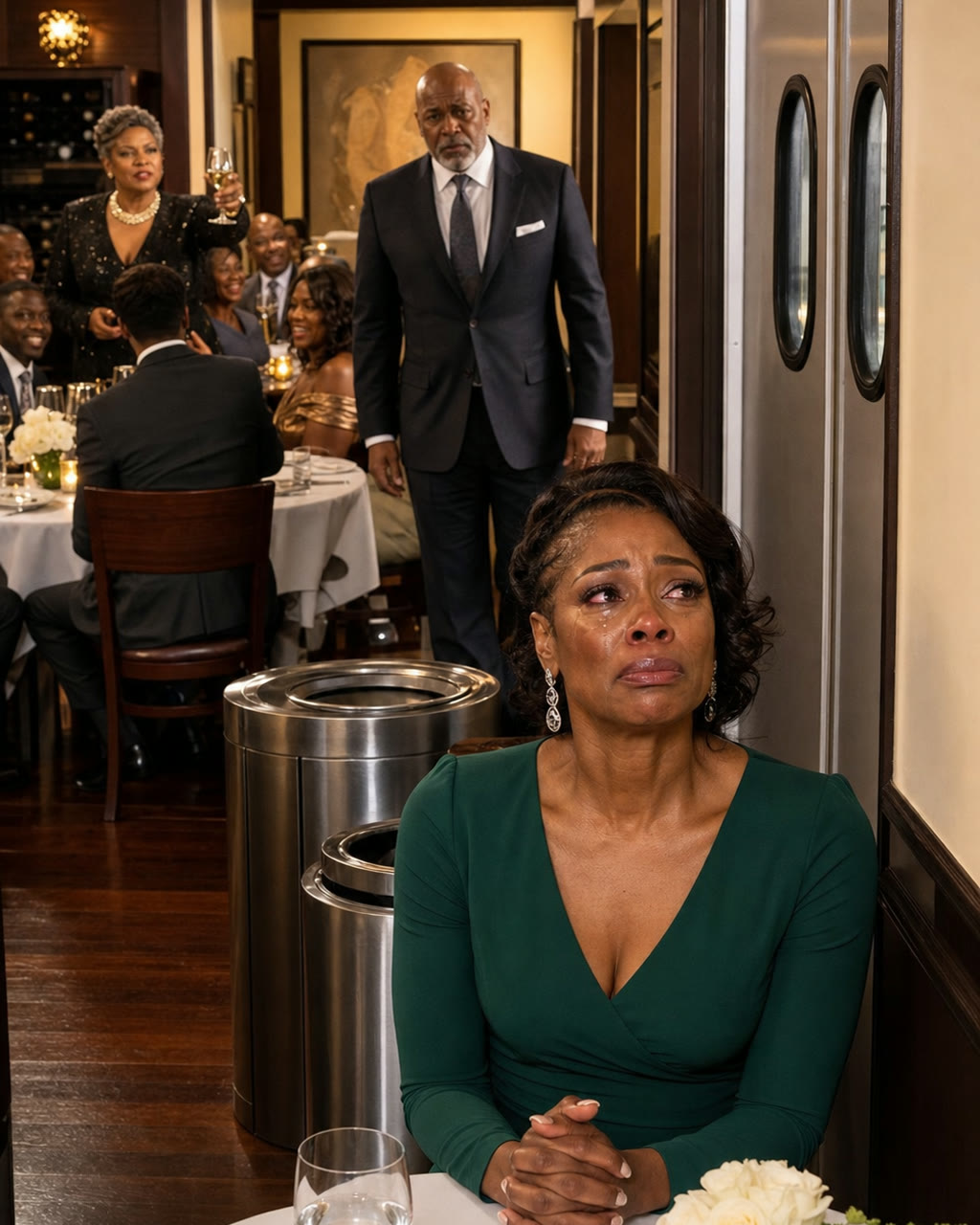
They sat me at a two-top by the kitchen doors, next to the trash cans, on my own 10th anniversary. My husband's whole family was thirty feet away at the good table, laughing, and nobody looked back at me once. I sat there in the dress I saved four months to buy, holding a menu I couldn't read because my eyes were doing that thing where the words swim. A busboy kept apologizing every time he dragged a full bin past my elbow.
Chapter 1
I ironed that dress three times before I put it on.
Deep emerald green, wrap style, the kind of thing I'd walked past for four months at the boutique on Crenshaw before I finally bought it. Marcus told me it was too much money. I told him a woman turns forty-one and ten years married exactly once, and I bought it anyway.
That was the first sign, if I'm honest. The "too much money" for me. Never for him.
We'd been married a decade. Marcus Whitfield and Deandra Coleman-Whitfield. I still liked writing both last names, the hyphen like a little bridge. I met him at a credit union in Inglewood where I processed loans and he came in to refinance a truck he couldn't afford. I approved the loan. I probably shouldn't have. That's a joke I used to tell at parties, back when we went to parties.
We have a daughter. Zuri. Nine years old, gap in her front teeth, reads two grades above where she should. She calls me "Mama D" when she wants something and "Mom" when she's mad, and both of those things live in my chest like they own the place.
The dinner was my idea. Marcus's family lives all over — Baldwin Hills, Ladera, one aunt out in Fontana — and getting them in one room is like herding cats who don't like you. But ten years felt like something. I wanted a table. I wanted candles. I wanted my mother-in-law to see, just once, that I'd made her son a home.
So I booked Ambrose. It's the nice place on the water in Marina del Rey, white tablecloths, a wine list thick as a Bible. I put down a four-hundred-dollar deposit off my own card. I made the reservation under my name. Table for eight, seven o'clock, Saturday.
I want you to hold onto that. My name. My card. My anniversary.
Marcus's mother is named Loretta. Loretta Whitfield, sixty-six, retired from the county assessor's office, and she has never once called me by my first name without a pause in front of it, like she's deciding whether I'm worth the syllables.
The first time we met she asked me what my people did. Not what I did. What my people did. I said my mama cleaned houses and my daddy drove a bus for thirty-one years and I put myself through Cal State Dominguez Hills, and Loretta smiled the smile you give a child who's just told you a long story.
Ten years, and that smile hadn't changed.
We got there at 6:50. I like being early. I had Zuri in a little yellow dress with a bow, and she was holding my hand and swinging it, and Marcus was on his phone in the parking lot.
Inside, Ambrose was everything I'd hoped. Gold light, a piano somewhere, the smell of butter and something citrus. A young hostess in black smiled at me and I gave her my name.
"Coleman-Whitfield," I said. "Party of eight. Seven o'clock."
She looked at her screen. She looked past me. And then she looked at someone over my shoulder, and her smile got careful.
I turned around. Loretta had come in behind us with Marcus's brother, Terrance, and Terrance's wife, Nicole, and an aunt named Pat. Loretta walked straight past me to the hostess stand like I was a coat rack.
"The Whitfield party," Loretta said. "I called ahead about the seating."
I didn't know what that meant. I stood there in my green dress with my daughter's hand in mine and I didn't know what "called ahead about the seating" meant.
The hostess led us in. And the family flowed around me the way water goes around a rock, and I ended up at the back of the line, and by the time I got to the dining room they were already sitting down.
There was a beautiful round table by the window. Candles lit, water poured, a view of the boats. Loretta took the seat facing the water. Terrance and Nicole. Aunt Pat. Marcus's cousin Reggie, who'd driven up from San Diego. Marcus.
And Zuri. They pulled out a chair for Zuri at the good table, right next to her grandmother, and Loretta patted it and said, "Come sit by Grandma, baby."
Zuri looked at me.
I nodded, because what else do you do. Go sit down, baby. Go on.
Then the hostess touched my arm, gentle, and said, "And you're right this way, ma'am."
She walked me to a two-top. Not by the window. Not near the round table. She walked me across the whole dining room to a little table for two shoved against the wall by the swinging kitchen doors.
Next to it, stacked, were three of those tall stainless-steel trash bins the busboys wheel around.
I stood there. I looked at the little table. I looked at the round table thirty feet away, glowing by the window, my whole husband's family and my own child, and there was one empty seat there — Zuri's chair had a chair next to it that nobody had taken.
There'd been eight of us. The round table sat eight.
Someone had made a phone call. Someone had asked for a separate table. Someone had counted the chairs and made sure there was no room left for me.
"There must be a mistake," I said to the hostess. My voice came out smaller than I wanted. "I made this reservation. It's my anniversary. I'm — that's my family."
The hostess had kind eyes and an impossible job. "The party requested a separate arrangement for one guest, ma'am. I'm so sorry. I can — let me see what I can do."
She went to the round table. I watched her lean down and say something to Loretta. I watched Loretta smile that smile and shake her head and say something back, and the hostess's shoulders dropped, and she came back to me alone.
"Can I get you started with some water?" she said, and she couldn't look at me.
I sat down. I don't fully know why I sat down. I think my knees just decided for me. I sat at the little table by the trash and I put my clutch on the white cloth and I folded my hands on top of it so they'd stop shaking.
From there I could see everyone. That was the design of it, I understood later. Not to hide me. To display me. I could see them and they could see me and everyone in that beautiful room could see the woman in the green dress sitting alone by the garbage while a party of seven laughed by the window.
A busboy came through the kitchen doors with a full bin and had to squeeze it past my chair. "Scuse me. Sorry. Scuse me." He was maybe nineteen. He said sorry like it hurt him.
Marcus laughed at something Terrance said. I heard it clear across the room. My husband's laugh, the one I fell for at the credit union, the one that made me approve a bad loan.
He hadn't come to get me. He wasn't coming.
Zuri kept turning around in her chair to find me. Every time she did, Loretta would touch her shoulder and turn her back toward the table. But Zuri kept doing it. Nine years old and she kept turning around to make sure her mama was still there.
I lifted the menu so my daughter couldn't see my face.
I made myself read it. Appetizers. Fish of the day. Prices with no dollar signs, which is how you know a place thinks it's better than you. The words swam and I blinked hard and forced them still, because I was not going to let one tear fall in that room. Not one. They wanted a show. I wasn't going to give them the ending they came for.
The waiter came to the round table first. I watched him lean in, pen ready. I watched Loretta gesture toward me — a little flick of her hand, dismissive, the way you'd wave off a fly — and I couldn't hear the words but I saw her mouth move and I saw the waiter's eyes come to me and then go back to her.
Later, the young hostess told me what Loretta said. She told me because she felt sick about the whole thing and she needed someone to know she'd heard it.
Loretta said: "Keep the help's table simple. She's fine over there."
The help's table.
That's when I stopped shaking. Isn't that strange? The insult so clean and so complete that it went past hurt into something colder and steadier. My hands went still on the menu.
I thought about my daddy driving that bus thirty-one years. I thought about my mama's knees, the way they cracked when she stood up after scrubbing somebody's floor. The help. That's who I came from. And I'd never once been ashamed of it, not until this family spent ten years trying to teach me I should be.
I took out my phone under the table. I didn't call anyone. I just needed to hold something that was mine.
And that's when a man in a charcoal suit came out from a door near the bar. Older, silver at his temples, a folded pocket square, the kind of calm that only comes to a person who owns the room he's standing in.
He was talking to the hostess. She was pointing. She was pointing at me.
He looked across the whole dining room, past the glowing round table by the window, straight at the woman in the green dress sitting alone by the trash cans.
And he started walking. Not toward the good table.
Toward me.
Chapter 2
He walked slow. Not because he was unsure. Because he wanted the room to watch him do it.
I know that now. In the moment I just saw a stranger in an expensive suit crossing forty feet of dining room, and every part of me braced. When you grow up the way I grew up, a man in a suit walking toward you usually means you did something wrong. I sat up straighter. I got ready to be small and polite and to leave without a fuss.
He stopped at my little table. And then this man in his sixties, silver at the temples, in a suit that cost more than my green dress and my shoes and my clutch put together — he pulled out the other chair.
And he sat down across from me.
At my table. By the trash.
"Good evening," he said. His voice was low and it didn't carry, which meant it was for me and not for the room. "My name is Julius. I own Ambrose. May I sit with you a moment?"
He was already sitting. I think it was a courtesy, the asking. I nodded anyway.
"I'm Deandra," I said.
"I know," he said. "It's your reservation. Ten years." He glanced at the round table, then back at me, and something moved behind his eyes, quick, gone. "Congratulations, Mrs. Coleman-Whitfield."
He said the whole name. Both parts, the hyphen and all. In ten years of marriage, Loretta had never once said my full name without cutting the Coleman off it, like my side wasn't worth carrying. This stranger read it off a reservation book and gave me all of it, and I felt something in my chest come loose that I'd been holding for a decade.
Nobody had said congratulations to me all night. Not one person at that window table. This stranger said it first.
I felt the tear come up and I pushed it back down with everything I had. He saw me do it. He didn't look away, and he didn't make a thing of it. He just waited, calm, like a man who has all the time in the world and has chosen to spend it here.
"There's been a mistake with your seating," he said.
"No," I said. My voice surprised me — steady. "There hasn't. This is exactly where they wanted me."
Julius was quiet for a second. Then he nodded, slow, like I'd told him something true that he already suspected.
"How long have you known this family?" he asked.
"Eleven years dating. Ten married. So." I did the math I'd done a thousand times. "Twenty-one years of Sunday dinners."
"Twenty-one years," he said. "And tonight they seated you by my kitchen doors."
"They've never liked me," I said. It came out plain, no drama, just a fact I was finally tired enough to say out loud. "His mama especially. I spent the first five years thinking if I just tried harder — brought the right dish to Sunday dinner, wore the right thing, talked the right way — she'd come around. I read books about it. Isn't that something? I read books on how to get your mother-in-law to like you."
Julius didn't laugh. He just watched me, steady.
"And then one Sunday I realized," I said, "there was no right dish. There was no right dress. The problem was never the thing I brought. The problem was me walking in the door. And you can't fix that with a casserole."
A busboy came through right then, of course he did, dragging a full bin, and it caught the leg of my chair and jolted me. The kid — the same nineteen-year-old — went white. "Oh — ma'am, I am so sorry —"
"It's okay, baby," I told him. Because it wasn't his fault. None of this was his fault. He was nineteen and doing his job and the shame in his face was breaking my heart worse than Loretta's smile had.
Julius watched that whole small exchange. The way I said baby to a busboy who'd bumped me. And I saw his jaw tighten, just slightly, and he turned his head and looked at that round table by the window for a long, long moment.
I need to tell you about Julius, because it matters.
I didn't know it at that little table, but he'd started as a busboy himself. Ambrose was his fourth restaurant. Forty-some years in this business. He'd come up out of nothing, a kid from Watts who'd bussed tables at a country club that wouldn't have served his own mother, and he had built himself all the way to owning the nicest room on the marina. And there was exactly one thing on this earth Julius Ambrose Reed could not stand, one thing that could reach across four decades and put its hand around his throat.
It was watching somebody get treated like they didn't belong in a room they'd paid to be in.
He told me later he'd almost not come out of his office that night. He'd been doing paperwork, tired, sixty-six years old and thinking about slowing down. The hostess had knocked twice. The second time she said, "Chef, there's a lady out here you need to see. Something's not right." And he'd sighed and gotten up, the way you do when you've stopped believing anything can still surprise you after forty years.
Then he'd seen me. And forty years fell off him like a coat.
But I didn't know any of that at the trash table. I just knew a rich stranger was sitting across from me being kinder than my own husband had been in a decade, and my body didn't know what to do with kindness that came without a price attached.
"Can I be honest with you?" I said. "I keep waiting for the part where you tell me the real reason you sat down. The catch."
"There's no catch," he said.
"There's always a catch. Twenty-one years with these people taught me that." I looked down at my folded hands. "Nobody gives you a good seat for free. You earn it, you beg for it, or you pay for it twice."
Julius was quiet a moment. Then he said, "Who taught you that?"
I didn't answer. I didn't have to. He looked over at the round table, at Loretta holding court by the window, and he understood.
But I didn't know any of that yet. So I just sat there while a rich stranger studied my in-laws like they were a stain on his tablecloth.
"Your husband," he said, turning back. Gentle. "Which one is he?"
I didn't want to point. God help me, some loyal broken part of me still didn't want to point at Marcus and hand him over to this man's judgment. Twenty-one years is a long time to protect somebody's name.
"The one in the gray jacket," I said finally. "Facing this way. He hasn't looked over here in twenty minutes."
Julius looked. Marcus was mid-story, hands moving, and Terrance and Reggie were laughing, and Nicole was refilling Loretta's wine, and my daughter Zuri was the only one at that whole table not smiling.
Zuri was watching me talk to the stranger. And she looked scared. Not of him. For me.
"That little girl keeps looking back here," Julius said.
"That's my daughter."
Something changed in his face when I said that. Something got very still and very serious.
"She's got a good instinct," he said. "She knows where her people are. She's not looking at that pretty table with the candles. She's looking at you, by the trash. Kids always know." He nodded, slow. "Nine years old and she's already voting with her eyes."
I felt that land somewhere deep. Because he was right. All night, through every laugh at that window table, my daughter had kept turning to find me. Not them. Me. And I'd been so busy holding myself together that I'd almost missed the one true thing happening in that whole room.
"She's nine," I said. I don't know why I told him her age. Maybe because he was the first person in that room who seemed to want to know anything true about me. "Her name's Zuri. And she's over there watching her mama get sat by the garbage, and she's trying to figure out what it means. About me. About whether I'm — whether they're right about me."
I stopped. That was more than I'd said out loud to anyone in years.
"They've spent ten years teaching her I'm less," I said. Quiet. "And tonight was the final exam."
Julius didn't say anything for a moment. He reached out and he straightened my water glass, a small pointless gesture, moving it half an inch so it sat squared to the edge of the table. A man taking care of a table. His table.
"Mrs. Coleman-Whitfield," he said. "I'm going to ask you something and I need you to tell me the truth, because what I do in the next five minutes depends on it."
"Okay."
"Do you want to leave? Because if you want to leave, I will personally walk you and your daughter out the front door, your deposit refunded, and you never have to think about my restaurant again. That's the first option and it's a good one and no one would blame you."
I thought about it. God, I thought about it. Grabbing Zuri's hand and walking out into the marina air and driving home and letting Marcus find his own ride and his own life.
But then what. Then I'm the woman who ran. Then Loretta gets to say, at the next Sunday dinner and every one after, "She made a scene and left. Couldn't handle a little seating mix-up. That's her all over."
Then Zuri learns that when they put you by the trash, you leave quiet and let them keep the window.
I thought about my mama, too. All those years scrubbing other people's floors and coming home too tired to do our own. She never once let me see her cry about it. She'd come in the door, take off her shoes, put her feet up for exactly ten minutes, and then she'd get up and make dinner and ask about my day like her back wasn't screaming. Dignity, she used to say, is just deciding they don't get to see you bleed.
I decided Loretta didn't get to see me bleed.
"No," I said. "I'm not leaving. My name's on that reservation. That deposit is mine. I paid for a celebration and I'm going to have one." I lifted my chin. "But I'm not going over there to beg for a chair, either. I'd rather sit here by your kitchen the rest of my life than ask that woman to make room for me."
Julius smiled then. The first real smile. It was a slow thing, and it had forty years of something behind it, and it changed his whole face.
"Good," he said softly. "That's the answer I was hoping for."
He stood up. He buttoned his jacket, one button, unhurried. And that calm came off him again, that ownership, but now there was something underneath it, banked and hot.
"Then here's what's going to happen," he said. "You're not moving to their table. Not tonight, not ever. A woman who paid for her own anniversary does not go crawling to the window."
He looked down at me, and his voice dropped even lower.
"They're coming to you."
He turned to the young hostess, who'd been hovering at the edge of the room this whole time, watching her boss sit at the trash table with the woman in green. He raised one finger and she came fast.
"Bring me the reservation book," Julius said. "The physical book, not the tablet. And find out who called ahead about this table. I want a name."
"Yes, chef." She hurried off.
Then he crouched down beside my chair, so we were eye to eye, and he said the thing that his own staff, close enough now to hear, went dead still at.
He said: "In forty-one years in this business, I have never once thrown a paying guest out of my dining room. But I've been looking for the right reason to start. Give me ten minutes, Mrs. Coleman-Whitfield. Ten minutes, and I promise you — everyone in this room is going to remember whose anniversary this was."
And he stood, and he turned, and he walked toward the window table.
Chapter 3
The whole room felt it before anything even happened.
That's the thing nobody tells you about a man who owns a room. He doesn't have to raise his voice. Julius crossed that floor and waiters stepped aside and conversations at other tables dropped to whispers, and by the time he reached the window, the round table had gone quiet on its own, the way animals go quiet when the light changes.
Loretta looked up at him with her wine in her hand and that smile ready. She thought he was the owner come to fuss over the guests of honor. She thought the party by the window was the party that mattered.
"Good evening," Julius said to the whole table. Warm. Public. His voice carried now — he'd chosen to let it. "I'm Julius Reed. I own Ambrose. I wanted to come welcome the Whitfield party personally."
"Well, isn't that lovely," Loretta said, and she preened. Aunt Pat sat up. Terrance nodded like a man being recognized. Marcus half-rose to shake his hand.
Julius shook Marcus's hand. Held it a beat.
"You're the husband," Julius said pleasantly.
"I am." Marcus, easy, charming, the credit union smile. "Marcus Whitfield."
"Ten years," Julius said. "Congratulations. It's a beautiful thing, ten years." He looked around the table, unhurried, warm as bathwater. "Now, I run a particular kind of house here. And I make it my business, every night, to know one thing about every table." He smiled. "I like to know who the celebration is for. So I can take care of them properly."
Silence. Loretta's smile flickered.
"So let me ask the table," Julius said. "Whose anniversary is it tonight?"
Nobody answered.
The piano kept playing somewhere. A fork clinked at a table across the room and then went still, like even the strangers could feel the air change.
Aunt Pat opened her mouth. Aunt Pat, who'd never once taken my side but who also wasn't cruel, just weak, just the kind of woman who goes along. She looked at Loretta, and Loretta gave her a look back that shut her mouth for her.
Reggie, the cousin from San Diego, shifted in his seat. He'd flown up for this. He barely knew the family politics. He was just starting to understand he'd been seated at the cruel table without being told.
I watched it from my little table by the trash. I watched seven grown people sit in a silence that got heavier by the second. Terrance looked at his plate. Nicole looked at Terrance. Reggie looked at the window. And Marcus — my Marcus — opened his mouth and then closed it, because the true answer was sitting thirty feet away by the garbage cans and he knew it and now everyone knew he knew it.
"It's a family celebration," Loretta said finally. Smooth. Recovering. "For my son."
"Your son," Julius repeated. "And his wife?"
The word wife landed on that table like a dropped tray.
"His wife made the reservation, I believe," Julius went on, and his voice was still warm, still pleasant, and that was the terrible part, how pleasant it stayed. "Under the name Coleman-Whitfield. A four-hundred-dollar deposit. Party of eight. I have the book right here." He held it up, the old leather reservation book, and he didn't need to open it. "Eight seats. I count seven of you."
He turned, slow, and he looked across the room at me.
The whole table followed his eyes. All of them. For the first time all night, every single person at that window table turned and looked at me sitting in my green dress by the trash cans, and I made myself sit up straight and I looked right back. I didn't shrink. Daddy drove a bus thirty-one years and never once ducked his head. Neither did I.
Zuri's face broke into something — relief, maybe, or hope. Her mama wasn't hiding anymore. Her mama was being seen.
"The guest of honor," Julius said, quiet now, to the table, "is sitting next to my dumpsters."
"There was a seating mix-up," Loretta started.
"There was no mix-up." Julius set the book down on their pristine tablecloth, gentle, final. "My hostess has the call log. Someone from this party phoned ahead at 4:15 this afternoon and requested — I'm quoting — 'a separate small table, away from the main party, for one additional guest.' The hostess has the name that call came under." He didn't say it. He looked at Loretta. He just looked at her, and he let the not-saying-it be worse than saying it. "Would you like me to read it out, ma'am? Here? At the table?"
Terrance spoke up then. Marcus's brother, the one who managed a car dealership in Culver City and thought that made him a heavy hitter. "You know what, this is a private family matter and I don't think it's your place —"
"It became my place," Julius said, and he didn't raise his voice, "the moment you made a woman sit next to my dumpsters in my dining room. You want privacy for your cruelty, sir? You should have been cruel at home. You brought it into my house. Now it's mine."
Terrance sat back like he'd been pushed.
Loretta's wine glass came down on the tablecloth. Not slammed. Set down, careful, the way you set something down when your hand isn't quite steady and you don't want anyone to see.
That was the moment. That small careful click of a wine glass on white linen. That was the sound of Loretta Whitfield losing a room she'd walked into like she owned it.
"Now," Julius said, straightening, and his voice went bright and public again, and every table in the dining room was watching now, forks down, "here is how this evening is going to proceed. I've been doing this forty-one years. I started as a busboy — that young man there, the one who kept apologizing to your guest of honor all night, that was me, forty years ago. And I made myself a rule a long time ago about who gets the good table in my house."
He let that sit.
"That busboy over there," Julius said, and he pointed at the nineteen-year-old, who froze with a water pitcher in his hand, "spent all night apologizing to your guest of honor every time he had to wheel a bin past her chair. A teenager. He had more grace than seven grown adults at this window. I watched him. I watched all of you." He shook his head slow. "The kid understood something you people forgot. That where you seat somebody tells them exactly what you think they're worth."
He let his eyes go around the round table, one face at a time.
"The good table," Julius said, "goes to the person the night is for. Always. No exceptions. Not the loudest. Not the oldest. Not the one who called ahead to hide somebody by the trash." He smiled, and it wasn't warm anymore, not to them. "It goes to the guest of honor."
He turned to his staff. Three waiters were standing at attention now.
"Clear the private room," he said. "The Harbor Room. Fresh linens, the good candles, the window that faces the lighthouse. Move Mrs. Coleman-Whitfield's celebration in there." He paused. "Party of two. Her and her daughter."
Party of two.
I heard it and my throat closed. Him and me — no. Her and her daughter. He'd already decided. The celebration was mine and Zuri's, and everyone else could stay out here by the window they'd been so proud of.
I watched Marcus during all of this. That's the part I keep coming back to. While Julius spoke, my husband didn't look at Julius, and he didn't look at his mother. He looked at the other tables. At the strangers watching. He was checking to see how bad this looked for him. Still doing the math. Even now.
And that's when the last little thread of something in me — call it hope, call it habit — finally let go. Not with a snap. Just a quiet slack, like a rope you didn't know was still holding weight until it wasn't.
"You can't just —" Terrance started.
"It's my restaurant," Julius said, without heat, the way you'd tell a child the sky is up. "I can seat my guests wherever I please. And I please to seat the woman who paid for this evening at the best table in my house, with her little girl, away from people who thought a paying guest belonged by the garbage." He buttoned his jacket again. "The rest of you are welcome to finish your meals. Out here. Your checks will be separate. And they will not be comped."
He walked back across the room to me. The whole dining room was silent — not the banned kind of silent, the real kind, the kind where two hundred strangers are holding their breath to see what a wronged woman does next.
Julius stopped at my little table and he held out his hand, palm up, like a man asking for a dance.
"Mrs. Coleman-Whitfield," he said. "Your table's ready. Would you like to go get your daughter?"
I stood up. Slow. I smoothed the green dress I'd saved four months to buy. I picked up my clutch off that little cloth by the trash cans.
And I walked — not to the private room, not yet. I walked to the window table. To my daughter.
Every eye followed me. I didn't rush. Twenty-one years of Sunday dinners walking on eggshells in that family, and I crossed that floor like the floor was mine.
I passed close by Loretta on the way. Close enough to touch. She didn't look up at me. Sixty-six years old, wine glass abandoned, hands folded, staring at the white tablecloth like it might tell her how the evening had gotten away from her. For the first time in twenty-one years I wasn't afraid of her. She was just a woman at a table who'd bet her whole dignity on humiliating mine, and lost.
I stopped at Zuri's chair. I held out my hand.
"Come on, baby," I said. "Our table's ready."
Zuri stood up so fast her chair scraped. She took my hand. And she didn't look at her grandmother, didn't say goodbye, didn't do any of the things Loretta had spent nine years drilling into her. She just took her mama's hand and held on.
Loretta reached out. "Zuri, baby, stay and finish your —"
"No thank you, Grandma," Zuri said.
Four words. Nine years old. No thank you, Grandma.
I have to tell you what that cost her, so you understand it. Zuri loved her grandmother. Loretta was the one who took her for ice cream, who bought her the good sneakers I couldn't always afford, who told her she was the prettiest girl in Baldwin Hills. Loretta had been kind to Zuri in every way she was cruel to me — that was the trap of it, the thing that kept me quiet all those years, the fear that leaving meant taking that grandmother away from my girl.
But children see. They see everything. And when the moment came, my daughter didn't have to be told which table was hers. She just knew. She let go of the ice cream and the good sneakers and the prettiest-girl and she chose the woman by the trash cans, because that woman was her mother.
That's a hard thing for a nine-year-old to do. She did it anyway.
I turned to leave with my daughter's hand in mine. And I felt someone stand up behind me. A chair pushing back. Footsteps.
"Deandra." Marcus's voice. "Deandra, wait."
I stopped. I didn't turn around yet. Zuri's hand tightened in mine.
Twenty-one years. The credit union. The bad loan. The hyphen like a little bridge. All of it standing behind me in a gray jacket saying my name in a room full of people who'd just watched him choose his fork over his wife.
I turned around.
And I saw my husband's face, and I finally understood the one thing this whole night had been trying to show me.
Chapter 4
Here's what I saw on Marcus's face.
Not guilt. I'd braced for guilt and I could have worked with guilt. Guilt means a person knows they did wrong.
What I saw was fear. And under the fear, worse than the fear, was calculation. Even now. Even standing up in front of a silent restaurant with the owner watching and his daughter's hand in his wife's, Marcus was doing math. Figuring the angle. Reading the room to see which way to lean.
"Baby, let me explain," he said. Low, urgent, stepping close so the room couldn't hear. "Mama set the whole thing up, I swear to God I didn't know until we got here, and by then what was I supposed to do, make a scene? In front of everybody? You know how she is. I was gonna fix it after dinner, I promise, I just didn't want to —"
"You didn't want to make a scene," I said.
"Right. Exactly. Baby, exactly."
"You know what I did tonight, before you all showed up?" I kept my voice low, just for him. "I got here ten minutes early. I stood in the doorway of this beautiful room and I imagined your mama seeing the candles and the water and the view, and just for one second being proud that I made this. That I built you a nice life. That's what I wanted, Marcus. Ten years and all I ever wanted was for your family to look at me one time and think, she's good for him."
His jaw worked. Nothing came out.
"That was never going to happen," I said. "Was it. Not because of anything I did. Because you never once made them. You let them decide who I was and then you married the version they hated and you never defended her. Not one time in twenty-one years."
"You sat down," I said. "You watched them walk me to the trash cans, and you sat down, and you picked up your fork, and you laughed at Terrance's story. I heard you laugh, Marcus. Clear across the room."
He didn't have anything for that. His mouth opened and there was nothing in it.
"For twenty-one years," I said, and I kept my voice quiet, because the peak of a thing should always be quiet, "I told myself your mama was the problem. That you were caught in the middle. That you loved me but you just couldn't stand up to her." I shook my head slow. "But a man caught in the middle looks miserable. You weren't miserable tonight, Marcus. You were comfortable."
That was it. That was the whole marriage in one word. He was comfortable.
He'd been comfortable for ten years letting his mother treat me like the help, because as long as Loretta aimed her cruelty at me, she never aimed it at him. I was the shield. I was the tax he paid to keep his mama sweet. And he'd have paid it forever, quietly, and let me think I was crazy for feeling it.
"Deandra." His voice cracked, and I think part of it was even real. "Don't do this here."
"I'm not doing anything here," I said. "You already did it. All of you. I'm just the only one saying it out loud."
Loretta stood up then. She'd been quiet too long and she couldn't stand it.
"After everything this family has done for you," she said, and her voice shook with the particular fury of a woman who has never once been told no. "We took you in. We accepted you, with your background, your people —"
"My people." I turned to her. And I wasn't shaking anymore, hadn't been for a while. "My people. My daddy drove the 210 bus down Crenshaw for thirty-one years, Loretta. Thirty-one years, in the heat, in the dark, never missed a shift, put me through college on it. My mama scrubbed floors in houses in this exact neighborhood so I could sit at tables like the one you tried to keep me away from tonight."
I took a breath.
"You called me the help," I said. "In front of the waiter. I know you did. And you meant it as the worst thing you could call me." I felt myself go steady, all the way down. "But the help built this country, Loretta. The help raised your children and cleaned your floors and drove your buses and never got a window seat in their lives. So when you called me that? You didn't insult me. You told me exactly whose granddaughter my Zuri is. And I have never in my life been prouder."
Julius, behind me, said one word, quiet. "Amen."
One of the waiters said it too. And then, softer, the busboy — the nineteen-year-old — said it a third time, barely a breath, and Loretta heard all three, and I watched her understand that she'd lost even the staff. Even the help she'd been so proud not to be.
Loretta sat back down. She reached for her wine and thought better of it and folded her hands instead. She was sixty-six years old and she had spent a lifetime being the most important person at every table, and she was learning, in real time, in a silent room, that she'd finally overplayed a hand.
I looked at Marcus one more time.
"I'm going to have dinner with our daughter," I said. "In the Harbor Room. At the good table. The one I paid for." I looked at him steady. "You can figure out your own way home. And you can figure out, tonight, whether you're a man who lets his mother sit his wife by the garbage. Because I already know the answer. I've known it for ten years. I just needed to see your face while you said it."
I turned. I walked. Zuri's hand in mine.
And behind me, my daughter — nine years old, gap in her teeth — turned around one more time. But not to check if her mama was still there.
She turned around to look at all of them at that window table, and she said, clear as a bell, "My mom's the guest of honor."
Then she faced forward and we walked into the Harbor Room together.
—
Behind me, as the door to the Harbor Room swung open, I heard the dining room start to breathe again. Low voices. A chair scraping — someone at another table, a stranger, standing up. And then, of all things, someone clapped. Once. Then a few more. Not a big Hollywood ovation. Just a handful of strangers in an upscale restaurant deciding they'd witnessed something and they weren't going to pretend they hadn't.
I didn't turn around to see. I didn't need to. I had my daughter's hand.
The Harbor Room was everything they'd tried to keep from me. A window facing the water, the lighthouse blinking way out at the point, candles in real glass, a tablecloth so white it glowed. Julius had them lay it for two, and he pulled out my chair himself, and then he pulled out Zuri's.
"Anything you want tonight," he said, "it's on Ambrose. That's not charity, Mrs. Coleman-Whitfield. Understand me. That's a business owner correcting an error in his own house. You paid for a celebration and by God you're going to get one."
"Julius," I said. "Why did you do this? You didn't have to cross that room. You could've just moved me quiet."
He was quiet a second. Then he told me. The busboy at the country club. His mother who couldn't have been served in the room he was clearing. Forty years building himself all the way up to owning the nicest floor on the marina, and never once, not one single time, had he found the right way to answer that old wound.
"Then tonight I came out of my office," he said, "and I saw a woman in a green dress sitting by my dumpsters with her chin up, saying baby to a busboy who bumped her chair. And I thought." He stopped. His eyes were wet and he didn't hide it. "I thought, there she is. There's my mother. Forty years I've been waiting to walk across a room for her, and there she finally is."
He straightened up. Cleared his throat. Owned the room again.
"You gave me that, Deandra," he said. "So we're even."
Then he left us to our dinner, me and my girl, at the best table in the house.
—
You want to know how it ended, so I'll tell you.
I filed the Monday after. I'd love to tell you it was hard, but the truth is my body had already left that marriage years before my paperwork caught up. Marcus called forty times the first week. Loretta called too, once, to tell me I'd "embarrassed the family." I let it go to voicemail and I never called back. Some doors you don't have to slam. You just walk through and keep going.
I found out later that the story got around. Not because I told it — I didn't tell anybody for a long time. But that dining room was full of strangers, and one of them wrote about it, a few careful lines online about a restaurant owner who moved a woman from the trash to the best table in the house on her anniversary. No names. It didn't matter. Loretta's church friends put it together anyway. For a woman who lived and died by what people thought of her, that was its own kind of sentence, one I never had to lift a finger to hand down.
Marcus fought me on nothing except Zuri, and even that he did half-hearted, the way he did everything, and the judge gave me primary and gave him every other weekend, and mostly he doesn't take them.
Terrance sent me a text about six months in. Just: I'm sorry. I should've said something. I never wrote back, but I didn't delete it either. Some apologies come too late to fix anything and are still worth keeping, just so you remember you weren't crazy.
Loretta never apologized. I didn't expect her to. Some people would rather be right on their way down than kind on their way back.
Zuri's eleven now. Still reads two grades ahead. She's got a picture on her wall — she asked me to print it — of an old bus route map. The 210 down Crenshaw. Her grandfather's route. She looks at it before school some mornings.
And Julius. Julius kept his word. Every year, on my anniversary — my old anniversary, the date I refuse to give back — there's a table waiting at Ambrose. The Harbor Room. The window with the lighthouse. Party of two. Me and Zuri. On the house, every year, no matter what, and he won't hear a word about it.
We went again last month. Zuri ordered like she owned the place, and Julius came out and sat with us for dessert, older now, silver all the way through, and he asked my daughter what she wants to be.
"I'm gonna own a restaurant," Zuri said. "And I'm gonna give the best table to whoever the night is for. Always."
Julius laughed until his eyes watered.
I think about that little table by the trash cans more than you'd expect. Not because it hurts. Because of what it taught my daughter to see.
They sat me by the garbage to show her I was less than them.
Instead, they showed her exactly who her mother was — and exactly who they were — and she chose, at nine years old, with the whole room watching, which side of that she wanted to stand on.
Some people try to seat you by the trash to make you small. But all a table like that ever really does is show the whole room who was willing to walk across it for you.
And who just sat there and picked up their fork.
You may also like
The Silent Truth Behind My Daughter's Accident
The call came at 11:47 at night.…
Read the full story →The Night Evelyn Harper Took Back Her Power
My husband's mistress openly mocked me while my husband smiled… While they laughed at my pain, they never realized that I was the one in control. The moment I whispered, "Everythin…
Read the full story →He Fired the "Cleaning Lady" in Front of the Whole Office — Nine Minutes Before the Board Handed Her the Company
My name is Eleanor Reyes, and for eighteen months the people at Meridian Textiles thought my name was "hey" or "the cleaning lady" or, on a good day, "Ellie, could you get the brea…
Read the full story →