The Night My Brother Bet My Son's Heart
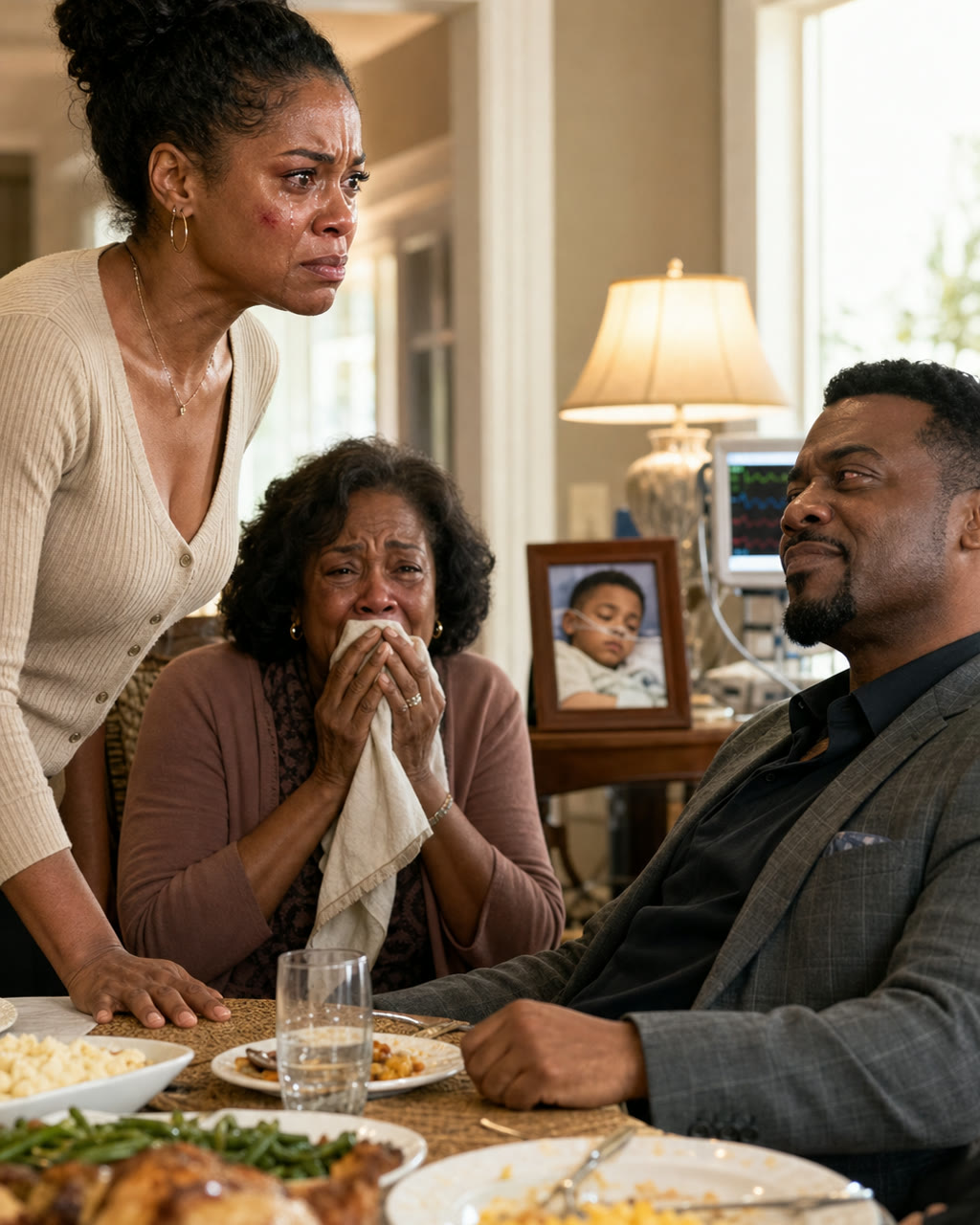
"We cancel:led your son's surgery to pay for my daughter's sweet sixteen," my brother said, and he smiled while he said it. I set down my fork. My hands were steady. That scared me more than shaking would have.
Chapter 1
My name is Danielle Ford, and for thirty-eight years I believed my family was the kind you could lean your whole weight against.
We grew up in a two-story house on Delmar in St. Louis, me and Marcus, with Grandma Ruth's collard greens filling the whole street on Sundays. My brother taught me to ride a bike. He stood behind me for a block before I knew he'd let go.
That's the thing about Marcus. He was always behind you until the exact second you needed him, and then you'd turn around and find air.
I didn't see it for years. Love makes you slow like that.
When we were kids he'd borrow my allowance every Friday and pay it back every other Sunday, and I let the math slide because he'd throw in a candy bar and a wink. I thought that was generosity. It took me thirty years to understand it was accounting. He always came out ahead, and he always made you feel good about it.
Grandma Ruth used to say Marcus could sell water to a river. She said it proud. She didn't hear the warning inside her own joke.
Elijah was born on a Tuesday in March, four pounds and a fighter. The nurse laid him on my chest and I felt his heart going fast, too fast, like a bird you're holding in two hands.
They found the defect when he was six weeks old. A ventricular septal defect, they called it. A hole between the two chambers, small enough to watch, big enough to matter.
"Some close on their own," Dr. Osei told me, gentle, her locs pinned up under a scarf that day. "We'll give him time."
We gave him nine years.
He didn't close on his own. He grew instead into a boy who loved dinosaurs and hated green peas and could name every player on the Cardinals roster before he could tie his shoes.
He knows he's different. Not in a sad way — Elijah doesn't do sad, he does careful. When the other boys race to the end of the block, he keeps a pace. When he gets that gray tired look, he sits down on a curb like he meant to all along and says he's "resting his engine." He learned that phrase from a mechanic show. He uses it so I won't hear the word tired.
He tucks his shirt in over the little sticker where the monitor clips and tells his classmates it's a spy gadget. Some days I think he's braver about his own heart than I am.
I raised him alone, mostly. His father, Terrence, sends a card at Christmas and a text on the birthday, and I stopped waiting for more a long time ago. I don't say that bitter. I say it plain.
So it was me and Elijah in a little rented duplex on Kingshighway, and my mother, Gloria, ten minutes away, and Marcus across the river in a house too big for the three people in it.
My mother is the spine of us. Gloria Ford, sixty-three, worked thirty years in the same hospital laundry, folding sheets for other people's emergencies. Her strength is that she never once complained where a child could hear her. Her weakness is Marcus — she has a blind spot the exact shape of her firstborn son. And the thing I love most about her is that she hums when she cooks, old church songs, no words, just the tune, so you always know what room she's in.
Grandma Ruth passed in the fall. Eighty-one years, quiet, in her sleep, with her Bible open on the nightstand.
She left something none of us expected.
A savings account, built dollar by dollar over forty years of cleaning offices downtown. Sixty-one thousand dollars. Her whole life, folded up small and handed forward.
The will said it was for family need. Those exact words. Grandma didn't trust lawyers to guess her heart, so she wrote it herself, in her own slanted hand. "For family need, as my grandson Marcus sees fit, he being the level head."
The level head. That's what she always called him. If she'd known, she would have named the account after Elijah's chest.
Because two weeks after the funeral, Dr. Osei called me into her office and closed the door.
"It's time, Danielle," she said. "The hole isn't closing. His heart's working too hard. We schedule the repair now, or we're looking at real damage down the line."
I asked how much. She slid a folder across the desk.
Our insurance was the kind that covers you right up until you actually get sick. The surgery, the hospital stay, the cardiac team — after everything they'd pay, we were short forty-one thousand dollars.
Forty-one thousand dollars. I said the number out loud in the empty office like it might get smaller if I heard it.
Dr. Osei watched my face. She's the kind of doctor who tells you the truth and then sits with you while it lands. "I know," she said. "I know what that number does to a family. But Danielle — the fund your grandmother left. You mentioned it once. Is it real?"
"It's real," I said. "Sixty-one thousand. For family need."
She let out a breath. "Then this is what it was for. There's no purer need than this. Get me the deposit and I'll get your son on that table."
I walked out to my car and sat in the lot and did the math three times to be sure. Twenty thousand left over after. Enough for the follow-ups, the medicines, the specialist visits. Grandma had left exactly enough, like she'd known. Then I called Marcus.
"Grandma's money," I said. "This is it. This is the family need. This is exactly what she meant."
He was quiet a second. "Let me look at the numbers, Dani. I got you. You know I got you."
I believed him. Lord help me, I believed him with my whole chest.
For three weeks, everything moved. Dr. Osei penciled in a date — the fourteenth. Elijah picked out a dinosaur to bring, a purple one named Chomp. I bought new pajamas, the soft kind, because hospital nights are cold.
I told Elijah he was getting a "tune-up," like the Cardinals get in spring. He grinned so wide I could see the gap where his tooth had just come out.
"Will I run faster after?" he asked.
"Faster than me," I said.
"Mama, that's not hard."
I chased him around the couch until he was laughing too hard to breathe, and then I made him sit down and rest, because that's the whole shape of my life now. Chase, then rest. Joy, then watch.
He wrote a list of things he'd do "after the tune-up." Ride the big roller coaster at Six Flags. Try out for the real Little League, not the slow one. Race his cousin Amara across the parking lot and win.
He kept the list on the refrigerator under a dinosaur magnet. I'd catch him standing there reading it to himself, mouthing the words, planning a whole faster life.
Every item on that list was a thing his heart couldn't do yet. He didn't write it as sadness. He wrote it as a countdown.
The trouble started small. Marcus stopped answering on the first ring. Then the second. Then he was texting instead of calling, and his texts got short.
"Working on it."
"Bank's slow."
"Trust me."
Three days before the surgery, the hospital's billing office left a message. The deposit hadn't cleared. Without it, they'd have to release the date.
I called Marcus eleven times. He answered the twelfth, at almost midnight, and his voice had a looseness in it, music behind him, a woman laughing somewhere close.
"Marcus, they're gonna cancel. Where's the deposit?"
"Dani, we'll talk Sunday. Come to Mama's for dinner. We'll figure it all out, family style."
"I don't want dinner. I want my son's surgery paid for."
"Sunday," he said. And he hung up.
I stood in my kitchen with the phone still warm against my ear and a feeling crawling up my spine that I didn't have a name for yet.
I checked the hospital portal one more time before bed. The date on the fourteenth had a little yellow flag next to it now. Pending deposit. Two words that held my whole son.
I lay awake and listened to the monitor on the nightstand, the soft steady beat of Elijah's heart coming through the little speaker, quick and uneven the way it always is. I counted it until I fell asleep. I've counted that heart more nights than I can say.
I should have driven to his house that night. I should have banged on his door until the neighbors came out.
Instead I did what my grandmother raised me to do. I waited for Sunday. I made a sweet potato pie because you don't come to family empty-handed, even when the family is the thing hurting you.
I dressed Elijah in his good shirt, the blue one, and he asked if we were going to church.
"Better," I said. "Grandma Gloria's. And Uncle Marcus."
He loved Marcus. That's the part I can barely write. He loved his uncle who bought him a bike and let him steer the boat that one summer and called him "little man."
At dinner Elijah got tired early — he does, around seven — so I laid him down in Mama's back bedroom with the monitor clipped to his collar and Chomp the dinosaur under his arm.
I came back to the table. Mama had made her greens. The candles were lit. Marcus was cutting his ham like he didn't have a care in the whole wide world.
I asked him straight. "The deposit, Marcus. Where is it. The surgery's in three days."
He set down his knife. He wiped his mouth slow, with the cloth napkin, and he looked at me with an expression I'd never once seen on my brother's face.
He looked pleased.
"About that," he said. "We cancelled Elijah's surgery. Used the money for Amara's sweet sixteen. It's gonna be a beautiful party, Dani. Real beautiful."
And my brother smiled at me across our grandmother's table.
I said nothing.
But something in me went very, very quiet — the kind of quiet before a thing you can't take back.
Chapter 2
There's a silence that means you're beaten, and there's a silence that means you're deciding. I want to be honest that in that first moment, I did not know which one I was in.
The candle flames leaned and straightened. The furnace kicked on somewhere under the floor. Ordinary house sounds, going about their business, while the ground opened under me.
I looked at the ham on my plate. I looked at the sweet potato pie I'd carried in with both hands. I looked at my brother's smile, which had not moved.
My mother's fork touched her plate with a small clean sound.
"Marcus," she said. "Tell me I heard you wrong."
He didn't look at her. He kept his eyes on me, watching, the way you watch a pot to see if it'll boil.
"Mama, Amara's turning sixteen once. Once in her whole life," he said. "And Elijah — come on. That surgery's not going anywhere. Kids with his thing live for years. Decades. I read about it. He can get it done later. When there's more money."
"When there's more money," I repeated. My own voice sounded far away to me.
"There's no rush," he said. "Doctors always make it sound like an emergency. That's how they get you. Everything's an emergency with them."
I thought about Elijah stopping on the fourth stair. Counting the pictures. Pretending.
"You spoke to the hospital," I said. "You cancelled the deposit. As me."
He shrugged, a little roll of the shoulder, easy as anything. "The account's in my name, per the will. I didn't have to pretend to be anybody. I just told them we're not paying right now."
I understood then. He hadn't stumbled. He hadn't been slow, or broke, or overwhelmed. He had sat down at some desk and made a choice, cold and clear, to take the money out of my son's chest and put it into balloons and a DJ and a chocolate fountain.
Amara wanted it themed. Hollywood glam. I found that out later. A red carpet. A step-and-repeat banner with her name on it.
The truth I'd learn later is that Amara had asked for something small. A dinner with her friends, maybe a cake, maybe a dress. It was Marcus who turned it into a production. Marcus who booked the ballroom. Marcus who needed the whole city to see what kind of father he was.
That's the part that sat in my stomach like a stone. He didn't even do it for her, not really. He did it for the version of himself he wanted people to applaud.
My mother pushed her chair back. "You put a party over that baby's heart? Ruth left that money for need. For NEED, Marcus."
"And what's more of a need than a girl's confidence, Mama? You don't understand these kids today. Amara's been through things. Her mother left. This party — it's healing for her. It's a whole healing thing."
He actually said that. Healing. For a party. While a boy slept forty feet away with a monitor on his shirt.
"Marcus." My voice came out low. "Elijah has a hole in his heart. A real one. Doctors, X-rays, a date circled on a calendar. That's not a maybe. That's not later."
"Kids are resilient," he said, and reached for the greens. "You baby that boy too much. My kids never—"
"Don't." My mother's voice cracked across the table like a switch. "Don't you dare finish that sentence in my house."
He put the spoon down.
I want you to understand something about my brother, so you don't think he was born a monster. He wasn't.
Marcus was the smart one, everybody said so. Straight A's, scholarship to Lincoln, a good job in commercial real estate. He wore his success like cologne, a little too much of it, so you smelled him coming.
He came up in the same house I did, ate the same greens, got tucked in by the same grandmother. Somewhere the roads split. I think it was the year he made his first real money and discovered that a nice suit and a warm voice would make people forgive him almost anything.
Forgiveness became a currency he could print. Every time somebody let it slide, he learned the lesson again: consequences are for other people.
His strength was that he could talk anyone into anything. His weakness was that he'd started to believe his own talking. Somewhere along the way he'd decided that whatever he wanted was, by definition, what was right.
And the memorable thing about Marcus, the detail I keep coming back to, is his hands. He has our father's hands, big and careful, and he was using them right then to build me a little house of reasons why my son could wait.
"He can wait," Marcus was saying. "It's not like he's dying, Dani. Don't be dramatic."
That word. Dramatic.
I stood up. Not fast. I just rose, and I put both my palms flat on the table, and I felt the grain of the wood under my hands, the same table where we colored Easter eggs, where Grandma taught me to shell peas.
I remembered Grandma at this table. Her hands over ours, teaching us to snap the ends off the beans. Saying, over and over, family takes care of family. She said it like a prayer. She said it so many times I thought it was just a sound the house made.
She never once imagined she'd need to write it into a will, and that even then it wouldn't hold.
"Say that again," I said. "Say he's not dying. Look at me and say you know that."
He met my eyes. And for one half-second, one flicker, I saw it — he didn't know. He hadn't asked. He hadn't read one true thing. "It's not like he's dying" was just another sentence he'd built to make himself comfortable.
He looked away first.
And in that looking-away I saw the whole architecture of him. He hadn't decided my son could wait because he believed it. He'd decided it because it was convenient, and then he'd built the belief afterward, brick by brick, to live inside. The party was the want. Everything else was scaffolding he'd hammered up around the want so he could sleep.
I'd watched him do it a hundred times over the years with small things. A borrowed tool never returned. A promise slid past. A story rewritten so he came out clean. I'd just never seen him do it with a life.
"You should be grateful I'm managing the money at all," he muttered. "Grandma trusted me. Not you. Me."
"That's on you, Danielle."
The words landed and just sat there in the middle of the table, next to the greens and the cornbread and the pie I'd carried in with both hands.
My mother started to cry, quiet, into her napkin, and that sound did something to me that his smiling couldn't.
Because my mother has cried maybe four times in my life. She buried her mother in the fall without breaking. She is a woman made of church pews and hard mornings.
And Marcus made her cry over a chocolate fountain.
"Amara's mine," he said, standing too now, getting loud the way he does when he's losing. "My daughter, my money, my call. Elijah's not my responsibility. You had a baby by a man who ran. That's on you, Danielle. Not on me, and not on Amara."
There it was. The oldest trick in his book — when the ground gets soft, blame the woman standing on it.
I've heard versions of that sentence my whole life. From teachers, from Terrence, from men in offices with my son's file open on their desks. You had a baby by a man who ran. As if that erased the boy. As if a child was a bill I'd run up alone and had no right to ask the family to help pay.
For nine years I'd swallowed it and kept moving, because I had a son to feed and no time to bleed. But there was a difference now. Now my brother had said it standing between me and Elijah's beating heart.
Something in me finished swallowing. There was nothing left to go down.
The room held that.
My mother stood between us now, one hand on the back of her chair to hold herself up. She looked at her son, then at me, then at the hallway where her grandbaby slept.
"Ruth is turning over," she said, very low. "Right now. My mother is turning over in the ground."
Marcus flinched at that. It was the only thing all night that seemed to reach him. Grandma Ruth was the one person whose good opinion he'd never stopped needing.
But even then he reached for a reason. "Grandma would understand," he started. "She loved Amara too, she'd want—"
I heard, down the hall, the small creak of a door.
Elijah stood at the edge of the dining room in his blue shirt, rubbing one eye with his fist, Chomp hanging from his other hand.
"Mama?" he said. "Why is everybody yelling? Are we still getting my tune-up?"
Nobody moved.
Marcus's face did something complicated. Some flicker of the uncle who bought a bike. And then it closed back over, smooth, because a man that far in can't afford to feel it.
I crossed the room and picked my boy up, all fifty-one pounds of him, and he wrapped his legs around me and put his warm face in my neck.
"We're getting your tune-up, baby," I told him. "I promise. Say goodnight to Uncle Marcus."
Elijah lifted his head and looked at his uncle with those open eyes, no idea in the whole world what had just been decided about him.
"Night, Uncle Marcus. I'm gonna run faster than Mama after."
Marcus opened his mouth. Nothing came out.
I carried Elijah down the hall to get his shoes. He leaned his head on my shoulder, still half-asleep, and murmured, "Uncle Marcus looked sad, Mama. Is Uncle Marcus okay?"
Nine years old, and worried about the man who'd just traded his heart for balloons.
"He's got some growing up to do, baby," I said. "That's all."
"He's a grown-up already."
"Some grown-ups aren't done growing."
He thought about that with the seriousness he brings to everything. "That's weird," he decided, and put his head back down.
I carried Elijah to the car. I buckled him in and gave him Chomp and told him to close his eyes.
Then I sat in the driver's seat in my mother's driveway and I gripped the wheel and I let myself feel exactly one minute of what was happening.
Sixty seconds. I counted them the way I count Elijah's heartbeat on the monitor at night. Steady. On purpose. All the way to the end.
And when the minute was over, I did not fall apart. I did the opposite. Something in me organized itself, cold and clear, like water finding the drain.
My son needed forty-one thousand dollars in three days.
I had two hundred and eleven dollars in checking and a job as a school nurse's aide.
I ran the options like beads on a string. A loan — no time, no credit for that number. A fundraiser — days, maybe weeks I didn't have. The father — a Christmas-card man, gone before it mattered. Sell the car I needed to get Elijah to the hospital in.
Every road was a wall. Every wall had my brother's smile painted on it.
And I had a brother who thought I was going to cry into a napkin like my mother.
That was his mistake. He mistook my quiet for surrender. He'd known me my whole life and he'd never once watched what I do when I go quiet.
I pulled out my phone, right there in the dark, and I started to type. Not to Marcus.
To someone Marcus had forgotten all about.
Chapter 3
The someone was Aunt Vernell.
Grandma Ruth had a younger sister, Vernell, seventy-four, sharp as a tack and twice as pointed, who'd moved to Atlanta in the eighties and made the whole family nervous because she said exactly what she thought at exactly the wrong volume.
Vernell had been at the funeral. Vernell had heard Grandma's will read aloud. And Vernell, I remembered, had leaned over to me in the pew and said, "That boy manages that money? Ruth loved him too much to see him clear."
She'd worked forty years as a paralegal in a firm in Atlanta, the kind of woman lawyers were afraid to lose. She knew where every comma in a document could cut. Her strength was that she was never, ever bluffing. Her weakness was that she'd outlived nearly everyone who could tell her no, and she'd stopped expecting to be told it. And the thing you remembered about Vernell was her reading glasses on a beaded chain, which she'd lower to look at you over the top of, so you always felt like a document she was deciding whether to sign.
She and Marcus had never gotten along. He couldn't sell her anything. That, I understood now, was exactly why I needed her.
I texted her that night: Aunt Vernell, I need to tell you what Marcus did. And I need your help. It's about Elijah's heart.
My phone rang in under a minute.
"Talk," she said. No hello. That's Vernell.
I told her everything. The surgery, the deposit, the sweet sixteen, "it's not like he's dying," my mother crying into her napkin. I told it flat and true, no drama, because Vernell can smell drama and it makes her mean.
She was quiet a long time. Then: "Do you have the will? The actual paper Ruth wrote?"
"Mama has a copy."
"Get it. Tonight. Photograph every word. And baby — did Ruth ever tell you why she made that account?"
"For family need. That's what it says."
"No," Vernell said. "I mean why. The reason. Because I know the reason, Danielle. I was on the phone with my sister the week before she died. And what she told me is going to matter very much."
My skin went cold and hot at once. "Tell me."
"Not on the phone. I'm getting on a plane. You just get me that will, and you get me every text that boy sent you, every single one, don't you delete a thing. And Danielle?"
"Yes ma'am."
"You keep going to that dinner table. You keep sitting down at it. You let Marcus think you folded. A man who thinks he's won gets careless. And careless men leave evidence."
"One more thing," Vernell said before she hung up that first night. "How's the baby's heart holding, right now, tonight? Truthfully."
"He gets tired," I said. "He stops on the stairs. The doctor says every month we wait, his heart works harder to make up for the hole. It gets bigger. Stronger in the wrong way."
"So this is a clock, not a calendar."
"It's a clock."
"Then we move like it's a clock," she said. "You did right calling me, Danielle. You did the first brave thing. Now do the second one and go get me that will."
I did what she said.
I photographed the will in my mother's kitchen at eleven that night while Elijah slept in the back bedroom. My mother stood over my shoulder in her robe.
"What are you doing, Dani?"
"Fixing it, Mama."
She put her hand on my back. "Ruth would be sick. She would be so sick over this."
"I know."
"Marcus was always her favorite," Mama said, and there was something old and tired in it. "I love that boy. God knows I do. But I have watched him take and take, and everybody keep handing, because he smiles so pretty when he takes."
She looked at me. "You were the one who gave, Danielle. Even as a little girl. You gave him your last dollar every time."
"I'm done giving him things, Mama."
She nodded slow. "Then I'll stand where you stand. He's my son. But that's my grandbaby, and Ruth was my mother, and there is a line."
She sat down heavy at the kitchen table then, her robe pulled tight, and she told me a thing I'd never known.
"When Marcus was little," she said, "he stole from the church collection plate. Passed it right down the pew and skimmed it, seven years old. I caught him. And I made a choice, Danielle. I put the money back myself and I never told a soul, because I didn't want my baby marked. I thought I was protecting him."
Her hands were folded on the table. "I've spent thirty years putting money back for that boy so nobody would see. And every time I covered him, I taught him he'd never get caught. This is the harvest of that. I helped grow it."
"Mama, you didn't—"
"I did," she said. "But it stops in my kitchen tonight. No more putting it back for him. This time he stands in what he did."
Aunt Vernell landed in St. Louis two days before the surgery date that no longer existed.
She came in like weather. Seventy-four years old, tailored coat, a leather folder under her arm, and a mouth set like a closed drawer. She hugged Elijah so long and so careful that he giggled and asked if she was checking him for ripeness.
"Ripe as a July peach," she told him. "Now go rest, baby. Grown folks have to fix a mess."
Elijah looked up at her, solemn. "Are you gonna fix my tune-up?"
Vernell went still for a second. Then she crouched down to his eye level, her old knees popping, and she took both his small hands in hers.
"Baby," she said, "your great-grandmama Ruth loved you before you were even born. She left you something to make your heart strong. And I flew all the way up here to make sure you get every bit of it. You understand me? You are getting that tune-up. Aunt Vernell does not fly coach for nothing."
He laughed at that, not knowing the weight of it, and ran off to show Chomp the window.
Vernell stood up slowly, and when she turned back to me her eyes were wet, and I'd never seen that on her, not once, not at the funeral.
"That's the one Ruth was afraid for," she said quietly. "In her dream. That exact face. Come on. Let's get to work."
Then she sat me and my mother down at the kitchen table and opened her folder.
"Here is what my sister told me, the last real conversation we had," Vernell said. "Ruth had a nightmare. She dreamed Elijah's heart gave out because nobody paid for the doctor in time. She woke up and she couldn't shake it. She called me and she cried, and Ruth did not cry."
My mother made a small sound.
"She said, 'Vernell, I'm putting my savings somewhere the family can reach it if that baby ever needs his heart fixed.' She said Elijah. By name. She named that account after his heart in her own mind, even if the paper says 'family need.'"
"Then why did she put Marcus in charge?" I asked, and it came out cracked.
Vernell's face softened, just a little. "Because Ruth was a proud woman and she wanted a man's name on it so nobody could push her family around at the bank. She never dreamed the man would be the one pushing. She trusted her grandson with a paper meant to protect her great-grandson. That was her one mistake, and she's not here to fix it. So we will."
She pulled out a second document. "I called a lawyer in Atlanta on the plane. Woman I've known thirty years. Here's what's true, Danielle. That will says 'as Marcus sees fit,' but it also says 'for family need,' and those two things are now in conflict — because there is a documented, urgent, doctor-ordered medical need, and he is refusing it to fund a party. That's not discretion. That's a breach. And there are ways to move on a breach fast when a child's health is at stake."
She lowered her glasses and looked at me over them. "A trustee who holds money 'for family need' can't spend it on a party while a child in that family is under doctor's orders for surgery. When there's a genuine emergency, a court can freeze that account overnight and appoint someone new to release the funds. Overnight, Danielle. I've seen it done. A judge does not enjoy hearing that a man chose a chocolate fountain over a boy's heart."
"Then let's go to the court now," I said. "Tonight. Why wait for anything?"
"Because a threat you're holding is stronger than a threat you've spent," she said. "Once we file, Marcus lawyers up and it gets slow. But if he signs the money over willingly, tonight, at that table, your baby's on the operating schedule by the weekend. The letter is the gun on the wall. We only fire it if he makes us."
I looked at that paper and I felt, for the first time since my fork touched my plate, something loosen in my chest.
"How fast?"
"Faster than you think," Vernell said. "But we're going to do it in the open, at that dinner table, in front of your mother and in front of God, because Marcus needs to hear it from family before he hears it from a court. Ruth would want that much. One chance."
"He doesn't deserve a chance," I said.
Vernell looked at me with those pointed eyes. "It's not for him, baby. It's for you. So that whatever happens to him, you never have to wonder if you were fair. Fair is a gift you give yourself."
She let that sit. "And there's Amara to think of. That girl is about to learn something ugly about her father whether we're gentle or not. If we come in swinging with lawyers first, she'll spend the rest of her life defending him against us. If we give him one honest chance to do right in front of her, and he still won't — then she sees the truth with her own eyes, and no story he tells later can take it back."
I hadn't thought about Amara. Vernell had. That's the difference seventy-four years makes.
"Now — one more thing. And this is the piece that turns the whole board."
She slid a phone across the table. Her own. There was a photo on the screen.
It was a screenshot of Marcus's Facebook. A flyer for Amara's sweet sixteen. Hollywood theme, red carpet, the works. And at the bottom, in glitter font, a line that made my stomach turn over slow.
"Presenting sponsor: The Ruth Ford Memorial Fund."
He'd named the party after our grandmother. He'd taken the money meant to save her great-grandson's heart, spent it on a chocolate fountain, and then he'd put her name on the banner like a blessing.
"He wrote it in stone himself," Vernell said quietly. "He told the whole world what he did and called it a tribute. Danielle — a man who publishes his own crime and thinks it's a gift is a man who does not believe anyone will ever tell him no."
I stared at the glitter letters. RUTH FORD MEMORIAL FUND. My grandmother, who scrubbed office floors after midnight for forty years so she could hand her family a way out of a nightmare, reduced to a sponsor line on a party banner.
I thought about her nightmare. The one Vernell told me about. Ruth waking up in the dark, certain that Elijah's heart would give out because nobody paid the doctor in time.
She saw it coming. She reached forward past her own death to stop it. And Marcus had turned her outstretched hand into a decoration.
"Okay," I said, and my voice didn't shake. "Okay."
She closed the folder.
"Sunday," she said. "We go back to that table. And somebody finally tells him no."
Chapter 4
We went back on Sunday.
The days between had been the longest of my life. The hospital had released Elijah's date. Every hour that passed was an hour his heart worked too hard, and I could hear it, I swear I could, in the way he'd sit down sooner, tire quicker, rest his engine more.
I didn't tell him the surgery was off. I couldn't put that on a nine-year-old. So I let him keep reading his list on the refrigerator, planning his faster life, while the grown folks decided whether he'd get one.
That's the part I carry. Three days of my son believing, while I held the truth so it wouldn't crush him.
My mother cooked like it was any other week, because appearances mattered to her and because she needed her hands busy. Greens, cornbread, a roast. The candles again.
She hummed while she cooked. An old song, no words. I stood in the doorway and let the tune tell me she was still standing, still with me, still on the right side of the line she'd drawn in her own kitchen.
Marcus came in loose and grinning, and he had Amara with him, and I want to say clearly: Amara did nothing wrong.
She's sixteen. She's a good kid caught in a bad man's love. She hugged me at the door and asked how Elijah was doing, real concern in her face, and I hugged her back and meant it. Her strength is a kindness her father never grew. Her weakness is that she believes him, still, the way I used to.
Elijah was there too, at the table, awake and bright, because I'd decided he would not be hidden this time. He would be seen. He is the whole reason. Let the reason sit at the table.
Marcus didn't notice Vernell's coat on the rack. He was too busy telling Amara where the photo booth would go.
Then he walked into the dining room and saw my aunt sitting at the head of the table, in Grandma Ruth's chair, with her leather folder squared in front of her.
Something went out of his face.
"Aunt Vernell," he said. "I didn't know you were in town."
"I imagine you didn't," she said. "Sit down, Marcus."
He sat. Men who talk their way through everything don't know what to do with a woman who won't be talked to. He reached for the ham and Vernell laid one hand flat on the tablecloth, and he stopped.
"We're going to eat in a minute," she said. "First, the family's going to settle something. Danielle."
I took out my phone. My hands were steady again, that same steadiness from the first night, and this time I understood it. It wasn't shock. It was resolve wearing shock's coat.
"Marcus," I said. "I have every text you sent me. 'Working on it.' 'Bank's slow.' 'Trust me.' And then, on Sunday, you told me you cancelled Elijah's surgery to pay for a party. Mama heard it. You said it to my face and you smiled."
"Dani—"
"I'm not done." I set the phone down. "I have Grandma's will. 'For family need.' And I have Aunt Vernell, who was on the phone with Grandma the week she died. Tell him, Aunt Vernell."
Vernell told him. About the nightmare. About Ruth crying. About his grandmother naming Elijah's heart in the dark, terrified of the exact thing her own grandson had just done.
Marcus's jaw worked. "That's — you can't prove a phone call. That's hearsay. That's not—"
"Then let's talk about what's not hearsay," Vernell said, and she turned her folder around and opened it. "This is a demand letter. Drafted by my attorney, filed first thing tomorrow if we don't resolve this tonight. It says you breached the terms of the trust by denying a documented, urgent medical need. It requests an emergency accounting of every dollar in Ruth Ford's account. Every dollar, Marcus. Where it went. When. To whom."
His eyes moved to the folder and stayed there.
"You're bluffing," he said, but his voice had a hairline crack in it now. "No judge is gonna freeze a family account over a — over a scheduling thing. Elijah can get the surgery whenever. I'll pay it back eventually. This is family business. You don't drag family into court."
"You dragged family into a hospital billing office and cancelled a nine-year-old's heart repair," Vernell said, and she didn't raise her voice at all. That was the terrible part. She said it like she was reading a grocery list. "Do not tell me about family, Marcus. I have known you longer than you've known yourself. I put the church money back when you were seven. Did you know that? I never told anybody. I have been covering for you for sixty years, and I am here tonight to stop."
He stared at her. Whatever he'd expected, it wasn't that.
"And this," Vernell said, sliding the second page across, "is a screenshot of your party flyer. Where you named the event after my sister. The Ruth Ford Memorial Fund. You spent a dying boy's surgery money and put your grandmother's name on the banner like a bow."
The table was still.
Amara spoke, small. "Daddy. What's the Ruth Fund? You said that was your money. You said Grandma left it to us."
Marcus turned to his daughter, and for the first time all night his mouth opened and no smooth thing came out.
"Baby, it's — the party, it's your day, I wanted—"
"Was that Elijah's medicine money?" Amara asked. Sixteen and cutting straight to the bone. "Is that why he didn't get his tune-up?"
Nobody answered her. She looked at her cousin across the table, at Elijah in his blue shirt with Chomp in his lap, and her face crumpled.
"Cancel it," she said to her father. "Cancel my party. I don't want it. I don't want a party bought with — cancel it, Daddy, right now, or I swear I will never—"
"Amara—"
"CANCEL IT."
My brother, who could talk anyone into anything, sat at our grandmother's table with his daughter shaking in front of him and his aunt's folder open and his sister's phone full of his own words, and he had, for the first time in his life, nothing to sell.
He put his big careful hands over his face.
"I didn't think," he said, into his palms. "I told myself he could wait. I told myself so many times I believed it. I didn't — I didn't read anything. I didn't ask his doctor. I just wanted Amara to have the thing I never—"
"Stop," I said. Quiet. "I don't need the reasons. I've heard enough of your reasons to last me a lifetime. I need the money. In Elijah's surgery account. By tomorrow."
He looked up. "There's forty-nine thousand left. The deposits on the party — I can cancel most of them. The venue, the DJ, I can get it back, most of it. I'll — I'll put it all in. All of it. Tonight, online, right now, you can watch me do it."
"I will watch you do it," Vernell said. "Every keystroke."
And he did. Right there at the table, phone in his shaking hands, my aunt reading over his shoulder, my mother standing behind him with her arms crossed, my brother transferred forty-nine thousand dollars into the surgery account and cancelled the party in the same twenty minutes.
Amara cried the whole time. Not for the party. I want that clear. She cried the way you cry when you learn something true about someone you love and can't un-know it.
Then she came around the table and knelt by Elijah's chair and said, "You're gonna get your tune-up, cousin. You're gonna run so fast."
"Faster than Mama," Elijah told her, delighted, having understood almost none of it, which was the only mercy in that room.
The surgery happened eleven days later.
The morning of the surgery, Elijah brought Chomp and his list. He'd folded the list into a small square and put it in the pocket of his gown.
"For after," he told the nurse. "So I remember what to do faster."
They let me walk beside the bed until the doors where I couldn't go. He held my hand the whole way, not scared, curious, looking at all the machines like a boy at a museum.
At the doors he squeezed my fingers. "Mama. When I wake up, will you be the first thing?"
"The very first thing," I said.
"Okay." He nodded, satisfied, a general approving a plan. "Rest your engine while you wait."
Then the doors, and the long quiet, and the clock.
Dr. Osei stitched the hole in my son's heart in a building on Kingshighway, and I sat in a waiting room with my mother on one side and Aunt Vernell on the other, and when the doctor came out smiling and said "It went beautifully, he did beautifully," my mother finally broke the way she hadn't at any dinner table.
I held her. Vernell held us both.
Elijah woke up asking for me, and I was the first thing, exactly like I promised. He blinked at me, groggy, and the first words out of my son's mended heart were, "Did it work? Am I fast now?"
"Not yet, baby," the nurse laughed gently. "Give it time. But your engine's fixed."
He smiled and drifted back under, one hand pressed over the little bandage on his chest, keeping his fixed heart safe.
Marcus paid it all back — the full amount, the accounting Vernell demanded, receipts for every dollar Ruth ever saved. The lawyer made sure. He signed the account over to a proper trust with my mother and Vernell as co-guardians, so no man's smile would ever hold that key alone again.
Amara stayed close. She's Elijah's favorite person now. She teaches him card games and lets him win most of them but not all, because she says winning all the time makes you soft, and she'd know.
Marcus I see at holidays. He's quieter. He came to the hospital the day after the surgery and stood at the door of Elijah's room like he wasn't sure he was allowed in, and Elijah waved him over and showed him the little bandage on his chest and said, "Uncle Marcus, I'm fixed."
My brother put his face down next to my son's small hand and stayed like that a long time. I let him. Not for his sake. For Elijah's. My boy doesn't need to carry what the grown folks did.
When Marcus finally lifted his head, his eyes were wet and old. "I keep thinking about Grandma's face," he said. "If she'd seen. I put her name on a banner, Dani. I don't know how I got to be a man who'd do that."
"One yes at a time," I said. "Same as anybody. Everybody around you kept saying yes."
"You didn't."
"No," I said. "I didn't."
He nodded slow, like it was the first true thing he'd let himself hear in years.
I don't know if Marcus is a good man now. I know he's a broken-open one, and sometimes that's where good starts.
Here's what I carry out of it.
Elijah is nine and his heart is whole, and last Saturday he beat me up the stairs, all the way to the top, and turned around at the landing to laugh at me.
He didn't stop on the fourth step. He didn't count the pictures. He just ran.
I stood at the bottom, out of breath, watching my son's fixed heart carry him up faster than mine ever could.
And I thought about my grandmother, who saw it all coming in a dream and tried to reach forward past her own death to catch him.
She did catch him. It just took the whole family, and one hard Sunday, and a woman who refused to cry into a napkin.
If you take anything from my story, take this: the ones who steal from you while they smile are counting on your silence. So say nothing, if you have to.
Then go be the mother who does everything.
You may also like
The Silent Truth Behind My Daughter's Accident
The call came at 11:47 at night.…
Read the full story →The Night Evelyn Harper Took Back Her Power
My husband's mistress openly mocked me while my husband smiled… While they laughed at my pain, they never realized that I was the one in control. The moment I whispered, "Everythin…
Read the full story →He Fired the "Cleaning Lady" in Front of the Whole Office — Nine Minutes Before the Board Handed Her the Company
My name is Eleanor Reyes, and for eighteen months the people at Meridian Textiles thought my name was "hey" or "the cleaning lady" or, on a good day, "Ellie, could you get the brea…
Read the full story →