The Night He Texted And I Answered
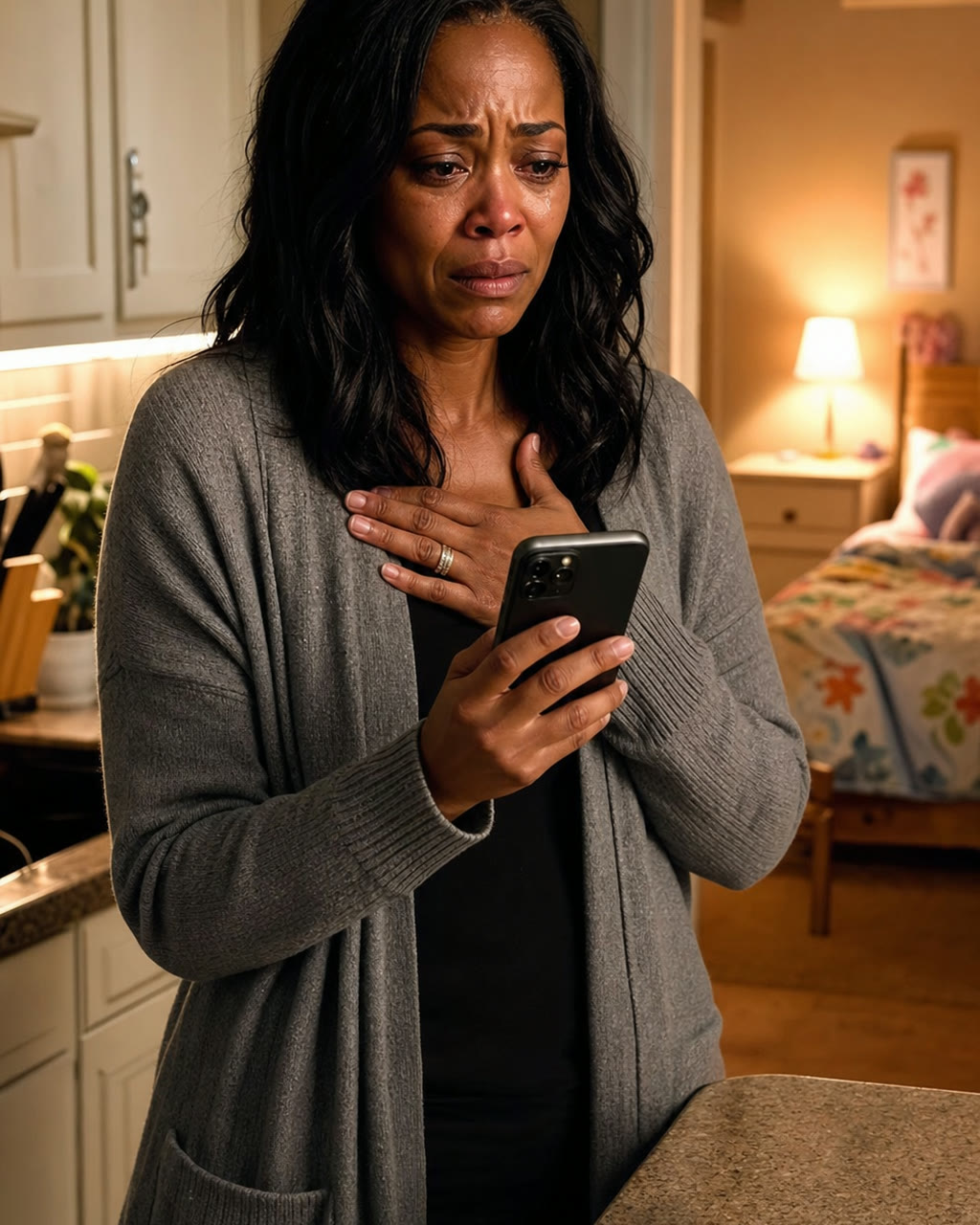
My husband texted me at 1:14 in the morning: "I left with your sister. Don't wait up." I read it three times standing in the kitchen in his old church socks. Our daughter had a fever of 102 down the hall and I still had the thermometer in my other hand when the phone lit up.
Chapter 1
The thermometer beeped again. 102.1. I set it down on the counter next to the phone and read the message a fourth time, like the words might rearrange themselves if I gave them another chance.
"I left with your sister. Don't wait up."
Marcus never used punctuation like that. He was a man who texted "k" and "on my way" and nothing else. Those two clean sentences looked like something he'd rehearsed.
My name is Dana Whitfield. I was thirty-eight that night, standing in my own kitchen in Marietta, Georgia, wearing my husband's church socks because my feet were cold and I hadn't planned on being awake.
Down the hall, my daughter Zora coughed in her sleep. Seven years old. She'd been running a fever since dinner, and I'd been up giving her Tylenol and cool washcloths while her father was supposedly at a conference in Cancun for his job.
That was the story. A regional sales conference. He'd packed his good gray suit and the blue tie I bought him and kissed the top of Zora's head on his way out the door two days ago.
I called him. It rang once and went to voicemail. His voice, cheerful and fake in the recording. "You've reached Marcus Whitfield. Leave it at the beep."
I hung up and called my sister, Nicole. Same thing. One ring, then her laughing voicemail greeting that she'd recorded years ago at a barbecue, you could still hear the music behind her.
Two phones off at the same time. I stood there and let that settle into my body like cold water going down.
I didn't scream. I want you to understand that. I've read stories where the woman falls to her knees and wails, and maybe some women do, but I just got very quiet inside, the way you get quiet before you lift something heavy.
The refrigerator hummed. The clock over the stove ticked. Somewhere in the walls the heat kicked on. All these ordinary sounds kept going like nothing had happened.
I looked down and noticed I was still holding the thermometer in one hand and the phone in the other, and I didn't know which one to put down first. That's a strange thing to remember, but that's the thing I remember.
I put the kettle on. I don't know why. My hands needed a job and the kitchen needed to feel normal.
While the water heated I opened our text thread and scrolled up. Yesterday he'd sent me a photo of the ocean. "Wish you were here babe." Nicole had been tagged in a beach post that same afternoon, some other beach, she'd said, a girls' trip to Destin.
Destin, Florida. Cancun, Mexico. Two different beaches, two different lies, one photo of the same white plastic lounge chair in the background of both.
I zoomed in until the picture went grainy. Same chair. Same striped towel folded over the arm the exact same way. Same little metal table beside it with the same green bottle sweating on top.
My sister and my husband had posted from the same resort, on the same day, and thought nobody would ever put the two pictures side by side. They thought I was too tired, too trusting, too busy raising their whole world to notice a plastic chair.
The kettle screamed. I turned it off and didn't make the tea. The water just sat there going cold, and I stood over it with both hands flat on the counter, breathing.
Here is the thing I need you to know about me and Nicole. She's my baby sister. Three years younger. When our mother's diabetes took her sight, I'm the one who moved Mama in with us, and Nicole is the one who visited on Sundays and cried the prettiest at every doctor's appointment.
I raised that girl half the time. Braided her hair for school. Covered for her when she snuck out. Gave her the down payment for her first car out of my own savings and never asked for a dollar back.
There's a picture of the two of us at the lake, Nicole in my lap, both of us gap-toothed, her arms around my neck. That picture still hangs in my hallway. I walked past it fifty times a day and never once thought it was a lie.
She stood up in my wedding. She held Zora at the hospital an hour after she was born and cried and said, "I'm gonna be the best auntie in Georgia." She meant it then. I have to believe she meant it then.
And Marcus. I met Marcus at twenty-six at a credit union, of all places. I was the loan officer and he came in nervous about his score, and he made me laugh, and eleven years later here we were.
He wasn't a bad man in the beginning. I keep having to say that, mostly to myself. He carried my mother's groceries. He fixed the neighbor's mower for free. People liked Marcus. I liked Marcus.
I built things with that man. Not just the marriage. I mean I literally built things.
Because here is what Marcus didn't think about at 1:14 in the morning when he sent that text. Here is the thing that was going to matter more than his suit or his blue tie or my sister's laugh.
The house. Our house. The pretty brick two-story with the good school district that he loved to show off to his friends at the cookout.
I bought that house before I ever met him. It's in my name. Only my name. He moved into my house when we married and we never got around to changing the deed, and every year at tax time I'd say we should, and every year he'd say "we'll do it later, baby."
The cars, the same. The one he drove to the airport, titled to me, because his credit was still climbing when we bought it and mine carried the loan.
The savings account with the real money in it, not the joint checking he raided for his sneakers and his fantasy football. The real money. My name.
I sat down at the kitchen table with all of this arranging itself in my head like a row of dominoes I'd set up years ago without knowing why.
I hadn't set them up to hurt him. I want that on the record. I set them up back when I bought the house single and scared at twenty-seven, before I ever knew his name, and I just never took them down.
I didn't feel powerful. I want to be honest. I felt sick and small and stupid, because a woman doesn't want to be smart in a moment like this, she wants to be loved.
I put my head down on the cool table for a minute. Just a minute. Then I sat back up, because a mother of a sick child doesn't get to lie down for long.
I wanted him to walk through the door and say it was a joke, a hacked phone, a wrong number to the wrong life. I wanted my sister to call back laughing.
But the beach chair in the two photos didn't laugh. It just sat there in the background, telling the truth they forgot to hide.
Zora coughed again and I went to her. She was hot but sleeping, her braids stuck to her forehead, her stuffed rabbit in a headlock. I laid the back of my hand on her cheek and stayed there in the doorway for a while.
She looked so much like her father when she slept. Same round cheeks, same little frown. I stood there and I made myself a promise, right there in that doorway, that whatever I did next, she would never see me broken by it. She'd see me steady. She'd see a mother who handled things.
I thought about my mother, asleep in the guest room down the hall, blind and trusting, who loved Marcus like a son and would be gutted when she found out. I'd have to tell her in the morning. I'd have to say the words out loud and watch them land on her face.
I thought about my job, the mortgage I still paid, the school pickup line, the church, all the people who'd ask where Marcus was. I thought about how a life that takes eleven years to build can start coming apart in the time it takes to read one text.
Then I did the thing I promised myself I'd never do. I picked up my phone and I typed a reply to Marcus.
Not a paragraph. Not a curse. Not a threat. I'm not a threatening woman.
I typed two words. I looked at them for a full minute. Then I deleted them and typed them again, exactly the same, because they were right the first time.
I didn't send it yet. I set the phone face-down on the table.
Because before I sent those two words, I needed to make one phone call. And the person I was about to call was going to change everything about how this night ended.
His card was still in my wallet from eight months ago, when I'd first started noticing things and told myself I was crazy.
I found it behind my library card. A little cream-colored rectangle, slightly bent.
I dialed the after-hours number at the bottom, and it rang, and a man's sleepy voice answered on the third ring, and I said, "This is Dana Whitfield. You told me to call any time, day or night, when I was ready. I'm ready."
Chapter 2
The card belonged to a family law attorney named Reginald Boyd. Everybody in our church called him Reg.
Eight months earlier I'd sat across from Reg in his office off Cobb Parkway with a folder of things I couldn't explain. Hotel charges on a weekend Marcus said he was fishing. A second phone bill I found in the recycling. A necklace on the credit card statement that never showed up on my neck.
Reg had listened without interrupting, which is rare in a man, and then he'd said something I never forgot. "Miss Dana, I'm not going to tell you your husband is cheating. I'm going to tell you to get organized. Hope for the best, prepare like a grown woman."
So I did. Quietly. Over eight months I made copies. I pulled the deed at the county recorder's office on my lunch break and confirmed it, held the paper in my hands, my name alone, recorded eleven years back.
I moved my real savings into a separate account at a different bank, one he didn't have the login for, one the statements didn't come to the house for. I updated my will. I put the folder in a locked drawer at my office, not at home.
I did it the way you'd tighten the lug nuts on a tire before a long drive. Not because you expect a blowout. Because you love the people in the car and you'd never forgive yourself if you didn't check.
Some nights I felt like a traitor for doing it. I'd lie next to Marcus while he snored and think, what kind of wife builds a case against her own husband? Maybe I'm the crazy one. Maybe I'm the cold one.
And then I'd remember the necklace that never came home to my neck, and the hotel charge from the weekend he swore he was fishing, and I'd stop feeling crazy.
And then I put the folder away and kept ironing his shirts, because part of me still believed the man I married would come to his senses.
He didn't come to his senses. He went to Cancun with my sister.
Reg answered the phone at 1:31 in the morning and he did not sound annoyed. He sounded like a man who'd been waiting for this call for eight months too.
"Tell me exactly what happened tonight," he said. "Word for word. Don't summarize."
I read him the text. I told him about the two beach photos and the plastic chair. I told him about the phones going straight to voicemail at the same second.
He was quiet a moment. I could hear him sit up in bed, a lamp click on, a pen scratch. Reg was the kind of man who took notes at one-thirty in the morning.
"Dana, do not send anything yet. Do not accuse him in writing. Do not call him names, do not threaten, do not beg. Anything you say tonight can be used to make you look like the unstable one, and trust me, that's the first move they make. They flip it. Suddenly you're the crazy wife and he's the poor man who had to escape. You understand?"
"I understand."
"Good. Because you are not crazy. You are the calmest woman I've ever had on this phone at this hour, and that is going to be worth more than you know."
"I already typed something," I said.
"What did you type?"
I told him the two words. I heard him breathe out slowly through his nose, and then, God help me, I heard him almost laugh, a low sound of respect.
There was a silence, and I heard him set his pen down.
"That's not an accusation," he said. "That's just a fact. That, you can send. In fact I want you to send that exactly. Not a word more, not a word less. But send it in the morning, though. Not tonight. Let him have his fun tonight. Let him get comfortable, let him think he's won clean."
"Why the morning?"
"Because a man who thinks he's won gets careless. And careless men leave a trail. Right now he's celebrating. He's telling your sister how it went, laughing about it, maybe. Let him. A man who's still afraid of you keeps his guard up. A man who thinks you're beaten walks right off the cliff on his own two feet."
"You've done this a lot," I said.
"Twenty-six years, Dana. And I'll tell you what I've learned. The women who win aren't the loud ones. They're the quiet ones who kept their paperwork. You kept your paperwork."
Before he let me go, Reg said one more thing. "Dana, whatever you decide in the daylight — leave him, forgive him, burn his suits in the yard — you decide it as a free woman. Not as a scared one. Scared women sign bad papers. Free women read every line. Go be free by morning."
I hung up and I did not send the message. I set my phone on the charger and I stood in my dark hallway for a minute, looking at the wedding photo on the wall, the two of us young and dumb and sure.
Then I went and lay down on the floor of Zora's room with a couch cushion under my head, because I couldn't be in our bed and I couldn't be far from my child.
The floor was hard and cold through the cushion. I could hear Zora breathing, that little wheeze she gets with a fever. I matched my breathing to hers. In, out. In, out. It's the oldest trick there is and it still works.
I didn't sleep. I watched the ceiling fan turn and I let myself remember, which is its own kind of grieving.
I remembered Marcus at the hospital when Zora was born, crying so hard the nurse brought him a chair. He held that baby like she was made of glass and he whispered, "I got you, I got you, Daddy's got you," over and over.
I remembered him teaching my mother to use the talking clock we bought her, patient as a saint, saying "again, Mama Rose, one more time," until she could set it herself and beamed like a girl.
I remembered slow-dancing in this same room to the radio the night we moved his last box in. He stepped on my feet the whole time and we laughed so hard my mother banged on the wall.
Where did that man go? That's the question that kept me up. Not where was he tonight — I knew where he was tonight. But where did the other one go, the one who cried over a newborn. When did he leave, and how did I miss it.
I let myself love him one last time in the dark, because I wasn't going to get to do it again after the sun came up. When you've decided to leave, the memories come to say goodbye whether you invite them or not.
Somewhere around four I stopped grieving him and started grieving the version of my life I'd been telling people about. The Christmas cards. The couple's trip we'd talked about for our anniversary. The second baby we sometimes said we might have. All of it just quietly went out, like someone walking through a house turning off lamps.
By five I wasn't sad anymore. I was clear. There's a difference, and you don't find it until you've been through a night like that. Sad is heavy. Clear is light. I stood up off that floor lighter than I'd been in a year.
Around six the light started coming gray through Zora's curtains. My mother's cane tapped down the hall toward the kitchen, that steady tap-tap she's made every morning for years, the most dependable sound in my house.
I got up and went to make her coffee before she could reach the stove herself. She heard my feet and said, "You're up early, baby. Marcus call and check on Zora's fever?"
I froze with the coffee scoop in my hand. My mother can't see, but she has never once been fooled by silence.
"Dana," she said. "What's wrong?"
I've never been able to lie to that woman. I told her. I told her all of it, the text and the beaches and the chair, my voice steady only because I'd practiced steadiness my whole life.
She set her cup down very carefully. Then she reached out her hand across the table until she found mine, and she held it, and she said the last thing I expected.
"That fool," she whispered. "That poor, dumb fool. He had a whole queen and he traded her for a card trick."
We sat there holding hands for a long time. My mother's grip was strong for a woman her age. She'd buried a husband and raised two girls on a school cafeteria salary, and she knew a thing or two about a morning you don't think you'll survive.
"You know what your grandmother used to say," she told me. "She said a man will show you exactly who he is, and the only sin is looking away twice."
"I looked away a lot of times, Mama."
"No, baby. You didn't look away. You just kept hoping. Those aren't the same thing. Hoping is a good thing to be guilty of."
Zora shuffled in around seven, fever broken, dragging her rabbit, asking for pancakes, and I made her pancakes because life does not stop for grief, it just makes you cook breakfast in the middle of it.
She asked where Daddy was. I said Daddy was still on his work trip. She nodded and asked for extra syrup, and I gave it to her, and I turned to the stove so she wouldn't see my face.
At 8:02, while Zora ate at the counter and my mother sipped her coffee, I picked up my phone. My hand was steady. I'd expected it to shake and it didn't, and I noticed that the way you notice a fever has finally broken.
Marcus had not texted again. Of course he hadn't. He'd said his piece at 1:14 and gone back to his beach and his new life, and he was waiting for me to fall apart in his silence.
I opened the thread. My two words were still sitting there, unsent, in the box. I read them one more time.
And I hit send.
Then I put the phone in my apron pocket and flipped Zora's second pancake, and I waited.
He read it at 8:09. The little "Read" appeared under my message, small and gray and enormous.
Then the three dots came up, like he was typing. Then they went away. Then they came up again. Then away. Zora asked me for more syrup and I poured it without looking down at the plate, my eyes on those dots.
For four minutes those dots came and went while my husband, twelve hundred miles away, tried to figure out how to respond to two words. I imagine my sister asked him what I said. I imagine he told her, and I imagine neither of them could figure out what it meant, and that not-knowing was the first crack in their perfect getaway.
He never did respond. Not with a text.
At 8:14 my phone rang, and it was not Marcus's number, and it was not Nicole's. It was an unknown number with a Georgia area code, and something told me to answer it standing up.
"Is this Dana Whitfield?" a woman's voice said. Professional. Careful.
"Speaking."
"Mrs. Whitfield, my name is Angela Ruiz. I'm calling from Sunrise Title and Escrow. I'm sorry to bother you so early, but we have a closing scheduled and there's an issue with a signature I think you need to know about."
I set the pancake spatula down.
"A closing," I said. "On what?"
"On the property at 4418 Hollyhock Lane," she said. "Your husband submitted paperwork to sell the house. And ma'am — I'm looking at the deed right now, and there's a serious problem with who's actually authorized to sign."
Chapter 3
I made Zora go watch cartoons in the den. Then I sat down at the kitchen table with my mother across from me and I put the phone on speaker so she could hear too.
"Ms. Ruiz," I said. "Say all of that again. Slowly."
Angela Ruiz was a title agent, and title agents are people who care very deeply about whose name is on paper, God bless them. She explained it plainly.
Marcus had walked into a competing title company two weeks ago, before he ever left for Cancun, and started the process to sell our house. He'd told them he was the owner. He'd forged something on an intake form. He had a buyer lined up, a cash buyer, and a fast closing scheduled for that very week.
He was going to sell the house out from under me while I thought he was at a sales conference. Take the money and start over in Mexico with my sister. That was the plan.
I stood up from the table without meaning to. My chair scraped the floor loud enough that my mother flinched.
"He was going to sell my house," I said, out loud, testing whether it was real when I heard it in my own voice. "He was going to sell the house with Mama in it and Zora in it and put us out."
"Sit down, baby," my mother said quietly. "Sit down and let the lady finish."
"But he can't," Angela said. "Because when we ran the title, the deed is in your name alone. Dana Whitfield, sole owner, recorded eleven years ago. He is not on it. He was never on it. He cannot sell what he does not own, and any signature claiming otherwise is fraud."
I looked across the table at my mother. She had both hands wrapped around her coffee cup and her chin was lifted, listening, the way she listens to everything now, with her whole body.
"How did this get to you?" I asked. "If he took it to a different company?"
"That's the part I wanted you to hear," Angela said, and her voice softened. "The buyer's lender flagged it. Standard title search. It bounced to us because we hold the original recording from eleven years ago."
"And?"
"And when I saw a sale being pushed through on a property whose sole owner hadn't signed a single legitimate document, I stopped it cold this morning. I put a hold on the whole file. Nothing's moving. I've seen this before, Mrs. Whitfield. Usually it's a man doing it to a woman who trusted him. I wasn't about to let it close on my watch."
I had to sit all the way down then. My legs just decided for me.
A stranger. A woman I'd never met, in an office I'd never seen, had gotten up that morning and gone to work and looked at a stack of paper and decided to protect me. She didn't have to. Nobody would have known.
I want to tell you about Angela Ruiz for a second, because 2 or 3 people in this story deserve to be remembered right.
Angela was a woman I never met in person, who worked in a beige office in a strip mall, who could have stamped a form and gone to lunch. Instead she picked up the phone at eight in the morning to warn a stranger. Her strength was that she noticed. Her weakness, she told me later, was that she'd once been the woman who didn't get the phone call, and she'd lost her own house to it. Her memorable detail was that she signed every email "Onward, Angela," and she meant it.
"Ms. Ruiz," I said. "Can I ask you something. Why? You could've just stamped it and let it go. This isn't your problem."
She was quiet for a second on the other end. Then she said, "Twelve years ago a man did this exact thing to me, Mrs. Whitfield. Sold the house out from under me and my son while I was at work. Nobody stopped it. Nobody made one phone call. I lost everything and I told myself if I ever ended up on this side of the desk, I'd be the phone call I never got. So. That's why."
I didn't know what to say to that, so I said thank you, and I meant it more than I've ever meant those two words in my life.
"What do I need to do?" I asked her.
"Nothing today except don't sign anything and don't talk to him about money over text. Call your attorney. The closing's already dead — I killed it this morning. But your husband committed fraud, ma'am, in writing, with his name on it. That's not a divorce thing anymore. That's a police thing, if you want it to be."
I hung up and immediately called Reg Boyd. He answered on the first ring. I told him everything Angela said, and this time he did laugh, a real one.
"He tried to sell your house," Reg said, slow, like he was savoring it. "The house that's in your name only. He forged a document to do it. Dana, listen to me carefully. Your husband didn't just leave you. He committed a felony to do it, and he signed his name to it."
"You're sure it's a felony?"
"Forgery of a deed instrument, attempted sale of property he doesn't own, false statements on a mortgage-adjacent document. Honey, that's not one crime, that's a handful. And the beautiful part is he did it in writing, at a business, with witnesses and copies and timestamps. He built you a case and gift-wrapped it."
"I don't want to send him to jail, Reg."
"I know you don't. And you might not have to. But you hold that card now, and he doesn't know you're holding it. Right now, he thinks he's twelve hundred miles away winning. He has no idea the sale collapsed. He has no idea you know. That's your power. Don't spend it cheap."
I sat with that.
Because here's what was really twisting the knife. It wasn't just that Marcus wanted to leave me. Men leave. Marriages die. I could have survived a man who fell out of love and said so like a grown-up.
What I couldn't get around was that he'd planned to sell my house — the house my mama lived in, the house my daughter took her first steps in — and hand me nothing but a text message at 1:14 in the morning. He was going to make me and Zora and my blind mother homeless from a beach.
That's not falling out of love. That's contempt. That's looking at the woman who ironed your shirts for eleven years and deciding she's furniture you can sell to fund your escape.
And the part that made me the sickest — he'd started it two weeks before Cancun. Which meant every "wish you were here babe" text, every kiss on Zora's head, every I love you, he'd already signed the papers to put us on the street. He'd been walking around our kitchen with that in his pocket, smiling.
My mother reached across the table again and found my hand. "Dana," she said. "You listen to your old blind mama one time. Don't you cry over him. You save your crying. You're gonna need it, but not for him. For you. Later. When it's safe."
"Yes, ma'am," I said, and I meant it, and I didn't cry.
Around noon, Nicole finally called. My sister.
I let it ring twice before I answered, and I made my voice as normal as a person can make it. "Hey, Nicky."
She was crying already. That was Nicole. Always the prettiest crier in the family. "Dana. Dana, I don't know how it happened, it just — me and Marcus, we didn't mean for it, it just happened, and I know you probably hate me, but Dana, we're in love, and I need you to hear it from me and not from —"
"Where are you," I said.
"Cancun," she said, and then caught herself. "Please don't be like that. I know how it looks."
"How's the resort," I said.
There was a pause. She didn't know what I knew. "It's — it's beautiful, actually. Dana, please. Marcus said you'd understand eventually. He said you're strong, you'll land on your feet, you always do —"
"Did Marcus tell you how he's paying for all this, Nicole?"
Another pause. Longer. "What do you mean?"
"I mean, did my husband tell you where the money's coming from for the resort and the flights and the fresh start? Because I'm curious what he told you."
"He — he said he had it handled. He said he had money coming this week. A big deal closing. He said we'd be set."
I closed my eyes. Even now, even doing this to me, she believed him. My baby sister, who I braided for school, sitting on a beach believing a man who'd bet their whole future on selling a house he didn't own.
There's a thing about my sister you have to understand. Nicole's strength was that she could make anybody feel like the most important person in the room. Her weakness was that she'd believe any man who told her she was special. Her memorable detail was that she never once in her life paid full price for anything — she charmed her way past it, and it always worked, and it made her think the rules bent for her.
The rules were about to stop bending.
"Nicole," I said, gently, because I still loved her and that's the worst part, "I need you to remember this phone call. Not now. But in about three days, I need you to remember that I tried to warn you, and I couldn't, because you wouldn't have believed me if I did."
"Warn me about what?"
I didn't answer that. Reg's voice was in my head. Don't spend it cheap.
"Take care of yourself, Nicky," I said. "Drink water. It's hot down there."
And I hung up on my sister, and I sat in my kitchen, and I felt the whole shape of what was coming settle over me.
Because I knew something they didn't. The big deal, the closing, the money coming this week — it was already dead. Angela Ruiz had killed it at eight that morning. Marcus had a hotel bill running up by the hour, a girlfriend expecting a fresh start, and a bank account that was about to hit a wall he didn't see coming.
His card was going to decline. Twelve hundred miles from home. In front of my sister. With no money coming and no house to sell and a wife back home holding every single thing in her own name.
I didn't have to do a thing. I just had to wait.
I spent the afternoon doing ordinary things with my hands shaking underneath the calm. I folded laundry. I checked Zora's temperature — normal now, ninety-eight point six, my baby was well. I called Reg back and told him about Nicole, and he said keep every voicemail, keep every text, don't delete a thing.
I made Zora a grilled cheese and helped my mother to her chair on the porch to feel the afternoon sun on her face, the way she likes. She sat with her eyes closed, turned toward the warmth, and she said, "It's coming, isn't it. The reckoning."
"I don't know, Mama."
"It's coming," she said. "You just make sure when it does, you're on your own porch, in your own house, with your own child fed. Let it come to them out there in the world. You stay home." So I stayed home, and I waited for the phone to ring.
It rang at 4:47 that afternoon. It was Marcus. First time he'd called me since the text.
I let it ring. Once. Twice. Three times. I watched his name light up my screen — "Marcus 💍," a heart I'd put there years ago and never changed.
On the fourth ring, I answered.
He was not calm. There was noise behind him, an airport or a lobby, and his voice came out high and cracked in a way I'd never heard in eleven years of marriage.
"Dana," he said. "Dana, baby, something's wrong. Something's really wrong and I need you to listen to me, and I need you to not hang up, because Dana — I can't get home."
Chapter 4
I sat down on the porch steps next to my mother's chair and I held the phone a little away from my ear so she could hear.
"What do you mean you can't get home, Marcus," I said. Flat. No question mark in my voice at all.
"My card's declining," he said, and the words came fast now, tumbling over each other. "All my cards. Every one of them. The hotel's holding our bags — they walked us out to the lobby, Dana, in front of everybody. The deal fell through, the house thing, it — there was supposed to be a closing, there was money coming, and it just fell apart, and now I got nothing, and I got Nicole here losing her mind, and I can't even buy us a plane ticket home, and I don't — I don't understand what happened."
"You don't understand what happened," I repeated.
I said it slowly, so my mother could hear every word from her chair, and so I could hear it too. There is a particular feeling, hearing a man who threw you away call you at his lowest and expect your hand.
"No. I swear to God I don't."
And here is the moment. Right here. This is the part I've turned over in my mind a thousand times since.
I could have told him. I could have said: Angela Ruiz. Sunrise Title. You forged a signature to sell a house that was never yours, and a stranger in a strip mall stopped you, and you're broke because you're a criminal, not because you're unlucky.
I could have twisted the knife the way he twisted his.
But I looked over at my mother, and she had turned her blind face toward the sound of his voice on the speaker, and she was slowly shaking her head — not at me, at him. And I thought about Zora inside watching cartoons. And I thought about the kind of woman I wanted my daughter to see when she grew up and looked back at how her mama handled the worst day of her life.
So I didn't twist anything. I've thought about whether that made me weak or strong. I've decided it made me free. A woman who has to hurt you back is still tangled up with you. I didn't want to be tangled up with Marcus anymore.
I just told him the truth, quiet and even.
"Marcus," I said. "You sent me a text at one o'clock in the morning while your daughter had a fever of 102. You told me you left with my sister and said don't wait up. Do you remember what you wrote?"
Silence on the line. The airport noise behind him.
"I remember," he said.
"I wrote you back this morning," I said. "Two words. Did you read them?"
A long pause. When he spoke, his voice had gone small. "Yeah," he said. "I read them."
"Say them back to me."
I heard him swallow. And then my husband — my soon-to-be ex-husband, standing broke in a Mexican airport next to my crying sister with their bags held hostage in a hotel — said the two words I'd typed at 1:14 in the morning and sent at 8:02 sharp.
"'Already handled,'" he said.
Already handled.
That was it. That was the whole reply. Two words that told him nothing and everything.
Because when he read "already handled" that morning, he thought I meant I'd handled my feelings. He thought I was being cold, or brave, or dramatic. He had no idea that "already handled" meant the deed, the savings, the cars, the attorney on retainer, the will, the eight months of quiet copies in a folder. He had no idea it meant the house he was trying to sell was already locked down tight, that the money he was counting on was already dead, that the woman he thought was furniture had already, quietly, months ago, handled every single thing.
He thought he'd left me with nothing. And I answered him with the truth: it was already handled. All of it. Just not the way he thought.
"Dana," he said into the phone, and now he was crying, and my husband never cried except the day Zora was born, "Dana, please. I made a mistake. A huge mistake. Please. I don't have a way home. Nicole's not even talking to me, she's just sitting there — she keeps asking about the money and there's no money, Dana, there's nothing, I don't know how it all went wrong so fast —"
"I know," I said.
"You — you know? You know how?"
"I've known since eight o'clock this morning," I said. "A woman named Angela Ruiz called my kitchen while I was making pancakes. She's the reason your closing died. She stopped you selling my house, Marcus. My house. The one with my mama in it and your daughter sleeping in it. You were going to put us out on the street from a beach chair, and a stranger you never met wouldn't let you."
The line was quiet. I could hear him breathing wet into the phone.
"You forged a deed, Marcus. You put your name where it had no business being. That's not a divorce anymore. That's the kind of thing that has a case number."
The line went so quiet I could hear the airport announcing a flight in Spanish behind him.
"I could've let you find out the hard way," I said. "I could've called the police this morning — Reg says forgery like that is a felony, and he's not wrong. I still might. That's not decided. But I'm not going to buy you a plane ticket, and I'm not going to rescue you, and I'm not going to fight my sister for you. You two wanted a fresh start. Congratulations. You're standing in it."
"Dana —"
"Don't call this phone again unless it's about Zora," I said. "The papers will find you. Reg is very good at finding people."
And then I did something I'm not proud of and not ashamed of either. I hung up on him and I blocked the number, and I sat on my porch step in the four-forty-five sunshine, and I let the phone go dark in my hand.
My mother reached over and found my shoulder. "There she is," she said softly. "There's my queen."
I want to tell you the rest, because you deserve to know how it landed.
Marcus and Nicole were stuck in Cancun for two more days. She had a little money on a credit card of her own, enough to move them off the resort to a cheaper motel by the highway, and by the time she'd bought their way home she'd learned exactly what kind of man builds a future on somebody else's house.
I heard about those two days later, in pieces. How the fantasy had curdled by the second morning. How he blamed her, how she blamed him, how the ocean stops looking romantic real fast when you can't pay for the room in front of it. How Nicole sat by the pool she couldn't order a drink at and finally understood that the man who'd told her she was special had been planning to fund their love story by making his own child homeless.
They landed at the Atlanta airport not speaking. They have not spoken since, from what I hear.
The house is still mine. My mama still lives in the guest room with her talking clock. Zora still takes her first-day-of-school pictures on the same front porch where I answered that phone.
Reg handled the divorce. It was not long and it was not close. A man who forges a deed does not have a strong day in family court, and Reg made sure the judge saw every page.
Marcus got his clothes, his fantasy football trophy, and a settlement so lean it was almost funny. He pays child support now, on time, because Reg made sure of that too. He sees Zora every other weekend, and he is gentle with her, and I let him be her father because she deserves a father, whatever he was to me.
I never did send him to jail. My mama asked me not to. "Let God have him," she said. "You've got a daughter to raise, and a jailhouse daddy is a heavy thing to hang around a little girl's neck. Take his shame, not his freedom." So I took the leverage and I let the criminal charge go, and Reg wrote it into the settlement so tight that Marcus signed anything I asked.
Angela Ruiz and I still text sometimes. She was right about herself — she'd lost her own house to a man like Marcus, years back, and she'd spent her whole career since making sure it didn't happen to the next woman. She signs off "Onward, Angela," and I've started signing my texts to her the same way. Onward.
And Nicole. My sister. She sent me a letter last month, handwritten, four pages, and I have not opened it yet. It's in the drawer with my mother's talking clock manual and Zora's baby bracelet. Maybe I'll read it someday. Maybe when it's safe.
I think about her more than I think about him, if I'm honest. You can replace a husband. There's only one baby sister you braided for school. That's the wound that doesn't have a clean edge. My mama said I'd need my crying for later, for me, and she was right about that too. When it finally came, months on, it wasn't for Marcus at all. It was for a little gap-toothed girl in my lap at the lake who used to think I hung the moon.
My mother still asks after her sometimes, in her way. "You hear from your sister?" And I say no, Mama, not yet. And she pats my hand and says, "In time. Everything in its time." Maybe. I keep the letter in the drawer.
The house is quieter now, but it's a good quiet. I sleep in the middle of the bed. I took the wedding photo down from the hallway and put up one of me and Zora and my mother, three generations on the front steps, all of us squinting and laughing in the sun. That's the picture people see when they come in now.
People ask me if it was hard. It was. There were nights those first weeks I sat on that cold kitchen floor again for no reason, just to remember I could get back up off it. Leaving isn't a single brave moment. It's a thousand small ones, most of them at two in the morning with nobody watching.
People ask me if I planned it. The deed, the savings, the folder. Like I was some kind of chess player who saw it all coming from a mile off.
I didn't. I want to be honest with you all the way to the end. I wasn't playing chess. I was just a woman who loved a man and got quietly afraid, eight months before I had any proof, and instead of ignoring the fear I tightened the lug nuts on the tire because I loved the people in the car.
That's not genius. That's just what my mama taught me. You hope for the best and you prepare like a grown woman, and you never, ever let a man sell the roof out from over your child.
Angela was right about one more thing, too. Onward really is the only direction that ever helped anybody. You can't go back and un-read a text. You can't un-know what a plastic beach chair told you at one in the morning. You can only decide what kind of woman walks out of the kitchen the next day.
I decided to be the kind my daughter could point to. The kind my blind mother could hold onto in the dark. The kind a stranger named Angela would be proud she picked up the phone for.
He texted me from Cancun that he left with my sister and told me not to wait up. I replied with two words — and I meant every letter of them, months before he ever knew he'd need to read them.
Already handled. And baby, it was.
You may also like
The Silent Truth Behind My Daughter's Accident
The call came at 11:47 at night.…
Read the full story →The Night Evelyn Harper Took Back Her Power
My husband's mistress openly mocked me while my husband smiled… While they laughed at my pain, they never realized that I was the one in control. The moment I whispered, "Everythin…
Read the full story →He Fired the "Cleaning Lady" in Front of the Whole Office — Nine Minutes Before the Board Handed Her the Company
My name is Eleanor Reyes, and for eighteen months the people at Meridian Textiles thought my name was "hey" or "the cleaning lady" or, on a good day, "Ellie, could you get the brea…
Read the full story →