The Chairman Handed Me a Scholarship Check — He Didn't Know I Was Holding the Document He Signed to Give Me Away
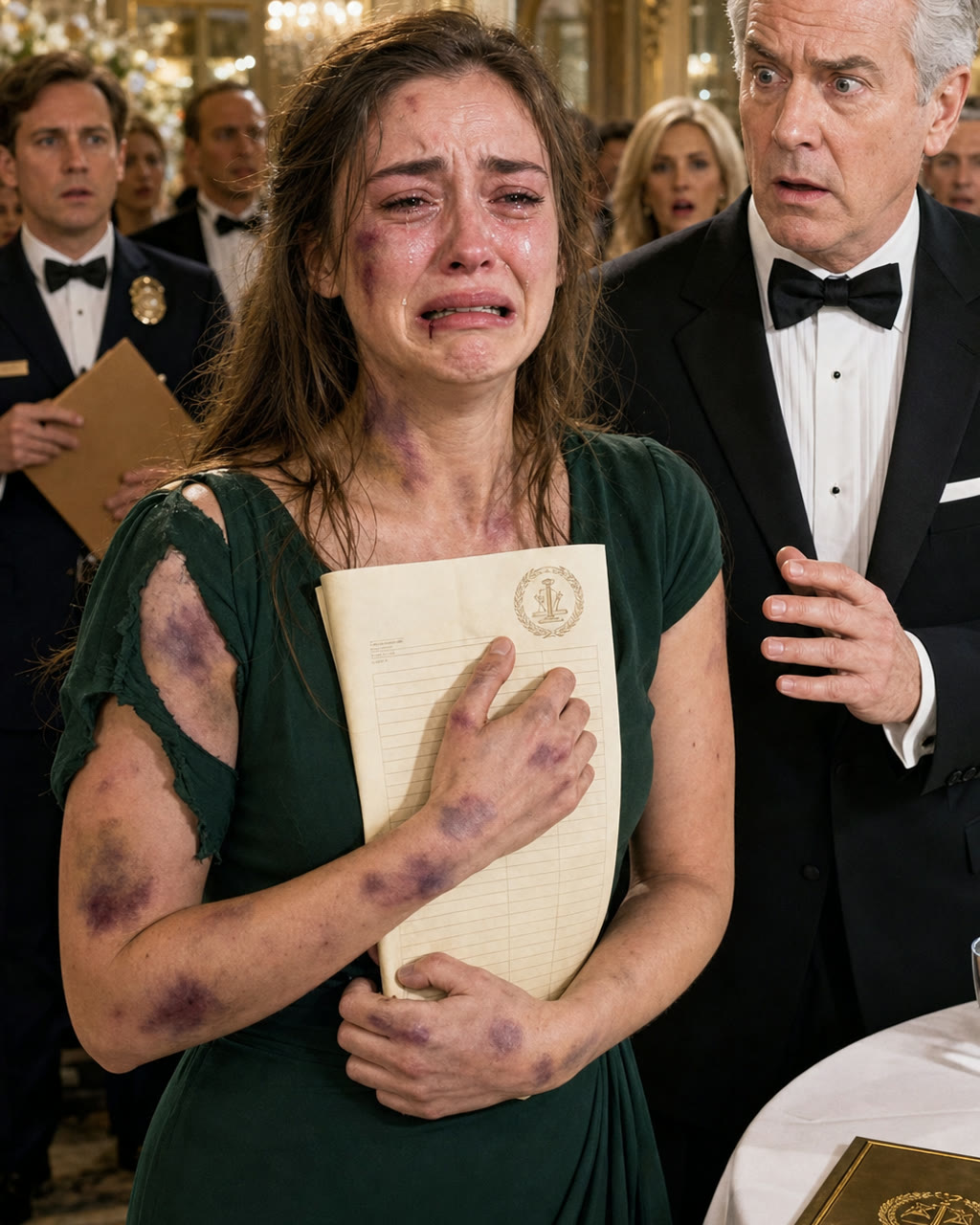
They flew me in as their "scholarship case" — the poor girl the Halloran family was so generously rescuing. The chairman shook my hand under the chandeliers, smiled for the photographers, and thanked me for being "an inspiration." He never once looked long enough to notice I have his exact eyes. Thirty years ago he signed a paper that made me disappear. Tonight I sat at table nine with that paper folded in my clutch, watching him toast his own kindness. I clapped when they told me to. I smiled when the cameras swung my way. And I waited, because some debts don't get paid at a gala — they get paid when the right person finally recognizes your face. FULL STORY IS IN THE COMMENTS BELOW 👇
Chapter 1
The invitation arrived in an envelope so thick it felt like a small gift, cream-colored paper with the Halloran Foundation crest pressed into the corner in gold. I remember standing in the doorway of my apartment with the mail balanced against the recycling bin, reading the front of it twice before I understood it was meant for me.
Miss Della Marsh. Honored Recipient. The Halloran Foundation Annual Gala for Educational Access.
I was thirty years old and I had never been called an honored anything. I ran a community literacy program out of a converted storefront on the east side, the kind of place that runs on grant money and secondhand furniture and the stubbornness of the people who won't let it close. Two months earlier a woman named Priya had come by to "assess our impact," clipboard in hand, and I'd thought she was from the city. She was from the Foundation. The letter said my program had been selected as a beneficiary of their new initiative, and that the Foundation would like to honor me personally at the gala. Black tie. A driver would be provided. Please indicate any dietary restrictions.
I said yes because we needed the money. That is the truth I want to put down first, before any of the rest of it, because I don't want to sound noble. My program needed forty thousand dollars to survive the year, and the Halloran Foundation was offering to be the hero of that story. I said yes for the children who came in after school to learn to read. I told myself that, at least, was clean.
I did not know, when I said yes, whose family the Halloran Foundation belonged to.
Let me tell you what my life looked like the week that letter came, so you understand the size of what forty thousand dollars meant to me, and how little it meant to them. My program was called Second Chapter. I'd started it four years earlier with a grant I wrote at my kitchen table and a lease I signed with money I didn't quite have, in a storefront that used to be a nail salon and still, faintly, on hot days, smelled of acetone under the fresh paint. We had eleven kids that first year. We had a hundred and forty now. They came after the last bell — kids the school system had quietly given up on, kids reading three and four grade levels behind, kids whose parents worked two jobs and couldn't sit with them over a book, kids who had decided, somewhere around age seven, that reading was a thing other people did. My whole job, the entire mission of my life, was to un-decide that for them.
We ran on nothing. I paid two part-time tutors and myself, barely, and the rest was volunteers and secondhand books and a copy machine that jammed if you looked at it wrong. That autumn our biggest recurring donor had folded — a family foundation of its own, much smaller, that had lost its patriarch and quietly closed its checkbook — and I had done the math a dozen times on the same legal pad and the math kept coming out the same. Without roughly forty thousand dollars I would make it to March. Maybe April. Then I would have to tell a hundred and forty children that the room with their names taped to the cubbies was closing, and I would have to do it to their faces, because I am not the kind of coward who does it by letter.
So when Priya from the Foundation came with her clipboard, I did not perform for her. I was too tired to perform. I just showed her the room and the kids and the jammed copier, and I told her the truth about March, and she wrote things down with a face I couldn't read. And two months later the cream envelope arrived, and I said yes, because a drowning woman does not interrogate the hand that reaches for her. She grabs it.
I found the rest out the way you find out most things now — I sat on the edge of my bed with my phone and I read. Arthur Halloran, chairman. Silver-haired, seventy-one, a face that photographed like a bank commercial. Real estate, then hospitality, then the money that money makes on its own. Married to Eleanor Halloran for forty-four years. Two adult children, Chase and Whitney, both on the Foundation board. A grandson. A house on the water. A whole life, laid out in glossy links, the way rich lives are.
I kept scrolling. I don't know what I was looking for. And then I saw the year the Foundation was established, and something in my chest went very still.
I sat there for a long time with the phone going dark in my hand and then lighting up again when I touched it, dark and light, dark and light, while I tried to make the feeling in my chest hold still long enough to name it. It wasn't certainty. I want to be honest about that. It was the shape certainty leaves in the sand before it arrives. It was a woman recognizing the outline of her own life in a stranger's story and being afraid, genuinely afraid, of what it would cost her to look closer.
I have known my whole life that I was adopted. Marlene and Gus Marsh, the people who raised me, never hid it, never made it into a secret you had to earn the right to know. They told me I'd been placed with them as an infant through a private arrangement, and that the paperwork was sealed, and that they loved me more than the sealing of any paper. They were good people. Gus died when I was nineteen; Marlene made it to my twenty-eighth birthday. When she was in the last stretch of it, in the hospital with the tubes and the terrible quiet, she pressed a manila envelope into my hands and said, You should have this now. I never wanted you to feel like you came from nothing. You didn't. Somebody rich enough to want it hidden went to a lot of trouble to hide you.
Somebody rich enough to want it hidden. Those were her exact words, and I had turned them over so many times in the two years since that they'd worn smooth, like a stone you keep in your pocket. Marlene was not a bitter woman and she was not a dramatic one; she had spent her life cleaning other people's houses and she chose her words the way she chose her cleaning supplies, carefully and for a reason. She would not have said rich unless she had seen the rich in it. She had signed papers, back at the beginning. She had sat across a table from someone in a good suit. She never told me the details and I never asked, because for most of my life the not-knowing was a wall I leaned against rather than a door I wanted open.
I had never opened it all the way. I'd looked at the first page — a private surrender-of-parental-rights document, the names of the birth parents redacted with a black bar so thorough it had bled through to the back of the page — and then I'd put it in the fireproof box under my bed and let it stay there for two years. It hurt too much to be a mystery. It was easier to be a woman with no beginning than a woman someone had paid to erase.
Being a mystery does something to a person that I've never heard anyone describe honestly, so let me try. It isn't the not-knowing that wears you down; it's the way the not-knowing quietly rewrites your idea of your own worth. When you don't know where you came from, and you know only that it was hidden, that someone took trouble to make you vanish, a small cold voice starts up in the back of your mind and never fully stops. It says: you were the thing that got erased. It says: whatever you were, it was less than the trouble of keeping you. You can be loved by good people your whole life — and I was, I was loved well by Marlene and Gus — and still carry that cold voice into every room, into every relationship, into every mirror. I had spent thirty years being very high-functioning around that voice. I had a program, a mission, a hundred and forty children who needed me. But the voice was always there, underneath, and I had built my entire adult life on top of it without ever once being able to look it in the eye, because I didn't know its name.
But the redaction had missed something. In the margin of the second page, in the notary's cramped handwriting, was a name that hadn't been blacked out, because it wasn't the parent's name — it was the name of the attorney of record who had drawn up the surrender.
T. Halloran, Esq.
Theodore Halloran. Arthur's younger brother. The family lawyer. Dead now, I'd learn later, of a heart attack in a golf cart, but very much alive thirty years ago, and very much the man who had made a baby vanish on behalf of his brother's family.
I sat there on the edge of my bed and I did the arithmetic that I think everybody in my situation does. I was born the same year the Foundation was established. A foundation for children. Educational access. Generosity as a public face. I thought about the timing of it, a family that gives a child away and then, that very year, begins to build a monument to how much they care about children they've never met.
I am not a fool. I know coincidence is real and I know grief makes patterns out of noise. I told myself all of that. And then I opened the fireproof box, and I took out the envelope, and I decided I would go to the gala after all — not as a beneficiary, and not yet as anyone's daughter, but as a woman who wanted, for once in her life, to stand in the same room as the person who had signed her away and watch his face while he had no idea.
That is a petty thing to want. I know that too. But I had spent thirty years being the mystery in someone else's fireproof box. I wanted, just once, to be the one holding the box.
Chapter 2
The week between the discovery and the gala was the longest of my life. I did not sleep the way people sleep; I slept the way animals sleep near a road, in pieces, always half-listening. I went back and forth on it a hundred times. There were mornings I decided the whole thing was a fever, a lonely woman finding faces in clouds, and I would resolve to go to the gala, take the check, thank them nicely, and never think about the notary's handwriting again. And then there were the nights, and the nights had a different logic. In the nights I would lie in the dark and feel the specific ache of having had, my entire life, a question shaped exactly like a family, and I would think: they have had thirty years of not thinking about you. You can give them one evening of you thinking about them. That is not so much to ask.
I told exactly one person. Her name is Dawn and she has been my friend since we were nineteen and stupid together, and she is a nurse now, which means she is very hard to frighten and impossible to lie to. I laid it all out on her kitchen table — the letter, the timeline, the notary's name — and she listened the whole way through without touching her coffee, which for Dawn is the equivalent of another person screaming. When I finished she was quiet for a while and then she said, "You're going to go, aren't you." Not a question. I said I didn't know. She said, "Della. You've had that box under your bed for two years and you never even Googled the man's brother. Now you have, and there's a party. You're going to go." Then she reached across the table and held my wrist, hard, and said, "But you take a copy, not the real one, and you don't say anything you can't take back, and you call me the second you're in the car, whatever happens. Promise me." I promised her. Two of the three, I even kept.
The driver came at six. He held the door and called me ma'am and I sat in the back of a car nicer than any room I had ever lived in, watching the east side slide away into the part of the city where the streetlights are warmer and the trees are older. I had bought a dress at a consignment shop, dark green, simple, the kind of dress that hopes not to be noticed. In my clutch, folded in quarters, was a photocopy of the surrender document. I had left the original in the fireproof box. I am not entirely without sense.
The gala was in the atrium of a museum, the great glass ceiling above us going lavender and then navy as the evening came on. There were ice sculptures and a string quartet and waiters carrying trays of things I couldn't name. I had spent my whole life in rooms where you counted the cost of things, and now I was in a room built entirely to make the cost of things invisible. That is the real luxury the very rich buy, I think — not the objects, but the disappearance of the price tag, the ability to move through a world where nothing visibly costs anything, where the labor and the money that made the evening possible have been swept so completely out of sight that you can float through it feeling that beauty is simply the natural state of the world for people like you. I watched a woman set down a full glass of champagne on a passing tray without a second glance, a glass that cost more than my morning, and drift on, and I understood something about the family I might have come from that no document could have told me. They did not throw me away out of cruelty. Cruelty would have required them to see me. They threw me away the way that woman set down the champagne — without malice, without a second glance, because keeping track of the cost of things is not something people like them are ever required to learn. The women wore dresses that cost more than my program's monthly rent and the men wore the kind of understatement that only money can afford. I stood near a pillar and I drank sparkling water and I watched, and I felt exactly as out of place as I was meant to feel, and I understood, slowly, that being out of place was the point of me being there. I was the texture of their generosity. I was the before, so that they could be the after.
Priya found me. She was warm, genuinely warm, and I think that was the cruelest part, that the people close to the ground in that machine had no idea what the machine was for. She walked me toward the front, past table after table of people who looked at me the way you look at a documentary. "The chairman is so looking forward to meeting our honorees," she said. "He does this every year. He really does care, you know. People think it's all optics, but he really does care."
And then there he was.
I had seen his face on my phone a dozen times, but a photograph flattens a person, and in the room he was enormous — not in size, he was slight, but in the way the space bent toward him. People turned when he moved. He had silver hair combed back off a high forehead and a tan that looked applied and eyes that were, and I need you to understand I checked, I checked three times, the same gray-green as the eyes I have looked at in the mirror every morning of my life. My mother — Marlene — used to say my eyes were "storm-colored." She said it like a compliment. I had never known where they came from.
Now I did.
"This is Della Marsh," Priya said. "She runs the literacy program on the east side. She's one of our honorees tonight."
Arthur Halloran took my hand in both of his. His hands were dry and soft and I felt, distantly, that I was shaking and hoped he couldn't tell. He smiled at me with a warmth so practiced it was almost real. "Della," he said, as if he were tasting the name. "What you do is extraordinary. Truly. Reading is the door to everything, isn't it? Everything. I always say that. You're an inspiration."
I was an inspiration. To the man who had signed the paper that was folded in my clutch eighteen inches from where his hands held mine.
"Thank you, sir," I said. My voice came out level. I don't know how.
A photographer swung toward us and Arthur's arm came around my shoulders, light, professional, the arm of a man who has posed with ten thousand strangers. "Smile, Della," he murmured, already smiling himself. The flash went off. Somewhere in a hard drive there is now a photograph of a man with his arm around a daughter he doesn't recognize, both of them smiling, and only one of them knowing why the moment mattered.
He held the pose for exactly as long as the camera needed and then his warmth slid off me and reattached itself to the next person, a donor, a man with a watch, and I was standing alone again with the ghost of his arm on my shoulders.
I want to tell you I felt rage. I have gone looking for the rage many times since, because it would be simpler. But what I felt, standing there under the lavender glass, was something closer to grief so large it had no edges. Because he had looked right at me. He had looked into the storm-colored eyes he had given me and he had felt nothing, no snag, no half-recognition, no cold breath on the back of the neck. I was a stranger to him. I had always been a stranger to him. The signing hadn't been an agony he carried; it had been a Tuesday. A form. Something Theodore handled.
I want to describe what he smelled like, because it undid me in a way I wasn't prepared for. It was cedar and something citrus underneath, an expensive quiet smell, and it hit some door in me I didn't know was there. I have no memory of my birth father. I was days old. There is no possible way I remember his smell. And yet standing in the circle of that scent I felt something in my body lean toward it, some animal recognition older than memory, some part of me that had spent thirty years not knowing and suddenly, wordlessly, knew. I have read since that scent bypasses the thinking brain entirely, goes straight to the oldest part of us. I don't know if I truly recognized him or if I was a lonely woman inventing a homecoming out of cologne. I only know that I had to lock my knees to keep standing, and that when his warmth slid off me onto the next donor, the loss of that scent felt, absurdly, unbearably, like being given away a second time.
I found my seat at table nine, between a retired judge and a woman who did something with horses, and I got through the salad. And then a young man sat down across from me, loosening his tie, dropping into the chair with the particular exhaustion of someone who'd been on his feet all night being a Halloran. He had the eyes too. Gray-green, storm-colored.
"God, these things," he said, to no one, to the table. "Sorry. Long night. I'm Chase." He put out his hand. "You're one of the honorees, right? The reading program. That's genuinely great work, by the way, I mean that, not the gala-voice version."
I studied his hands while he talked, the way you study a stranger you're trying to place. He bit his nails; the chairman would never. He had a callus on the side of his middle finger, the kind you get from holding a pen wrong, the exact kind I have, the kind Marlene used to tut over when I did my paperwork at the kitchen table. It meant nothing. It meant everything. I have learned since that the mind, when it decides someone is family, will find family everywhere, in a callus, in the tilt of a head, in the way a laugh runs out of air at the end. I couldn't trust any of it and I couldn't stop cataloguing it either.
Chase Halloran. My brother, if the arithmetic was right. I shook his hand and I felt the room tilt very slightly, because he was kind. He was actually kind, in a tired, unguarded way, and I had come here armed against monsters and I was being handed a brother who wanted to talk about literacy rates.
"Della," I said.
"Della," he repeated, and then he looked at me for a second too long, the way you look at a word you're sure you've spelled wrong. "Have we — sorry. You look really familiar. Do you know Whitney? My sister?"
"No," I said. "I don't know anyone here."
"Huh," he said, and shook it off, and reached for the wine, and I sat very still with my clutch in my lap, because he had felt it. Whatever his father hadn't felt, Chase had. A snag. A half-recognition. A cold breath on the back of the neck.
Chapter 3
The program moved the way these things do, through the plates and the speeches and the slow warming of the wine. There was a video, tastefully lit, about the Foundation's thirty years of work, and Arthur's voice came over the images of children in classrooms, none of them, I noticed, actual footage, all of them the polished stock of people who could afford to buy the idea of children rather than photograph the real ones. "When Eleanor and I started this Foundation thirty years ago," his voice said, "we made a promise. That no child in this city would ever be told they didn't belong."
I set down my fork very carefully so it would not make a sound.
At the podium, later, he told the origin story again, live this time, and I watched Eleanor Halloran at the head table while he told it. She was beautiful in the way that money keeps women beautiful, a silver bob and a still, composed face, and when Arthur said the words no child would ever be told they didn't belong, I saw her hand tighten on her water glass, just for a moment, just enough. She did not look at her husband. She looked at her plate. And I understood something I had not let myself understand until then, which was that whatever had happened thirty years ago, she had been in the room for it. Maybe she had wanted it. Maybe she had fought it and lost. But she knew. Wives know. And the Foundation, this whole cathedral of generosity toward children, had been her penance, or her cover, or both, built the same year they gave one away.
While he told it, I made myself watch the room instead of him, because if I watched him too long I was afraid of what my face would do. And watching the room taught me more than watching the chairman ever could. I watched the donors, the men with the watches and the women with the still, expensive faces, and I saw the exact machinery of it — how the story of the thrown-away child made good became a product they were buying, how their applause was a kind of purchase, how everyone in that atrium got to go home feeling that they had, personally, saved a girl like me. I was the proof of concept. I was the receipt.
And I watched Chase, two tables over, and Chase was not performing. Chase had his elbows on the table like a boy who'd been told all his life not to, and he was watching his father with an expression I recognized because I had worn it myself for years about my own life — the look of someone who suspects the official story has a seam in it and hasn't yet let himself pick at the seam. When his father said no child would ever be told they didn't belong, Chase's jaw tightened, just slightly, the way it had when he'd looked at me and said you look really familiar. He didn't know what he knew. But some part of him knew there was something to know.
I thought about Whitney, the sister I hadn't met, somewhere in that room or not, and about the grandson, and about all the people whose family this actually was, whose Christmases and inheritances and holiday photographs I had been quietly deleted from before I could form a memory. I did not hate them. That surprised me, then and now. You would think, sitting at table nine watching your own erasure be applauded, that hatred would be the natural weather. But hatred needs a relationship, and I didn't have one. You can't hate a family you never had. You can only grieve it, which is worse, because grief has no target and never fully ends.
They called the honorees up one at a time. A food bank director. A man who ran a shelter. And then Priya said my name, and I walked up the three carpeted steps into the light, and Arthur Halloran turned to me with a check the size of a door and that warm, practiced, terrible smile.
I want to tell you what went through my mind on those three carpeted steps, because they were the longest three steps of my life and time did the strange thing it does at the edge of a cliff, stretching, going slow and bright. I thought about Sofia, eight years old, who came to Second Chapter reading like a five-year-old and hiding it with jokes, because a child would rather be the class clown than be seen as slow. I thought about the copier that jammed. I thought about March, and the hundred and forty children, and the specific faces I would have to close the room in front of. I thought about Marlene pressing the envelope into my hands in the hospital and saying you didn't come from nothing. And I thought, climbing toward the light and the check and the man who'd signed me away: he thinks this is charity. He thinks he is the one giving. He has no idea that the amount on that check is the exact price of the room where I keep the promise he broke. He is handing me, for the price of a photo op, the means to be to a hundred and forty children the one thing no one was to me — someone who stays. And he will never know that's what he did. That was the moment the anger turned into something else in me, something I didn't have a name for on the steps and only found later: it turned into a kind of terrible, level clarity.
The check was for forty thousand dollars. Exactly what my program needed. I had never told them the number. They had simply chosen it, the way you'd choose a portion size, generous enough to feel good, small enough not to notice.
"Della Marsh," he said into the microphone, "is exactly why we do this."
The applause came up around me like water. Cameras. The warm arm again, around my shoulders, for the photograph. And in that moment I had a choice, and I want to be honest about it, because I had rehearsed a version of this night in which I turned to the microphone and I unfolded the photocopy and I said the notary's name out loud into that glass room and I watched the Foundation's thirty years of penance shatter on live streams and morning news.
I had the paper. It was in my clutch. My hand was on the clasp. And I want you to understand that in that half-second, standing in the light with a man's arm around me, I was not calm and I was not wise. I was a thirty-year-old woman one small motion away from setting fire to the largest room she had ever stood in, and part of me — a real part, a loud part — wanted to do it. Wanted to hear the microphone catch the words. Wanted to watch the still expensive faces stop being still. Wanted, after thirty years of being the quiet mystery, to be, for once, the loudest thing in the room.
And then I looked out at the tables, and I found Chase, who had stood up to clap, who was clapping for me with the uncomplicated warmth of a man who did not know what his family was, and I found Eleanor, who was not clapping, who was looking at me now — finally, fully looking at me, her still face gone the color of paper, her hand pressed flat against her collarbone — because she saw it. She saw the eyes. She saw thirty years walk up three carpeted steps in a consignment dress. She knew before anyone at that table would ever know.
And I understood that if I burned it all down at that microphone, the people who would burn with it were Chase, who was innocent, and Priya, who was innocent, and a room full of donors who would write smaller checks next year, and the children in the not-real video who would become, again, an abstraction. Arthur would survive it. Men like Arthur always survive it. He would have a statement by morning. He would be, if anything, a more sympathetic figure — the grieving patriarch ambushed at his own charity.
The person I would destroy was not the chairman. It was the girl in the dark green dress who had wanted, for one night, to be more than a mystery, and who would forever after be the scandal, the DNA headline, the woman who did that thing at that gala.
There is a version of me that regrets not saying it out loud. I have met her, late at night, more than once. She is angrier than I am and she thinks I was a coward at the microphone, that I had the truth in my clutch and the whole world in that room and I chose to whisper eight words instead of speaking the one sentence that would have made every camera swing and every glossy link rewrite itself. She thinks I let him win. I have argued with her a great deal, and here is what I have come to say to her, and what I'll say to you: the loud version would have made me the story. Della Marsh, the illegitimate daughter, the DNA scandal, the woman who did that at the gala. My whole life afterward would have been an appendix to his. Every child I ever taught would have been asked about their teacher who caused the scene. I would have become, permanently, a thing that happened to the Halloran family — a footnote in their saga, defined forever by the moment I chose them as the center of my life. And they had already made me a footnote once, thirty years ago. I was not going to volunteer to be one again, and call it justice.
I took the check. I said thank you, sir, into the microphone in a voice that carried. I let him keep his arm around me for the length of one more flash. And then I leaned in, close, under the applause, close enough that only he could hear, and I said the notary's name.
I said: "Theodore did good work. The surrender held up for thirty years."
I felt his arm go rigid on my shoulders. I felt the exact half-second his smile stopped being a face and became a mask over a face. I stepped out from under his arm, into the light, holding a check for forty thousand dollars, and I walked back down the three carpeted steps while the room applauded a moment it had entirely misunderstood.
Chapter 4
He found me by the coat check. Of course he did. A man like that cannot bear a loose end; it will keep him awake more surely than a grief will.
The atrium had thinned by then, the string quartet packing up, the ice sculptures weeping down to nothing on their silver trays. Arthur Halloran came around the pillar without his warmth on, and I saw for the first time what his face did when there was no camera to arrange it for. It was an old face. It was a frightened face. It had my eyes in it.
"Who are you," he said. Not a question. A demand, low, the voice he must have used across thirty years of tables where deals got made and people got made to disappear.
"You know who I am," I said. "You felt it. Your son felt it. Your wife knew before I got to the top of the stairs. You're the only one at that whole table who looked at me and felt nothing, and I've been trying to decide all night whether that makes you a monster or just a man who signed a form he never thought about again."
For a moment he tried the old face on again — I actually watched him reach for it, the warm chairman, the patriarch, the man who could charm a hostile board and a skeptical reporter and a room full of people who didn't want to give money. I watched him reach for that man and I watched the reach come up empty, because that man requires an audience to exist and there was no audience here, just the two of us and the weeping ice sculptures and thirty years standing between us in a consignment dress.
His jaw worked. "Theodore handled a great many private matters," he said. "I don't know what you think you have —"
"I have your brother's handwriting in the margin of a surrender he forgot to redact," I said. "I have your eyes. I have thirty years of a foundation you built the same year you gave me away, which I used to think was a coincidence, and I don't anymore, because I watched your wife's face tonight." I let that sit. "I don't want your money, Mr. Halloran. I already have your check, and it's going to teach children to read, which is more than your Foundation has ever actually done for a single child I could find in your not-real video. I don't want a paternity suit. I don't want your name. I have a name. Marlene Marsh gave it to me, and she stayed up with me when I had fevers, which is more than an attorney of record ever did."
"Then what," he said, and his voice cracked on it, one clean crack down the middle of all that composure, "do you want."
And here is the thing I had not known until I heard him ask it. I had come to that gala thinking I wanted him to recognize me. I had built the whole night around the fantasy of his face changing. But standing by the coat check with his ruined composure in front of me, I realized his recognition was worth nothing to me. It had come thirty years too late and only under threat, and a recognition you have to extract at gunpoint is not recognition, it's surrender. I didn't want his surrender. Theodore had gotten one of those from my birth mother thirty years ago, and look what it built.
The question hung there between us, what do you want, and I realized he was braced for a number. Of course he was. It was the only language he had. Every problem that had ever walked up to Arthur Halloran had, in the end, wanted a number, and he had paid it, and the problem had gone away, and that was the entire operating principle of his life — that everything, in the end, has a price, and a man rich enough can always meet it. He was standing at the coat check doing the sum in his head, I could see it, calculating what thirty years of silence was worth, what the original had cost his brother, what my forgetting would run him. He was, even now, even frightened, reaching for the checkbook of the soul. And that, more than the arm around my shoulders, more than the not-real video, more than the check the size of a door, was the thing that finally freed me. Because I looked at a man who could only imagine wanting money, and I understood that whatever I had come from, I had not come from that. Marlene had raised a woman who wanted something he could not price.
"I want you to know that I turned out well," I said. "That's all. I wanted to stand in your house and let you see, just for one second, that the thing you signed away became a whole person, with a good life and storm-colored eyes and a program full of kids who love her. You spent thirty years and a fortune trying to make sure I'd feel like I came from nothing. I want you to go home tonight and know that it didn't take. I came from somewhere. Just not from you."
He didn't answer me. I don't think he had an answer; I think men like Arthur Halloran outsource their answers the way they outsourced everything else, to a Theodore, to a Prescott, to a lawyer of record, and there was no lawyer of record standing at the coat check to tell him what to feel. He just stood there, an old man in a good tuxedo, holding the wreckage of an evening he'd expected to end with a photograph and a headline about his generosity. I almost felt sorry for him. Almost. Then I remembered the not-real children in the video, and the exact amount of the check, chosen like a portion size, and the thirty years of a Foundation built to launder a single signature, and the almost went away.
I picked up my coat myself; the attendant had drifted off. Behind Arthur, across the emptying atrium, I saw Eleanor standing very still by the head table, watching us, her hand still at her collarbone. She did not come over. But when I looked at her, she gave me one small nod — not an apology, you can't nod an apology that size, but an acknowledgment, one woman to another, of a truth that had finally walked into the room and out again on its own two feet.
I called Dawn from the car, finally, the way I'd promised. The driver was taking me back across the city, back toward the warmer part becoming the ordinary part becoming home, and I got her on the second ring and I couldn't speak at first, and she didn't rush me, she just stayed on the line breathing while I put myself back together enough to talk. "Did you do it," she said finally. "Did you burn it down." And I told her no. I told her I'd said eight words to him under the applause and taken the check and walked out. There was a long pause and then Dawn, who is very hard to move, said in a thick voice, "That's the strongest thing I've ever heard you do." And I understood, sitting in the back of that beautiful car with my face wet, that she was right, and that the strength wasn't in the eight words. It was in all the words I'd swallowed. It was in choosing not to become, at the very last second, a person who solves thirty years of silence with one loud act. My birth family had solved a problem loudly and permanently once, with a signature, and it had cost me my whole beginning. I was not going to answer them in the only language they knew. I was going to answer them in mine, which was quieter, and which lasted longer.
I mailed the photocopy back to the Foundation the following week, with a note. The note said: I don't need this. But you should know I have the original, and I have chosen not to use it, and I want you to understand every day for the rest of your life that the choice was mine and not yours. That was the whole revenge. Not a scandal. A leash, handed back, so he'd know I'd been the one holding it.
The forty thousand dollars kept my program open. We painted the storefront that spring, a color the kids picked, a green almost exactly like my dress. A girl named Sofia, eight years old, read a whole chapter book out loud to the room in June, stumbling and triumphant, and everybody clapped, and I clapped hardest, and I thought about a video full of children who weren't real, and a room full of adults who applauded a moment they'd misunderstood, and I thought: this is real. This clapping is real. This is what belonging actually sounds like, and it doesn't cost a black-tie gala, it costs staying.
I never saw Arthur Halloran again. I heard, months later, that he stepped back from the Foundation, "to spend more time with family." I hope he did. I hope it was hard. But mostly I don't think about him at all, which is, in the end, the exact thing he once paid a great deal of money to make me — forgettable — and which I have decided to keep, this time, entirely on my own terms.
You may also like
The Silent Truth Behind My Daughter's Accident
The call came at 11:47 at night.…
Read the full story →The Night Evelyn Harper Took Back Her Power
My husband's mistress openly mocked me while my husband smiled… While they laughed at my pain, they never realized that I was the one in control. The moment I whispered, "Everythin…
Read the full story →He Fired the "Cleaning Lady" in Front of the Whole Office — Nine Minutes Before the Board Handed Her the Company
My name is Eleanor Reyes, and for eighteen months the people at Meridian Textiles thought my name was "hey" or "the cleaning lady" or, on a good day, "Ellie, could you get the brea…
Read the full story →