The Voice Memo That Told The Whole Truth
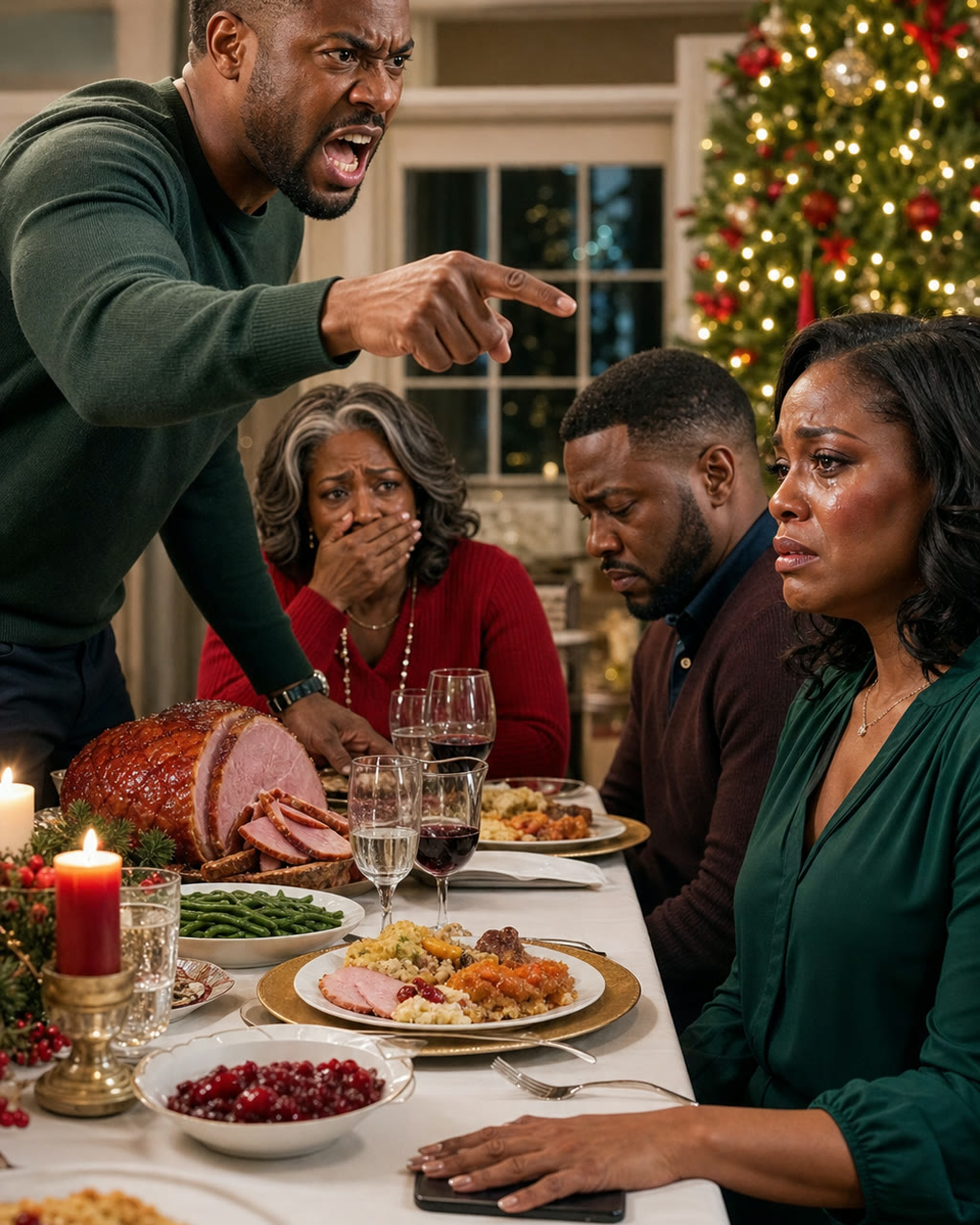
My brother-in-law stood up at Christmas dinner, pointed his fork at me in front of my whole family, and called me a freel0ader who "mooched off" my sister for years. I set my glass down slow so my hand wouldn't shake. My eight-year-old niece was watching me from the end of the table with her fork frozen halfway to her mouth.
Chapter 1
I want to start by telling you about my sister's house, because the house is where all of this really lives.
It's a two-story brick colonial off Delmar in St. Louis, with a porch swing my daddy hung the summer before he passed, and a driveway wide enough for three cars. Denise picked out the paint color herself, a soft butter yellow with white trim.
I picked up the down payment. Fifty-two thousand dollars, seven years ago.
Nobody at that Christmas table knew that second part except me and Denise. And by the end of the night, every single one of them would know.
My name is Renata Coleman. I'm forty-one years old, I never married, and I have spent most of my adult life being the person everybody calls when something goes wrong.
I run a medical billing company I built out of the spare bedroom of a one-bedroom apartment eleven years ago. It is not glamorous work. I chase insurance companies and clean up other people's paperwork for a living.
But it did well. And I did well. And somewhere along the way I learned to keep quiet about money, because the second folks smell it on you, the phone starts ringing and it never really stops.
My sister Denise is three years younger than me. She's the pretty one, the funny one, the one who lights up a room the second she walks into it. I love her more than I love almost anything on this earth.
She married Marcus Ellison eleven years ago in a church on Natural Bridge Road, and I stood up at that altar in a lavender bridesmaid dress and cried real tears, because she looked so happy I could barely stand it.
That's the part people forget when I tell this story. I liked Marcus once. I wanted to like him. I gave that man every benefit of every doubt for a long, long time.
He was charming back then. A firm handshake, looked you dead in the eye, called my mama "Miss Gloria" and pulled her chair out at every family dinner. He worked in car sales, and Marcus could sell you anything on this earth, including himself.
I remember standing at that wedding thinking, this man is going to take care of my sister. I remember being genuinely glad about it.
It took me about two years of marriage to understand something about Marcus Ellison. He could sell you a story. But he could not finish one.
The first loan was for a work truck. He swore it was for a delivery gig that was about to take off, said the commission checks were already coming, said he'd have every penny back to me inside ninety days.
I gave him nine thousand dollars, because Denise asked me to, and because that's what family does, and because I could afford it. That was the first time. It was nowhere near the last.
I'm not going to sit here and list every dollar like I'm reading off a bank statement. But I need you to understand the shape of it, because the shape is the whole point of this story.
When their furnace died in the middle of February with both kids in the house, I paid for the new one. Four thousand two hundred dollars, and I told the HVAC man to just bill me direct so Denise wouldn't have to worry.
When Denise's car got repossessed out of that same butter-yellow driveway, I bought her a used Camry, put it in my name, and just let her drive it like it was hers.
When Marcus's "business" — and there was always a business, always a new one — folded and took their savings down with it, I covered two months of their mortgage so they would not lose the house my daddy's porch swing hung on.
And when my nephew DeShawn needed braces, and my niece Amara fell behind in reading after they switched schools and needed a tutor twice a week, I wrote those checks too. Every single one.
I never made a big production out of any of it. I'd wire the money straight to Denise, or I'd pay the vendor myself, and I'd tell her the same thing every time.
"Don't worry about it, Neesy. Just take care of my babies."
That's what I called those two kids. My babies. DeShawn is twelve now and Amara is eight, and I have loved them both since the day each of them got laid in my arms at Barnes-Jewish, wrinkled and hollering and perfect.
I never had my own children. Life just didn't shake out that way for me — a couple of relationships that didn't hold, a couple of years I spent building the company instead, and then one day I looked up and I was thirty-eight.
So I poured it all into theirs. Every birthday, every school play, every scraped knee. I was there.
Here is the part that matters most, and I need you to hear it clearly. Everything I did, I did for Denise and for those two kids. I never once did a single thing for Marcus. Not for his ego, not for his comfort, not for him.
And somewhere along the line, Marcus decided in his own head that all of it had been him.
I don't know the exact day the story flipped in his mind. But I started catching it at the small family things, the cookouts and the birthday parties.
Marcus would be leaning back in a folding lawn chair holding court with a plate on his knee, and somebody would compliment how well the kids were doing, and Marcus would say, "Yeah, I make sure my family don't want for nothing."
And I'd sip my sweet tea and say absolutely nothing, because I was never in it for the credit. I told myself the credit didn't matter. I told myself God saw it, and that was enough.
But it built up. Little by little, over years, like water working on a stone.
He started talking about "the house I bought Denise." He talked about "putting my kids in the best." He told my cousin Renard, straight-faced at a barbecue, that Amara's reading tutor was "an investment I decided to make in that girl's future."
I had paid for that tutor. I was still paying for that tutor, that very week, thirty-five dollars an hour, twice a week. And I sat right there in a folding chair and let Marcus wear it like a coat he'd found hanging in my closet.
Denise knew the truth. That's what made all of it so complicated.
When it was just the two of us, my sister would grab my hand across her kitchen table and say, "Nay, I swear I don't know what we would do without you. I mean that." And she did mean it. Denise has the biggest heart of anybody I have ever known.
But her weakness is that she would rather keep a room comfortable than tell it the truth. She will swallow a hard thing whole and smile through it just to keep the peace. She got that straight from our mama, and Mama got it from hers.
So when Marcus told his little stories in front of company, Denise would just go quiet and change the subject. Ask if anybody wanted more potato salad. Get up to check on the kids.
She never once corrected him. Not one time in eleven years. And every single time she didn't, a small cold place opened up in my chest that I did not like feeling toward my own sister.
Now let me tell you about my mama, because you cannot understand why I didn't walk out of that house on Christmas without understanding her.
Gloria Coleman is seventy-three years old. She raised two girls mostly by herself after my father's heart gave out on him when I was nineteen and Denise was sixteen.
She is a proud woman and a soft woman at the very same time, which is a hard way to move through this world. She believes family is the last thing you truly have on this earth, and she will forgive a person seventy times seven before she will ever let go of them.
She loves Marcus like a son. That's just the plain truth of it. Marcus is good to her face — he fixes her storm door when it sticks, he calls her every year on her birthday and sings to her, he tells jokes that make her laugh so hard she has to wipe her eyes.
My mama does not know about the money. She never did. Denise begged me for years to never tell her, and I kept that promise.
"It would break Mama's heart to know Marcus can't provide," Denise told me once, crying, sitting in my passenger seat outside the bank. "Please, Nay. Let me keep this one thing."
So I carried it silent. For Mama, so she wouldn't worry herself sick. For Denise, because she was ashamed. For the kids, because they didn't need to know.
I got good at carrying silent things. Way too good, honestly. That was always my problem.
Which brings me to this past Christmas.
Denise called me the week before, and right away I could hear it in her voice that something was off. She was talking too fast and too bright, the way she does when she's covering.
She said Marcus had "some big news." Said he was excited. Said please come, Mama would be there, DeShawn had a solo in the church program, and Amara had made me a card with her own two hands.
I told her of course I'd come. I always came. In eleven years I had never missed a single Christmas at that house.
But I hung up that phone and stood in my own kitchen a long minute with a strange, heavy feeling sitting square on my chest. Marcus with "big news" was never, ever a good thing. Marcus with "big news" had cost me nine thousand dollars the very first time I ever heard those words.
I told myself I was being paranoid. I told myself it was Christmas, and I should be ashamed of myself for thinking the worst of family.
Still.
Two days before that dinner, I did something I had never once done in my entire life. Something I still feel some kind of way about, even now, even after everything.
I decided that when I walked into that house on Christmas Eve, I was going to quietly start a voice memo on my phone and just let it run in the side pocket of my purse.
I didn't tell a soul. Not Denise. Not anybody.
But some old, tired, careful part of me — the part that had been floating this family for eleven years and cleaning up other people's messes for a living — that part looked me dead in the eye and said, Renata, this year, you cover yourself.
I did not know, driving over there on Christmas Eve with a trunk full of wrapped gifts and a warm sweet potato pie riding shotgun on the seat beside me, that by the end of that night, that one little glowing red dot would be the only thing in that entire house telling the God's honest truth.
Chapter 2
I got to the house a little after six, and the whole block smelled like woodsmoke and somebody two doors down cooking greens.
Denise had gone all out this year. There were white lights strung along the porch railing, a big fresh wreath on the door with a red velvet bow, and through the front window I could see the tree.
The same tree we've been decorating since the kids were babies. Drowning in mismatched ornaments and silver tinsel, an angel on top that DeShawn made out of a paper plate in the second grade.
I sat in the car a second before I went in. I reached into my purse, opened the voice memo app, pressed the red circle, and watched the little timer start counting up from zero.
Then I slid the phone down into the side pocket of my purse, screen against the lining, and I fixed my face. I grabbed the pie off the seat and I walked up that butter-yellow walkway I'd paid a piece of.
Amara yanked the door open before I could even knock.
She had on a red velvet dress and her hair done up in twists with little gold beads on the ends, and she threw both arms around my waist so hard she nearly knocked the pie out of my hands.
"Auntie Nay! You came!"
"Course I came, baby girl. When have I ever, ever not come?"
She grabbed my free hand and dragged me inside, already talking a mile a minute about the card she made me, and DeShawn's solo, and a puppy she wanted that her daddy said maybe on if she was good.
The house was warm and loud and full of people, and for a second all of my bad feelings just melted right off of me.
My mama was set up in the good chair by the tree with a crocheted blanket over her knees, and she lit up like a girl when she saw me come around the corner.
"There's my Renata," she said, and held both her arms up like I was still six years old.
I bent down and kissed her soft cheek and she smelled like the exact same rosewater she has worn my whole entire life, and I held on to her a second longer than I needed to.
DeShawn came thundering down the stairs, twelve years old and shooting up like a weed, all elbows and knees. He gave me the too-cool half-hug that boys that age give you. But he held on one extra second. He always does. That's my DeShawn.
Denise came out of the kitchen wiping her hands on a dish towel, and she looked beautiful and bone-tired at the very same time. She had on the gold hoop earrings I bought her two Christmases back.
"Nay," she said, and pulled me into a hug, and I felt her hold on a beat too long, the way you do when you're nervous about something coming.
"You okay?" I said low, right in her ear.
"I'm fine," she said, way too fast. "Come on, dinner's just about ready. Marcus is in the den."
She wouldn't quite meet my eyes when she said it. She turned back toward the kitchen too quick, wiping at the counter that was already clean.
I stood there in the front hall a second, taking my coat off, and that's when I heard it. Marcus's voice, low and easy, coming through the wall from the den. He was on the phone with somebody, laughing about something.
I didn't catch much of it right then. Just the tail end. Something about "the holidays" and "she can't say no." I remember thinking it was probably nothing. Marcus was always on the phone about some deal.
I hung my coat on the hook by the door, right up against that thin den wall, and my purse went on the hook beside it. The little red dot kept glowing inside it, quiet, catching every word I wasn't catching myself.
I didn't think a thing of it. I went and kissed my mama.
Marcus.
He came out of the den holding a glass of something brown over ice, wearing a brand-new Christmas sweater with the tags probably still warm, and a great big smile.
"The famous Renata," he said, spreading both arms wide. "The successful one. We are truly honored to have you."
There was something living underneath those words. There always was, with Marcus. A little hook buried down in the meat of it.
"Hey, Marcus. Merry Christmas." I handed him the pie mostly so I wouldn't have to hug him. "Sweet potato. Mama's recipe."
"You know I love your pie," he said, and for one second he was just a man holding a pie plate, and I thought to myself, maybe I really am being paranoid. Maybe this year everybody's just going to have a nice time.
I want to be fair to him, even now, even after all of it. So let me tell you the one good thing about Marcus, because the man did have one.
Marcus was fun. When he was up, he was the best time in any room in America. He'd have DeShawn doubled over laughing doing impressions of people from church. He'd pull my mama up out of her chair to slow dance with him in the kitchen while the greens simmered. He could tell a story so good you'd forget halfway through that not a word of it was true.
His weakness was that he could not stand to feel small. He needed to be the biggest man in every single room, the provider, the king of it all. And when he felt that slipping — when he felt somebody else in the room might be carrying more than him — he got mean in a quiet, dressed-up way that took me years to learn how to see coming.
The thing I'll always picture about Marcus, the detail burned into me now, is the way he'd straighten his shirt collar with two fingers right before he said something cruel. Like he was putting a nice suit on the ugly words before he let them out the door.
We finally sat down to eat right around seven. The table was gorgeous. Denise had put out our grandmother's good china, the pattern with the little blue flowers around the rim. A honey-glazed ham right in the center, collard greens, mac and cheese baked with the crust on top, cornbread, candied yams. My pie waiting on the sideboard.
My mama said grace. She thanked God for family, for health, for the food on that table, and for "having all my babies under one roof for one more Christmas." She had DeShawn's hand on one side and mine on the other, and she gave my fingers a little squeeze on "babies."
For about twenty minutes, it was the exact Christmas I had driven across town praying for.
DeShawn told us about his solo. Amara showed everybody the loose tooth she was working on. Mama and Denise got to laughing about some cousin who showed up to Thanksgiving with a store-bought pie and tried to pass it off as homemade.
And then Marcus tapped the side of his glass with his fork. Ting, ting, ting.
"Before we get too deep in this good food," he said, pushing his chair back and standing up, "I got myself an announcement to make."
Denise's smile went stiff on her face. She reached for her water glass and held on to it.
Marcus straightened his collar with two fingers.
"Now, y'all know I been working on something big," he said, and he looked slow around the whole table, gathering us all up. "Well. I am officially going into business with Terrence — some of y'all know Terrence from the lot on Kingshighway. Me and him are opening our own dealership. Our own place. Ellison and Boyd Auto."
He let it just sit there in the air a second, waiting on the reaction he wanted.
My mama clapped her hands together. "Oh, Marcus, that is wonderful. Praise God."
"It's a big move," Marcus said, warming up now, feeding off her. "A big, big investment. It takes real capital to sit down at a table like that. But I have always been a provider. Every one of y'all can ask my wife."
Denise looked down at her plate. She didn't say a word.
"See, that's the thing about being the man of a household," Marcus went on, gesturing now with his fork, pointing it around the room. "You carry it. And nobody sees what it takes out of you. This house right here. These beautiful kids. Everything your eyes can see around this room — all of that is on my back. Mine."
I kept my face still and I kept eating. I had heard this speech before, in little pieces, at cookouts and holidays for years. I had made a decision in the car that I was not going to let it get to me tonight. It was Christmas. I was going to let him have it.
But then he turned and he looked right at me.
"Now, Renata's done real well for herself, and we are all proud of Renata," he said, and there was that hook again, sinking in. "But there is a difference — a big difference — between doing well for your own self and carrying a whole family on your back. Some people only ever had they own self to worry about. Must be nice."
DeShawn's eyes cut over to me. Amara had gone completely quiet, her fork stopped halfway to her mouth.
"Marcus," Denise said, real soft. A warning she didn't have the strength behind.
"I'm just saying the truth," Marcus said, louder now. "It's easy to have a nice car and a nice little condo when it's only you. Try feeding four mouths, Renata. Try being the one that everybody in the whole family leans on when it hits the fan."
I set my glass down on the tablecloth, slow and careful.
And something inside of me shifted. It wasn't anger, exactly. It was more like a door swinging open in a house I thought I had locked up and left behind years ago.
"Marcus," I said, calm as I could make it. "I think that's enough now."
I don't fully know why those three little words did it. Maybe because in eleven years I had never once pushed back on him. Maybe he had been waiting all that time for me to finally push back, so he'd have his excuse to say the thing he'd been holding.
He put both his hands flat on the table and leaned his whole weight toward me.
"Enough?" he said. "Enough? You sitting up in my house, at my table, gonna tell me enough?"
"Marcus, please," Denise said, and her voice cracked right down the middle.
"No. No." He wasn't even looking at her. He was locked onto me. "Let me say something to your sister, Denise. Let me finally say the thing that everybody at this table already knows and won't nobody say."
The whole room went dead quiet. That awful, ringing kind of quiet where all of a sudden the hum of the refrigerator in the next room is the loudest thing you have ever heard in your life.
My mama started to say, "Now, it's Christmas, y'all, let's just—"
Marcus talked right over the top of her.
He raised that fork and pointed it straight across the table at the center of my chest. And in front of my mama, in front of DeShawn, in front of my eight-year-old niece sitting there in her red velvet dress with her gold beads, he said the word.
Chapter 3
"You're a freeloader, Renata."
That's what he said. Loud. Flat. Almost proud of himself, like he'd finally gotten to set down something heavy he'd been carrying a long way.
"You come around here twice a year with your little gifts, playing the rich auntie, acting like you're the answer to everybody's prayers. But you don't do a thing. You mooch off the closeness me and Denise built in this house. You mooch off these kids' love. You're a freeloader with a nice purse, and everybody's too polite to say it."
Amara's fork clinked down against the edge of her plate. Nobody moved.
I remember the exact feeling in my two hands. They wanted to shake, and I would not let them. I laid them flat on the tablecloth, one on each side of my plate, and I pressed them down until they went still and quiet.
"Marcus," Denise said, and now she was crying. Not loud. Just the tears sliding straight down her face without her making a single sound, the way she cries. "Stop it. Stop. You don't even know what you're—"
"I know exactly what I'm talking about!" He brought his open hand down hard on the table and my grandmother's china jumped and rattled. "I'm sick of it! Everybody in this family treating her like she's some kind of saint that walks on water! What has she ever done for this family that I didn't do first and do better?"
My mama had her hand up over her mouth. Her eyes were wet and confused, going back and forth, back and forth — Marcus, then Denise, then me — like a woman watching a car wreck happen in slow motion and not able to stop any of it.
"Denise?" my mama said, and her voice came out so small. "Baby, what is he talking about?"
And my sister Denise — my heart, the one with the biggest heart of anybody I have ever known in my life — opened up her mouth, and not one word came out.
She looked at me. She looked at Marcus. She looked over at our seventy-three-year-old mama sitting there with her hand over her mouth.
And Denise said, "Nothing, Mama. It's nothing. He's just — he's had a little too much to drink. That's all it is."
That was the moment. That right there was the moment. Not the word he called me. I could take a word.
It was watching my own sister choose the comfortable lie one more time. With our mama's frightened, confused face sitting right there. With the whole truth resting in her mouth like it always had for eleven years, and her swallowing it back down whole just to keep that room from getting any uglier than it already was.
And something in my chest that I had been holding on to for a very long time just quietly let go.
It didn't hurt the way I always figured it would. It felt more like finally setting down a heavy bag I'd been carrying so long I'd plumb forgotten my arms were even tired.
I thought about all the times I'd told myself Denise would speak up one day. That she just needed to find the right moment. That eleven years of the wrong moments would eventually add up to one right one.
I thought about the check I wrote for that furnace, and how cold it had been in that house before I did, and how Denise had thanked me by making me swear not to tell Mama.
I thought about sitting in my car outside the bank while my sister cried in the passenger seat and begged me to let her keep one lie.
And I understood, finally, sitting at that Christmas table, that the right moment was never coming. That I had spent eleven years waiting on my sister to be somebody she was too scared to be. And that as long as I kept covering for both of them, quiet, in the dark, I was helping to build the very thing that was crushing me.
Marcus needed a soft touch to be the man he pretended to be. And I had made myself soft on purpose, for years, because I loved the people standing behind him.
DeShawn spoke up then. Twelve years old, his voice cracking.
"Dad, that's not true," he said. "Auntie Nay pays for my—"
"Boy, hush up and eat your food," Marcus snapped at him, and DeShawn flinched back into his chair like he'd been touched by something hot.
And that's when I felt the fury finally come up in me. Not for myself. For that boy flinching back in his own chair on Christmas.
I looked at DeShawn. He had his eyes down on his plate and his jaw was working, trying not to cry in front of his daddy. I have watched that child hold DeShawn's own hurt in like that too many times, and I knew exactly where he learned it. He learned it from watching his mama do it, and he learned it from watching me.
That was the thing that hit me hardest, sitting there. Not just what Marcus was doing to me. What all of us swallowing it for eleven years had been quietly teaching those two kids.
Teaching them that you keep your mouth shut. That you eat the lie so the grown folks can keep the table pretty. That love is a thing you carry in secret and never once get to name out loud.
Amara reached over under the table and found my hand. Eight years old. She didn't say anything. She just held on to two of my fingers and squeezed, the way I used to hold my mama's hand.
I squeezed back. And I made a decision.
But I have never once in my life been a loud woman. My daddy, God rest him, used to say I was the quiet one who ran the whole show from the back of the room. So I did not yell. I didn't raise my voice one inch.
I let go of Amara's little hand, gentle. And I reached down into my purse.
I want you to know that I almost didn't. My thumb was resting right on the zipper of that little side pocket, and there was a full second where I thought to myself, if I do this thing, nothing between me and this family is ever going to be the same again.
And then I thought about DeShawn flinching. And Amara frozen up with her fork. And my mama's wet, confused eyes going back and forth. And Denise looking down at her plate and choosing the lie one more time.
And I thought: it's already not the same. It hasn't been the same for years and years. I was just the only one at this table who kept on pretending that it was.
I took out my phone.
Marcus laughed. An ugly, short little laugh. "Oh, what, you gonna call somebody now? Call who? Your accountant? Call the police on me at Christmas dinner?"
He was still trying to be the biggest man in the room. Still performing for the table, looking around to see if anybody would laugh along with him. Nobody did. DeShawn was staring at his father like he'd never seen him before. Amara had gone stone still.
For eleven years I had watched Marcus read a room and work it. And for the first time, I watched him misread one completely. He thought I was reaching for my purse to leave. He thought he'd finally run me off.
"No," I said.
My voice came out steadier than I felt inside. The whole table was looking at me now, every one of them.
I set the phone down face-up on the tablecloth, right there next to my plate, where every single person at that table could see the screen of it.
And there it was.
The voice memo app, still open. The timer still climbing, second by second. One hour, fifty-three minutes, and counting. And that little red dot, glowing steady and calm, the way it had been glowing quietly since I sat parked out on that street almost two hours before I ever set foot through the front door.
"What is that?" Marcus said. His voice had changed. Just a little. Just at the edges.
"That," I said, "is every single word you just said to me. And it's a whole lot of other words too."
I watched him do the math behind his eyes. I watched him try to remember every place he'd opened his mouth in that house since I walked in the door. I watched him land, finally, on the den — on the phone call, on the wall between the den and the front hall where I'd hung my coat.
I saw the exact second it reached him. His shoulders came down half an inch. His mouth opened and then closed again.
"You had that recording the whole time," he said. It wasn't a question.
"I've had a bad feeling about this family for a long time, Marcus," I said. "I just finally stopped ignoring it."
My mama leaned forward in her chair. "Renata, what on earth—"
"Mama," I said, gentle as I could. "I need you to hear something. All of you do. And I need you to hear it in Marcus's own voice, out of his own mouth, so that nobody in this room can tell you later that I made a single bit of it up."
Denise went pale under the kitchen light. "Nay," she said. "Nay, please. Please don't do this."
"I've been protecting you for eleven years, Denise," I said. And there — right there on my sister's name — my voice finally, just barely, cracked. "Eleven years. I'm done protecting him."
"Nay." She reached across the corner of the table toward my hand and I let her take it. Her fingers were cold. "Not in front of Mama. Not in front of the kids. Please. Whatever's on that phone, you and me can talk about it after. Just — not like this."
I looked at my sister's face. I loved her so much in that second it was hard to breathe around it.
"That's what you've said every single time, Neesy," I told her, quiet. "For eleven years. Not in front of Mama. Not in front of the kids. Not at the cookout. Not at Thanksgiving. There's never been a good time, because there is no good time to tell the truth about a man like this. There's only telling it, or not."
She didn't have an answer for that. She just held my hand, and she cried, and she let go.
I looked over at Marcus. He had gone very still. His hand was still half-curled where he'd slammed it down on the table. And that collar-straightening confidence of his was draining right out of his face while I watched it go, drop by drop.
"You want to talk," I said, quiet now, so quiet the whole room had to lean in to catch it, "about who really provides for this family?"
I picked the phone back up. My thumb hovered over the screen.
"Then let's let the recording talk."
And I scrolled all the way back to the beginning of it. Back to a phone conversation Marcus had had in the den forty minutes before dinner — a conversation he had no idea I'd caught the tail end of when I stepped inside to set my coat down, a conversation my phone had picked up clean and clear right through that thin den wall.
I pressed play.
Chapter 4
Marcus's own voice came out of that little speaker into the dead-silent dining room.
It was him on the phone with Terrence — the man he was "going into business" with, the big new dealership. And I'll tell you exactly what my phone caught, because I have listened to it more times since than I would ever want to admit to you.
"—naw, man, I'm good for it," recorded-Marcus was saying, easy and loose, the way that man talks when he thinks nobody important is anywhere around. "Denise's sister's loaded. She been floating us for years now. The house, the cars, the kids' school, all of it. Woman is a soft touch, man. Soft as they come."
The real Marcus, the one standing at the head of the table in his brand-new sweater, said, "Turn it off."
I did not turn it off.
Recorded-Marcus kept right on going.
"—yeah, so my capital's covered, don't even worry about it. I'll hit Renata up right after the holidays. Little sob story about the kids, 'cause she cannot ever say no to them kids. Get her in for like thirty, maybe forty. She won't even feel it. Won't even miss it."
Somebody at that table made a small, broken sound. It was my mama.
"Turn it OFF, Renata!" Marcus shouted, and he lunged across the table reaching for the phone in my hand. But I pulled it back out of his reach — and DeShawn, God bless that child forever, threw his own skinny arm out across his daddy's like a little gate.
The recording ran on. Because there was more. There was always going to be more.
There was Marcus laughing on that phone and saying, "Man, she really thinks she's family. She just the ATM with a pulse, bro. Long as she thinks them kids need her, she'll keep on paying."
There was Marcus, forty short minutes before he stood up and called me a freeloader at my own mama's Christmas table, sitting in the next room planning out how he was going to take another forty thousand dollars off of me using a lie about his own two children.
I let it play all the way to the end of that part. Then I reached over and I stopped it myself.
The dining room was quiet in a way I have never in my life heard a room be quiet. Not the movie kind of quiet. The kind where you can hear a woman breathing wrong across the table because she is fighting with everything she has not to break down.
That woman was my mama.
She turned in her chair and she looked at Marcus. Seventy-three years old, the crocheted blanket still over her knees, and she said, "Is that true?"
Marcus opened his mouth. And for the first time in the eleven years I had known that man, the salesman had absolutely nothing to sell.
"Miss Gloria—" he started.
"Don't you Miss Gloria me." My mama's voice was shaking hard, but it did not stop, and it did not turn away. "Is that true? Has my Renata been paying for this house? For these babies' schooling? Denise. Denise, you look at me right now. Is what that phone just said the truth?"
And my sister Denise — finally, with her whole face wet and both her hands pressed up over her mouth — nodded her head.
"Yes, Mama," she whispered. "It's true. All of it's true. Nay's been carrying this family for years and I let him — I let all of y'all think—" And she couldn't finish it. She just folded over the table and sobbed.
I looked at my sister and I did not feel one bit triumphant. I want to be honest with you about that. I didn't feel like I won anything.
I just felt tired, and I felt sad, and I felt about ten years lighter, all at the very same time.
DeShawn was crying openly now, the way a twelve-year-old cries when a thing he always halfway suspected turns out to be true after all. Amara had slid down out of her own chair and climbed up into my mama's lap without a single word, and she pressed her whole face into her grandmother's shoulder.
And Marcus stood there at the head of that table, in his brand-new Christmas sweater, with all of it lying broken and open on the tablecloth in front of him. And he did the thing I know I will remember the very longest.
He straightened his collar. Two fingers. Trying to put a nice suit on the moment one last time.
But there was nothing left to dress up. Not one thing.
"Y'all really gonna believe some recording?" he tried, and his voice was weak now, thin. "She coulda — that coulda been edited, that's — Denise, tell 'em. Tell 'em she edited that."
Denise pushed her chair back and she stood up.
My quiet, peace-keeping little sister. The one who had swallowed every single hard thing whole for eleven years just to keep a room comfortable. She stood straight up at that table, and she stopped keeping it comfortable.
"I'm not telling them anything but the truth anymore, Marcus," she said. Her voice was still shaking, but it held. "I'm done. I have been done for a long time. I was just too scared to say it out loud."
I put my phone back down in my purse. I stood up too.
And I went around that table — not toward Marcus — to my mama.
I got down on my knees right there beside her good chair, with Amara still buried against her shoulder, and I took both of my mama's soft old hands in mine.
"I never wanted you to know, Mama," I said. "Not because I was ever ashamed of it. Because I didn't want you to lie awake at night worrying. I did it for Denise, and I did it for these two babies. And I would do every bit of it again tomorrow. But I could not sit at this table one more time and let that man call it his."
My mama took one of her hands out of mine and she laid it flat against the side of my face, the exact way she used to do when I was a little girl and I'd come to her crying.
"You are the backbone of this family, Renata," she said. "You always were. Since you were small. And I am so sorry it took a telephone to make me see with my own eyes what my own heart should have known all along."
Marcus tried one more time. I'll give him that. He looked around the table for somebody, anybody, to grab onto.
"After everything I do for this family," he started, "after all the—"
"Name one thing." I said it quiet. I didn't even turn around from where I was kneeling by my mama's chair. "Name me one single thing you did for this family, Marcus, that I didn't pay for. Take your time."
The refrigerator hummed in the next room. Nobody said anything. The ice in his forgotten glass shifted and cracked.
He couldn't name one. And the whole table watched him not be able to.
I'm not going to sit here and tell you the rest of it went smooth. It did not.
Marcus left that night. He didn't storm out. He just kind of got small, and quiet, and he gathered up his coat off the back of the couch, and he left. And that whole house felt bigger the second the front door clicked shut behind him.
For a long minute after, none of us moved. Then Amara said, into the quiet, "Is Daddy coming back?" And Denise crossed the room and pulled her up into her arms and said, "Grandma's here. Auntie Nay's here. We're all right, baby. We're all right."
We didn't finish that dinner. Nobody had the stomach for the ham. But we sat together, the five of us, and my mama had me tell it — all of it, all eleven years, the furnace and the Camry and the mortgage and the braces — while she held my hand and shook her head and said "Lord, Lord" real soft.
DeShawn wanted to hear all of it too. And I decided right then, sitting at that broken table, that I was done keeping things from those kids to protect the grown folks. They'd earned the truth. They'd been carrying the weight of the lie without even knowing what it was.
Denise called me the next morning, Christmas Day, before the sun was even all the way up. She cried on the phone for a while before she could get any words out.
"I let him do that to you for eleven years," she said. "At my own table. In front of Mama. I let him call you a freeloader and I sat there and I lied for him. My own sister."
I told her the truth. I told her I forgave her, because I did, and I do. Denise wasn't the villain in this. Denise was just somebody who got so used to keeping a room comfortable that she forgot she was allowed to burn it down when it needed burning.
"You didn't lie for him," I told her. "You lied for the peace. There's a difference. It's just not much of one when the peace is costing you your whole self."
She was quiet a while. Then she said, "He'd already spent it in his head, Nay. The forty thousand. I heard him on that phone same as you did. He'd already spent money you hadn't even said yes to yet."
Denise filed for divorce in February. It wasn't final yet when I sat down to write all this out, and it's been ugly in the way those things always are. There were nights she called me shaking, nights she second-guessed herself, nights Marcus showed up at the door with that old salesman smile trying to sell her one more story.
But she has got herself a lawyer now, a good one, and I made real sure of that. And this time I made sure it was all done out in the open, in the light, where every person in this family could see it plain. No more secret checks. No more carrying it silent.
And my mama — my proud, soft, seventy-times-seven mama — she surprised me. She didn't try to smooth it over. She didn't ask Denise to forgive him for the sake of the kids. She just said, "Some people you love from a distance, and you keep your grandbabies close." And that was that.
The kids stay with me most weekends now. DeShawn got his braces off in June, and that boy's smile is perfect, and it was worth every single dollar I ever spent, and I will fight anybody who tries to tell me different.
Amara made me a brand-new card back in the spring. On the front of it, in purple marker, in her careful eight-year-old handwriting, it says: AUNTIE NAY — THE BACKBONE. She heard her grandma say those words that Christmas night and they stuck in her.
That card is on my refrigerator right now. And it is going to stay right there on that refrigerator until the day I die.
I still cover things for this family. I always will. That part was never the problem, and it never will be.
The problem was letting a man stand up and convince a whole roomful of the people I love that my giving was some kind of weakness he was free to spend.
People ask me sometimes if I feel bad about the recording. If it was a sneaky thing to do. And maybe it was. Maybe I'll answer for that one part someday.
But then I think about all those years I stayed quiet just to keep other folks comfortable. And I think about how close that quiet came to costing me my own family's understanding of the plain truth.
So here is the one thing I learned out of all of it. It's the only thing I really need you to carry away from this.
Being the person who gives everything does not make you a freeloader. It never did. No matter who says it, no matter how loud they say it, no matter whose table you're sitting at when they do.
And staying silent to keep the peace was never peace at all. It was just me letting somebody else stand up and tell the story of my own life.
I finally hit stop on that recording. And for the first time in eleven years, I stopped letting Marcus tell it.
You may also like
The Silent Truth Behind My Daughter's Accident
The call came at 11:47 at night.…
Read the full story →The Night Evelyn Harper Took Back Her Power
My husband's mistress openly mocked me while my husband smiled… While they laughed at my pain, they never realized that I was the one in control. The moment I whispered, "Everythin…
Read the full story →He Fired the "Cleaning Lady" in Front of the Whole Office — Nine Minutes Before the Board Handed Her the Company
My name is Eleanor Reyes, and for eighteen months the people at Meridian Textiles thought my name was "hey" or "the cleaning lady" or, on a good day, "Ellie, could you get the brea…
Read the full story →