The Sister He Forgot Ran This Place
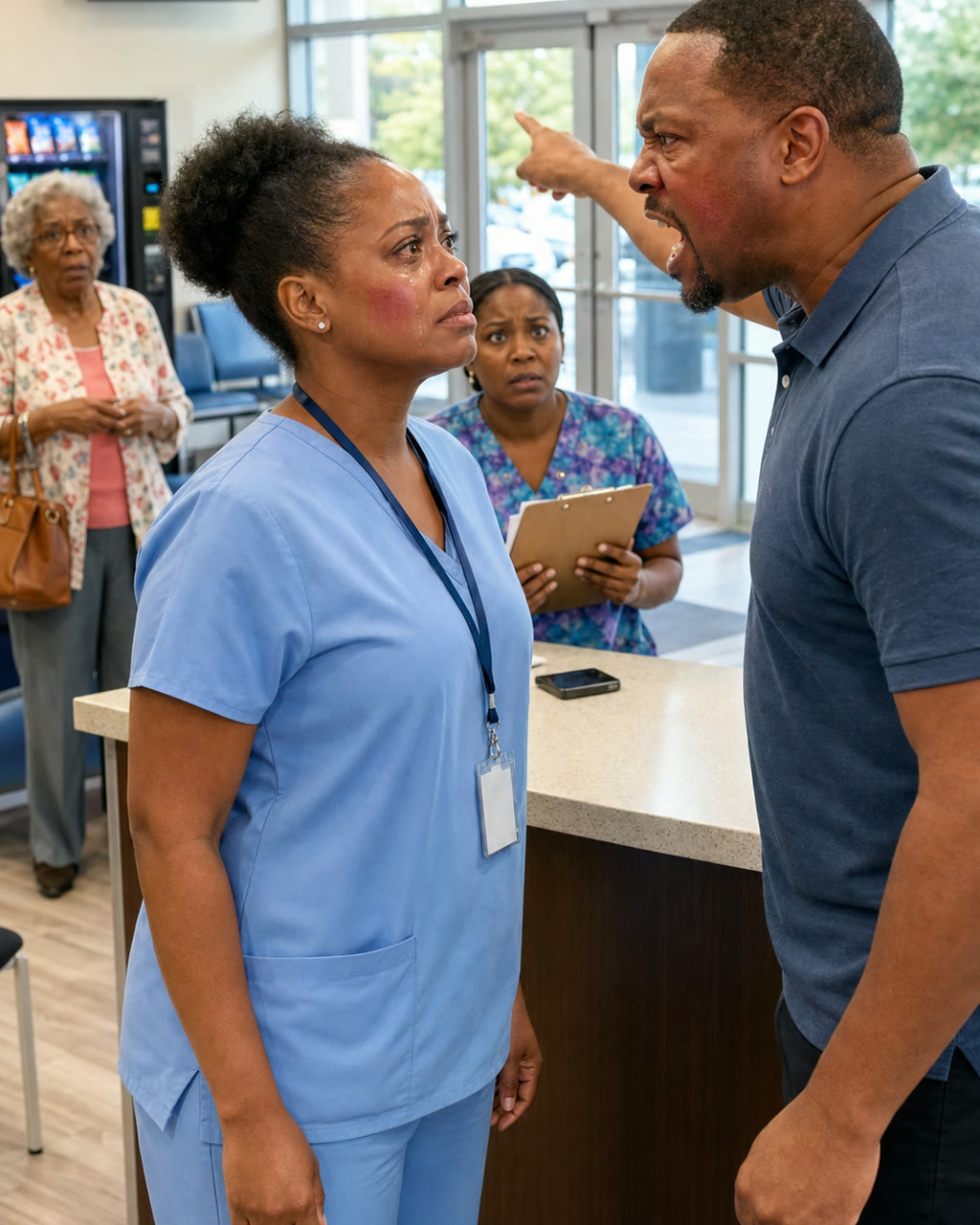
My stepbrother slapped me in the middle of the waiting room and screamed "pay or get out" so loud that a baby in the corner started crying. My cheek was still hot when he grabbed my collar and shoved me toward the door. I'm forty-one years old and I let him do it. I stood there in my scrubs and I let a man call me trash in front of a room full of strangers.
Chapter 1
The morning it happened, I got to the clinic at 6:40, the way I always do.
I like being the first one in. I punch the code into the back door, flip the lobby lights on one bank at a time, and stand there for a second while the fluorescent hum settles. The building smells like floor cleaner and cold coffee at that hour. I find that smell comforting. My mother would laugh if she heard me say that.
My name is Renata Doss. Most people at Fairwood Family Health call me Miss Renata, even the doctors, even the ones with twelve more years of school than me.
I've worked in medicine for nineteen years. I started as a front-desk temp who couldn't spell "hypertension," and I clawed my way up through billing, then office management, then the part nobody sees. I keep the lights on. That's the honest way to put it.
That morning I made the coffee. I checked the schedule. Mrs. Alvarez had her diabetic foot check at nine, and Deacon Pearl was coming in for his blood pressure at ten-thirty, and somewhere in the middle of the afternoon, my mother was penciled in under a name that wasn't quite hers.
I did that on purpose. I book my mother under "Cora D." so the front girls don't fuss over her. Cora Doss raised four kids in a two-bedroom on Ferndale Street, and she does not like a fuss.
My phone buzzed at 7:15. It was a text from my mother.
"Baby, Marcus said he's bringing me today. Don't come get me. He wants to help."
I read it twice. I set the coffee cup down so I wouldn't grip it too hard.
Marcus is my stepbrother. My mother married his father, Big Ray, when I was thirteen and Marcus was fifteen, and for six years we lived in the same house without ever once living in the same world.
He's not a bad man on paper. He sells cars in Southfield, wears good shoes, drives something with a payment bigger than my rent. He calls my mother "Miss Cora" in that warm, loud way that makes church ladies love him.
But Marcus grew up believing there were two kinds of people in a family. The kind you protect, and the kind who protect them. He always knew which one I was supposed to be.
I texted back, "Okay. I'll be here anyway. It's where I work."
He didn't answer that.
I want to be fair to him, because my mother raised me to be fair. When we were teenagers, Marcus once drove forty minutes at two in the morning to pick me up from a bus station when my ride fell through, and he never told his father, and he never held it over me. So there's a version of Marcus that's real and decent.
But that version got smaller every year, and the loud one got bigger. By the time our parents' generation started getting sick, the loud one was the only one left in the room.
My mother has congestive heart failure. She has diabetes that's fighting her. She had a small stroke two years ago that took the confidence out of her left hand, so now she signs her name slow, like she's apologizing to the paper.
I've handled all of it. Every appointment, every refill, every 2 a.m. drive to the ER when she couldn't catch her breath. Not because Marcus couldn't. Because Marcus was always "about to," and my mother learned a long time ago not to wait on "about to."
He didn't know how much I handled. That was the thing. My mother never told him, because she didn't want him to feel bad, and because a part of her still wanted her stepson to be the strong one. Mothers do that. They protect the child who needs it least.
So when Marcus decided, that summer, that he was going to "step up," nobody had bothered to tell him the whole story.
He'd found out that our mother's treatment was getting expensive. The heart-failure clinic, the labs, the medication management, the specialist visits we'd folded into Fairwood so she wouldn't have to drive all over the county. It added up. Insurance covered most of it. Some of it fell through the cracks the way it always does with people who worked their whole lives and still ended up on the wrong side of a co-pay.
What Marcus didn't know was where those cracks were being quietly filled.
He didn't know that a certain account at Fairwood had "Cora D." marked as courtesy-covered. He didn't know whose signature was on that arrangement. He didn't know a lot of things, and he'd never once asked, because asking would have meant admitting there were things he didn't already run.
That morning I got a second text. From my mother again.
"He's upset about a bill he saw. Please don't argue with him, Renata. For me."
My stomach dropped when I read that.
I knew exactly which bill. Two weeks earlier, a statement had gone out with the wrong header — a printing error, an old template that showed the full un-adjusted amount before the courtesy credit posted. It looked, on paper, like my mother owed four thousand dollars.
She didn't owe four thousand dollars. She owed almost nothing. But somebody had shown Marcus that piece of paper, and Marcus had decided, in his big loud generous way, that he was going to march down to the clinic and fix it. Fix it his way. Loud.
I texted my mother, "I'll take care of it. I promise. Just let me handle him."
She sent back a single heart. Red. Shaky, probably, the way her left hand shakes.
At 8:50 the doors opened for the day. Mrs. Alvarez came in for her foot. Deacon Pearl came early, the way he always does, and sat by the window doing a crossword in pen because he's the kind of man who's proud he never needs to erase.
I was up front helping our newest girl, Tamika, fix a scheduling conflict, when I heard the outer door bang open harder than a door should be opened.
I knew the sound of Marcus arriving before I ever saw him. He arrives like weather.
He had my mother on his arm. That's the part that still gets me. He had her walking slow beside him, one hand on her elbow, playing the good son for the whole lobby, and she was smiling up at him because she wanted so badly for it to be true.
"Renata," he said, spotting me. Loud. Warm and loud, the car-lot voice. "There she is. Miss Cora, look, your sister's here already, working hard."
He always called me her sister to strangers. Never his sister. A small thing. I'd stopped noticing it years ago the way you stop noticing a stone in a field you've walked a thousand times.
"Hi, Mama," I said, and I came around the counter and took her free hand, the shaky one, and she squeezed as hard as she could, which wasn't very hard anymore.
"Baby," she whispered. "He means well."
I looked at Marcus over her head. He was smiling, but his jaw was set, and I saw the folded paper sticking out of his jacket pocket. The bill.
"Marcus," I said, keeping my voice even. "Let's get Mama seated first. Deacon Pearl, would you mind—"
"We need to talk about this," Marcus said, and he pulled the paper out and held it up like a summons. "Four thousand dollars, Renata. For Miss Cora. And you been letting this ride? You work here. You supposed to be handling this."
The lobby went quiet in that specific way rooms go quiet when they're deciding whether to keep pretending they're not listening.
"That statement is wrong," I said. "It's a printing error. I already know about it. Mama doesn't owe that."
"So why'd they send it?" He stepped closer. My mother's hand tightened on mine. "Why they sending my mother bills for money she don't got, huh? You know how much stress this put on her? She been up worrying. You supposed to protect her and instead—"
"Marcus." I kept my voice low, the way you talk to a dog that's deciding whether to bite. "Sit down. Let me take Mama back, and I will fix this in five minutes. I promise you."
"Promise." He laughed, ugly. "You always promise. You been promising your whole life. Little Renata, always gonna handle it, always broke, always working some little job—"
"Marcus," my mother said. Weak. "Please, baby."
And that word — baby — she'd said it to me an hour before, in a text, and now she was saying it to him, and I watched something curdle in his face because he'd wanted to be the hero and instead his mother was pleading with him to stop.
That's the thing about men like Marcus. Shame doesn't cool them down. It lights them up.
He shoved the paper at my chest.
"You know what," he said. "I'm sick of you acting like you the one holding this family together with your little clipboard. You want to play boss? Then pay the bill, Renata. Pay it or get her the hell out of here and I'll take her somewhere that treats her right."
I looked down at the paper against my chest. I looked up at him. And I made a mistake. I smiled. Just a little. Not because it was funny. Because the whole thing was so upside down that my face didn't know what else to do.
I should not have smiled.
Chapter 2
Marcus's hand came up before I understood it was going to.
I heard it before I felt it. That's a strange thing about being slapped — the sound arrives at your own ear a half-second before the sting does, like your body is trying to warn you about something that already happened.
My head turned. My badge lanyard swung and clacked against my collarbone. My cheek went from cold to hot all at once, a spreading heat like standing too close to an open oven.
My glasses slid halfway down my nose. I remember that detail more than the pain. The little slide of plastic down the bridge of my nose, and how I had to fight the reflex to push them back up, because pushing them up felt like something a person does when their world is still normal.
Somewhere behind me a chair scraped. The baby in the corner started to cry.
For a second the whole clinic held itself very still, the way a house does right after a glass breaks in the kitchen. That waiting. That listening.
"Pay or get out," Marcus said. He said it loud, but his voice cracked in the middle, and I think that crack scared him more than it scared me.
I didn't touch my face. I want you to understand that. I've replayed it a thousand times and the one thing I'm proud of is that I did not put my hand to my cheek. I let it burn.
There's a reason I didn't touch it. When I was fourteen, in Big Ray's house, I learned that reaching for the sore spot is how they know they got you. You keep your hands down. You keep your face still. You make them wonder if it even landed. That was a survival trick I'd packed away twenty-five years ago, and there it was, waiting, still loaded.
So my hands stayed at my sides. Both of them. Open.
My mother made a sound I'd never heard her make. Small and broken, like a hinge.
"Marcus," she said. "Marcus, no. Not her. Oh God, not her."
He'd already grabbed my collar. He shoved me back toward the glass doors, two steps, and my heels caught on the entry mat.
"Get out," he said again, but quieter now, because the room had turned into something he didn't recognize.
Deacon Pearl was on his feet. Eighty-one years old, crossword still in his hand, and he'd stood up like a man half his age. "Son," he said. "Son, you don't want to do this."
Tamika, my newest front girl, had one hand over her mouth and the other reaching for the phone on the counter. The nurse, Danielle, had frozen in the hallway door with a chart in her hand and a patient's name half-spoken.
And the old woman by the vending machine — I found out later her name was Miss Otha, she was there for a wound-care follow-up — she was clutching her purse to her chest and saying, over and over, softly, "Lord. Lord. Lord."
The young mother in the corner had scooped her baby up and turned her body to shield him, one shoulder toward Marcus, the animal thing a mother does. She wasn't even a patient of ours. She'd walked in off the street to ask about pediatric hours. She came for a question and got this instead.
I thought about her, in that half-second. I thought, this woman is going to leave here and tell people Fairwood is a place where a woman got hit in the lobby. That was the thought that steadied me, strangely. Not my own face. The clinic's face. Because the clinic is mine, and when something threatens what's mine, I get very calm. I've always been that way. Calm is just what fear looks like when it decides to be useful.
I got my footing. I straightened up. My cheek was pulsing now, a real heat, and I could feel my heartbeat in it.
Marcus stood there breathing hard. He'd expected me to shrink. That's the whole thing. His whole plan, if you could call it a plan, ran on me shrinking. Little Renata, always gonna fold.
I've thought a lot about what he expected. I think he expected me to cry and clutch my face and say sorry-sorry-sorry the way I used to at fourteen. I think a slap, to Marcus, was supposed to be a full sentence. A period at the end of an argument. He'd probably never once in his life hit somebody who didn't immediately become smaller.
He hadn't planned for after. Men like that never do. They plan the blow and not the silence.
I didn't fold. I looked at him and I saw a man who had just done the worst thing he'd ever done in public and hadn't yet figured out how bad it was.
"Renata," he said. And there it was, the first ripple of fear under the anger. "Renata, I—"
"Don't." My voice came out flat and quiet. I didn't recognize it. "Don't say my name right now."
I've been in that lobby through a lot. A man came in seizing once. A little boy split his chin open on the coffee table and his mother screamed the paint off the walls. I've stayed calm through all of it, because that's the job, because when everyone else in a room is losing it, the person who owns the room can't. You learn to move your fear somewhere in the back of the house and deal with it later, after everybody's gone home.
That's what I did with Marcus. I took the shaking and the sting and the twenty-five years of it, and I set it all in the back room, and I locked the door on it, and I turned back around wearing the only face I had left.
People think calm under fire is the same as being unafraid. It isn't. Calm is a decision you make with your whole body while the fear stands right next to you, breathing on your neck. I made that decision maybe forty times a year in that clinic. I'd just never had to make it about my own family, in my own lobby, with my own cheek still warm from a hand I used to trust.
My mother was crying. Tamika had her by the arm, easing her into a chair, and my mother kept reaching toward me and saying my name, and I couldn't go to her yet because if I moved toward her I was going to lose the thing I was holding onto.
That's a hard thing to explain. My whole body wanted to go to my mother. Every year of being her daughter pulled me toward that chair. But I knew — the way you know things in your gut before your head catches up — that if I went and knelt down and let her hold me right then, I'd become the hurt little girl again, and the room would see the hurt little girl, and Marcus would win the only way he knew how.
So I made her wait. I made my own mother wait ten seconds while I decided who I was going to be. I'll carry that. It was the right call and it still cost me something.
I bent down. My badge had come loose in the shove and it was on the floor by the entry mat. I picked it up. I clipped it back onto my scrubs.
My hands weren't quite steady doing it. I got the clip on the second try. Nobody could see that but me, and I'm telling you now because I don't want you thinking I was made of stone in there. I was scared. I was just scared with my chin up.
I wiped the corner of my mouth with the back of my hand, checked it, no blood, just the memory of the sting.
And then I did the thing that turned the whole room around.
I turned to Danielle, my nurse, the one frozen in the hallway. And in my normal work voice, the voice I use forty times a day, I said, "Danielle, can you take Mrs. Doss back to Room 3 and get her comfortable? Her legs have been swelling. Elevate them. I'll be back."
Danielle blinked. Then she moved, because that voice is a voice everyone in that building follows without thinking. "Yes, Miss Renata," she said, and she came and got my mother.
Marcus watched me give an order.
I watched him watch me.
I want to describe his face when Danielle said "yes, Miss Renata." It's the closest I've ever come to watching a person's certainty leave their body. He blinked. His head tilted, just barely. The way a man tilts his head when a familiar song comes on played in the wrong key and he can't place why it sounds wrong.
Danielle got my mother up out of the chair — gentle, one arm around her waist, the way I'd trained every nurse in that building to move a frail patient — and walked her toward the back. And my mother let herself be walked, but she kept her eyes on Marcus the whole way, over her shoulder, the way you watch a pot you're afraid is going to boil over.
He looked at Danielle saying "yes, Miss Renata." He looked at Tamika reaching for the phone, waiting for my nod before she called anyone. He looked at Deacon Pearl, still standing, on my side of the room. He looked at the badge on my chest and for the first time, I think, he actually read it.
Something started to go wrong in his face. Slow. Like a man doing math he doesn't want the answer to.
"Renata," he said. "What— what is this. You said you worked here."
"I do work here," I said.
"You said—" He stopped.
I never lied to him, is the thing. Not once. Every time Marcus asked what I did, I told him the truth in the smallest words I could find. "I work at a clinic." "I do the billing and the running of it." All true. He heard "little job" because "little job" was the only shape his mind had for me. I let him keep the shape. That was my lie — the lie of letting a person keep believing something wrong because correcting it costs you your hiding place.
He looked around the lobby again, and this time he looked at it differently. At the framed certificates on the wall. At the mission statement in the nice gold frame. At the little brass plaque by the reception window that most patients never read.
His eyes went to the plaque.
I saw the exact moment he started walking toward it.
"Marcus," my mother called from the hallway, her voice wet and thin. "Marcus, baby, sit down. Please. You don't understand. Just sit down."
But he was already at the plaque. He leaned in to read it. His lips moved.
I couldn't see the words from where I stood. I didn't need to. I've read that plaque every morning for four years. I know exactly what it says and exactly whose name is on the second line.
Marcus straightened up very slowly.
I watched his hand come off the reception counter. He'd been steadying himself on it without knowing.
He turned around and looked at me across the whole length of that waiting room, and the color was gone out of his face, and he said one word.
He said, "No."
Not to me. Not really. He said it to the plaque, and to twenty years of a story he'd told himself about who was strong in our family and who was weak. He said it the way you say no to a doctor who just gave you a diagnosis you already suspected and prayed against.
And behind me, from the mouth of the hallway, my mother had gone quiet. Too quiet. The kind of quiet that made every nurse in that building turn her head.
Chapter 3
I need to back up, because you can't understand that plaque without understanding the four years before it.
Fairwood Family Health used to belong to a doctor named Harold Weeks. Dr. Weeks delivered half the babies in our part of the city back in the eighties. He was old-school, gruff, kept a practice that ran on index cards long after everyone else went digital.
I came to work for Dr. Weeks eleven years ago as a billing clerk. He was already sick then, though he wouldn't say it. Emphysema. He kept a nebulizer in his desk drawer next to a bag of butterscotch candy.
I loved that old man. I'm not going to pretend I didn't. He was the first boss who ever looked at me and saw more than a woman who could type fast.
Dr. Weeks was gruff to the point of rudeness and soft to the point of foolishness, both at once, and you never knew which one you'd get. He'd bark at a drug rep till the poor man's ears went red, then turn around and write off a whole family's balance because the father had lost his job at the plant. His weakness was that he could not, would not, run the place like a business, and it was quietly dying under him because of it. His strength was that he'd sooner die broke than turn away a sick child. He did, in the end, come pretty close to both.
He had this habit. When he was thinking hard, he'd unwrap a butterscotch and roll the cellophane into a tiny tight ball between his thumb and finger. His desk was always dotted with these little gold beads of twisted plastic. After he passed, I found one in the crack of the office chair, and I couldn't throw it away, and it's in a drawer in my kitchen to this day.
"Renata," he told me once, "you're the only person in this building who understands that medicine is math you do so poor folks don't die of arithmetic. Don't let anybody make you feel small about billing. Billing is where the mercy hides."
Billing is where the mercy hides. I wrote that on a sticky note. It's still on my monitor.
Over the years Dr. Weeks got sicker and I got more of the building. Not because I asked. Because things kept needing doing and I was the one who did them. I learned the licensing. I learned the contracts. I sat in on the vendor meetings when he couldn't breathe well enough to talk.
Four years ago, Dr. Weeks called me into his office. He had the nebulizer going. He looked like a man who'd already half-left.
"I'm closing it," he said. "Or selling it to the group up north, and they'll gut it. Turn my patients into billing codes." He looked out the window. "Sixty years my family kept a door open on this street. And I got no children to hand it to."
I didn't say anything. What do you say to that.
"Unless," he said, and he turned around and looked at me the way he did the day he hired me. "Unless somebody who understands where the mercy hides wants to try."
I told him I had eleven thousand dollars in savings and a mother who was getting sick. I told him I was a billing clerk who'd gotten above herself. I told him no.
He waved his oxygen tube at me like he was shooing a fly.
"I didn't ask for your bank account," he said. "I asked if you understand this place. Sit down, Renata. Let me tell you how a person buys a building she can't afford."
It took eleven months. A small-business loan I nearly cried filling out. A seller-financing arrangement where Dr. Weeks carried part of the note himself because he trusted me more than he trusted a bank. A community-development grant that a young loan officer named Priya fought for on my behalf like it was her own family's money.
I remember Priya. Small woman, sharp as a tack, wore reading glasses on a beaded chain and pushed them up onto her head when she got serious. Her strength was that she read every line of every form and caught the traps banks bury in paragraph nine. Her weakness was that she took every rejection personally, and when the first grant committee turned us down she cried in her own office and I had to be the one to tell her we'd try again. Her memorable detail was that she kept a jar of hard peppermints on her desk "for the customers" and ate them all herself. We laughed about that later, after it went through.
There were nights I didn't sleep. I'd sit at my kitchen table with the loan packet and a cup of tea gone cold and read the same page until the words stopped meaning anything. There were mornings I sat in my car in the parking lot and asked God, out loud, in the quiet, what I thought I was doing. A Black woman from Ferndale Street who never finished her associate's degree, buying a medical practice. The audacity of it scared me more than the debt did.
I'd think about my mother in that little kitchen on Ferndale, feeding four kids on the wages of a woman who cleaned other people's houses, and I'd think: she never once got to own the thing she built her whole life around. She built four children and a home and she never held a deed to any of it. And I decided that if I did nothing else worth a headline in my life, I was going to hold a deed. For her. So there'd be one Doss woman whose name was on the front of something.
But I did it.
Three years ago this spring, the deed to Fairwood Family Health changed hands. The name on it is Renata Doss. I own the building, the practice, the equipment, the little brass plaque by the reception window that says FAIRWOOD FAMILY HEALTH and underneath, in smaller letters, OWNED & OPERATED BY R. DOSS, and under that, IN MEMORY OF HAROLD WEEKS, MD — "MERCY HIDES IN THE DETAILS."
Dr. Weeks lived long enough to see the deed. He died that August. I held his hand. He was still telling me how to negotiate a lab contract with his last good breaths, and I let him, because it made him happy, and because he was usually right.
The last thing he said to me that made full sense, he said with the oxygen mask pushed up on his forehead so he could get the words out clean. He said, "Don't you dare hang my name up in there like I was a saint. I wasn't. Hang it up so the next broke woman who walks in scared knows somebody kept the door open once. That's all a plaque's good for." Then he asked for a butterscotch, and I gave him one, and he held it in his hand without unwrapping it and fell asleep.
That's why the plaque says what it says. That's why it's small letters. He'd have barked at me for gold letters.
I never told Marcus.
I never told anybody in the family except my mother, and I made her promise to keep it quiet, and here is the shameful truth of why.
Because I was still, somewhere down deep, the thirteen-year-old girl who moved into Big Ray's house and got told to keep her voice down. Because some part of me believed that if my family knew I'd become somebody, they'd take it from me, or laugh at it, or find a way to make it small. Because when you spend your childhood being the one who protects and never the one who's protected, success feels like something you have to hide so it can't be stolen.
Let me tell you about that house, so you understand. Big Ray wasn't cruel. He was worse than cruel in a way. He was indifferent. He had one son and he had a wife and he had a stepdaughter, and in his mind those were three sizes of person, and I was the small size. At dinner he'd ask Marcus about his day and my mother about hers, and when the table got to me, his eyes would already be somewhere else. Not mean. Just gone. A child can survive mean. Gone is harder.
Marcus learned that at that table. He learned that some people at a table matter and some are just seated there. He didn't invent it. His father taught it to him with a fork in his hand, night after night, and by fifteen it was just how Marcus saw the world. I don't forgive him for the slap. But I know exactly which table it grew on.
And I learned my own lesson at that same table. I learned to make myself useful and quiet, because useful-and-quiet was the only thing that ever got Big Ray's eyes to land on me with something like approval. Wash the dishes without being asked and maybe he'd grunt "good girl." That grunt was the whole prize. I spent six years working for a grunt.
You carry that. You carry it into a career. You carry it into a clinic you own free and clear, and you still, God help you, hide the deed from your own family because some fourteen-year-old ghost inside you is sure that being seen is dangerous.
So I let them think I was still little Renata with her clipboard and her little job.
My mother knew. My mother had been coming to my clinic — my clinic — for three years, being treated for free under a courtesy code that I set up myself, and telling her son, when he asked, that "the clinic works something out."
That's the arrangement Marcus never understood. That's the account marked "Cora D. — courtesy." That's whose signature was on it.
Mine.
The four-thousand-dollar bill he'd waved in my face was a printing error on a statement for a woman who owns the place that sent it.
Now do you see it. Now do you see what he did.
He walked into a building his sister owns, in front of a room full of her patients and her staff, and he slapped her, and he told her to pay a bill she'd already forgiven, or get out of the clinic she runs.
And he stood there at that brass plaque, reading OWNED & OPERATED BY R. DOSS over and over, and I watched twenty years of a certain idea of me come apart in his face.
"No," he said again. Barely a whisper. "R. Doss. That's— Renata, that's you? You own—"
Behind me, in the hallway, my mother had heard him read it. She'd heard the word "own." And she started to cry harder, not from the fear now, but from something else, because her secret and my secret were both loose in the room at the same time, and there was no putting either one back.
"Renata," Marcus said. He took a step toward me. His hand — the hand — came up, but not to strike this time. It was shaking. "Renata, I didn't— I swear to God I didn't know—"
"I know you didn't know," I said.
And that was the worst part, wasn't it. That was the part that made the whole room hold its breath.
Because I said it soft. I said it kind. And there is nothing in this world more terrifying to a man who just hit you than kindness he knows he doesn't deserve, coming from the one person who now holds every single thing he needs.
The front door opened.
Two police officers walked in. Tamika had called them in the first ten seconds, the way our training says to, and I had never told her to stop.
The younger officer looked around the room. "We got a call about an assault," he said. "Somebody get struck?"
The whole lobby turned and looked at me.
My cheek was still red. Deacon Pearl was still standing. Miss Otha still had her purse against her chest. Marcus stood frozen in the middle of the floor with his shaking hand still half-raised, next to the plaque with my name on it.
The officer looked at me, at my scrubs, at my badge, at the certificates on the wall.
"Ma'am," he said, "is this your clinic?"
Every eye in the room waited for my answer.
And I realized that whatever I said next, there was no version of my life after this sentence where I got to be little Renata anymore.
Chapter 4
"Yes," I said. "It's my clinic."
Three words. I'd owned the building for three years and I don't think I'd said those three words out loud to a stranger more than a handful of times. I'd say "I run it." I'd say "I'm the office manager," which was technically a lie of shrinking. Saying "it's mine" felt like taking off a coat I'd been wearing indoors for years. My shoulders actually dropped an inch.
I heard Tamika let out a breath. I heard Deacon Pearl say, quiet, "That's right." I heard my mother, down the hall, say my name one more time, but softer now, almost like a prayer that had already been answered.
The officer took out his notepad. "And the man who struck you — do you know him?"
There it was. The whole thing, laid down in front of me like a fork in a road.
I could have said yes, arrest him, and it would have been fair. He'd hit me in front of witnesses. There were nine people in that room who'd have signed anything. Deacon Pearl was already reaching for his reading glasses like a man preparing to give a statement in full.
I could have ended Marcus right there. Twenty years of being made small, and here was the moment the scale finally tipped my way, with two officers and a room full of witnesses and a bright red mark on my face to prove it.
I looked at Marcus.
He wasn't looking at the officers. He was looking down the hallway, at the open door of Room 3, where our mother sat in a chair with her swollen legs up, watching her son through her tears, waiting to see what kind of man he turned out to be and what kind of woman I turned out to be.
And I thought about a bus station. Two in the morning, twenty-some years ago. A fifteen-year-old boy who drove forty minutes and never told his father and never held it over me.
I'd been stranded coming back from a church youth trip. My ride fell through, and I was too scared to call the house because Big Ray would've been angry I "made a fuss." So I sat on a cold bench in a Greyhound station with my knees pulled up, sixteen years old, watching the door.
And Marcus walked in. I don't know how he knew. My mother must have said something and he'd read her worry. He walked in wearing his pajama shirt under a coat, having taken his father's truck without asking, and he didn't say anything smart. He just said, "Come on, Nay." Nay. Nobody's called me that in twenty years. He drove me home and told me to sneak in the side and he never breathed a word of it to Big Ray, and the next morning at that indifferent breakfast table he acted like nothing happened, and under the table he bumped my foot with his once. Just once. That was the whole apology for a world that treated me small — a foot-bump under a table where I didn't count.
That boy was real. He'd been buried under twenty years of car lots and loud shoes and a father's poison, but he was real, and he was still in there somewhere, and I was not going to be the one who handed him to the police in the same building where our mother sat waiting for one of her children to be good.
I thought about how the loud Marcus ate the good Marcus alive over the years, and how nobody in that family ever once stopped it, least of all me.
"He's my brother," I said.
Not "stepbrother." I heard myself say it. Brother.
The officer's pen paused. "You want to press charges, ma'am? You're within your rights. We saw the mark on your face when we walked in. We got a duty to ask you clear: do you want him arrested."
The room was so quiet I could hear the vending machine humming.
Marcus finally looked at me. Full on. And I saw him understand, in that second, that his whole life was sitting in my mouth, and that I could close it or let it go, and that either way he would never again get to pretend he was the one who protected me.
"No charges," I said. "But I need everybody to hear something."
I turned to the room. To my patients. To my staff. To Miss Otha and her purse and Deacon Pearl and Tamika and Danielle in the hallway doorway.
"This is my brother Marcus," I said. "He came here today because he thought our mother owed a bill she couldn't pay. He thought I was too small to fix it. He was wrong about the bill and he was wrong about me, and he found both of those out the hard way, in front of all of you, and I'm sorry you had to see it."
My voice did not shake. That surprised me.
"My mother is a patient here. She's treated for free, and she has been for three years, because I own this building and I decided a long time ago that no mother of mine was ever going to lie awake over a co-pay in a place with my name on the door." I looked at Marcus. "That's the arrangement you didn't know about. That's the bill you came to fix. It was already fixed. It's been fixed the whole time."
Marcus made a sound. He put his hand over his own mouth, the striking hand, and he pressed it there like he was trying to keep something in.
"I'm not pressing charges," I said, "because in my family we already lost too much to men who couldn't be soft and women who couldn't be seen. I'm done losing to that. Both directions." I turned back to the officers. "But I would like him escorted out. He can wait in his car. When our mother's appointment is finished, he can drive her home, if she still wants to ride with him. That's her choice, not mine and not his."
I want to be honest about that decision. A woman shouldn't have to be a saint about being struck. Grace shouldn't always fall on the person who got hit.
But here's what I knew standing in that lobby. An arrest wouldn't un-slap me. And it would have taken my mother's son from her in the last chapter of her life, in the one place she came to feel taken care of. She'd have visited him. She'd have blamed herself. She'd have spent whatever heartbeats she has left carrying that.
I didn't spare Marcus for Marcus. I spared him for the woman with the swelling legs in Room 3. That's the only reason.
The officers looked at each other. The older one nodded slowly, the way people nod when they've watched a family choose grace over a charge and they can tell it cost something.
The younger officer leaned in and said low, just to me, "You sure, ma'am? I've seen how these go. First time it's a slap in a lobby. It escalates."
"I'm sure," I told him. "But thank you for asking me like I'm a person and not a report."
He nodded, and something in his jaw eased, and he stepped back.
"Sir," he said to Marcus. "Let's step outside."
Marcus didn't move for a second.
Then he walked toward me. The officers tensed, but I lifted my hand, just slightly, and they let him come.
He stopped close. Up close I could see he was crying, this big loud man who'd spent his life making sure nobody ever saw him do that.
"Renata," he said. Just above a whisper. "All these years. Why didn't you tell me you'd done all this? Why'd you let me think—"
"Because you never asked," I said. "You never asked what I'd made of myself. You just decided."
He flinched harder at that than he had at anything.
"I would've been proud of you," he said.
"No." I said it gently. "You would've had to stop being the one who protects. And you weren't ready. Neither was I. I hid it so you couldn't take it. We were both cowards in our own way."
He nodded. Tears just running now, no shame left to spend.
"Go wait in your car," I said. "And Marcus." He looked up. "You don't get to touch me again. Not ever. Not in anger, not to make up. You can still be my brother. But that door is closed forever."
He nodded again, and the officers walked him out, and the glass door swung shut behind him, and through it I watched him sit down on the curb by his expensive car and put his face in his hands.
I went to Room 3.
My mother reached for me before I got through the door, both hands, the shaky one and the strong one, and I sat on the little rolling stool beside her chair and let her hold my face — the sore cheek, gently, her thumb barely touching it.
"Baby," she said. "My baby. I kept your secret so long I forgot it was a good thing. I should've been telling everybody. I should've been telling everybody for three years."
"It's alright, Mama."
"It is not alright. He hit you. In your own house." Her chin trembled. "I raised him too. That's the part that— I raised him too, and he did that."
"You raised me too," I said. "And I didn't hit back. That's your work in me, Mama. Both of us are your work. He just forgot the lesson today. Maybe he'll remember it tomorrow."
She cried into my shoulder for a while. I let her. Danielle brought her a cup of water and quietly checked her blood pressure over my shoulder, and it was high, 168 over 94, and I made a note to watch it, because I'm still the one who watches it.
Then my mother pulled back and held me at arm's length, the way she used to when she was about to say a thing she wanted to stick.
"You put your name on a door," she said. "Your grandmother cleaned the county courthouse. Mopped the room where they kept the deeds. And here you are with your name inside one of them." Her voice broke. "Floor to deed. And I almost let a bill and a scared boy keep me from bragging on you."
"You can brag now, Mama."
"Oh, I'm gonna brag at church so hard they gonna have to fan me."
And she laughed, wet and shaky, and it was the best sound I'd heard all day.
Deacon Pearl was gone by the time I came back out front, but he'd left his crossword on my counter with a note in pen at the top margin. It said: "Miss Renata — you handled that better than the Book of Job. Proud to be your patient. — Pearl." He'd finished the whole puzzle. In pen. No erasing. On a day when my own family couldn't see me clear, an eighty-one-year-old man with a pen saw me just fine.
Tamika hugged me, which wasn't professional, and I let her, which also wasn't professional. She's twenty-three, this is her first real job, and she'd had the police on the line before I'd even gotten my badge off the floor. I told her she did right, and she cried, and then she got embarrassed about crying and went to refill the tissue boxes, which is exactly what a person does when they don't know where to put their hands.
Miss Otha patted my hand on her way out. "God don't miss a beat, does He, baby." Then she looked back at the spot on the floor where it happened and added, quieter, "My first husband used to raise his hand. Fifty years ago. I never had nobody stand up in a room the way you just stood. I waited my whole life to see it." She squeezed my hand once, hard, and left before I could answer.
I had to go stand in the supply closet for a minute after that. Just breathe. That one got past my guard.
That night I sat in the parking lot in my car, the way I used to when I first bought the place and couldn't believe I'd done it.
My cheek didn't hurt anymore. The red was gone by evening. That's the thing nobody tells you about being hit by family. The mark on the outside heals on schedule. It's the only part that does.
I'd lived a hundred versions of the day where I shrank — cried, clutched my face, paid a bill I didn't owe just to make the loud stop. In that kitchen, in that Greyhound station, at that dinner table. I knew that day by heart.
I'd just never lived the other one. The one where I stayed standing. I was forty-one and I'd finally lived it, and I found out it doesn't feel like triumph. It feels like grief, mostly. Grief for all the times you didn't.
Marcus texted me a little after nine. Three words. "I am ashamed." Then, a minute later, "Mom got home safe. She's sleeping. Thank you for letting me drive her." Then, a long minute after that, one more: "Big Ray hit her once. When you were at school. I saw it and I never told nobody. I think I been trying to become him so it wouldn't scare me no more. I'm sorry, Nay. I'm gonna get help."
I read that one four times.
So there it was. The table I'd grown up at was worse than I'd let myself remember, and my brother had been carrying a piece of it I never knew about, alone, since we were kids. It didn't excuse the slap. Nothing does. But it explained the man, and sometimes the explanation is its own small mercy, the kind Dr. Weeks meant. Mercy hides in the details. Even the ugly ones.
I didn't answer right away. I looked at the building instead. The Fairwood sign, lit up soft against the dark. Dr. Weeks's name on a plaque I could no longer see from the lot but knew was there, next to mine.
Billing is where the mercy hides.
I finally texted Marcus back one line, and then I turned off my phone, and I drove home to sleep in a house that was mine, in a life I'd built with two hands nobody thought were strong enough.
I wrote him: "You didn't know who owned the clinic, Marcus. But the truth is, neither did I — until the day you made me stand up in front of everybody and finally say my own name out loud."
You may also like
The Silent Truth Behind My Daughter's Accident
The call came at 11:47 at night.…
Read the full story →The Night Evelyn Harper Took Back Her Power
My husband's mistress openly mocked me while my husband smiled… While they laughed at my pain, they never realized that I was the one in control. The moment I whispered, "Everythin…
Read the full story →He Fired the "Cleaning Lady" in Front of the Whole Office — Nine Minutes Before the Board Handed Her the Company
My name is Eleanor Reyes, and for eighteen months the people at Meridian Textiles thought my name was "hey" or "the cleaning lady" or, on a good day, "Ellie, could you get the brea…
Read the full story →