He Married Me For Six Months And Counted Down The Days — Then His Grandfather's Real Will Named Me The Heir To Everything
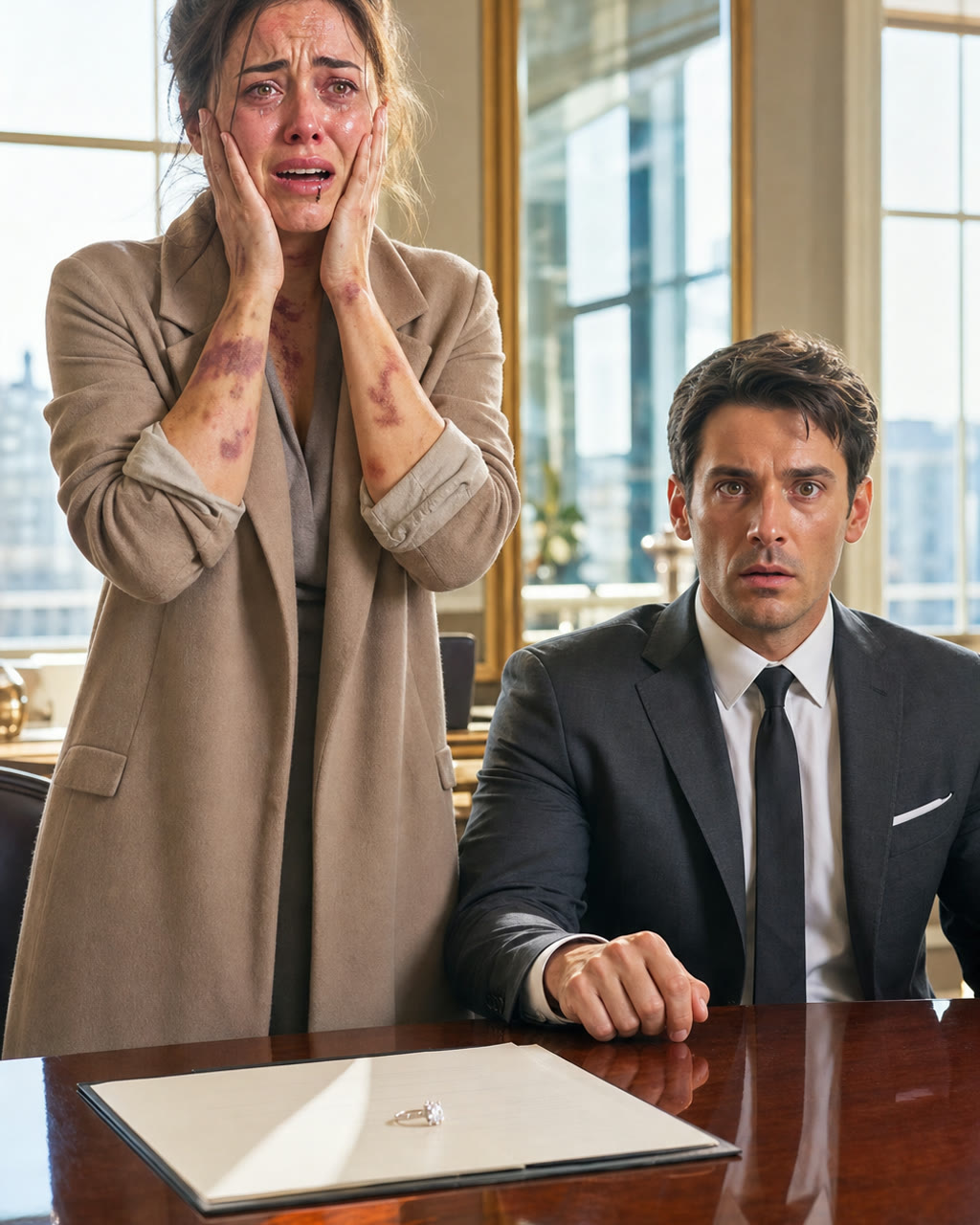
He married me for six months to satisfy his grandfather's will — a contract, a fixed price, no feelings allowed. He picked me the way you pick a rental car: available, unremarkable, easy to return. I signed because I needed the money and because I had stopped believing anyone chose me for anything else. We had a wedding no one cried at. We had a marriage measured in a spreadsheet. He counted down the days out loud, like a man waiting for a flight to board.
Chapter 1
The contract was eleven pages long, and there was a clause about how often we had to be photographed together.
I remember reading that clause in the lawyer's waiting room, my coat still on, a cup of vending-machine coffee going cold in my hand, and thinking: this is my life now. Subsection 4.2. "The parties shall appear jointly at no fewer than six public or family functions per quarter, with photographic documentation."
My name is Nora Bennett. I was twenty-nine years old and eleven thousand dollars in debt from my mother's last hospital stay, and I had answered what I thought was a personal-assistant listing and found out, three interviews in, that the job was to be somebody's wife.
Not a real wife. Let me be clear, because I was very clear with myself. A contractual wife. Six months, a fixed sum paid in installments, a nondisclosure agreement thicker than the marriage agreement, and one absolute rule stated in bold on page nine: NO PERSONAL OR ROMANTIC ENTANGLEMENT. Underlined. As if I might forget.
The man I was to marry was named Adrian Hale, and the first time I met him he looked at me the way you look at a form you have to fill out.
He was thirty-four, coldly good-looking in a tailored gray suit, with the kind of face that had clearly never had to ask for anything twice. He ran the operating side of his family's company — Hale Mercantile, a shipping and logistics empire that his grandfather, Everett Hale, had built out of a single freight route sixty years earlier. Adrian had the office and the title and the corner view. What he did not have, it turned out, was control. And that was the whole reason I was sitting in that waiting room.
"My grandfather's will contains a condition," Adrian explained to me at that first meeting, in a conference room so quiet I could hear the building's air handlers. He did not offer me coffee. "Everett is ninety-one. He is old-fashioned. He has decided that the person who inherits control of Hale Mercantile must be, in his words, 'a settled man with a wife and a home.' Not a bachelor. He believes bachelors are unserious." Adrian's jaw tightened when he said it, and I understood that this was a wound. "The current will names me as heir, conditional on my being married by my thirty-fifth birthday. Which is in seven months. I am not married. I have no intention of being married, in any way that matters. So."
"So you need a wife who doesn't matter," I said.
He looked at me then, actually looked, and I saw something flicker — surprise, maybe, that the form had spoken. "I need an arrangement," he said, "with someone discreet, presentable, and in need of money. My people tell me you are all three."
"Your people are very thorough," I said.
"They're paid to be." He slid the folder across the table. "Read it. Take it to a lawyer of your own; I'll pay for that too. If you sign, the marriage happens in three weeks, we perform it convincingly for my grandfather and the family and the necessary photographs for six months past my birthday, and then we divorce quietly and you walk away with enough to erase whatever it is that's brought you here. Nobody gets hurt. Nobody feels anything."
Nobody feels anything.
I want to tell you that I hesitated for noble reasons. The truth is I did the math. Eleven thousand in debt, a lease I couldn't cover, a mother eight months in the ground and a father I'd never met, and no one on this earth who would notice if I vanished. The sum Adrian Hale was offering would not just erase the debt. It would give me a floor to stand on for the first time in my adult life.
I signed the contract on a Tuesday. I underlined nothing.
Here is what you have to understand about being chosen for what you are not. Adrian chose me because I was unremarkable. Available. Easy to return. He said as much, more politely, in one of our early "rehearsal" meetings, where we practiced the story of how we met so it would hold up at dinner parties. "The beauty of you," he said, not unkindly, meaning it as reassurance, "is that no one will look twice and wonder if it's real. You're perfectly ordinary. That's exactly what I needed."
I smiled and said, "Happy to be forgettable," and I went home to my empty apartment and I did not cry, because I had stopped believing anyone chose me for anything else a long time ago.
I had spent my whole life being the practical option. The reliable friend, the good employee, the daughter who handled the paperwork while the relatives who came to the funeral wept prettily and left. I had learned that the world sorts people into the ones who are wanted and the ones who are useful, and I was useful, and useful was safe, and I had made my peace with it.
Everett Hale, it turned out, had other ideas about what was useful. But I didn't know that yet.
Three weeks later I married Adrian Hale in a small ceremony at his grandfather's estate, in a garden full of roses that someone had been paid to make perfect. I wore a dress Adrian's stylist chose. I said vows I didn't mean to a man who didn't mean them either. And at the end of the aisle, in a wheelchair with a blanket over his knees, an ancient man with fierce pale eyes watched the whole thing and did not smile.
That was Everett. And when Adrian bent to introduce me — "Grandfather, this is Nora, my wife" — the old man ignored his grandson entirely, reached out with a hand spotted and trembling, took mine, and held it. He looked up at me for a long moment. And then he said the strangest thing.
"You," he said. "You're not one of them."
I didn't know what he meant. I said something polite. He kept holding my hand.
I did not know, then, that Everett Hale had just decided something. I did not know that the sweet, doddering old man everyone was performing for was the sharpest person in that garden, and that he had seen, in about four seconds, exactly what his grandson was doing and exactly what kind of woman his grandson had hired to do it with.
I didn't know that he was about to change his will.
Chapter 2
The marriage, as a marriage, was an empty apartment with two people in it.
We shared a penthouse for the sake of appearances — separate rooms, a schedule taped inside a kitchen cabinet detailing which functions we'd attend and when. Adrian was gone before I woke most days and back after I'd eaten alone most nights. When we were in public we performed beautifully; he'd put a hand at the small of my back and murmur something that looked, from six feet away, like affection, and I'd laugh at the right moments, and the photographs came out warm and convincing. Subsection 4.2, satisfied.
In private we barely spoke. He treated me with a scrupulous, chilly courtesy, like a good hotel treats a guest. And he counted.
That was the thing I couldn't get used to. Adrian counted the time out loud. "A hundred and forty days," he'd say, reading a document, not even looking up, the way another man might mention the weather. "A hundred and thirty-one." He had a countdown running to the day the contract released us both, and he referenced it the way you'd reference a flight you were waiting to board — an inconvenience to be endured, an interval before real life resumed.
I told myself it didn't sting. I was very good at telling myself things didn't sting.
But something unexpected happened in those months, and it happened because of Everett.
The old man asked for me. Not for Adrian — for me. He lived in a wing of the estate with nurses and a view of the water, and about two weeks after the wedding he sent word, through a formal handwritten note, that he would enjoy the company of his new granddaughter on Sunday afternoons.
Adrian was thrilled, in his bloodless way. "It's perfect," he said. "It reinforces everything. Go. Be charming. He likes you — use it."
So I went. And what began as an assignment became, quietly and against every clause in my contract, the realest relationship in my life.
Everett Hale was not doddering. That was a performance he put on for people he'd decided were fools, and it delighted him that I saw through it in the second week. "They all think I'm gone up here," he said, tapping his temple, "and I let them, because a man learns more when people think he's not listening." He had built an empire out of a single freight route and he told me the stories of it — the gambles, the failures, the one bridge contract that nearly ruined him and then made him — with the vividness of a man reliving his best days. He asked me about myself and, unlike everyone else in that world, he actually listened to the answers. I told him about my mother. I told him about the hospital, the debt, the funeral where the relatives wept and left. I did not tell him about the contract, because I couldn't, but I think he already knew.
"You handle things," he said to me one afternoon, watching me sort out a mess his nurses had made of his medication schedule. "You don't wait to be told and you don't wait to be thanked. My wife was like that. God, forty years and she never once waited to be thanked." He was quiet. "Everyone around me now waits to be thanked. Adrian waits to be thanked just for existing."
"He works very hard," I said, because it was true and because I felt, strangely, that I owed my contract-husband at least that.
"He works hard at being owed," Everett said. "There's a difference. You know the difference. That's why I like you."
I started to look forward to Sundays in a way that frightened me. I'd catch myself, midweek, saving up a story to tell him. When his cough got worse in the fourth month and the nurses started speaking in lower voices, I sat with him longer, and I held his hand the way he'd held mine in the garden, and I stopped thinking of it as an assignment at all.
Adrian noticed the shift, and it made him uneasy in a way I didn't understand at the time.
"You're spending a great deal of time up there," he said one night, the countdown clearly running behind his eyes. "Eighty-eight days. You don't need to get attached. Remember what this is."
"He's dying, Adrian," I said. "He's your grandfather and he's dying and he's lonely, and I like him. That's not in violation of any clause I signed."
"Everything's in the clauses," he said. "Don't feel things you'll have to be paid to stop feeling."
I looked at him for a long moment. "Is that how it works for you?"
He didn't answer. He went back to his documents and his counting.
Everett Hale died on a gray morning in the fifth month, with his hand in mine and a nurse crying in the doorway and his grandson somewhere across the city in a meeting he chose not to leave. The old man's last fully coherent words to me, two days before, had been strange, and I turned them over for weeks afterward without understanding them.
"I fixed it," he'd said, his pale eyes clear and fierce and pleased with himself, gripping my fingers hard. "I saw what he was doing and I fixed it. You'll see. You'll be all right, girl. I made sure of it."
I thought he meant something kind and vague, the way the dying reassure the living. I thanked him. I told him he'd made me all right just by being my friend on Sunday afternoons, which was the truth.
The will was read eleven days after the funeral, in the offices of Hale Mercantile's counsel, and I almost didn't go. It wasn't my business. I was the temporary wife; I had eleven days left on my contract and a plane to catch out of that family forever. But the lawyer's office called specifically, formally, and asked that Mrs. Nora Hale attend in person.
Adrian assumed it was a formality — a small bequest, a token, the old man's fondness translated into a nice piece of jewelry. "Come and collect your keepsake," he said, almost warm for once, almost generous in his relief that it was nearly over. "Then we'll sign the divorce papers next week and you'll be free. A hundred and — well. Eleven days."
He held the door for me on the way in.
He was smiling.
Chapter 3
The lawyer's name was Priscilla Vane, and she had been Everett Hale's personal attorney for thirty years, and she did not smile.
There were more people in the room than I expected. Adrian, of course, sitting forward with the loose confidence of a man about to receive what's his. Two of his cousins — a sharp-faced woman named Camille and a soft, resentful man named Douglas — who I'd met twice and who had each managed, at those meetings, to make it clear they thought Adrian's sudden marriage was suspiciously convenient. A junior lawyer. A notary. And me, in a chair near the door, in my good coat, twiddling the wedding ring I would be returning in eleven days, planning my exit from all of them.
Priscilla Vane put on her glasses and explained that Everett Hale had executed a new will four months prior, superseding all previous versions, and that she would read the operative provisions aloud.
I remember the room going very still.
She read the small things first — bequests to the household staff, to the nurses (I saw the one who'd cried in the doorway press a tissue to her mouth), to a maritime museum Everett had loved. Adrian sat patiently through it, checking his watch once, the countdown running even here.
Then Priscilla Vane turned a page and said, "I'll now read the disposition of the controlling interest in Hale Mercantile and the residuary estate."
Adrian straightened.
"'It has been the assumption of my family,'" she read, in Everett's own words, "'that control of the company I built will pass to my grandson Adrian upon his marriage, as my previous will provided. I have watched, these last months, the marriage he arranged for the purpose of satisfying that condition.'"
The room's temperature dropped ten degrees.
Adrian's face didn't move, but his hand, on the arm of the chair, went white at the knuckles.
"'I am ninety-one,'" Priscilla read on, "'not ninety-one and blind. My grandson did not marry. He hired. He found a decent woman in a hard place and he rented her, and he counted the days until he could return her. I know this because I have eyes, and because in five months my grandson visited me four times and his wife visited me nineteen, and only one of them ever once asked how I was.'"
Camille made a small sound. Douglas leaned forward. I couldn't breathe.
"'The condition in my prior will was never about a certificate of marriage,'" Priscilla read. "'It was a test. I wanted to know whether the person who would inherit what I built understood that an empire is not a possession but a responsibility — a thing you tend, like a marriage, like a dying old man, whether or not anyone is watching, whether or not you are thanked. Adrian passed the certificate and failed the test. He proved, exactly, that he works hard at being owed.'"
I looked at Adrian. He was staring straight ahead, and I have never seen a human face go so pale.
"'Therefore,'" Priscilla Vane read, and her voice was steady and clear and I realized she had known this was coming and had been waiting thirty years to read something this satisfying, "'I revoke the prior disposition. I direct that the controlling interest in Hale Mercantile, together with the residuary of my estate, pass in its entirety not to my grandson Adrian Hale — '"
She paused. She looked up, over her glasses, directly at me.
" — 'but to his wife. To Nora. Because in the one season that mattered, she was the only person in this family who behaved as though something other than money was at stake.'"
The room erupted.
I don't remember all of it. I remember Camille on her feet, saying the word "fraud." I remember Douglas saying "she's not even really —" and stopping, because there was no way to finish that sentence that didn't confirm exactly what Everett had written. I remember the junior lawyer looking like he wanted to disappear into the carpet. And I remember, most of all, Adrian, turning very slowly to look at me across that room, and the thing in his face was not rage.
It was recognition. It was the look of a man who has just understood that the old man he thought a fool had beaten him at a game he never knew he was playing.
"You," Adrian said, very quietly, and it was almost exactly what his grandfather had said to me in the garden. "You knew."
"I didn't," I said, and my voice broke, because it was true and because I had just watched a room full of strangers decide I was a thief. "Adrian, I swear to you, I didn't. He never — he said 'I fixed it,' at the end, he said 'you'll be all right,' I thought he meant — I thought he meant he'd left me a brooch. I didn't know. I would never —"
And then I stopped. Because I looked at the paper in Priscilla Vane's hands, and I looked at the diamond ring on my own finger — the contract ring, the prop, the rental — and I understood that whether I had known or not, whether I had wanted it or not, everything had just changed, and there was no clause in any contract that could put it back the way it was.
I put my hands over my face and I wept.
Not delicately. Not the pretty weeping of the relatives at my mother's funeral. I wept the way you weep when a friend you loved reaches out from beyond his own death to tell you that you mattered — that someone, once, chose you for exactly what you were and not for what you were useful for. My face crumpled. My eyes burned and streamed. I could not stop and I did not try.
Across the table, Adrian Hale watched his temporary wife fall apart over the fortune he had lost, and for the first time since I'd met him, I saw him feel something he had not budgeted for.
Chapter 4
The lawyers, of course, went to war. Camille and Douglas hired their own counsel within the week and filed to contest the will on the grounds that Everett had been "unduly influenced by a fortune-hunter." That phrase — fortune-hunter — followed me for months, in filings and in the one poisonous article a business tabloid ran under a photograph of me looking guilty, which is to say looking like someone who had just been ambushed.
Here is the irony that no one contesting the will could get past, and that Priscilla Vane laid out with grim relish in a conference room full of hostile attorneys: the very contract Adrian had made to control me was the thing that proved Everett right.
Because there it was, in eleven pages, notarized. The fixed price. The countdown. Subsection 4.2. Bold type on page nine: NO PERSONAL OR ROMANTIC ENTANGLEMENT. Adrian's own lawyers had drafted a flawless legal record of the fact that he had rented a wife to satisfy a will — which was precisely the behavior Everett had cited as his reason for changing it. The contract meant to reduce me to a prop became the state's evidence that the old man had seen clearly. You could not argue I'd seduced my way into a fortune while holding a document that specified, in bold, that seduction was forbidden.
The contest collapsed inside four months.
But I need to tell you what I did with the four months, and with everything after, because the will is not the point of this story. The will was Everett's parting gift and also, I came to understand, his final test — not of Adrian this time, but of me.
I did not keep it. Not the way you're thinking.
I sat with Priscilla Vane, and I read every page of what Everett had left me, and I sat with the weight of controlling an empire I had wandered into by answering a personal-assistant listing. And I thought about the old man in his wheelchair saying an empire is not a possession but a responsibility. And I made a decision that my own contract lawyer told me was insane, which is how I knew it was right.
I took control of Hale Mercantile, exactly as Everett willed it — and then I did not throw Adrian Hale out into the street.
I could have. Everyone expected me to; Camille certainly did, and I think in some airless part of himself Adrian expected it too, was braced for it, was almost relieved by the clean justice of it. Instead I called him into the office that had been his and was now, absurdly, mine, and I put a proposal on the desk between us.
"Your grandfather didn't take the company away from you because you're incompetent," I said. "You're not. You run the operating side better than anyone he had. He took it away because you work hard at being owed and you needed to be reminded that you're not. So here's the arrangement." I saw him flinch at the word; I used it on purpose. "You run this company. I hold the control, and I hold you to a standard — his standard. Not what you're owed. What you're responsible for. And if, over time, you show me you understand the difference, I will begin, piece by piece, to give it back. Not as an inheritance. As something earned."
He stared at me for a long time. "Why," he finally said. "After how I treated you. I rented you. I called you forgettable to your face."
"Because your grandfather chose me," I said, "and he wasn't a fool, and he loved you even while he was furious with you, and I don't think he wanted to destroy you. I think he wanted to wake you up. I'd rather finish what he started than get rich off your failure. That's the difference he was talking about. I finally understand it."
Adrian Hale put his face in his hands, and the coldest man I had ever met, the man who counted the days out loud, sat in his lost office and wept — quietly, but really — and I understood that I was watching something thaw that had been frozen a very long time.
We did not fall in love. I want to be honest with you, because Everett taught me to put the truth on the record. This is not that story. The contract ended on its scheduled day; we filed the divorce exactly as planned, and I returned the diamond ring, the prop, into Priscilla Vane's keeping. Whatever grows between two people who've been through a thing like this, it isn't romance and it doesn't have a name, and I've stopped needing to name it. Adrian became, over the years that followed, something I never expected: a friend, and a good steward, and a man who eventually — the day I signed the last of the control back over to him, five years on, exactly as I'd promised — told me that marrying me was the worst thing he ever did and the best thing that ever happened to him, and that he knew his grandfather would have said the same.
I run a foundation now, funded by a settlement I insisted on carving out of the estate before I gave the rest back — the maritime museum Everett loved is only the beginning of it. I put my mother's name on a wing of the hospital where she died, so that the next daughter handling the paperwork alone at 2 a.m. has one less bill to cry over.
I was chosen once for what I was not. Available, unremarkable, easy to return. And an old man who everyone thought was gone up there watched me for five Sundays and chose me for what I actually was.
"You're not one of them," he told me in a garden full of roses, the first day, before I understood anything.
I spent my whole life being the useful one, the practical option, the person no one weeps for. It took a dying man with fierce pale eyes to teach me that being the one who shows up — who tends the thing whether or not anyone is watching, whether or not you are thanked — is not the small life I thought it was.
It's the whole inheritance.
Everett knew that. He tried to teach it to his grandson with a company.
He taught it to me with an afternoon, every Sunday, and his hand in mine.
I got the better gift.
You may also like
The Silent Truth Behind My Daughter's Accident
The call came at 11:47 at night.…
Read the full story →The Night Evelyn Harper Took Back Her Power
My husband's mistress openly mocked me while my husband smiled… While they laughed at my pain, they never realized that I was the one in control. The moment I whispered, "Everythin…
Read the full story →He Fired the "Cleaning Lady" in Front of the Whole Office — Nine Minutes Before the Board Handed Her the Company
My name is Eleanor Reyes, and for eighteen months the people at Meridian Textiles thought my name was "hey" or "the cleaning lady" or, on a good day, "Ellie, could you get the brea…
Read the full story →