The Hoodie She Wore All Summer
My daughter whispered "Dad, help me" and the line went dead. I was standing at the kitchen sink in my socks, soap up to my elbows, and the phone slid right out of my wet hand and clattered on the floor. She's twenty-three years old. She still keeps the little chipped tooth she lost at seven in a jewelry box, because she swears one day she's going to show it to her own kids.
Chapter 1
I was rinsing a plate when the phone rang.
I remember the plate. It had a blue rim, one of the four my late wife Renée picked out at a flea market the year before she passed. I had soap up to my elbows and the water running warm and the radio playing low, some old Al Green song I wasn't really listening to.
The name on the screen was "Zaria." My daughter. My only child.
I dried one hand on my jeans and answered with the easy voice you use when you're sure everything is fine. "Hey, baby girl."
There was a sound like a hand pressing over a mouth. Then her voice, low and fast, the way you talk when you don't want the person in the next room to hear you.
"Dad. Help me."
That was it. Two words. Then a click that wasn't her hanging up on purpose — too sudden and too wrong for that. It was the sound of a phone being pulled away from somebody's face.
I said her name into the dead line. I said it again, louder, like volume could reach through a call that had already ended. The plate was still in my other hand. I set it down in the sink very slow and careful, the way you'd set down something that might crack the whole world if you dropped it.
I called her back. It rang twice and went to voicemail. Her voicemail is from senior year. She's laughing in it, telling somebody to stop, then remembering the phone and saying "leave a message, byeee."
So I stood there on the kitchen floor and listened to my daughter laugh at eighteen while both my hands started to shake.
I want to tell you I stayed calm. I didn't. I called four more times. Same laugh. Same silence after the beep. I didn't leave a message because I didn't have any words yet, just a low sound stuck behind my ribs.
Then I grabbed my keys off the hook by the door.
Let me back up, because you need to understand who I am and who she is, or none of the rest of this is going to land the way it should.
My name is Marcus Whitfield. I'm fifty-one years old. For nineteen years I've driven a city bus for the transit authority in our part of Missouri. I know every pothole on Route 74 by feel, in the dark, in the rain. People think a bus driver's life is a small life. It never felt small to me. I raised a family on it.
Renée and I only had the one child. Zaria. We tried for more and it just didn't come, and after a while we stopped being sad about it, because the one we got was worth about three.
Renée passed six years ago. A stroke. She was fifty-two and standing right at that stove and she said, "Marcus, my arm feels funny," and by the time the ambulance came the woman I'd loved since I was nineteen years old was mostly already gone.
After that it was just me and Zaria. She was seventeen. We carried each other through it. Some nights we didn't have a single word to say, so we'd just sit out on the porch and let the crickets do the talking for us. That became our way.
She grew up good. That's not a father bragging on his kid. She grew up kind in a way that honestly scared me a little, because I've lived long enough to know kind people get taken from, and I couldn't stand behind every door in her life to catch it.
She went to community college and got her associate's in dental hygiene and landed a real job with benefits at an office off Grand Boulevard. She was so proud of that job. She'd come home and tell me about her patients like they were personal friends. She remembered all of them.
Then she met Devon.
Devon Callahan. Thirty years old. Worked in something to do with commercial real estate, one of those jobs where nobody can ever quite explain what you actually do all day, but you wear a nice watch doing it.
He was polite. I'll give him that much, and I'll hate myself for it before this story is done. The first time he came to Sunday dinner he brought a sweet potato pie from a real bakery, and he stood in my kitchen and looked at Renée's blue-rimmed plates up on the shelf and he said the exact right thing.
"These are beautiful, Mr. Whitfield," he said. "They've got history in them. You can feel it."
I liked him for noticing. God help me, I liked him right then, over a stack of my dead wife's flea-market plates.
They got married last spring. Small wedding, just family and a few friends in a church hall. Zaria wore Renée's earrings, the little gold hoops. I walked my daughter down that aisle and I cried the good kind of crying, the kind where you're just so full up that it has to come out of you somewhere.
Devon's people had a little money. Not rich-rich, but the comfortable kind — owned their house free and clear, drove new cars, said things like "the market." His parents, Harold and Gwendolyn Callahan, lived out in one of the nicer suburbs, a two-story brick house with a real fireplace and a lawn service that came on Thursdays.
And here's the part I did not think hard enough about at the time. After the wedding, Devon and Zaria didn't get their own place. They moved into his parents' house. "Just till we save up for a down payment," Devon said, easy as anything. "Family helping family."
I remember thinking that was a decent, responsible thing for a young couple to do. Live with the in-laws a while, save your money, do it smart. I did not know then that a house can be a cage if the wrong people are the ones holding the door.
The changes came in small. So small that I could explain each single one away, and I did, one at a time, like a fool laying bricks up in front of his own two eyes until he's walled off from the plain truth.
She stopped answering on the first ring. Started answering on the fourth, the fifth. Sometimes she'd call me back twenty minutes later, out of breath, like she'd had to step outside to talk to her own daddy in private.
"You alright, baby?" I'd ask.
"I'm good, Dad. Just tired. Work's a lot right now."
Then she quit the dental office. Just up and quit. Said Devon thought her commute was too long, said the two of them wanted to "focus on building the family." My Zaria loved that job. And then one day it was just gone, and when I asked her why, her voice went flat and careful, like a woman reading words off a little card somebody handed her.
Then the Sunday dinners started thinning out. Every other week, then once a month. Then Devon started showing up alone, all smiles, "Zaria's not feeling too great today, she says she loves you and she'll call."
She didn't call much.
And then in July — this is the one that sits down low in my stomach even now — she showed up to my birthday cookout wearing my old maroon college hoodie. My hoodie, the one I'd left over at their place one time. In the dead middle of a Missouri summer. Sleeves pulled all the way down past her wrists, both hands tucked up inside them the whole afternoon.
It was ninety-one degrees. I checked the phone later, just to be sure I wasn't making it worse in my memory than it was. Ninety-one degrees.
"You not hot in that, baby?" I asked her, flipping burgers, half paying attention, and that is the sentence I would give ten years off the back end of my life to say over again with my whole heart in it.
"I'm always cold now, Dad," she said, and she laughed, but the laugh didn't get near her eyes, and I let it go, because the burgers were about to burn and I am, apparently, a man who will flip a burger while his own child is drowning in front of him.
I let all of it go. Every single sign. I saw, and I let it go, because the shape of the truth was too big and too heavy and I did not want to be the man who had to pick it up.
So when she whispered "Dad, help me" into that phone and the line went dead, some buried part of me had been standing in the dark for eight months, just waiting to finally be told the thing it already knew.
I got in my truck. It's a fifteen-year-old Silverado, rust creeping up the wheel wells, a Cardinals air freshener on the mirror that stopped smelling like anything years ago. I threw the phone on the passenger seat.
It was raining. Not hard, just that fine cold mist that makes the whole road shine. I backed out of my driveway on Delmar and I did a thing I have never once done in nineteen years of professional driving. I ran the light at the corner. Solid red. Empty intersection, but still — solid red, and I ran it, and I did not so much as tap the brake.
The Callahans lived twenty-six minutes away by the map on a good clear day. I'm not going to sit here and tell you exactly how fast I was going. I'll just tell you the needle sat past 90 on the empty stretch out by the interchange, and the rain came at the windshield like television static, and I kept the phone in my right hand and I redialed at the top of every straightaway.
Voicemail. Her laugh. The beep. Nothing. Again, and again.
Somewhere around the eighth call I finally found some words. "Zaria. It's Dad. I'm coming. You hear me, baby? I'm coming right now, and I am not stopping. Just hold on for me."
I don't know if that message ever got to her. I said it more for myself than for her, if I'm honest. A man needs to hear his own mouth make a promise out loud before his hands can find the strength to keep it.
I thought about calling the police. I did think about it, right there on the highway with my thumb over the screen. But I couldn't figure out what I'd even say that a dispatcher could use. My grown, married daughter said two words to me and the call dropped. In a nice suburb. To a nice family. With a son-in-law who brings pie to Sunday dinner and knows which fork is which.
They'd send a car eventually. They'd knock, polite, and Devon would open the door with his easy smile and say, "Officer, everything's fine, my wife just gets emotional." And they would believe him. People always believe the man with the good watch and the sweet potato pie.
So I drove. I passed the exit for the hospital where Renée died. I don't usually let myself so much as look that direction when I go by. That night I turned my head and I looked right at it, lit up blue and white in the rain, and I said out loud, to her, "I am not losing this one too. You hear me? Not this one."
The rain got harder. My wipers couldn't keep the glass clear. I was maybe four minutes out, taking the exit ramp way too fast, tires hissing on the wet asphalt, when the phone lit up on the seat beside me and started to buzz.
It wasn't Zaria.
The name on the screen was "Devon Callahan."
Chapter 2
I answered on speaker and I did not say hello.
For a second there was just breathing on his end of the line. Then Devon's voice came through, and it was doing something I had never once heard it do in the whole time I'd known him. It was working. He was picking up every single word before he spent it, the way a man counts out cash he can't afford to lose.
"Mr. Whitfield. Hey. I think — I think maybe there's been a misunderstanding here."
I kept my eyes on the wet road coming at me. "Put my daughter on the phone."
"She's resting right now. She had a little too much wine tonight, honestly, and she got herself all emotional, and you know how she can—"
"Devon." I said it low. Quiet is the loudest thing I have ever owned. "Put my daughter on this phone, or I am going to be standing on your daddy's porch in three minutes, and then we are going to do this a whole different way. Your choice."
The breathing again. Then a smoothness slid back over the top of the panic, like oil spreading out over water. "There's really no need for any of that, Marcus. Come on by. We'll all sit down together like family and clear this whole thing up. But I do want you to understand, before you get here — Zaria's been having some issues. Emotional issues. Ever since her mother passed. She exaggerates things. She gets these ideas. She's not always—"
"Don't." One word. It came up out of a part of me I keep locked shut most days. "Don't you say her mother in the same breath as a lie. Not to me. Not ever."
He went quiet.
"Three minutes," I said, and I hung the phone up on him.
My hands were steady now. That's the strange part I still can't quite explain. Back at the sink they'd shaken. On the highway they'd shaken. But the second Devon Callahan opened his mouth to tell me my child exaggerates, everything inside me went cold and flat and level, like the top of a pond that nobody's touched in a hundred years.
I knew that feeling. My own daddy had it in him. It's the calm that settles over a man right before he does the one thing he was raised his whole life never to do.
Let me tell you about the Callahans, so you can see the room I was driving into. So you understand it wasn't a nest of movie monsters. It was worse than that.
Harold Callahan was sixty-eight. Retired from a management job at a big distribution company. A large man gone soft, the kind who had been genuinely strong once and still moved through the world like he expected doors to be pulled open ahead of him. His strength was that he could talk to anybody — church folks, bankers, the man reading the water meter — and make each one of them feel important for about ninety seconds. His weakness was that he had never in his whole life been told no by somebody he couldn't fire or walk away from. And the detail I'll always remember about Harold is the gold pinky ring with the little ruby chip in it, the one he turned around and around and around on his finger whenever he wanted something and didn't have it yet.
Gwendolyn Callahan was sixty-five. She ran that house like it was a chapel. Everything sitting in its exact right place, plastic still on the good couch after fifteen years, a big Bible on the side table that she used more for decoration than for reading. Her strength was loyalty — fierce, total, bone-deep, the kind that would step in front of a bullet without a blink. Her weakness was that all that loyalty only ever pointed one single direction her whole life, straight at her son, and everything else in all creation came second to that boy, including the truth, including another man's daughter sleeping under her own roof. Her memorable detail was that she hummed old hymns under her breath when she got nervous, mouth closed, and you could always measure exactly how bad things were getting in that house by how fast she was humming.
And then Devon. My son-in-law. His strength was that he could read a room in about one second flat and turn himself into precisely the man that room was hoping to see. His weakness was that underneath all that reading and turning, there was nothing solid holding him up at all — just a scared, controlling boy who'd been told his whole life that he was special, and who could not stand the thought of anybody deciding he wasn't, least of all his own wife. His memorable detail was the watch, that heavy silver watch he touched at his wrist every single time he told a lie, the same nervous way his father turned that ruby ring.
I know all of that now, top to bottom. I'm laying it out for you here so you understand I did not drive into a house full of cartoon villains. I drove into a family. And that is somehow worse. Monsters you can hate clean and simple. A family you have to take apart careful, piece by piece, just to pull your child up out of the middle of it.
I turned onto their street. Big quiet houses, dark manicured lawns, one soft porch light every forty feet. The kind of neighborhood where nobody ever hears a thing, because everybody's worked very hard at being careful not to.
Their house was lit up all across the bottom floor. Every window on the first level glowing warm and yellow, cozy, like the front of a Christmas card. I parked crooked across the mouth of their driveway, half up on the wet grass, and I left the truck running and the driver's door hanging wide open behind me.
I want to be honest with you about what was in my head walking up that lawn in my socks. I was not planning to talk. I had spent eight whole months talking myself out of every single thing my own eyes were trying to show me. I was all the way done talking.
But then I heard her.
Through the big front window, muffled by the glass, my daughter's voice — not the two whispered words from the phone, but crying. Real crying. That hiccupping kind she used to do as a little girl when she scraped her knee real bad on the sidewalk. And underneath her crying, a man's voice, low and hard and steady, going and going and going, never once rising, which is somehow the worst way of all.
I did not knock. I put my hand on the door and it was unlocked and I walked straight into Harold and Gwendolyn Callahan's front hall in my socks — I never did put shoes on, I realized right then, I'd driven twenty-six miles at ninety miles an hour in the rain in my sock feet — and I stopped dead in the doorway to the living room.
Here is exactly what I saw. I'm going to give it to you the way it was, because I have gone over it in my head ten thousand times since.
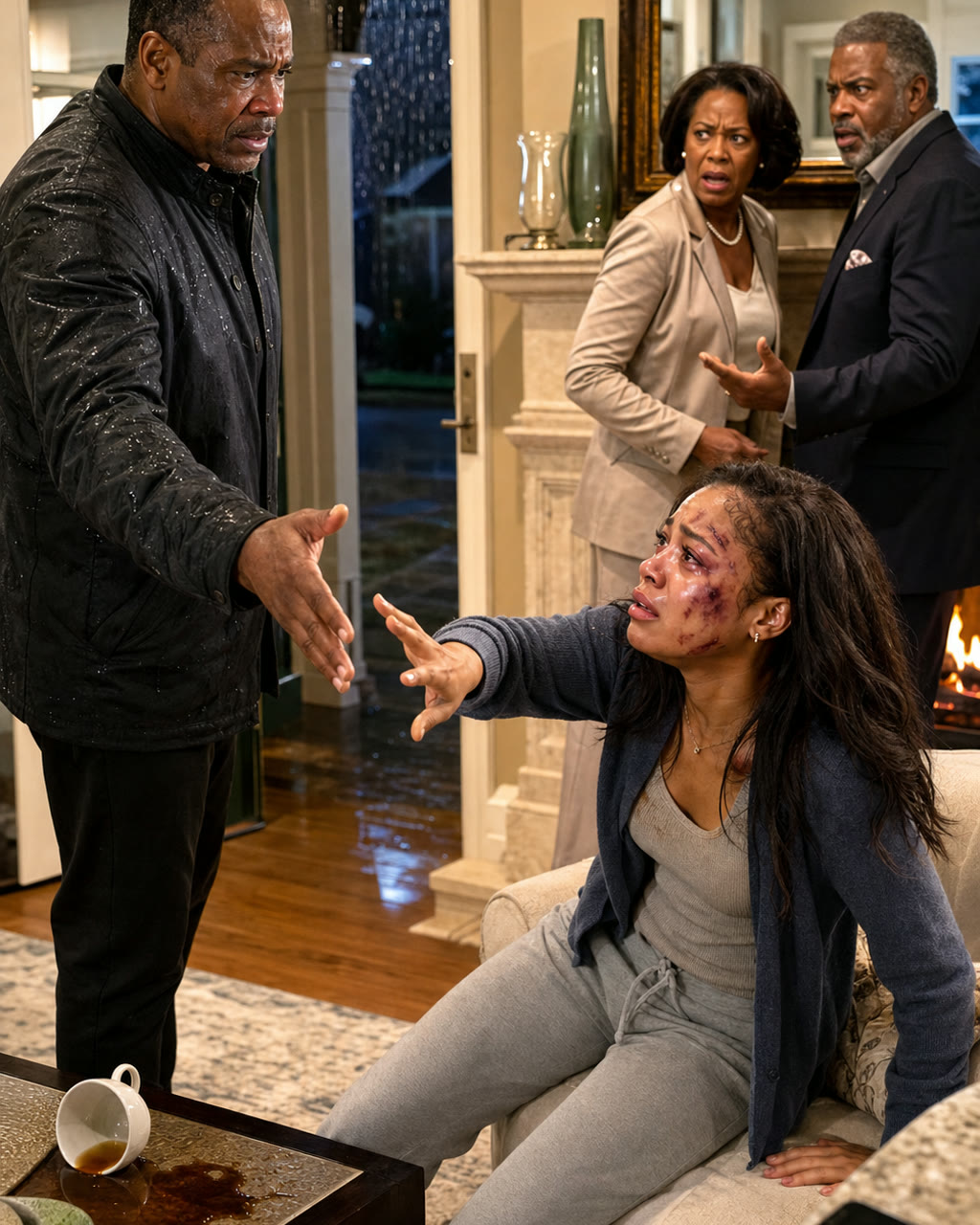
Zaria was on the couch. The good couch, the one with the plastic still on it. She had her knees pulled all the way up to her chest and both her arms wrapped tight around them, and she was wearing my maroon hoodie, sleeves down. Her face was wet and swollen and red, and when she caught sight of me standing there in the doorway, something happened to that face that I do not have one clean word for. Relief and shame and pure terror, all three of them fighting to fit on the same face at the same second.
Devon was standing over her. Not touching her, not right in that moment. Just standing close enough that "over" is the only honest word for it, the silver watch bright on his wrist, one hand pointed down at her like he'd been driving a point home with it.
Harold sat back in his recliner, turning the ruby ring around and around and around. Gwendolyn stood over by the fireplace with her arms crossed hard over her chest, and I could see her lips moving. Humming. Fast. So fast.
Not one of them had heard me come in the front door.
"Zaria," I said.
Four heads snapped around at once.
My daughter said "Daddy" in the smallest voice I have ever heard come out of a grown woman, and she started to push herself up off that couch to get to me, and Devon reached out and put his hand flat on her shoulder and pressed her right back down into the cushions.
He didn't shove her. That's the thing I most need you to understand about men like Devon Callahan. He did not shove. He just pressed — gentle, casual, easy, a husband's hand settling his wife back down into her seat — and to anybody watching from across a room it would have looked like absolutely nothing at all. It would have looked like care. It would have looked like love.
And that one gentle press of his hand was the single most violent thing I have ever witnessed in my entire life.
"Mr. Whitfield," Devon said, turning to face me now, the smile already building itself back up out of nothing. "I'm so glad you're here. Really, I am. Now we can all sit down and clear this whole thing up. Come on in, have a seat, let me get you—"
"Take your hand off my daughter."
The smile flickered. It held. "Marcus. Come on now. Let's all be adults about this, alright? Let's just—"
I crossed the room.
I'm not a big man. Fifty-one years old, bad knees, a bus driver's aching back. But I crossed that living room floor and I put my whole body square between Devon and my child, and I took hold of his wrist — the one with the watch on it — and I lifted his hand up off her shoulder and I moved it away from her, and he let me. He let me, because in that one second he read the room the way he always did, and he understood that whatever he had built inside those walls over eight long months, it did not cover this. It did not cover me.
Zaria grabbed a fistful of the back of my shirt with both her hands. Grabbed it the exact way she used to grab it when she was seven years old and the water at the pool was over her head. I felt her forehead press down hard between my shoulder blades.
"I got you," I said, not turning around, keeping my body a wall in front of her. "I got you, baby girl. I got you now."
"Now you hold on just a minute," Harold said, heaving himself up out of that recliner, the ruby ring catching the lamplight. "You do not come walking into my house—"
"Harold." Gwendolyn's voice, thin and high. The humming had stopped.
"—you do not come walking into my house, in your socks, like some kind of—"
"Where are her shoes," I said.
The whole room went still.
"What?" Harold said.
"My daughter's shoes." I was looking at Devon now, only at Devon. "It's raining out there. She's a grown woman. She's got a job, she's got her own car. So if everything in here is just fine, and she only had a little too much wine and got herself emotional — then where are her shoes, Devon? Where is her purse? Where is her phone? Tell me why a grown married woman in her own home doesn't have her own phone on her."
Devon's mouth came open.
And there on the coffee table, face down, half slid up under a magazine like somebody had set it there fast and covered it, I saw Zaria's phone. The pink case I bought her two Christmases back. The little crack in the corner of it from when she dropped it on the patio at my cookout.
I looked at that phone. I looked back up at Devon. And Devon Callahan, for the very first time in the eight months I had known the man, ran clean out of things to say.
Then Zaria spoke, muffled into my back, and what she said stopped the blood in me cold.
"Dad. There's a folder. Up in his office." Her voice cracked right down the middle. "You need to see what's inside the folder. Please."
Chapter 3
"There's no folder," Devon said. Too fast. Way too fast.
That was exactly how I knew for certain that there was a folder.
I kept Zaria tucked behind me and I looked at each of them, one at a time — Devon, then Harold heaving up out of his chair, then Gwendolyn frozen stiff by the fireplace — and I did the cold math that a scared man does. Three of them. One of me. My daughter shaking against my spine.
"Baby," I said, still not turning, still keeping my body between her and all three of them. "Can you walk?"
"Yeah," she whispered. "Yeah, I can walk."
"Then we are going to walk out to my truck. Right now. It's running, the door's open. You get in and you lock it and you don't open it for anybody but me."
"Dad—"
"The folder can wait, baby. You can't. Come on."
Harold moved to fill the doorway to the front hall. Not fast, not lunging. Just enough. Sixty-eight years old and soft in the middle, but a big man still, and he filled that space, and he kept turning that ring. "Nobody is leaving this house until we all sit down and talk this out like grown folks. This right here is a family matter."
"This stopped being a family matter," I told him, "the second my child called my phone and said the word help."
"She's dramatic," Devon said, from behind me now. "She has always been dramatic, Marcus, ever since—"
Zaria let go of my shirt.
I felt her hands leave me and my whole stomach dropped straight through the floor, because I thought the fear had finally taken her all the way under. I thought she was folding herself back down into that couch. I turned my head to catch her.
She wasn't folding. She had stood herself up straight. First time all night she'd stood up straight. And she reached down and she pushed the hoodie sleeves up — up, past her wrists, past her forearms — and she held both her arms out into the warm yellow lamplight so that every single person in that room had no choice but to look at them.
I am not going to describe to you what was on my daughter's arms. I promised her I never would, and some things in this life belong to her and not to any story I could ever tell. I'll only tell you they were the marks of a person who had been h:urt over and over, across a long, long time, in the places that clothes are made to cover. I'll tell you that's why she wore my hoodie all summer long in ninety-one-degree heat, so her own father wouldn't see. And I'll tell you that when I finally did see, my knees actually gave out under me, and I had to put one hand flat against the wall to keep my feet.
"Dramatic," Zaria said. Her voice was shaking hard but it did not stop. It did not stop. "Say it again, Devon. Look my daddy in his face and tell him I'm dramatic. Go on."
Gwendolyn started humming again. Fast now. So fast it wasn't any hymn at all anymore, just a scared closed-mouth sound, a kettle building toward its whistle.
"Gwen," Harold snapped. "Gwen, stop that noise."
"Those could be from anything," Devon said. And he actually turned to me then, man to man, patient, reasonable, the watch flashing on his wrist. "Marcus, come on. She bruises so easy, you know that. She's clumsy, she's always banging into—"
I have never once struck a man in anger in my whole adult life. I need that written down here plain. I raised my right hand up off my side and I did not do it, and the not-doing of it took everything I had left in me, and my whole arm shook with the size of what I was choking back down.
I put the hand back down. I turned to my daughter.
"Get your phone," I said to her, soft. "The pink one. Off the table."
She stepped around me and picked it up off the coffee table, and the very second it was back in her own hand, something came back up into her spine. A phone is a small thing to most people. To a person who's had one taken away from them, it's the whole entire world handed back.
"Now the folder," I said. "You said it matters. Where is it, baby."
"Upstairs. His office. Second drawer down in the file cabinet." She swallowed hard. "He thinks I don't know the code to the lock on it. I've known for two months."
Harold started toward the stairs. I stepped in front of him. We were close enough now that I could smell his aftershave, close enough to see the sweat standing up on his forehead. A big soft man, used his whole life to being the biggest thing in every room he ever paid for.
"Harold," I said. Quiet. So quiet. "I have been driving city buses for nineteen years. You know what all that means? It means for nineteen years I have kept my temper with drunk men, and angry men, and men twice your size, every single working day of my life, because I had a little girl waiting at home who needed her daddy to come back through that door in one piece. I have got more not-fighting stored up inside me than you have ever once had fighting in your whole soft life. Do not go testing the size of it tonight. Move."
I don't know what he saw in my face right then. Whatever it was, Harold Callahan stepped aside.
I sent Zaria up the stairs first, told her to go straight into that office and stand by the window and stay there. Then I backed up the staircase behind her, keeping my eyes locked down on the three of them in the living room the whole way, and I swear it was the longest flight of stairs I have ever climbed in my life.
Devon's office was a small room with a great big desk in it, the kind of room where a man plays at being a whole lot more than he actually is. Zaria was already crouched at the file cabinet, punching a code into a little keypad lock with hands that barely worked.
It clicked. She pulled the second drawer open.
Inside was a manila folder, thick, and I lifted it out and opened it flat on the desk under the lamp, and this is the part where I have to slow down and be careful with you, because what was inside that folder is the whole reason none of this was random. None of it was just temper. None of it was "she bruises easy."
It was documents. Neat ones. Sorted and clipped, the way a man sorts things he is proud of.
There was a life insurance policy. On Zaria. Taken out four months into the marriage. The number written on it made my mouth go dry as sand. Devon was the sole beneficiary. Every dollar of it went to him.
There were papers changing the title on Zaria's car over into Devon's name. Her signature was down at the bottom of them. I would know my daughter's signature anywhere on this earth, and this one was hers, and this one was wrong — too careful, pressed down too hard into the paper, the shaky signature of a hand that's being watched while it writes.
There was a power of attorney. Her name. His name. Dated just three weeks back.
And there were printouts. Her bank statements, months of them. Every withdrawal circled in red pen. And a ledger, handwritten in a careful hand, of money — her money, from before the marriage, the little bit she'd saved up from that dental job she loved so much — being walked out of her accounts, dollar by dollar, week by week, and dropped into an account with only one name on it. His.
And down at the very bottom of that folder, on a single yellow legal-pad page, written in Harold Callahan's own handwriting — I had seen that exact handwriting on the birthday card he mailed us, I knew it — there was a plan. Steps. Numbered out, one through six.
It was about how to "handle Zaria's situation." How to "protect the family's position going forward." And item number four on that list — I read item four twice, to be dead sure I had it right — item four was about getting her declared unstable. It talked about her "emotional issues since her mother's death." It talked about building a record of how she "exaggerates" and "makes accusations."
They had been building a story. For months. The exact same story Devon had tried to sell me on the phone not one hour before. She's dramatic. She exaggerates. She's been emotional ever since her mother passed. They weren't only h:urt:ing my daughter behind those cozy yellow windows. They were writing every bit of it down, careful, so that when it finally got bad enough — when she finally broke, or ran, or worse — everybody in the world would already know she was the crazy one, and Devon was just the poor, patient, long-suffering husband.
The pie. The plates. "They've got history in them." He had been reading me at that very first dinner. Reading every one of us at that table. Casing the whole family the way a man cases a house before he breaks into it.
Zaria was standing very still over by the window, watching me read it all.
"I found it two weeks ago," she said, so quiet. "That's when I knew. That it wasn't ever going to just get better if I could only be good enough. That it was never about me being good enough at all." Her voice broke apart on the word good. "I couldn't call you from inside the house, Dad. He always watches the phone. Tonight Gwendolyn had the TV turned up loud, and I grabbed the phone off the kitchen counter and I locked myself in the downstairs bathroom, and I—" She stopped. Her chin was shaking. "I only got two words out before he got the door open."
"Two words was enough," I told her. "Two words got me here."
I took out my own phone. I laid that insurance policy out flat and I photographed it. Then the car title. Then the power of attorney. Then Harold's yellow legal-pad list, item four and every other item, all of it. My hands were steady again — that cold, flat, level calm — and I photographed every single page in that folder, front and back, twice.
Because I finally understood something up there in that little office that I hadn't understood down on the highway doing ninety in the rain. This was never a fight I could win with my fists in a living room. Harold was right about one thing, one only: this was a family matter, and families like the Callahans — comfortable people with a lawn service and a Bible for decoration and lawyers on speed dial — those families do not lose to a bus driver standing in their hall in his socks. Not with fists. Never with fists.
They lose to a folder. Their own folder.
"We are going to walk back downstairs together," I said. "You're going to hold my hand the whole way. We are going to walk right out the front door, and we are not going to stop and explain one single thing to anybody in this house. You understand me?"
She nodded. She slid the pink phone down into the hoodie pocket. She reached out and took my hand.
We came down the stairs side by side, and all three of them were waiting for us down in the front hall, and Devon's eyes went to my phone still gripped in my other hand, and then up past me to the light spilling out of his office at the top of the stairs where I'd left that folder wide open on the desk. And every last drop of the smile drained straight out of his face all at once.
"You went in the cabinet," he said.
"I did."
"You had no right to go in my—"
"Devon." I was at the bottom of the stairs now, my daughter's hand tight in mine. "In about ten minutes I am going to be standing at a police station, showing a wide-awake officer some photographs. And after that, I am going to be sitting across a desk from a lawyer. So the only question left to answer in this house tonight is whether you and your daddy are going to try and stop my child from walking out that front door. Because I am telling you, as calm as I know how to say a thing — that would be the very last mistake either one of you ever makes."
And that was the exact moment Gwendolyn Callahan stopped humming, stepped away from her own son, and said the thing that cracked the whole night wide open.
Chapter 4
"Harold. It's true. All of it."
Gwendolyn said it down to the floor first. Then she made herself lift her head all the way up, and she turned and she said it straight to me.
"It's true, Mr. Whitfield. Everything that girl says. I knew." Her voice was a rag torn straight down the middle. "I knew, and I hummed my hymns, and I told myself over and over it was a private matter between a husband and his wife."
"Gwen," Harold said. Just her name. A low warning.
She did not stop. Sixty-five years old, loyal to that boy every single day of his life, and something inside that front hall had finally, after all those years, come to weigh more than the loyalty.
"I heard it through the ceiling," she said, and now the words were coming faster than she could hold them. "Night after night. I heard her crying up there and I turned the television up louder so I wouldn't have to be the one to do anything about it. Same as I did tonight. I turned it up loud so I wouldn't have to be the one." She looked over at Zaria and her whole face came apart at the seams. "You called me Mama one time. Right after the wedding. You stood in my kitchen and you called me Mama, and I let my son do this to you. God forgive me. God forgive me, I let him."
"Mama, don't," Devon said, and the panic was all the way through his voice now, the reading-the-room gone clean out of him, just a scared boy watching the story he'd spent months building fall down around his ears. "She's lying. She's turning you against your own—"
"I saw the folder too, Devon." Gwendolyn's voice climbed and cracked. "I saw your father's list. I saw what you wrote down about her mind, about her mother, about making her out to be crazy. And I said nothing." She pressed one hand flat over her own mouth for a second, like she could shove the words back in, then pulled it away. "I'm saying something now. I'm saying it now."
Harold's ring stopped turning. For the first time all night that big soft man had absolutely nothing left to reach for.
I did not stay in that hall to watch a family come apart. That part wasn't mine to witness, and standing in the middle of it wasn't going to do one thing to help my daughter. I turned and I opened the front door.
The rain had softened all the way down to almost nothing. The porch light lit up the wet lawn and my crooked truck sitting at the end of the drive with the door still hanging wide open and the engine still faithfully running after all that time. Good old thing. Never quit on me once.
I walked Zaria out to the truck with my hand around hers. She climbed up into the passenger seat where I'd been throwing my phone all night, and I shut her door soft, and I heard the lock thunk down before I'd even come all the way around to my own side.
I got in. I put the truck in reverse with a hand that had finally, now that it was allowed to, started to shake again. I backed off their wet grass. And I drove my daughter home at exactly the speed limit, both hands set on the wheel at ten and two, a professional again, because the emergency was over now, and the only cargo that had ever once mattered to me in my whole life was buckled in safe on the seat beside me, breathing.
She didn't say anything for a long, long while. Then, about halfway home, small as a child: "I'm sorry, Dad."
I had to pull over for that one. I couldn't drive and hear that at the same time. I put the truck in park on the wet shoulder of the road and I turned in my seat to face my grown daughter sitting there in my old college hoodie, and I said the truest thing I have ever said in my life.
"You do not apologize to me. Not for one single second of any of this. You hear me? You were being brave in a place where being brave had to look like being quiet. You were being brave every day. I'm the one that's sorry. I saw the sleeves. I saw the hoodie in the middle of July. I saw you flinch when a man raised his voice at my own cookout, and I stood there and flipped a burger. I saw all of it, and I told myself little stories instead. You were braver sitting at that dinner table than I was standing at my own grill. It was never you that failed, baby. It was me."
She cried then. Not the pretty kind you see in movies. The hiccupping kind, the same as when she was seven and scraped her knee wide open on the sidewalk out on Delmar. I reached over and I put my hand on the back of her head the way I used to when she was small enough to fit in the crook of my arm, and I just let her. I let her cry it all the way out on the side of the road.
We sat there on that shoulder a long time with the hazards ticking. A couple of cars went by, slowing to look, then moving on. I didn't put the truck back in drive until she was done. Some things you don't rush a person through, not even to get them home to safety. Especially not then.
When she finally sat back up, she wiped her face on the hoodie sleeve, and she looked down at her own wrist where the cuff had ridden up, and then she pushed both sleeves up to her elbows on purpose and folded her arms in her lap and left them that way. Bare. In front of me. She held them there the rest of the drive like she was daring the whole world to say one word about it. I have never in my life been prouder of a small, quiet thing.
"You want me to take the long way?" I asked her. "Past the river?"
"No, Dad," she said. "I want to go home. I just want to go home."
So that's what I did. I took my baby girl home.
Here is how it went after, because you deserve to know it didn't just fade off into the dark.
I did go to the police station that same night, straight there, with the photographs still on my phone. And here is the thing about photographs of a folder — of a life insurance policy, and a forged-looking car title, and a power of attorney, and a yellow legal pad in a man's own handwriting laying out step by step how to make his wife look crazy — they don't cry. They don't get emotional. They don't "exaggerate." They just lie there being flatly, plainly true under a fluorescent light while a detective's face gets harder and harder and quieter and quieter.
Gwendolyn came in on her own two days later and told them all of it. That was the piece that mattered most of all. The mother testifying against her own son. Her loyalty finally, after sixty-five years, swinging around to point at the truth instead — and it cost that woman every single thing she had, her marriage, her son, her whole comfortable life, and she stood there and she paid it anyway.
I will never fully forgive Gwendolyn Callahan for the ceiling, and for the television turned up loud, night after night. But I will also never forget that when the entire house was built and wired to call my daughter a liar, Gwendolyn was the one who finally chose to stand up and call her honest.
Devon was arrested. The paper trail did most of the heavy lifting — the money walked out of Zaria's accounts, the forged documents, the policy with his name sitting all alone on the beneficiary line. There were charges that I'm not going to list out here, because Zaria asked me, please, not to turn the worst year of her life into a headline for strangers to chew on. He took a plea in the end. He's away now. Not forever. But long enough. Long enough to matter.
Harold's lawyers kept him out of a cell, the way comfortable men usually manage to stay out of cells. But the house went. The lawn service went. The whole comfortable life he'd built went right along with it. Last I heard, he and Gwendolyn split up after forty years of marriage, and she moved into a small apartment over near her sister, and she sends Zaria a card every single year on her birthday. My daughter hasn't answered a single one of them yet. But she doesn't throw them out, either. I've seen them, kept in a drawer. Zaria is a whole lot kinder than I am. She can't quite bring herself to throw away a person who finally, way too late, chose the truth.
Zaria moved back home. Into her old room. We painted the walls together, a color she picked out herself — a bright, warm yellow, about as far from that house as you can get. She said she was done with cozy. She wanted bright.
It's been a little over a year now. She went back to school. Not for dental hygiene, though — she couldn't, too much of the old life is caught up in it. She's studying to be a counselor instead. She wants to work with women who are standing in the exact spot she was standing in — the ones wearing hoodies in July, the ones who can only ever get two words out before the door opens.
"So they know somebody's coming," she told me one night out on the porch. "Before they even have to ask for it. So they know somebody's already on the way."
She still has that little chipped baby tooth from when she was seven, still tucked away in the jewelry box. She showed it to me again just last week, laughing that real laugh, the one that gets all the way up to her eyes now, and she said she still fully intends to show it to her own kids someday. She said it like a promise she's finally allowed to make again.
Some nights the two of us sit out on the porch on Delmar and we don't say one word to each other. We just let the crickets do the talking, the same way me and her mama used to do, all those years ago. That was ours, and I thought it was gone, and it came back. It came back.
I used to promise that little girl that nothing bad would ever get past me. I know now that was a lie I told her out of love — nothing on this earth keeps everything away from everybody, and the bad thing got a whole year past me while I flipped my burgers and believed in a man's sweet potato pie.
But I've made her a smaller promise since. One I can actually keep. And I'll leave you with it, because if you've got a daughter, or a sister, or a friend somewhere who's gone quiet on you lately and started wearing long sleeves in the summertime, it's the only promise in this whole world that ever really counts for anything:
Whisper "help me," baby girl — just those two words, that's all I need — and I don't care what I'm doing, or how fast I have to drive, or whose fine brick house I have to walk into in my sock feet. I am already turning the key. I am already on my way.
You may also like
The Silent Truth Behind My Daughter's Accident
The call came at 11:47 at night.…
Read the full story →The Night Evelyn Harper Took Back Her Power
My husband's mistress openly mocked me while my husband smiled… While they laughed at my pain, they never realized that I was the one in control. The moment I whispered, "Everythin…
Read the full story →He Fired the "Cleaning Lady" in Front of the Whole Office — Nine Minutes Before the Board Handed Her the Company
My name is Eleanor Reyes, and for eighteen months the people at Meridian Textiles thought my name was "hey" or "the cleaning lady" or, on a good day, "Ellie, could you get the brea…
Read the full story →