The Hallway Camera Kept What She Buried
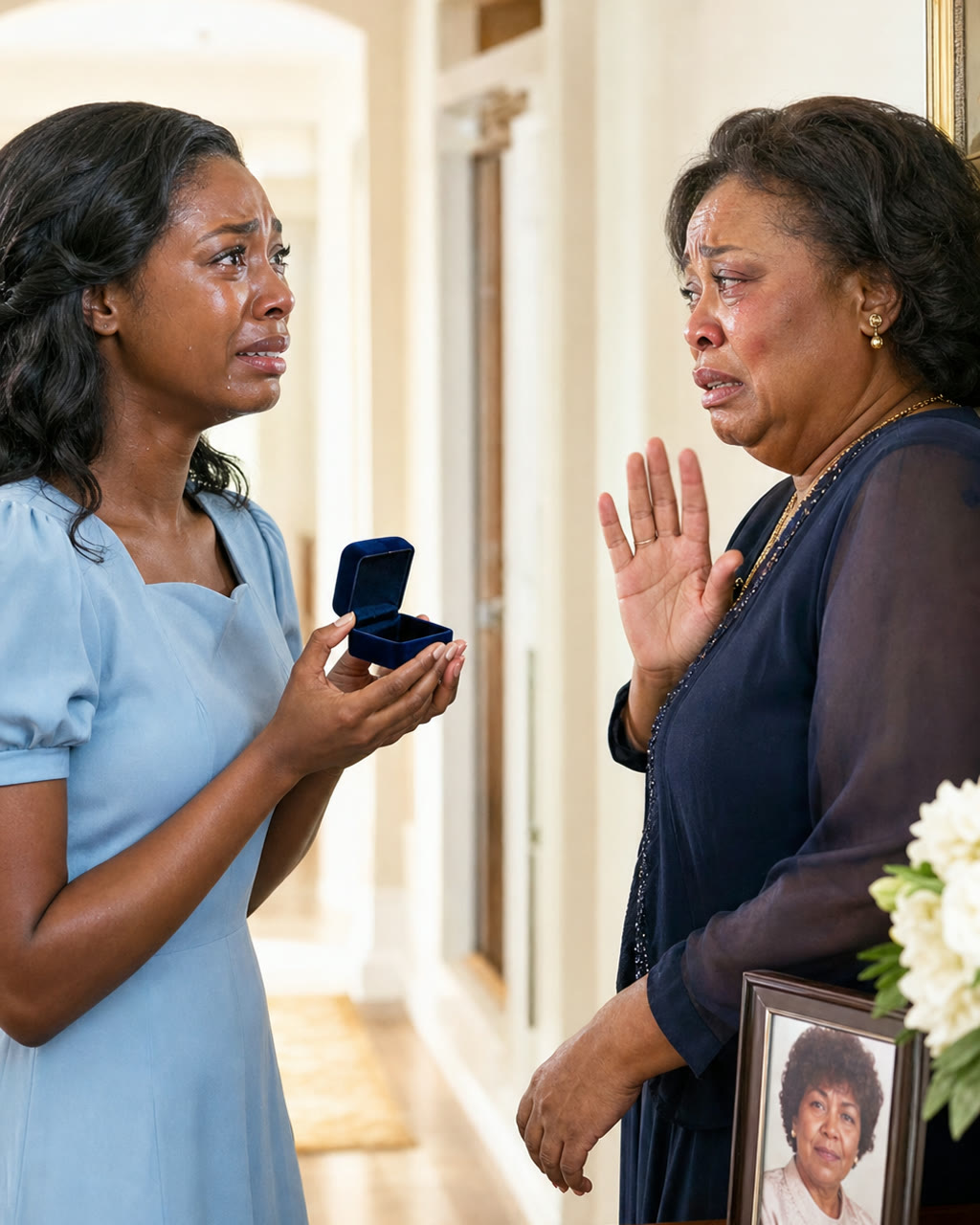
The little velvet box was open on the dresser, and the ring was gone. I stood there in my church dress holding an empty box, and my knees did something I didn't ask them to do.
Chapter 1
The box was light in my hand. That was the first thing.
A ring box has a weight to it, even a small one, and when I picked it up off the dresser that Sunday morning I already knew before I opened the lid. My thumb pushed it back and there was just the little slit in the velvet where the gold used to sit.
I set it down. I picked it up again. As if the ring might come back if I gave it a second chance.
My name is Renata Colvin. I am thirty-four years old, and I have been married to Marcus for nine of those years. We live in a brick house on Delmar with a porch swing that squeaks and a hallway that always smells like whatever I've got in the oven.
My mother, Doreen, passed two years ago this coming October. Pancreatic. It moved fast the way it does, and by the time we caught it she had maybe four months, and she used every one of them being more of a mother than most people manage in a lifetime.
The ring was hers. A thin gold band with a small garnet, dark red, nothing a jeweler would get excited about. My daddy bought it for her when they had nineteen dollars between them and a baby coming. She wore it until the day she couldn't lift her own hand anymore, and then she put it on my finger herself.
"Now you keep the good part of me," she said. Those were nearly her last clear words.
I didn't wear it every day because I was afraid of losing it. That is a thing I am going to have to live with. I kept it in the velvet box on the dresser in the hall, where I saw it every morning, and I touched it and I said good morning to her before I made the coffee.
It became a small church, that hallway. Not a big one. Just me and the box and thirty seconds before the day started. I'd flip the lid, look at the garnet, and I'd say whatever was on my heart. Sometimes it was "morning, Mama." Sometimes it was "I miss you" or "Marcus is being stubborn" or nothing at all, just my thumb on the cold stone and a breath let out slow.
People will tell you grief gets easier. It doesn't get easier. It gets a shape. Mine had a shape, and the shape was that dresser, and that ring, and that thirty seconds where my mother was still a person I checked in with instead of a photograph on the mantel.
I used to think the danger was the ring falling off my hand down a storm drain. I planned for that danger. I kept it locked in that box for that danger.
I never once planned for somebody in my own house reaching in and taking her.
That Sunday I reached to say good morning and my mother was gone.
Marcus was already dressed for church, standing in the bathroom doorway with his tie loose around his neck the way he wears it until the last second. I must have made a sound, because he came out fast.
"Ren. What's wrong."
I held up the empty box. I could not get a word to come.
He looked at it and I watched him try to make it smaller than it was. That is Marcus's way. He is a good man and a soft man, and when trouble comes into a room he tries to talk it back out the door.
"Okay," he said. "Okay, it's here somewhere. You probably moved it and forgot. You do that with your keys."
"I don't do that with my mother."
He heard how it came out and he stopped. He put his hands up, palms out. "I know, baby. I know. Let's look."
We looked. We pulled the dresser out from the wall. I got down on my knees on the hall runner and put my cheek to the floor and looked under everything, and there was a dust bunny and a bottle cap and a hair clip I'd lost in the spring, but there was no gold.
That was when Miss Pearl came out of the guest room.
Miss Pearl is Marcus's mother. She is sixty-eight and she had a hip surgery in February, which is the whole reason she was living in my house at all. I want to be honest about her before I tell you the rest, because the easy thing would be to make her a monster from the first sentence, and she wasn't. Not to me. Not for the seven years I knew her before.
She came to my wedding and cried in the front row. She taught me to make her greens the right way, with the smoked turkey instead of the ham hock, because Marcus's blood pressure. She called me "daughter" and not "daughter-in-law," and she meant it, or I believed she meant it, and there is a difference I did not learn until much later.
She had a strong back and a hard mouth. She could carry a full pot of gumbo across the kitchen at sixty-eight, and she could cut you down to the ankle with one sentence and then act like she never said it. Her weakness, if I'm telling it clean, was pride. She could not stand to be beholden. Living in my house, needing my arm to get to the bathroom those first weeks, ate at her in a way I didn't understand until it came out sideways.
The first month she was with us, I'd bring her breakfast on a tray and she'd say thank you and then not eat it, and I'd find it later gone cold, and the next day she'd tell Marcus I never fed her. Little things like that. I chalked it up to the pain pills and the surgery and being a proud woman in somebody else's kitchen. I told myself she'd settle. I told Marcus she'd settle.
There was a granddaughter in the mix too, Marcus's niece Kiana, nineteen, who came by on weekends to sit with her grandmother and paint her nails and let Pearl fuss over her. Kiana adored Pearl. To Kiana, her grandmother was a queen who could do no wrong, and I loved watching them together, and I want you to hold onto Kiana, because she matters later, and because there was real love in that woman that makes what she did harder to hold, not easier.
That was the thing I kept tripping over, all that day and all the days since. Pearl was not a woman with no love in her. She was a woman with plenty of love, who chose, one gray morning, to do something that had none in it at all.
"What's all this commotion?" she said, leaning on her cane in the doorway.
"Mama's ring is gone," I said. "Doreen's ring. It was right here."
And here is the thing I keep coming back to. Here is the small thing.
She did not ask which ring. She did not say "the garnet one?" or "the one on the dresser?" She looked at the empty box in my hand, and then she looked at the hall table, and then she looked at me, and something moved across her face fast and got put away just as fast.
"Well, these things turn up," she said. "You'll find it."
"Miss Pearl, did you see it? When you were cleaning this morning?"
Because she had been cleaning. She'd been up since six, she told us proudly at breakfast, feeling more herself, going through the closets and the drawers, bagging up old things for the donation drive at Mount Zion. She'd done four garbage bags. Marcus had loaded them in her friend Sister Belinda's trunk at eight, and Belinda had driven them straight to the church.
"I didn't touch your ring," Pearl said. "Why would I touch your ring?"
"I'm not saying you did. I'm asking if you saw it."
"I said I didn't touch your ring." Sharper now. "You keep too much junk on that table anyhow. I've been telling you."
Marcus stepped between us the way he does. "Alright, alright. Nobody's accusing anybody. Ren, let's think. Mama did a lot of bags. Is it possible—"
"Is it possible what?" Pearl turned on him. "You gonna stand there and let her say I threw out her dead mama's ring? In front of me?"
Nobody had said that. Nobody had said the word threw, or thrown, or stole, or any of it. I had asked if she'd seen it.
But she said it herself. She reached into the air and pulled out the accusation nobody had made and held it up so we could all look at it.
I have replayed that moment more times than I can count. The way you name the thing you did before anyone points at it. The way guilt talks first, to get ahead of the question.
"I'm going to call the church," I said quietly.
"Call whoever you want." Pearl turned back toward the guest room. "This is what I get. This is the thanks. I break my hip and come stay and I'm a thief."
The word thief was hers too. Not mine.
I called Mount Zion. A woman named Sister Antoinette answered, and she was kind and she was busy, because the rummage sale was set up in the fellowship hall for that afternoon after service.
"Baby, we got so much stuff donated this week," she said. "Bags coming in all Saturday and this morning. We sorted it last night and priced this morning."
"There would have been jewelry. In one of the bags. Costume stuff, but there'd be a real gold ring in with it, a garnet, red stone. It's mine. It went in by mistake."
I heard her put the phone down. I heard the fellowship hall, folding tables and gospel radio and somebody laughing. I stood in my hallway holding the empty box and I looked up, and that's when I saw it.
The camera.
Small and white, up in the corner where the hall ceiling meets the wall, aimed down the length of the hall. Marcus had put it there in April after the third package walked off our porch. A little dome, blinking green, and none of us had thought about it in months. It just lived up there watching an empty hallway all day.
Watching the dresser. Watching the hall table.
Watching this morning, while Miss Pearl was up alone at six o'clock, cleaning.
Sister Antoinette came back on the line. "Renata? Honey, I got a bag of jewelry here already sorted. There's a gold ring in it, looks like a garnet, real pretty. It's tagged. We got it priced at eight dollars."
Eight dollars.
"Don't sell it," I said. "Please. I'm coming. Don't let anybody buy it. That's my mother's."
"I'll set it aside, baby. You come on."
I hung up. Marcus was watching me. Pearl's door was shut.
I looked back up at that little green light in the corner of my hallway, and my whole body went cold and still, because I understood two things at the same time.
My mother's ring was sitting on a folding table at the church with an eight-dollar tag on it.
And whatever had happened at six o'clock that morning, in this hall, it had a witness. It had been watching the whole time. And I had not yet pressed play.
Chapter 2
We drove to Mount Zion with the windows down because I couldn't breathe with them up.
Marcus didn't say much. He kept one hand on the wheel and one on my knee, and every red light he squeezed a little, and I let him, because I needed to feel like somebody was holding onto something.
Pearl stayed home. She said her hip hurt and she wasn't going to sit in a hot car so I could go make a scene at the church. She said it from behind the guest room door and I didn't argue. Part of me was glad. Part of me wasn't ready to sit next to her yet.
On the way I kept turning it over. Trying to build a version where it was innocent. Pearl had bagged up her own jewelry roll. Both boxes on the same table. A tired old woman, up too early, one hand not knowing what the other did. It happens. People sweep things into bags all the time. I've thrown out my own reading glasses more than once.
I wanted that version so bad I could taste it. Because the other version cost too much. The other version meant I had to look at seven years of "daughter, not daughter-in-law" and wonder which of those years were real.
"She loves you, you know," Marcus said at a light, like he'd heard my thinking. "Whatever this is. She loves you. She brags on you to her church ladies. Belinda told me."
"I know she does."
"So it had to be a mistake."
I didn't answer him. Because love and cruelty aren't opposites. I learned that the hard way that Sunday. The people who can hurt you worst are exactly the ones who love you, because they're the only ones who know where the soft places are.
Mount Zion is the church I've gone to since I married Marcus, and Doreen's church was on the other side of town, but a church is a church when your knees are gone. The fellowship hall was set up with long tables and everything sorted into sections, clothes and shoes and dishes and toys, and in the back, a card table with a hand-lettered sign that said JEWELRY & TREASURES.
Sister Antoinette was a wide, soft woman in a yellow dress, and she saw me coming and she knew, the way church women know things.
"Renata Colvin," she said. "Come here, baby."
She had a sandwich bag set aside behind the cash box. She opened it and poured it out into her own palm and picked through the tangle of chains and clip earrings, and then she held it up.
My mother's ring. The thin gold band. The small dark garnet, catching the fluorescent light the way it used to catch the morning sun on the dresser.
There was a little orange sticker on the band. It said $8.
I took it and I closed my hand around it and I brought my fist up to my mouth, and I stood there in the fellowship hall breathing into my own fingers while a gospel station played from somebody's phone.
"That's her," I said. "That's my mama."
"I know it is," Antoinette said. "I could tell it wasn't costume. That's why I set it back. Now who mixed a real gold ring into a donation bag, that's what I want to know."
An older man in a deacon's vest had drifted over, drawn by the little knot of us at the jewelry table. He introduced himself as Deacon Ellison, and he'd been the one working the pricing that morning.
"I almost bought it myself," he said, shaking his head. "For my wife's birthday. Thought it was a nice little costume piece, eight dollars, why not. Something told me to leave it." He looked at me over his glasses. "Glad I did, daughter. That would've been a sin I didn't know I was committing."
I thanked him. I meant it more than he knew. Eight dollars. My mother had come that close to riding home in a deacon's pocket to be somebody else's birthday surprise, and I'd have spent my life on my knees looking under that dresser.
I want you to feel how thin the thread was. A stranger's whim. A "something told me." That's all that stood between me and losing Doreen a second time, for good, with no camera and no answer, just an empty box and a lifetime of blaming my own carelessness.
That's what she gambled with. My mother's whole memory, against a stranger's impulse buy. And she'd have won, if a deacon hadn't gotten a feeling.
I peeled the sticker off with my thumbnail. Eight dollars. My daddy paid more than that in 1987 with nineteen dollars to his name. My mother wore it through fifty years, a marriage, a burial, a daughter's whole childhood, and it had sat on this table priced under a chipped gravy boat.
I put it on my finger. It fit like she left it warm.
"Which bag was it in?" I asked. "Do you know?"
Antoinette pointed to a corner where the sorted bags were stacked. "We keep them till the sale's over in case somebody comes looking, like you. Sister Belinda brought in four this morning from the Colvin house. The jewelry came out of the third one. Had a lot of ladies' things in it. Slips, church gloves, a jewelry roll."
A jewelry roll. Pearl's cloth jewelry roll, the one she kept her own things in.
Now here is where I have to be careful, because I want to tell you the truth and not just the story that makes me feel righteous.
When I heard "jewelry roll," my first thought was relief. An accident. It fell in. Pearl was packing her own jewelry roll to give away, and my mother's ring, sitting in its open box on the same hall table, somehow got swept in. A terrible careless accident, but an accident, and accidents you can forgive. Accidents don't cost you a family.
I wanted that so bad. I stood there wanting it.
But then I remembered the box.
The velvet box was still on the dresser. Open. Empty. If the ring had gotten swept into a bag by accident, wouldn't the box have gone too? Or the box would've stayed closed and full and untouched, and I never would've known anything was wrong. For the ring to be gone and the box to be sitting there open and emptied out, somebody had to take the ring out of the box. On purpose. With their fingers.
You don't accidentally open a box, remove what's inside, set the empty box back down neat, and carry only the ring into your own bag.
I felt Marcus come up behind me. He'd been talking to Pastor's wife by the door, keeping it quiet, keeping it small.
"You got it," he said, and I heard the relief pouring off him. "Thank God. Ren, you got it back. It's okay now. Everything's okay."
"It's not okay."
"Baby, you got the ring. That's what matters. Let's just—let's go home and let it go. It was a mistake. Mama's been through a lot, her mind's not—"
"Her mind is fine." I turned around. "Marcus, her mind is sharp as yours. You know that. You've watched her run a hand of spades and clean out your uncle for forty dollars three weeks ago. Don't tell me her mind."
He didn't have anything for that.
"The box was open and empty on the dresser," I said. "The ring was taken out. Set aside. The box put back. That's not a bag getting swept. That's a decision."
"You don't know that."
"I know my own hallway."
And even as I said it, I heard my own words hang there, and I felt the cold come back, because I'd said the wrong thing and the right thing at the same time.
I did know my hallway. I knew exactly what was watching it.
We got home a little after one. Pearl's door was open now and she was in the kitchen, moving slow but moving, warming up the greens from Friday. She had put on her good house dress. She'd fixed her hair. She was performing being fine, and she did it well, because she always did everything well.
"You find your little ring?" she said, not turning around from the stove.
"I found my mother's ring, yes." I held up my hand. The garnet sat there dark and sure.
"Good. Then we can all stop with the drama." She stirred. "I told you it'd turn up. You people work yourself into a state over nothing."
You people. Me and my dead mother, I guess.
Kiana was there too, that afternoon. She'd come by to sit with her grandmother, and she was on the couch in the front room, and she called out, "Auntie Ren, you found it? Grandma said you lost your ring."
Grandma said. I filed that away. Pearl had already gotten to Kiana with a story. Renata lost her ring and worked herself into a state. The narrative was built before I even got home from the church.
"I found it, baby," I called back, and I kept my voice sweet for the girl, because none of this was hers to carry.
Then I turned back to the stove and the woman standing at it.
"Miss Pearl." I kept my voice level. It cost me. "How did it get in the donation bag?"
"How would I know? You leave junk all over that table. Probably knocked it in yourself and forgot."
"The box was on the dresser. Open. Empty. Somebody took the ring out."
She turned around then. And she looked at me with a face I'd never seen her wear, not in seven years, a flat closed-up face, and she said:
"Are you calling me a liar in my son's house?"
Her son's house. Not mine. Not ours. Hers, through him.
Marcus said, "Mama—" and she cut him with a look, and he stopped, and I watched my husband become nine years old in his own kitchen.
"I have raised this boy alone since he was six," Pearl said. "I have gone without so he could have. And I move into this house, and the first thing goes missing, y'all look at me. The old woman. The burden. Go 'head. Say it. Say I stole your dead mama's ring."
Nobody had said stole. I want that on the record. She said it. Again. She kept saying the loud part herself and daring us to agree.
I looked at Marcus. He was looking at the floor.
And I made a decision I have thought about every day since. I could have let it go. I had the ring. I could have hugged her and cried and blamed it on stress and painkillers and old age, and we could have eaten those greens and pretended, and maybe held the family together on a lie.
Instead I said, very quietly, "The hallway camera was on this morning, Miss Pearl."
The wooden spoon stopped moving in the pot.
She didn't turn around. Her back was to me. But I watched her shoulders, and I watched her free hand find the edge of the counter and hold it.
"What camera," she said.
And that was the moment I knew. Not suspected. Knew. Because an innocent woman says "what are you talking about" or "so what" or "good, then you'll see." An innocent woman doesn't go still and grip the counter and ask, in a voice gone small, what camera.
"The one Marcus put up in April," I said. "Over the hall table. It records to his phone."
Marcus's head came up. I watched it land on him. I watched him remember. His mouth opened.
Pearl set the spoon down on the spoon rest, careful, like it might break. She stood at my stove with her back to both of us, and for a long moment the only sound was the greens bubbling.
"I'm tired," she finally said. "I'm going to lie down."
She walked past us with her cane, slow, chin up, and she didn't look at me and she didn't look at her son, and she went into the guest room and closed the door soft.
And I stood in my kitchen with my mother's ring on my finger and my husband staring at me, and I said the thing that had been sitting in my chest since eight o'clock that morning.
"Marcus. Pull up the camera. I want to see this morning at six."
Chapter 3
Marcus didn't want to pull it up.
I need you to understand him before you judge him, because it would be easy to make him weak and leave it there. He isn't weak. He's loyal, and his loyalty had two mothers pulling it in half, and one of them was standing in front of him alive and one of them was living on my finger, and he did not know how to serve both.
"Ren, what does it change," he said. He was sitting at the kitchen table now with his phone in his hand, face down. "You got the ring. If we watch it and it's what you think it is, then what? Then I know my mother for a—" He couldn't finish it. "And it's in my head forever. And we still all live here. What does it change."
"It changes whether we live in the truth or a lie."
"Maybe I'd rather have the lie." He said it low and honest and it was the saddest thing I ever heard him say. "Maybe the lie lets me keep my mama."
I sat down across from him. I put my hand flat on the table, the ring up, so he could see it.
"You know what your mother did for you," I said. "You told me a hundred times. Two jobs. Never let you feel poor. Sat in the front at every game even when it was raining. She's a strong woman, Marcus. I have loved her for being that strong woman."
"Then why—"
"Because strong people can do a wrong thing. And a wrong thing done to my mother doesn't stop being wrong because the person who did it is strong, or old, or your mama, or living under my roof." I took a breath. "I'm not asking you to hate her. I'm asking you to look."
He turned the phone over. His thumb hovered. And I understood that hover, because mine had done the same thing on that same button before we left for church.
"If I look," he said, "and it's bad, I can't unlook."
"I know."
He set the phone back down. He wasn't ready. I let him not be ready for a minute, because I loved him, and because I remembered my own thumb hovering that morning.
"When I was ten," he said, "I broke a lamp. Living room lamp, the good one, playing ball in the house. And I was so scared of what she'd do that I hid the pieces in the trash and I told her the cat did it. We didn't even have a cat. I said a cat got in." He almost smiled. "She let me lie. She knew, and she let me. And that night she came in my room and she sat on the bed and she said, 'Baby, you don't ever have to lie to me. Whatever you did, we face it together.' And I never lied to her again. Not once in thirty years."
He looked at the phone.
"And now I'm scared to look at what she did. Because I don't want to face it. I want a cat to have gotten in."
"There's no cat, Marcus."
"I know there's no cat."
"You could just have the ring. We could go on."
"She called it your house," I said. "Not ours. Not mine. When she thought I was accusing her, she reminded us both whose house this really is. That was for me, Marcus. That was to put me in my place." I kept my voice soft because the truth doesn't need to be loud. "I have cooked her food and washed her sheets and helped her to the toilet. And when it counted, in one sentence, she told me I'm a guest here. So no. I can't just go on."
He opened the app.
I came around the table and stood behind his shoulder. The app loaded the hall camera. There was the timeline down at the bottom, a gray bar with little orange marks where it had caught motion. He scrolled it back. Saturday. Then to Sunday. Then he found the six o'clock hour, and there were three orange marks clustered in it.
He tapped the first one. 6:04 a.m.
The hallway came up on the little screen, gray and grainy in the early light, the dresser and the hall table and the runner. For a few seconds nothing. Then Pearl came into frame from the guest room, in her robe, moving slow with her cane but steady, and she went past toward the kitchen, and the clip ended.
"Getting coffee," Marcus said, too fast. "See. She's just up early."
"Play the next one."
6:31 a.m. Pearl came back down the hall from the kitchen with a mug. But this time she stopped at the hall table. She set the mug down on it. And she stood there in the gray light, and she looked at the wall for a second, and then she looked down the hall both ways.
Both ways. Down toward our bedroom. Then back toward the kitchen. Checking.
"Marcus," I said.
"I see it."
On the little screen, Pearl reached out and picked up the velvet box from the dresser. She opened it. She tilted it toward the window light to see inside. And then, with two fingers, careful, she lifted my mother's ring out of it.
She held it up. She turned it. In the gray dawn on my husband's phone, my mother-in-law examined my dead mother's wedding ring like a woman at a pawn counter.
Then she closed the empty box. She set it back down on the dresser, exact, the way it had been. And she slid the ring into the pocket of her robe.
And she picked up her coffee mug and walked back toward the guest room, calm, unhurried, and out of frame.
The clip ended. The hallway sat there empty and gray on the screen.
Neither of us said anything for a long time. The greens were still bubbling on the stove. Somebody's lawnmower started up next door. Ordinary Sunday sounds carrying on like the floor hadn't just dropped out of the world.
"She checked both ways," I heard myself say. "She looked to make sure nobody was up."
Marcus put the phone down on the table, face up, the empty hallway still glowing on it. He put both his hands over his face. He didn't make a sound. His shoulders went up and down once, hard, and that was all, and I put my hand on his back and left it there.
I keep thinking about how ordinary she looked doing it. That's what I couldn't get past. In the movies a person does an evil thing and their face does something, twists, or they glance around wild-eyed. Pearl's face did nothing. She lifted my mother's ring out of that box with the exact calm she'd use to take a biscuit off a plate. She turned it to the light like she was pricing it. And her face was just her face. Sunday-morning tired, a little puffy from sleep. The most ordinary thing in the world.
That's the part that told me it wasn't a moment of madness. A moment of madness has a face. This had no face. This was a woman doing something she had already decided to do, and had made her peace with, and was simply now getting done before the coffee got cold.
I want to tell you that I felt vindicated. I didn't. I felt sick.
Because I had loved that woman, and I had needed there to be some other answer, some accident, some confusion, right up until the second her two fingers lifted my mother out of that box. And there wasn't one. She checked both ways down the hall. You don't check both ways for an accident. You check both ways for a crime.
And watching it undid a memory in me I wasn't ready to have undone.
Because those two fingers, lifting the ring, put me right back in the hospice room. My mother, so thin the band spun loose on her own hand, working it off with the last of her strength. She'd held my hand in both of hers and pushed the ring onto my finger and pressed it there, sealing it.
"Now you keep the good part of me," she said.
Two years apart, two sets of hands, one giving and one taking, and I was standing between them and couldn't reach either one. I gripped the back of Marcus's chair. He felt me sway and put his hand up over mine without looking, and we stayed like that, holding on over a glowing phone like two people bailing the same boat.
"There's a third clip," I said quietly.
Marcus dropped his hands. "Ren."
"6:52. There's a third one. Play it."
"I don't want to."
"Play it, Marcus."
He tapped it.
6:52 a.m. The hall again. And Pearl came back, and this time she had one of the black garbage bags, the donation bags, half full, dragging a little because of her hip. She stopped at the hall table again.
She took the ring out of her robe pocket.
And she reached down into the garbage bag and pushed it in, down among the slips and the church gloves, into the jewelry roll. Burying it. Not keeping it for herself. Burying it in a bag headed to strangers where it would never be seen again, where it would be sold to a stranger for eight dollars and disappear off the face of the earth, and I would spend the rest of my life thinking I had lost my own mother through my own carelessness.
That was the part that took the wind out of me. She didn't want the ring. She had no use for a garnet band worth eight dollars. She didn't take it to have it.
She took it so I couldn't.
She tied the bag shut, on the little screen. She smoothed the top of it. And she looked up.
She looked up, right at the corner of the hall, right at the camera, for half a second.
And then she looked away and dragged the bag toward the front door, and the clip ended.
"She looked at it," Marcus whispered. "At the end. She looked right at it."
"I saw."
I have watched that half-second a hundred times since. Her eyes going up to the corner where the camera sat. I still can't tell you what was in them. Maybe she remembered it and thought it wouldn't reach the table. Maybe she saw it and did it anyway, past caring. Maybe she wanted, some buried part of her, to be caught, so somebody would finally know the whole of her and not just the queen she'd built.
I'll never know. That's the one thing that little green light couldn't record. It kept everything her hands did and none of what her heart meant, and I've learned to live inside that gap, because it's the same gap you live in with everybody you love.
"Did she know? Did she know it was there?"
I didn't answer, because I didn't know, and it didn't matter. She had looked at the one witness in my house and then buried my mother in a garbage bag anyway.
Marcus stood up so fast the chair scraped. He walked to the sink and gripped it and stared out the window at the neighbor's yard.
"I have to talk to her," he said.
"Marcus—"
"Not you. Me. She's my mother. I have to be the one." He turned around, and his eyes were red, and his jaw was set in a way I'd never seen on my gentle husband. "Stay here. Please. Let me."
He walked down the hall. I heard him knock on the guest room door, soft, the way you knock when you already know the answer is going to break you.
I heard the door open.
And I stood in my kitchen with the greens burning now, starting to catch and stick, and I turned off the stove, and I sat back down at the table where my husband's phone still glowed with a picture of an empty gray hallway, and I waited to hear what a mother says to her son when the wall she built around her whole life has just come down in three clips, sixty seconds long.
Chapter 4
I couldn't hear the words at first. Just the shapes of them through the wall.
Marcus's voice, low and even, and then Pearl's, sharp, climbing, then the sharpness cracking. Then a long quiet. Then Pearl's voice again, and this time it wasn't sharp at all.
I sat at the table and I turned my mother's ring around and around on my finger, the way she used to when she prayed, and I understood for the first time what her hands had been doing all those years. She was holding on to something while everything else was uncertain. So was I.
After a while Marcus opened the guest room door and came to get me. His face was wet and he didn't hide it.
"She wants to talk to you," he said. "She asked for you. You don't have to. But she asked."
I went. I want to tell you I went with grace in my heart. I went with a garnet ring on my finger and a stone in my chest, and I told my feet to move, and they moved.
Pearl was sitting on the edge of the guest bed. She looked small on it. She had her hands folded in her lap and her cane leaned against the nightstand, and the good house dress and the fixed hair suddenly looked like a costume she was too tired to keep wearing.
"Sit," she said. Then, softer, catching herself, "Please. Sit down, Renata."
I sat in the chair by the window. Marcus stood in the doorway.
For a while she didn't say anything. She looked at my hand. At the ring.
"I knew about the camera," she said finally.
I didn't move.
"Marcus told me about it back in the spring. When he put it up. I forgot, and then this morning I remembered halfway, and I thought—I thought it only pointed at the door. For the packages." She let out a breath that shook. "I looked up at it at the end and I thought, that's aimed too high, it won't have caught the table. I told myself that. I've been telling myself that all day."
"It caught everything," I said.
"I know it did." She nodded slow. "I know."
The room was bright. That's a thing I remember. Sunday afternoon sun coming full through the window, no shadows to hide in, everything lit up plain.
"Why," I said. Just the one word. I had promised myself I wouldn't cry in front of her and I was keeping it, barely.
Pearl looked down at her folded hands. Old hands. Working hands. Hands that raised a boy alone.
"You had something of your mother's," she said. "Right there on the table. Every morning you touched it. You talked to it. I heard you. 'Morning, Mama.' Every day." Her voice bent. "And I had nothing of mine. My mother didn't leave me a ring. My mother didn't leave me anything but debt and a bad temper. And I raised my boy in that same nothing, and I made something out of him, and then I broke my hip and I had to come live in your house and be fed and washed like a child."
She stopped. She pressed her lips together.
"And every morning I'd hear you in that hall, saying good morning to a woman who's dead and still loved better than I'll be loved alive. And something in me went bad, Renata. I'm not going to dress it up. Something in me went ugly and small, and I wanted—" Her hands twisted. "I didn't want the ring. God knows I didn't want the ring. I wanted you to feel it. To lose your mama again. To wake up and reach for her and have her gone. I wanted you to hurt the way I—"
She couldn't finish. She put her hand over her mouth.
I sat very still.
I want to tell you I felt fury. I'd earned fury. But what came up instead, sitting in that bright room across from this proud broken woman, was something worse and heavier, and it was grief. Grief for how much pain a person has to be carrying to want to plant that same pain in somebody else and bury it where it can't be found.
"You were going to let me think I lost it," I said. "Forever. You were going to watch me blame myself for the rest of my life."
"Yes." She didn't look away when she said it. I'll give her that. She looked right at me. "Yes. I was."
"That's the part I can't—" I stopped. My voice was going. I let it. "My mother put this ring on my hand herself. With the last strength she had. And you took it out of the box and checked both ways down the hall and buried it in the trash. And you were going to let me carry that."
"Yes."
Marcus made a sound in the doorway. Pearl looked at him and then back at me.
"You want to know the ugliest part?" she said. "I felt better after. For about an hour, I felt lighter. I sat in this room and I heard you two get ready for church, all normal, and I thought, now she'll know. Now she'll know what it is to reach for your mother and touch air." She shook her head slow. "That's a rot, Renata. That's a rot in a person. To feel lighter off somebody else's grief. I've had that rot in me a long time and I never let it out before because I never had somebody's whole heart sitting on a table where I could reach it."
"Kiana thinks the world of you," I said. I don't know why I said it. Maybe to remind her she wasn't only this.
"Kiana doesn't know me," Pearl said quietly. "Kiana knows the grandmother I built for her. You just met the rest."
"There's no fixing it," she said. "I know that. I'm not going to sit here and ask you to forgive me like it's a bowl I dropped. I did it on purpose. I did it cold. You can hate me. You should. I'd hate me."
And here is where the story doesn't go the way the anger in me wanted it to go.
Because I looked at her, and I looked at Marcus standing in the door destroyed by both of us, and I thought about my mother. About Doreen. About what she'd say if she were sitting in this chair instead of on my finger.
My mother forgave people who didn't deserve it her whole life. Not because they earned it. Because she said carrying the hate cost her more than it cost them, and she wasn't going to pay to keep somebody else's ugliness alive in her own chest.
"I'm not going to hate you," I said. And I watched it confuse her, because she'd braced for hate and hate would have been easier for her than what I said next. "But you can't stay here."
Marcus said my name.
"She can't stay here, Marcus." I kept my eyes on Pearl. "Not because I hate you. Because I forgave my mother's death by talking to her ring every morning in that hall, and you know that, because you heard me, and you used it to try and break me. I can't heal in a house where you're down the hall. I just can't. I don't have it in me."
Pearl nodded. Tears were coming down her face now and she let them, didn't wipe them, just let them fall on her folded hands.
"That's fair," she said. "That's more than fair."
We found her a place three weeks later. A senior apartment across town, near Sister Belinda, one floor, a rail in the bathroom. Marcus moved her himself. He visits her every Sunday. I have not gone with him, and he has not asked me to, and one day maybe I will, but that day isn't here yet and I've stopped pretending it's close.
Kiana didn't take it well at first. She'd heard her grandmother's version, the one where I put an old woman out on the street over a lost trinket, and she came to the house hot about it, and I let her be hot. I didn't show her the clips. That would've been for me, not for her, and there'd already been enough people using that girl to carry a story.
But Pearl told her. That's the one thing I'll always give Pearl. A month in, sitting in that senior apartment, she told Kiana the truth herself, all of it, the box and the checking both ways and the garbage bag. Kiana called me crying. Not angry anymore. Just a nineteen-year-old learning that the people we love are bigger and darker than the shapes we keep them in.
"I don't know how to still love her," Kiana said.
"You love her the same," I told her. "You just love a real person now instead of a queen. That's harder. But it's the only kind of love that's actually true."
I meant it. I was still figuring out how to do it myself.
I keep the ring on now. Every day. I stopped being afraid of losing it, because I already lost it and got it back, and I learned that the losing I was really afraid of isn't a ring falling off a hand. It's forgetting to hold on to the good part of somebody after they're gone.
Marcus and I are alright. Better than alright, some days. We went through a fire together and came out still holding hands, and there's a strength in that I didn't have before.
It cost him more than me, I think. She's his mother. He had to sit with the fact that the woman who worked two jobs so he'd never feel poor was also the woman who buried his wife's mother in a garbage bag to watch her grieve. Both true. Both his mama. He goes every Sunday and he loves her and he doesn't excuse it, and I have watched that break him and rebuild him at the same time, and I love him more for choosing the hard, honest version over the easy lie he told me he wanted.
There was a Sunday, a few months on, when he came home from visiting her and sat down at the kitchen table where we'd watched the clips.
"She asked about you," he said. "She wanted me to tell you she's sorry. Not to make it okay. Just so you'd know she's still sorry, every day."
I turned the ring on my finger.
"Tell her I heard it," I said. And that was all I had. But it was real, and it wasn't hate, and some days that's the most a person can honestly hand across a broken table.
We took the camera down out of the hall. We didn't need it anymore. The packages had stopped going missing, and the thing it was really watching for had already come and gone.
But I saved the clips. Not to use them. Not for anything. I just couldn't bring myself to erase the last footage of my mother's ring sitting in that box on the dresser, catching the morning light, right where she belonged, in the seconds before it went into the dark.
Some mornings I still stand in that hallway.
I touch the ring on my finger, and I say good morning to my mother, out loud, to nobody, in a hall with no camera watching anymore.
And she's not gone. That's the thing Pearl never understood, the thing that tried to make her cruel and only made her small. You can take the ring and bury it in the trash and price it at eight dollars.
But you cannot donate a mother. She stays in your hands whether they're empty or full.
You may also like
The Silent Truth Behind My Daughter's Accident
The call came at 11:47 at night.…
Read the full story →The Night Evelyn Harper Took Back Her Power
My husband's mistress openly mocked me while my husband smiled… While they laughed at my pain, they never realized that I was the one in control. The moment I whispered, "Everythin…
Read the full story →He Fired the "Cleaning Lady" in Front of the Whole Office — Nine Minutes Before the Board Handed Her the Company
My name is Eleanor Reyes, and for eighteen months the people at Meridian Textiles thought my name was "hey" or "the cleaning lady" or, on a good day, "Ellie, could you get the brea…
Read the full story →