The Son He Threw Away Signs His Freedom
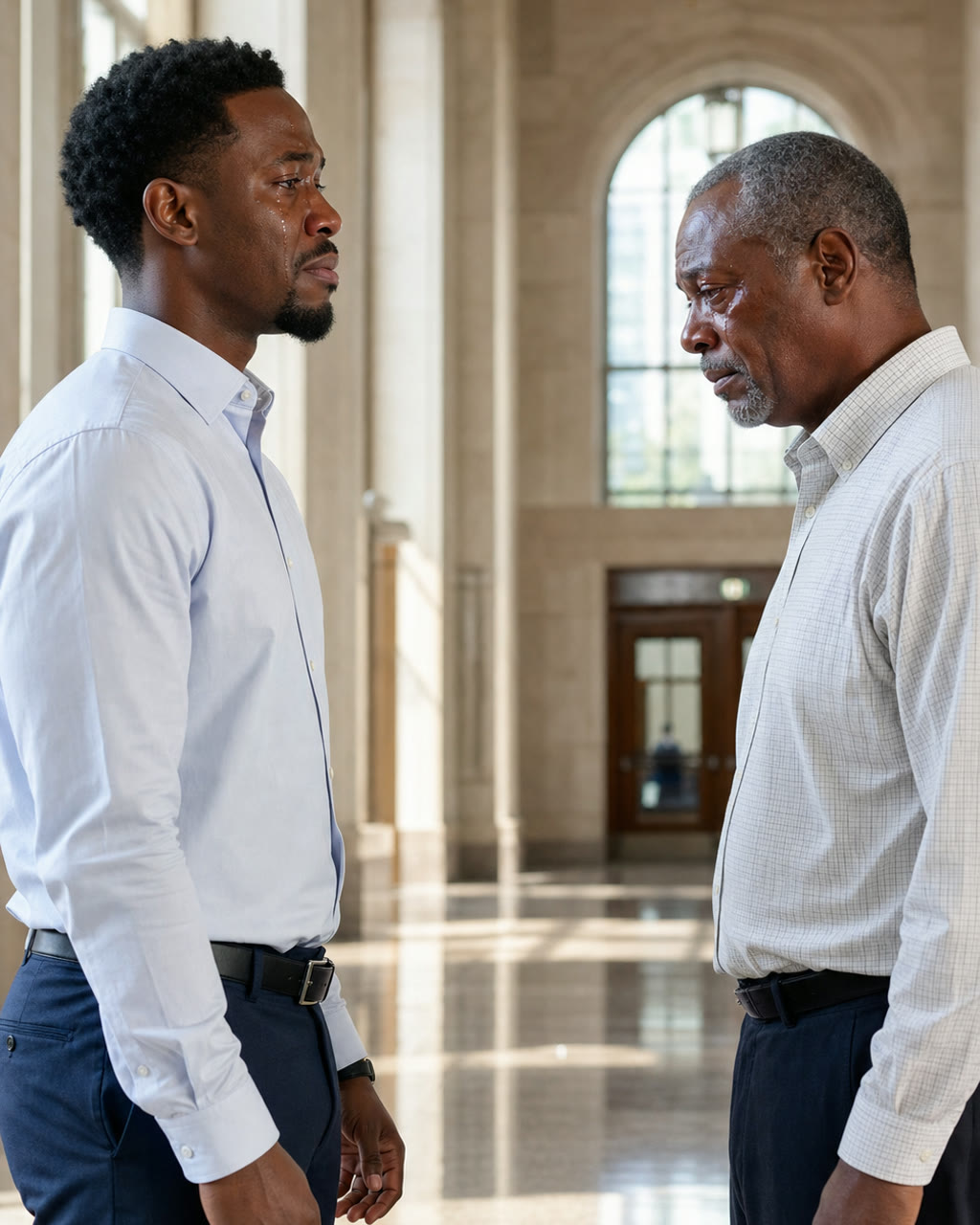
The bail clerk slid the paper under the glass and asked for my name, and behind me my father whispered, "You don't have to do this." I was sixteen the last time he looked at me that long. Back then he said I'd never amount to anything. Now he was the one in the county jumpsuit, and I was the one with the checkbook.
Chapter 1
I was sixteen when my father decided who I was going to be.
We were in the kitchen on Delmar, the one with the yellow linoleum that curled up at the corner by the stove. My report card was on the table between us. Three C's, a D in chemistry, and a note from Mr. Abara that said I had "potential I refuse to spend."
My father read it twice. He always read things twice, like the words might change if he gave them a chance.
"Sit down, Andre," he said.
I sat.
Marcus Whitfield was a big man then. Not fat — built. He hung drywall and hauled sheetrock for a contractor named Pruitt who paid him in cash and disrespect, and by the end of a day his forearms looked carved. When he came home he smelled like joint compound and cigarettes.
He put his finger on the D.
"You know what this is," he said.
"Chemistry."
"This is your whole life. Right here. This little letter."
I didn't say anything. Silence was the safest thing to hand him.
My mother, Renelle, was at the counter cutting onions, and I watched her knife slow down. She wanted to step in. She always wanted to. But my father had a way of filling a room so completely that there was no air left for anybody else's voice.
"You think somebody's coming to save you," he said. "Some scholarship. Some lucky break. Let me tell you what I know." He leaned across the table. "You'll never amount to anything, Andre. I've watched you your whole life. You don't have the fight. You quit swimming. You quit the trumpet. You'll quit this too, and then you'll be exactly like every other boy on this block, and don't come crying to me about it."
The onions stopped.
I remember the exact shade of the linoleum. I remember the hum of the refrigerator. I remember thinking, very calmly, the way you think a thing you'll spend twenty years unthinking: *He means it. This is not a threat. This is a forecast.*
My mother set the knife down.
"Marcus."
"Stay out of it, Nelle."
"He's a boy."
"He's sixteen. I was working two jobs at sixteen." He stood up. His chair scraped. "That's the problem. Everybody keeps calling him a boy."
I went upstairs. I didn't slam the door. I've thought about that a lot — how a slammed door would have been an argument, and I didn't have an argument. I just had the forecast. I lay on my bed and listened to them go at it downstairs, my mother's voice climbing and his going flat and low, and I stared at the water stain on my ceiling until it stopped looking like anything.
That was February.
By June I had a plan, and the plan was made entirely out of spite, and spite turned out to be the strongest material I ever built with.
I didn't quit chemistry. I stayed after with Mr. Abara three days a week, and he was a patient man with a bad knee and a habit of saying "again" until you got it. I pulled the D up to a B. I stopped hanging on the block with Tré and them. I got a job bagging at the Schnucks on Kingshighway and I saved every dollar in a shoebox because I didn't trust a bank not to tell my father.
I wasn't doing it for a future. I want to be honest about that. I was doing it to prove one man wrong. Every A was a word I couldn't say to his face.
He never noticed. That's the part that still catches me.
I made honor roll junior year and left the certificate on the kitchen table, face up, for two days. He moved it to get to the salt. He never said a thing.
I told myself I didn't care. I was seventeen and I was a very good liar, mostly to myself.
The truth is I used to picture the moment he'd finally see it. Not a big scene. Just him looking up from the paper, meeting my eyes, saying one word. I didn't even need the word to be *sorry.* I'd have taken *okay.* I'd have taken a nod.
I built that little movie in my head so many times it wore a groove. And every time the real kitchen refused to play it, I filed another A away like a brick, and the wall between us got one row higher, and neither of us said a word about the construction.
My teacher, Mr. Abara, noticed instead. He was from Nigeria and he had a way of saying my name that made it sound like it belonged to someone worth the trouble. One afternoon after chemistry he looked at me over his bad knee propped on a chair and said, "Andre. Who told you that you were small?"
I didn't answer him.
"Somebody did," he said. "I can always tell. The quiet ones carry a voice around that isn't theirs." He tapped my notebook. "You are going to have to decide whose voice you obey. His, or the one that shows up in these numbers. They cannot both be right."
I've thought about that more times than I can count. At the time I just shrugged and went to my shift.
The house got quieter after that. My father lost the job with Pruitt when Pruitt lost the contract, and for a while there was no work, and a man like Marcus with no work is a dangerous kind of still. He sat in the front room with the TV off. He stopped shaving. My mother started picking up extra shifts at the nursing home, and I started coming home later, and the three of us moved around that house like we were avoiding a hole in the floor that only we could see.
There was one night, though.
I have to tell it because it's the reason my pen wouldn't stop moving at that bail window twenty years later, and if I skip it I'm lying to you.
It was a Saturday in the fall of my senior year. I was walking home from a shift, cutting through the lot behind the laundromat, and two guys I half-knew from Sumner stepped out from between the dumpsters. One of them, Deshawn, owed money to somebody I owed nothing to, but that's not how it works when you're seventeen and in the wrong lot. There was a lot of chest. There was a hand that went to a waistband.
And then there was my father.
I don't know how he was there. I've asked him since and he won't say — I think he was walking home from a bar he'd deny going to. But he came across that lot like weather, and he didn't say much, just put himself between me and the waistband, and looked at Deshawn the way he used to look at my report cards.
"That's my son," he said. Just that.
Something in the way he said *my son* made both of them find somewhere else to be.
We walked home the long way. He didn't lecture me. He didn't ask what I was doing there. About a block from the house he said, without looking at me, "You keep your grades up?"
"Yeah."
"Good," he said.
That was it. That was the whole conversation. But he'd said *my son* like it cost him something and he'd pay it anyway, and I carried that sentence around like a stone in my pocket for two decades, taking it out when I needed to remember he was more than the forecast.
Here's the thing I never understood until I was older. A man can love you and still be the biggest danger in your life. Both at once. Nobody teaches you how to hold that. You just carry it, and it never gets lighter, it only gets more familiar.
That night I lay awake and listened to him move around downstairs, opening the fridge, not eating, sitting back down. I wanted to go down there and say something. I didn't have the words and neither did he, and so the both of us sat in the same silence on different floors, closer than we'd been in a year and unable to do a single thing about it.
I left for Mizzou nine months later on a partial scholarship, three jobs, and a shoebox. My father didn't come to the send-off. My mother told me he'd said he had work. There was no work.
The last thing he said to me before I left St. Louis was in the driveway, through the screen door, not even coming outside.
"We'll see how long you last."
I lasted.
I lasted six years to a bachelor's and a master's in civil engineering. I lasted through the semester I ate ramen twice a day and the semester my roommate stole my textbooks and the phone call where my mother's voice was too careful and I knew before she said it that she and my father were done. I lasted into a job with a firm in Kansas City designing water systems, the invisible bones of cities, pipes that carry away the things people don't want to look at. There's a joke in there I've never been able to finish.
I married a woman named Yolanda who is smarter than me and knows it and loves me anyway. We have a daughter, Simone, who is six and fearless and has my mother's laugh.
I want to tell you it all felt like winning. It didn't. Every promotion, every closing on a house, every time somebody called me "sir" and meant it, some small back room of me turned toward St. Louis and waited for a man to say he was wrong. He never did. And the ache of that never quite left, no matter how much I built on top of it. You'd think proving somebody wrong would set you free. Mostly it just ties you to them tighter, because now you need them to admit it, and they never will, and so you keep climbing to spite a man who isn't even watching.
And I built a wall.
The wall was my best work. My father did not have my number. He did not have my address. He did not know Simone existed. When my mother wanted to tell him things about my life, I asked her, gently, not to, and she — who had her own wall, thinner than mine — agreed.
For fourteen years the wall held.
Then, on a Tuesday in April, at 5:52 in the morning, my phone rang with a number from a 314 area code I didn't recognize, and a recorded voice said I had a collect call from an inmate at the St. Louis City Justice Center, and did I accept the charges.
My thumb hovered over the red button. Decline. It's a stranger. It's a wrong number. Decline and go back to sleep next to your wife in the life he swore you'd never have.
I looked at the wall I'd spent fourteen years building.
Then I pressed the green button, and my father's voice came through, smaller than I had ever heard it, and said my name like a question.
"Andre?"
Chapter 2
I didn't say anything for a second. The wall was still standing, but there was a crack in it now with his voice coming through, and I hated how well I knew that voice even after fourteen years.
"Andre. It's — it's your father."
"I know who it is."
Yolanda stirred beside me. I got up and took the phone into the bathroom and sat on the edge of the tub in the dark.
"How'd you get this number?"
"Your mother." A pause. "Don't be mad at her. I told her it was — I told her something happened."
"What happened."
He breathed. I could hear the payphone hum, that specific institutional emptiness behind him, other men's voices, a door somewhere.
"I got picked up," he said. "It's a mess, Andre. It's not — it's not what they're saying."
"What are they saying."
He wouldn't tell me. Not then. He talked around it in circles, and the circles told me it was bad — a warrant, a bench date missed, something with a woman named Carla I'd never heard of, some money, a car that wasn't his in a way he couldn't explain fast. My father, who read everything twice, couldn't get the story straight in his own mouth, and that scared me more than any of the words.
"They set a bail hearing," he said finally. "Friday. And they need somebody. A person. To be responsible. They won't cut me loose to nobody."
"So call somebody."
The line went quiet.
"There's nobody, Andre," he said.
I have known my father to be many things. Cruel. Proud. Certain. I had never once known him to be alone. He was a man who filled rooms, remember. He'd spent my whole childhood making sure there wasn't space in any room for anyone but him.
And now there was nothing but space.
I want to describe what that did to me and I can't, exactly. It wasn't triumph. I'd imagined this moment in a hundred ugly forms over the years — the great man brought low, calling the son he threw away — and I'd always thought it would taste like something. It didn't taste like anything. It just sat there, heavy and gray, a man alone in a room full of strangers saying *there's nobody* to the one person he'd spent a childhood teaching to leave.
"Ma won't do it?" I asked.
"I didn't ask your mother." His voice got rough. "I'm not putting this on her. She's got a life. She did her time with me."
That, at least, was true.
"Andre," he said. "I'm not asking you to fix anything. I know what I — I know. Just Friday. Just be there Friday. You don't even have to say anything."
I looked at the crack of light under the bathroom door. On the other side of it was Simone's room, and Yolanda, and the whole architecture of a life I'd built on the foundation of proving this man wrong.
"I'll think about it," I said, and hung up before he could answer.
I didn't sleep. I sat in the kitchen with coffee I didn't drink and watched the sky go from black to gray to that thin morning blue, and I ran the numbers the way I run everything, because numbers don't lie and don't leave and don't tell you you'll never amount to anything.
The number was four thousand dollars, more or less, if I stood good for a bond.
I could afford four thousand dollars. That was the thing that made it hard. If I'd been broke, the answer would have been made for me. But I wasn't broke. He'd made sure of that, in the worst way — he'd built me into someone who could afford to save him, using a hammer, and now the tool was going to be turned back around.
Upstairs, I could hear Simone's sound machine, the little ocean loop she can't sleep without. I sat there in the not-quite-morning listening to my daughter's fake ocean and doing arithmetic about my father's freedom, and the two things did not belong in the same house, and yet there they both were, in mine.
Yolanda came down at six-thirty in her robe and read my face and sat across from me without a word. She's good like that. She lets a thing arrive before she touches it.
"That was him," I said.
"I figured."
"He's locked up. He wants me to sign for his bail Friday."
She wrapped both hands around her mug. "What do you want to do?"
"I want to not go."
"Okay."
"But I'm going to go."
She nodded slowly. She didn't ask why, which is one of about four hundred reasons I married her. She just said, "Are you going alone?"
"Yeah."
"You sure?"
I thought about it. About walking into that building with someone at my side who loved me, someone who'd remind me who I was when the old kitchen started whispering.
"Yeah," I said. "This one I have to do by myself. If you're there, I'll perform for you. I'll be the good husband, the man who rose above. I don't want to rise above anything in that room. I want to just be whatever I actually am when nobody's watching, and find out if that's enough."
Yolanda studied me for a second, then nodded. She's never once tried to save me from a thing I needed to walk through.
"He doesn't know about Simone," I said. "He's not going to know about Simone. This isn't — he doesn't get access to us. I go, I do the thing, I come back, and the wall goes back up with him on the other side of it."
"That's a lot of rules for one Friday," Yolanda said gently.
"They're not rules. They're a fence. There's a difference." I turned my coffee cup a quarter turn. "A fence you build once and you're done. Rules you have to keep enforcing. I don't have it in me to keep enforcing anything with that man. I just want a fence."
She reached across the table and put her hand over mine and stilled it, and only then did I realize I'd been turning that cup around and around like a man winding a clock that had already stopped.
Yolanda looked at me for a long moment.
"Baby," she said, "you can build the wall as high as you want. But you're the one who has to live inside it."
I didn't have anything to say to that.
I flew into St. Louis Thursday night. I could have driven the four hours, and I told myself I flew to save time, but the truth is I wanted the trip to feel unreal, and nothing makes a homecoming feel more like a dream than watching your whole childhood shrink to a grid of lights out an airplane window.
I got a room by the airport. I didn't call my mother. I lay on top of the hotel bedspread in my clothes and looked at the ceiling, and there it was, faint as a water stain — the forecast. *You'll never amount to anything.* I'd carried it so long it had a shape.
I almost called my mother a dozen times that night. I'd start the text and delete it. *Ma, I'm in town.* Delete. *Ma, he called me.* Delete. I didn't want to make her carry it with me. She'd carried enough of that man for one lifetime. If I was going to reach into the fire, I wasn't going to pull her arm in after me.
So I lay there alone with the airport noise outside and the forecast inside, and around three in the morning I did something I hadn't done since I was a kid. I prayed. Not for anything in particular. Just to have somebody in the room while I decided who I was going to be in the morning.
I went to see him Friday morning before the hearing. They let you have twenty minutes.
The justice center is the kind of building designed to make you feel like a form being processed. I put my belt and my watch and my wedding ring in a plastic tray. I walked through a metal detector. A guard with a kind face and tired eyes walked me down a hall the color of an old tooth, and I sat down on a plastic stool in front of a scratched panel of glass.
Then they brought him in.
I had built a version of my father in my head over fourteen years, and I'd kept him big on purpose, because a big villain is easier to leave than a small old man. The person they brought to the glass was not the person in my head.
He was thin. His shoulders, which used to block doorways, had come in like a tent with the poles pulled out. His hair had gone mostly white and his hands — I keep coming back to the hands — were an old man's hands now, knuckles swollen, veins standing up, and they trembled with a fine steady tremor that had nothing to do with fear.
He picked up the phone on his side. I picked up mine.
For a second neither of us said anything. He looked at me like he was checking my work, the way he read report cards twice, and something moved across his face that I didn't have a name for.
"You got tall," he said.
I'd been tall at seventeen. He just hadn't looked.
That was the whole tragedy of Marcus Whitfield in five words. Not that he didn't love me. That he never once looked long enough to see what was already there. I'd grown up right in front of him, and he'd kept his eyes on some forecast in his own head instead of the boy at his own table.
I almost said that. I didn't. You don't hand a man in cuffs the thing that would finish him. Even a man who never spared you the same.
"You came," he said, and his voice broke on the second word, and he pressed his lips together and looked down at his trembling hands like they'd embarrassed him.
"I came to the hearing," I said. "That's what I came for."
"Right." He nodded fast. "Right. Of course."
We got through the twenty minutes. He told me the real story, most of it — Carla was a woman he'd been staying with, the car was hers, there was an old warrant from a fine he never paid and a fight he didn't start and a night that spun out of his control the way, I was learning, a lot of his nights had spun since my mother left. He wasn't the monster of my childhood. He was something sadder and more ordinary: a proud man who'd run out of road and didn't have the tools to build any more of it, because the only tool he'd ever owned was that hammer, and you can't build a life with a hammer. You can only knock things down.
At the end, the guard said time, and my father put his hand flat on the glass. Not asking me to match it. Just resting it there.
"Andre," he said. "Whatever you decide in there today. I want you to know I saw the certificate."
I didn't understand.
"The honor roll," he said. "On the table. I saw it. I moved it to get the salt, and I put it back exactly like it was so you'd think I didn't." His jaw worked. "I looked at it every morning for a week before your mother put it away. I never told you. That was — that's the worst thing I ever did, and I did a lot of things."
The guard's hand came down on his shoulder.
"Time," the guard said again, gently.
And they took my father away before I could pick my hand up off my knee, and I sat there alone in front of the scratched glass with the phone still against my ear, listening to the dial tone of a call that had already ended.
Chapter 3
The bail hearing was in a courtroom on the third floor, and I got there early because I get everywhere early, and I sat in the back row on a wooden bench worn smooth by decades of people waiting to find out what would happen to the people they loved.
My mother was already there.
I hadn't told her I was coming. She was in the second row in her good church coat, hands folded, and when she turned and saw me something crossed her face — relief and worry braided so tight you couldn't pull them apart. She slid out of her row and came back to mine and sat down and took my hand and held it in both of hers the way you'd hold something that might fly off.
"He called you," she said.
"He called me."
"I'm sorry, baby. I didn't know what else to do. He caught me on a bad morning and I —"
"It's okay, Ma."
"It's not." She squeezed my hand. "I spent thirty years cleaning up after that man. I promised myself I was done. And here I am."
Renelle Whitfield is a small woman with a spine made of rebar. She raised me while working double shifts at a nursing home, wiping strangers' faces and coming home to wipe ours. Her weakness — and she'd tell you this herself — is that she could never quite stop loving a man who never learned how to be loved. Her strength is that she never once let it stop her from loving me right.
"You know I left him," she said quietly, watching the front of the room. "Best thing I ever did. And I'd do it again tomorrow." She paused. "But I never wanted to see him like this, Andre. Nobody deserves to end up with nobody."
I looked at her hands folded in her lap. Small, strong, a burn scar on one thumb from a nursing-home kitchen twenty years back.
"Ma," I said. "Can I ask you something I never asked?"
"Ask."
"Why'd you stay as long as you did?"
She was quiet a while. On the bench in front of us a young woman rocked a baby and whispered to it that Daddy was coming home today.
"Because I kept seeing the boy in him," my mother said finally. "His daddy used to beat him with a extension cord, Andre. Did you know that? Left marks he wouldn't let me look at. His daddy told him the same thing he told you — that he'd never be nothing." She smoothed her coat. "I thought if I loved him enough, I could out-argue his daddy for him. I thought love was a court and I could win the case." She shook her head slowly. "You can't win somebody else's case. They have to sit in the chair themselves. Took me thirty years to learn that, and it cost you a childhood, and I am sorry for it every day of my life."
I didn't know he'd been beaten. He'd never said. Of course he hadn't. It didn't excuse a single thing he did to me. But it explained the machine — how a boy told he was nothing grows into a man who can only speak that one language, who hands his son the exact weapon that was handed to him, because it's the only tool that ever got passed down in that house.
I sat with it. It didn't make me forgive him. It made me tired, and it made me sad, and underneath the sad it made me determined that the extension cord stopped here. It wasn't getting to Simone. Not through him. Not through me either.
The courtroom filled slowly with the particular crowd of a bail docket — young mothers, tired grandmothers, a couple of men in work boots who'd clearly come straight off a shift. Everybody there for somebody. Everybody doing the same private math I'd done at my kitchen table, weighing love against money against how many times a person gets to break your heart before you're allowed to stop showing up.
A young public defender came in, harried, arms full of folders. Her name, I'd learn, was Ms. Okafor, and she had my father's file somewhere in that avalanche of paper, one of maybe forty people she was responsible for that day. She found us. She had a quick, tired kindness about her and a habit of talking fast because the docket was long.
"You're the son?" she asked me.
"I'm the son."
"Okay. Good. That helps." She flipped through a folder. "Here's where we are. Your father's got an old failure-to-appear, that's the anchor. The new stuff — I think I can get most of it knocked down, it's thin, it's really about the warrant. Judge is going to set a bond. If he's got someone responsible willing to sign, someone with roots, a job, an address that isn't a couch — that changes the whole temperature of the room." She looked up at me. "That you?"
Everyone at that table was waiting to find out who I was going to be.
It was the kitchen table on Delmar all over again. Except this time I was the one on the other side of it, and my father was the boy waiting for the forecast.
"Let me hear it first," I said. "Everything. Then I'll tell you."
She gave me the everything. It wasn't pretty, and it wasn't a monster either. It was a man who'd been sliding for a decade — losing work, losing my mother, losing the apartment, moving in with Carla, a fine unpaid because he didn't have forty dollars the week it was due and then a warrant because he didn't have the sense to go handle it, and then one bad night that put him in cuffs. There was a moment in her recitation where I almost laughed, and it wasn't a good laugh. The whole disaster, all of it, could have been prevented by forty dollars and a little humility, and my father had never in his life been able to afford the second one.
"He's not a danger," Ms. Okafor said. "He's just a man nobody's catching."
Ms. Okafor was maybe thirty. She had a chipped nail on the hand holding the folder and a coffee stain on her cuff and the particular exhaustion of a person who carries forty strangers' worst days at once and still, somehow, keeps finding the thread of dignity in each of them. She could have processed my father like a number. She didn't. She kept calling him "your dad" instead of "the defendant," and it did something to me each time.
"Can I say something?" she said, lower, just to me. "I do a lot of these. Most of the time nobody comes. The chair beside me stays empty and the man in the jumpsuit looks at that empty chair the whole hearing." She glanced toward the holding door. "Your dad's been asking me since Tuesday whether you'd show. Every time I came back there. *Did my son call. Is my son coming.*" She shrugged. "For what it's worth. The showing up is already most of it. Whatever you decide about the money."
I turned that phrase over. *A man nobody's catching.* There'd been a time I'd have paid good money to watch him fall with no net. I'd rehearsed it. In the worst years of missing a father I never really had, I'd built whole fantasies out of his ruin — him old, him sorry, him reaching, me turning my back the way he'd turned his in that driveway. *We'll see how long you last.* I'd wanted to say it back to him one day with his whole life as the proof.
And now here it was, the fantasy, handed to me by a courthouse. All I had to do was nothing. Sit still. Let the net stay gone.
I noticed I didn't want it. That surprised me more than anything that whole morning. The revenge I'd carried for twenty years, when it finally arrived, turned out to weigh nothing and taste like nothing and I set it down on that wooden bench and it just sat there, small and ugly, and I couldn't figure out why I'd ever wanted to hold it.
"Ms. Okafor," I said. "If I sign, and he skips — what happens to me?"
"You lose the bond money. And you look like a fool." She said it plainly, no judgment. "It's a real risk. Your father's got a history of not showing up. I won't lie to you about the odds."
"But if I don't sign?"
"Then he sits. Weeks, maybe. Until a court date. In there." She nodded toward the holding door. "It won't be good for him. He's not a young man."
I looked at the empty chair beside Ms. Okafor. I thought about my father back there watching a door, asking a stranger with a coffee stain on her cuff whether the boy he'd forecast into nothing had grown into a man who'd show up anyway.
I didn't have my answer yet. But I knew the empty chair was going to get filled by somebody, and there was only one somebody in the building it could be.
They called the case.
My father came in through a side door in the county jumpsuit, wrists cuffed in front of him, and he found my mother first, and I watched him flinch — physically flinch — like the sight of her hurt worse than the cuffs. Then he found me. And then he looked at the floor and kept it there, because Marcus Whitfield could not stand to be looked at low by the two people he'd taught himself he was above.
The judge was a Black woman in her sixties with reading glasses and no time for anybody's story. She ran through the charges. Ms. Okafor made her arguments, fast and clean, and got two of the three lesser things set aside just like she said she would. Then the judge peered over her glasses at my father.
"Mr. Whitfield, you've got a failure-to-appear from last year. Why should I believe you'll come back this time?"
My father opened his mouth. Nothing came out. This man who had a verdict for everyone else's life had no argument for his own.
"Your Honor." Ms. Okafor stood. "His son is here. Andre Whitfield. He's a civil engineer, lives in Kansas City, no record, steady employment. He's prepared to stand as the responsible party and post bond."
The judge looked at me. The whole room looked at me. My mother's hands tightened on mine.
"Is that right, sir?" the judge asked. "You're willing to be responsible for this man?"
And there it was.
Every ugly thing he ever said to me was in the room, and every A I earned to spite him, and the shoebox and the ramen and the wall I'd built so high, and the water stain on the ceiling, and *you'll never amount to anything,* and *we'll see how long you last,* and *that's my son* in the lot behind the laundromat, and the honor roll certificate he'd put back exactly so I'd think he never saw it.
I stood up.
I felt my mother let go of my hand so I could stand, and I felt every year of it come to rest on the single second where I had to open my mouth and decide, in front of a judge and a courtroom and the man himself, who my father was going to be.
He was looking at me now. He couldn't help it. His trembling hands were folded in front of him and his jaw was set hard against whatever was trying to come up his throat, and in his eyes was the last thing I ever expected to find there.
He was afraid I'd say no.
He'd spent my whole childhood forecasting my failure, and now he stood in a courtroom in cuffs, and the only thing he had left in the world was the hope that the son he'd thrown away had turned out to be a better man than the father who threw him.
The judge cleared her throat.
"Sir. I asked you a question. Are you willing to be responsible for this man, yes or no?"
Chapter 4
"Yes," I said. "I am."
The word came out steadier than I felt. My father's shoulders dropped — not relief exactly, more like a man setting down something he'd been carrying too long to remember what his arms felt like without it.
The judge nodded and moved on, because to her it was one case in forty, a bond set, a form signed, a Friday. She had no idea she was standing at the exact place where a thing that broke twenty years ago either got fixed or got buried. Judges never do. That's not what the building is for.
She set the bond. Ten percent to walk. Four thousand and change.
They took my father back through the side door to be processed out, and Ms. Okafor shook my hand and was gone into her avalanche of other people's fathers, and my mother stood up in her church coat and let out a breath she'd probably been holding since 1994.
"You didn't have to do that," she said.
"I know."
She looked at me, and her eyes were wet, but she is not a woman who lets it fall in a public building.
"Your father," she said, "does not deserve you."
"No," I said. "He doesn't."
"But you did it anyway."
"I didn't do it for him, Ma."
She waited.
"I did it because I didn't want to become the kind of man who could walk away," I said. "He already showed me how that turns out. I've spent twenty years making sure I'm nothing like him. Walking out of here would've been the most like him I ever got."
My mother put her hand on my cheek, the way she used to when I was small and the world was loud, and she didn't say anything, because there wasn't anything left to say that her hand didn't say better.
I went down to the bail window on the first floor. That's where the caption ends and the truth begins.
The clerk slid the paper under the glass. Behind me my father — released now, in his own clothes, a paper bag of his belongings in his cuffless hands — said, quiet, "You don't have to do this."
"You already said that."
"I mean it. I can figure something out. A payment thing. You shouldn't have to —"
"Dad." It was the first time I'd called him that in fourteen years, and it stopped him cold. "Let me sign the paper."
I signed the paper.
Four thousand dollars of the money I earned with the life he swore I'd never have, spent to walk him out of a building he'd talked his way into with pride and forty unpaid dollars. If you want a revenge story, that's where it would end — the son triumphant, the check like a slap, walk away clean.
I don't have that story. I have this one.
We stood on the courthouse steps in the bright April morning, the three of us, and nobody knew what came next because we'd never gotten this far before. My mother said she'd catch the bus. My father said he'd walk. I said I had a rental car and I could take them both, and the ordinariness of it — a son offering his parents a ride — sat strange and enormous on those steps.
I dropped my mother first. She hugged me on the sidewalk longer than she'd hugged me in years, and she whispered, "Don't let him break your heart again, baby. You've got a family to protect." And she went inside, and it was just me and my father in the car.
I didn't know where he lived now. He told me an address I didn't recognize, a rooming house on the north side. We drove. He looked out the window at a city that had changed around him while he stood still.
"You got kids?" he asked. He asked it carefully, like he knew he'd forfeited the right.
I could have lied. The wall was right there. Fourteen years of good masonry.
"A daughter," I said. "Simone. She's six."
He nodded slowly, looking out the window. His trembling hand came up and pressed against his mouth, and he held it there a while.
"Six," he said, behind his hand.
"Yeah."
"She good?"
"She's fearless," I said. "She's got Ma's laugh."
He made a sound I'd never heard my father make. He turned it into a cough and looked harder out the window, and I let him, because a man that proud needs you to pretend you didn't notice, and I'd learned that trick from him a long time ago in a lot behind a laundromat.
We pulled up outside the rooming house. He didn't get out right away.
"I'm not going to ask to meet her," he said, still facing the window. "I know I don't get to ask for that. I just — I want you to know I heard you say her name, and I'm going to hold onto it. That's enough. Hearing her name is more than I earned."
And there it was — the whole reversal, sitting in a rental car outside a rooming house. Not the check. Not the courtroom. This. My father, who'd spent my childhood telling me exactly what I'd never be, sitting there telling me the one thing he'd never be: enough.
I thought about the forecast. I thought about the water stain. I thought about *that's my son* said like it cost him something.
"Dad," I said. "The night behind the laundromat. When those guys came at me. You stepped in front of me."
He turned from the window.
"You never asked why I was in that lot," I said. "You never lectured me. You just walked me home and asked about my grades." I looked at him. "I've held onto that for twenty years. It was the one time I knew for sure you'd rather it happened to you than me. It's the reason I answered the phone last week. That one night bought you a phone call fourteen years later."
His jaw was working hard. The steady tremor had spread up into his shoulders.
"I don't remember being a good father," he said, low. "I remember one night in a parking lot. And I've been trying to figure out how one right thing weighs against all the wrong ones, and it doesn't. It doesn't balance, Andre. I did the math a thousand times in that cell. It doesn't come out even."
"No," I said. "It doesn't."
"So why'd you pay it."
I sat with that. The engine ticked. A kid rode a bike past us on the sidewalk.
"You want the math to come out even," I said. "It doesn't. I gave up on even a long time ago. Even was never on the table for us."
He waited.
"Because you don't get points back for the parking lot," I said. "But I don't get to be the man I built either, if I let you rot in there to prove a point I already proved. I'm not signing that paper for you, Dad. I signed it for me. And for her." I nodded toward the north, toward Kansas City, toward Simone. "So that one day if she ever asks me what kind of man her daddy is, the answer isn't the one you'd have given about me."
He put his hand on the door handle and didn't pull it.
"Can I ask you something," he said, "and you can say no."
"Ask."
"When she's older. When it's safe. When I've — when I've got some road under me again and you can see I'm not going to break anything." He swallowed. "Not now. I'm not asking for now. But someday. Would you ever let me hear that laugh? Just once. I'd stand across a whole park. I don't need to be close."
The wall was still there. I want you to understand that. I didn't tear it down on the steps of a rooming house in a single April morning. That's not how walls come down. They come down one honest brick at a time, and most of them stay up their whole lives, and that's okay too.
But I took out one brick.
"Not now," I said. "Maybe not for a long time. You've got a lot of road to put down first, and I'm going to watch you do it before I let you anywhere near her. You understand me?"
"Yeah." His voice was barely there. "Yeah, I understand you."
"But someday," I said, "if you do the work — yeah. Someday she can hear you say her name back."
He nodded, fast, the way he'd nodded at the glass. He got out of the car. He stood on the curb with his paper bag, an old thin man in front of a rooming house, and he looked back in at me through the open door.
"You amounted to something, Andre," he said. "You amounted to everything I said you wouldn't. And the worst thing I have to live with is that I saw it coming and called it the opposite, just to keep from being scared of you."
He shut the door before I could answer. He always did read a room and leave before it could read him back.
I watched him walk up the steps and fumble his key and disappear inside. Then I sat there a while in the bright morning with the engine running, a grown man in a rental car, forty-thousand-dollar degree, four-thousand-dollar check, one brick out of a wall I'd spent half my life building.
I called Yolanda. She picked up on the second ring.
"It's done," I said. "I signed it. He's out."
"You okay?"
I looked at the rooming house, at the north side, at a city that raised me and a man who almost didn't.
"He said my name like he was proud of it," I said. "I waited thirty years to hear that and I don't even know where to put it."
Yolanda was quiet a second. Then she said, "Put it down somewhere you can find it later. And come home to your daughter."
So that's what I did.
On the flight home I looked out the window at the country going by underneath, all those grids of lights, all those houses with all those kitchens, and I thought about how every one of them probably held some version of the same thing — a father who couldn't say it, a child who needed him to, a table with the wrong words on it.
I didn't fix my father. You can't fix a man; you can only leave the door unlocked and let him find his own way to it, or not. Some days I think he will. Some days I don't. But I know this: I got on a plane a son who'd built a wall to keep a small man big, and I got off a son who'd let a big man be small, and somehow that was heavier and lighter at the same time.
My daughter met me at the door with my mother's laugh.
I picked her up. She smelled like grape juice and crayons. She pressed her forehead to mine, the way she does, hard, like she's trying to tell me a secret through the bone.
"Daddy," she said, "you look sad and happy."
"That's exactly right, baby," I told her. "That's exactly what I am."
And over her shoulder, out the window, north was still north, and somewhere down that road was an old man with my name in his pocket like a stone, taking it out when he needed to remember he'd made something good — one time, by accident, then spent twenty years too proud to admit it.
He'd told me who I was going to be, at sixteen, in a kitchen with yellow linoleum.
He was wrong.
And the day I finally proved it, I did it by being the one thing he never managed to be: the one who came back.
You may also like
The Silent Truth Behind My Daughter's Accident
The call came at 11:47 at night.…
Read the full story →The Night Evelyn Harper Took Back Her Power
My husband's mistress openly mocked me while my husband smiled… While they laughed at my pain, they never realized that I was the one in control. The moment I whispered, "Everythin…
Read the full story →He Fired the "Cleaning Lady" in Front of the Whole Office — Nine Minutes Before the Board Handed Her the Company
My name is Eleanor Reyes, and for eighteen months the people at Meridian Textiles thought my name was "hey" or "the cleaning lady" or, on a good day, "Ellie, could you get the brea…
Read the full story →