The Blanket, The Garage, And The Deed
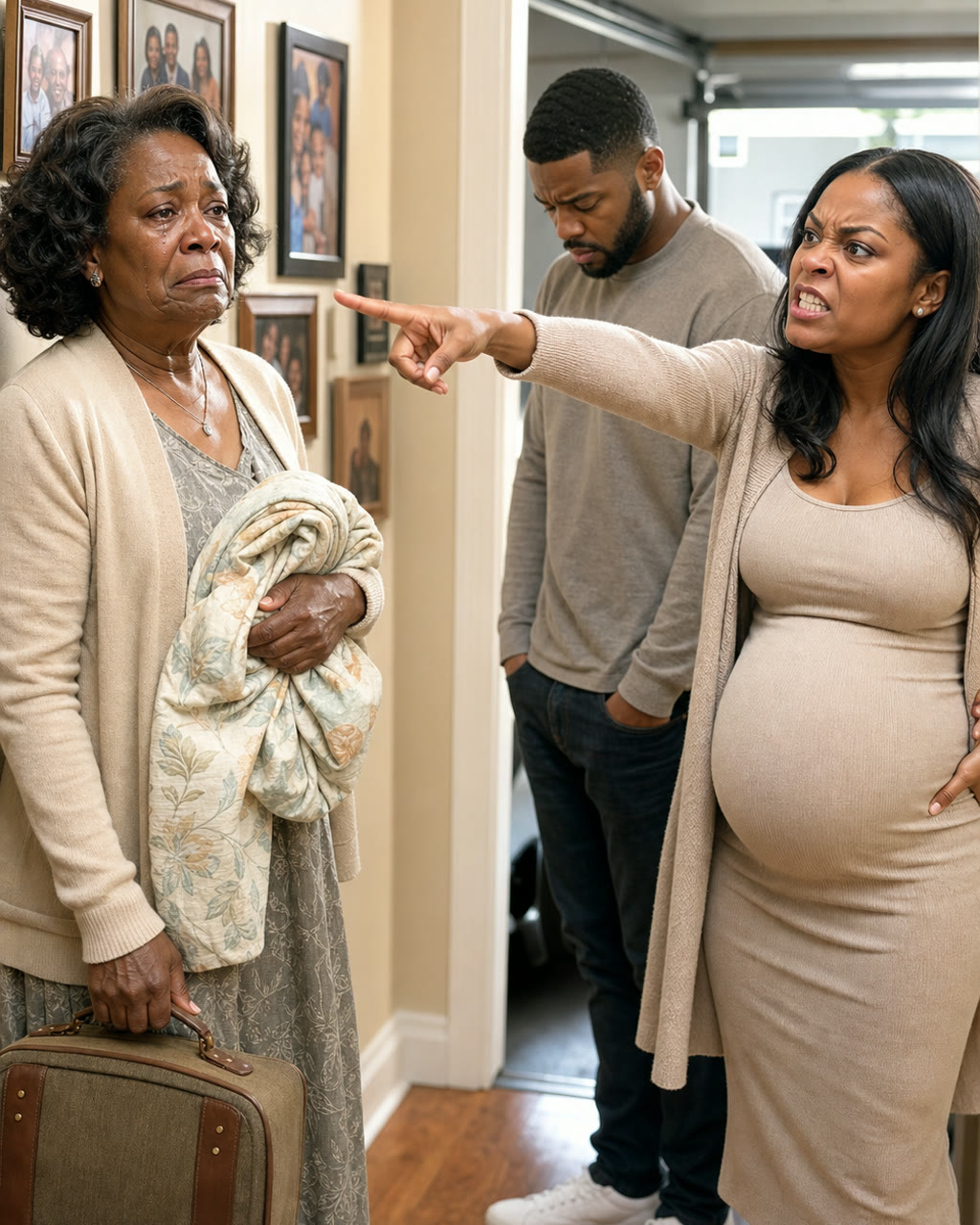
She handed me a folded blanket and pointed past the kitchen. "You can take the garage until the baby comes," she said. "We need the guest room for the nursery." I stood there in my own hallway holding that blanket like a fool.
Chapter 1
My name is Loretta Mae Coleman, and I have swept the same stretch of Delmar Court for forty-one years.
People on this street call me Miss Loretta. The mailman calls me Miss Loretta. The kids who are grown now with kids of their own called me Miss Loretta when they were small and scraping their knees on my front walk.
Nobody calls me a burden until they marry into the family.
Her name is Brianna. She married my son Marcus two years ago in a church I paid half the rental on. She is twenty-nine, sharp as a new knife, and she has never once looked at me like I was a whole person.
I want to be fair to her. She's carrying my first grandchild and her ankles swell and her back aches. Pregnancy is hard, and she was scared, and scared people get mean.
But fair only stretches so far before it snaps.
It started small, the way these things do. A comment about how I fold the towels wrong. A little sigh when I hummed in the kitchen. The way she'd say "we" about the house when the mortgage had my money buried all in the roots of it.
I let it slide. I always let it slide. My mother raised me to keep the peace, and I got so good at keeping it that I let it eat me alive.
There was a Tuesday, about six months back, when I'd spent all day on my feet making a Sunday-sized dinner on a weekday because Marcus mentioned he was homesick for my cooking. Brianna walked in, looked at the table, and said, "You didn't have to make all this. It's a lot of dishes for somebody else to clean."
Somebody else. Meaning her. Never mind I'd wash every one of them myself, like I always did.
I just smiled and said the food would keep. Kept the peace. Kept it right down my own throat.
My friend Pearl from church told me once, "Loretta, you'd apologize to a door for walking into you." She wasn't wrong. Pearl is seventy-four and says exactly what she thinks, which is why I love her and why I don't tell her everything.
Because if Pearl had known half of what went on in that house, she'd have marched over there herself and there would have been words. And I wasn't ready for words yet. I was still telling myself it would get better once the baby came.
That's the lie I lived on. Once the baby comes. Everybody in that house was living on that same lie, just from different rooms.
Let me back up so you understand what kind of woman was standing in that hallway.
I was born in 1957 in a house with no hot water on the wrong side of a city I won't name. My daddy cleaned floors at a hospital and my mama took in laundry, and between them they raised six of us on nothing but grit and Sunday hope.
I started working at fourteen. Cleaning houses, then a diner, then a hospital cafeteria when I got old enough. I married my husband Cornelius when I was twenty-four and we didn't have two nickels to rub warm.
But Cornelius, God rest him, had a mind for one thing: land.
"They ain't making no more of it, Retta," he'd say. "Everything else they can print. Not this."
So we scraped. We ate beans four nights a week for years. When other folks bought new cars we bought a run-down duplex two streets over and fixed it with our own hands on weekends.
Cornelius did the plumbing. I did the painting and the books. We rented one side and lived in the other and we did it again, and again, and again.
I want you to understand what that cost. There were winters we kept our own heat down to fifty-eight degrees so we could pay the plumber for a rental's burst pipe. We wore coats in our own living room. I learned to see my breath and not complain.
There was a Christmas Marcus was seven and asked for a bicycle, and we had the money — we had it three times over sitting in the bank for the next down payment — and Cornelius looked at me and I looked at him and we bought that child a used bike and let him think it was all we could do.
He rode that bike for six years. He never knew. That's the kind of quiet we lived in. We hid our own success from our own son on purpose, like it was a shameful thing, when really it was the proudest thing we ever built.
Some nights I wonder if that was cruelty dressed up as wisdom. But then I remember the men Cornelius came up with, the ones who got a little money and got loud and lost it all and lost their sons too. And I think maybe we saved Marcus from something, even if we cost him something else.
By the time Marcus was born in 1988, we owned three little houses on Delmar Court. By the time he was in high school, we owned nine.
We never told him. That was the thing.
Cornelius had a rule. "A child who knows he's rich," he said, "forgets how to work." So we lived plain. We drove old cars. Marcus got a scholarship because he thought he had to, and he never knew we could have paid.
We wanted him hungry. We wanted him decent. I think somewhere along the way we forgot to teach him one thing, and I've laid awake many nights over which thing it was.
When Cornelius died, the properties came to me. Fourteen of them by then, plus the vacant lots on the corner. I quietly kept collecting rents through a management company, kept the tenants happy, kept my mouth shut.
I never spent it on myself. What does an old woman need? I gave it away, mostly. Scholarships at the church. A new roof for a neighbor. Groceries left on porches with no note.
The whole street knew Miss Loretta helped people. Nobody knew Miss Loretta owned the ground they were standing on.
Ida Jenkins, who rents the house across the street, has called me her guardian angel for eleven years because her rent never once went up and repairs happen the same day she calls a number she thinks belongs to a management company. That number rings a phone that Deborah answers. Deborah calls me. I say fix it. It gets fixed.
Ida thinks she got lucky with a kind landlord. She doesn't know the kind landlord is the old woman she waves to every morning while I water my roses.
That's how I liked it. There is a particular quiet joy in being the reason for a blessing that nobody can trace back to you. Cornelius taught me that too. "The left hand," he'd say, quoting the scripture, "don't need to know what the right hand's doing."
Not even my son.
So when Marcus called me two years ago and said Brianna was pregnant and money was tight and would I consider selling my little house and moving in to help — I said yes before he finished the sentence.
I sold my house. I put the money toward their mortgage without making a show of it, told them it was "a little gift to help out." Sixty thousand dollars, that little gift. I gave up my own front door to sleep in their guest room and be near my grandbaby.
I told myself it was love. It was. But I know now it was also loneliness, and loneliness will make you agree to your own erasure.
After Cornelius passed, that house I lived in got so quiet I could hear the clocks. I'd set two coffee cups out of habit and then have to put one back. A woman can only pour out one coffee cup for so many mornings before she'll trade almost anything for a full table.
So when Marcus offered me a spot at his, I didn't hear "we need a live-in cook and a down payment." I heard "come be near your grandchild." I heard "you won't be alone." I heard what I wanted to hear, the way lonely people do.
The first year was all right. I cooked. I cleaned. I stayed out of the way. Brianna and I even laughed sometimes, over cooking shows, both of us pretending we liked the same one.
Then the pregnancy came and the house filled up with tension like water filling a basement. Slow. Then all at once.
The night it happened, I had made oxtails. Marcus's favorite since he was a boy, the way my mama taught me, cooked down soft for three hours until the meat falls off clean.
He came home late and didn't touch them. Said he ate at work. He wouldn't look at me and I should have known something was already decided before I even set the table.
We sat in the living room. Brianna had that folded blanket in her lap, the good one, the blue one I'd knitted. And she came out with it plain, like she was ordering at a drive-through.
"Loretta, we've been talking. We're going to need the guest room for the nursery. So you can take the garage until the baby comes. We fixed it up a little."
I heard the word garage and I didn't hear much after.
I looked at my son. My Marcus. The boy who used to hold my hand in the grocery store because he was scared of the freezer aisle.
He was looking at his shoes.
The refrigerator hummed. Somewhere down the block a dog barked twice and quit. I heard all of it very clearly, the way you hear everything when the ground drops out from under a moment.
"There's a space heater out there," Brianna went on. "And a cot. It's really not that bad. It's just temporary."
Temporary. I have learned that temporary is the most dangerous word in the English language. It's how you get people to accept the permanent.
My hip was aching from standing at the stove all afternoon. It was thirty-eight degrees outside and that garage shared one thin wall with the cold.
I opened my mouth to say something with dignity in it.
Nothing came out.
I thought about Ida across the street in a house I own, warm as toast. I thought about the fourteen deeds in Deborah's fireproof drawer. I thought about a young man crying in a grocery store freezer aisle who grew into a man who could send his mother out to the garage without a word.
And I understood that all the land in the world hadn't bought me the one thing I came to this house for. Respect. A chair at the table that couldn't be moved.
So I did the thing I have done my whole life. I nodded. I took the blanket. I stood up slow, one hand on the arm of the couch, and I walked toward the kitchen and the door that led out to the concrete.
I passed the wall of family photos on my way. Cornelius in his good suit. Marcus in his cap and gown, the degree I helped pay for that he thought he earned alone. Me and my mama, both of us young and tired and smiling anyway.
I looked at my mama's face on that wall. She raised six children in a house with no hot water and never once let anybody put her in a corner. I felt her looking back at me like she was ashamed of how quiet I'd gotten.
Not tonight, her face said. Tomorrow. But tonight, one more time, be smart instead of loud.
And behind me, my son Marcus finally spoke. He said the words that I will carry to my grave.
He said, "Thanks, Ma. It really helps us out."
Chapter 2
The garage smelled like gasoline and old cardboard.
They had "fixed it up," which meant they'd swept a path to a folding cot and plugged in a space heater that clicked and buzzed and did almost nothing against the cold coming up through the floor.
I sat down on the edge of that cot with the blue blanket in my lap and I looked at my hands.
Working hands. Big knuckles now, from the arthritis, but strong. Hands that had painted a hundred rooms and raised a son and buried a husband and never once been raised against anybody.
There was a box on the shelf above the cot marked MARCUS - SCHOOL in Cornelius's handwriting. Report cards. A macaroni turkey from second grade. A father who saved every scrap of a boy he was too proud to spoil.
I reached up and touched that box in the dark and I thought, Cornelius, look what I let him become. Look what I let myself become right alongside him.
I did not cry. I want you to know that. I have cried plenty in my life but not that night.
Something else happened instead. Something I hadn't felt in a long, long time. My mind got very clear and very cold, like the air around me.
I thought about Cornelius. I thought about what he would have done, and I knew, because I knew that man for thirty-two years.
He wouldn't have raised his voice. He never did. He'd have gotten quiet, and then he'd have gotten precise.
I slept maybe two hours. My hip screamed every time I turned. Around four in the morning I gave up and sat wrapped in the blanket listening to the heater tick.
The cold in a garage is a different animal than the cold outside. It comes up through the floor, through the thin legs of a cot, into your bones where it settles in and makes itself at home. My daddy died of pneumonia he caught working a cold job he was too proud to quit. I thought about him too, out there. I thought about a lot of dead people that night. The cold brings them close.
I pulled the blue blanket tighter and I noticed my own hands had stopped shaking. Not from warmth. From something else. From decision.
That's when I did the math.
The house I was sitting behind — the one Brianna called "ours" — sat on Delmar Court. I owned the two lots directly beside it. I owned the house across the street where the Jenkins family rented. I owned the corner where the little store was, and the three houses on the next block, and the empty lot where the kids played ball.
But here's the part that made me sit up straight in the dark.
That mortgage. Marcus and Brianna's mortgage. I knew something they didn't.
When Marcus bought that house four years ago, he was short on his down payment and his credit was thin. The bank was going to deny him. He came to me crying, and I made a call — a quiet call, to a man named Otis Freeman who runs the small local lender that holds paper on half this neighborhood.
Otis is seventy-one. He and Cornelius came up together, two Black men trying to buy property in a city that spent thirty years telling them no in a hundred polite ways. They got told no at banks that would've said yes to a white man with half their savings. So they built their own way around it, slow and legal and stubborn.
Otis owes my late husband more favors than he can count, and Otis is loyal the way old Black men from our generation are loyal, which is to say completely and without a receipt. When Cornelius was dying, it was Otis who sat with me in that hospital every single night so I could sleep an hour. You don't forget a man who does that. And Otis has never forgotten what Cornelius did for him first, back when it counted.
I had asked Otis to carry Marcus's loan through his company. To make it work. And Otis did.
Which meant the note on that house — the very roof over Brianna's head — was held by a company that answered to a man who answered to me.
I had never told a soul. I'd meant it as a blessing. A secret hand under my son's life, holding him up so he'd never know how close he came to falling.
Sitting on that cot at four in the morning, I understood that the blessing had a second face. The same hand that holds you up can stop holding.
I want to be honest about the thought I had, because a lie would make me look better than I am.
For one long minute, I thought about ruin. About making a call and letting them feel the ground move. I thought about the look that would come across Brianna's face.
Then I thought about the baby. My grandchild, not even born yet, who had done nothing but exist inside a scared and unkind woman.
And I put the thought down. But I didn't put down the clarity. Those are different things.
I decided I would not be ruined by them and I would not ruin them. But I was done being invisible. That night in the garage, invisible Loretta died on that cot, and something with a spine got up in the morning.
Then I stood up off that cot, and my hip locked, and I had to hold the shelf a full minute before I could straighten. Sixty-eight years old, bent over a cot in a garage, waiting on my own body to let me stand.
And I made myself a promise right there. No grandchild of mine is ever going to see me bent like this in a corner. That baby is going to know a grandmother who stands up straight in the middle of the room and belongs there.
I made breakfast like always. Grits, eggs, the good bacon. Brianna came down in her robe and didn't say good morning. Marcus came down and mumbled something and stared at his phone.
"Morning," I said, clear and even. "Sleep good?"
Brianna glanced up, a little surprised at my tone. "Fine," she said.
"I didn't," I said, and smiled, and set his plate down. "But I'll manage. I always do."
I saw Marcus's jaw tighten. Good. Let it.
Over the next few days I did three things, quietly, the way Cornelius taught me.
First, I called Otis Freeman and had lunch with him at the diner where I used to work. We talked a long time. I told him everything. He got quiet in that way old men do, and at the end he put his hand over mine and said, "Retta, you say the word and it's done. Whatever word you pick."
Second, I called my attorney. Yes, an old cleaning woman has an attorney. Her name is Deborah Nwosu and she has managed my properties and my will for eleven years, and she is the only person alive besides Otis who knows exactly what I'm worth.
I asked Deborah to pull every document. The deeds. The trust. The will. I told her I might be making changes.
Deborah did more than pull documents. She sat me down in her office with a cup of tea and asked me the hard question, the one only a good lawyer and a good friend will ask.
"Loretta," she said. "What is it you actually want? Because I can make almost anything happen with what you own. I can make them homeless by Friday. I can make them rich by Monday. Tell me the want underneath the want."
I sat with that a long time. And what came up surprised me.
"I want to matter in that house," I said finally. "Not the money. The money never mattered to me a day in my life. I want to walk into a room and have my own son see me. That's the whole thing, Deborah. Sixty-eight years old and I just want to be seen by the boy I raised."
Deborah wrote something on her pad and didn't show me. She just nodded and said, "Then that's what we'll build toward. Not revenge. Being seen. Those take different tools."
Third, and this is the one that cost me the most, I started paying attention. Really watching. Not the wounded watching of somebody looking for hurt, but the clear watching of somebody gathering truth.
And what I saw over those two weeks in that garage broke something loose in me.
I saw that Marcus was afraid of his wife. Not in a hitting way — nothing like that. In a smaller, sadder way. He had traded his backbone for peace, the same trade I'd made my whole life, and watching him do it was like watching myself in a cruel mirror.
I saw that Brianna wasn't just mean. She was drowning. She'd say cruel things and then stand at the sink shaking. There was fear under the meanness, thick and old, and it didn't start with me.
I saw that this family was going to bring a child into a house running on fear and silence, the exact things I'd spent my life running on, and I could not — I would not — let that baby inherit our disease.
One evening I overheard them through the wall. I wasn't trying to. The garage shares that thin wall with their bedroom and voices carry.
Brianna was crying. "I keep waiting for the day you decide I'm too much and put me out," she said. "Everybody does. My own mother did."
And Marcus said, so soft I almost missed it, "I'm never going to put you out, Bri." And then, after a pause that told me everything: "But I don't know how to stand up to you either. So I just go quiet. And I hate myself for it."
Two frightened people, holding onto each other and drowning both. And I was the mother who'd taught one of them to go quiet in the first place. I heard my own failure in my son's voice through a garage wall.
That's when the plan stopped being about my pride. It became about breaking a chain before it wrapped around a baby's neck.
So I made my plan. And on a Sunday, two weeks into my life on the concrete, I put on my good church dress, and I asked Marcus and Brianna to sit down at the table because I had something to say.
Brianna rolled her eyes. "Loretta, we're really busy today —"
"Sit down," I said.
I did not raise my voice. I have never in my life had to raise my voice to be heard, because when a quiet woman finally speaks plain, the whole room leans in.
Brianna opened her mouth to argue and then looked at my face and closed it again. Whatever she saw there was new to her. It was new to me too. I'd caught a glimpse of it in the bathroom mirror that morning and hardly knew the woman looking back.
They sat.
I put a manila envelope on the table between us. Deborah had prepared it. It was thick.
"Before either of you says a word," I said, "I need you to open that and read the first page. Just the first page. Then we'll talk."
Marcus reached for it. His hand was shaking.
He slid out the papers, and I watched my son's eyes move down the page, and I watched the color leave his face as he read the address at the top.
His own address. On a document that had my name on it in a place he never expected to see it.
He looked up at me, and for the first time in two weeks, my son looked me full in the face.
"Ma," he whispered. "What is this?"
Chapter 3
I let the question sit there a second before I answered. I'd earned that second.
"That," I said, "is a summary of everything I own. Deborah put it together. Read it out loud, Marcus. Your wife should hear it too."
His hands were unsteady but he read.
The duplex on Vine. The two lots beside their own house. The rental across the street where the Jenkins family lived. The corner store property. Three houses on the next block. The vacant lot. On and on. Fourteen properties and change, all held in the Cornelius and Loretta Coleman Family Trust.
Brianna had gone very still. Her hand drifted to her belly the way it did when she was rattled.
Marcus got to the last line and his voice cracked. "Estimated value," he read, "two point four million dollars."
The number sat in the kitchen like a third person nobody had invited.
Brianna's coffee cup stopped halfway to her mouth. She set it back down without drinking. Her eyes went from the paper to me and back to the paper, doing a kind of math I could watch happen on her face.
"Ma," he said. "I don't — you clean houses. You drive a two-thousand-and-six Corolla. You cut coupons. I've watched you cut coupons."
"I know," I said. "Your daddy and I decided you'd never know. We wanted you to grow up hungry so you'd grow up decent." I paused. "One of those took."
"The bicycle," Marcus said suddenly, and his voice cracked on the word. "The used bicycle. When I was seven. You could've — you had the money the whole time?"
"We had it three times over," I said. "And I have regretted that bicycle for forty years, son. Not because we were wrong to teach you the value of a dollar. Because I let you believe your parents couldn't give you things, when the truth was we chose not to. There's a difference, and it's a difference I owed you and never paid."
He wiped his face with the back of his hand, a gesture I hadn't seen since he was a boy.
Brianna's mouth opened. "Wait. You have two million dollars and you let us struggle with this house? You let Marcus almost lose the loan?"
There it was. Even now, even here, she made it about what she'd been denied.
I looked at her a long moment.
I let that hang a second, and I chose my next words like Cornelius choosing which board to buy.
"Let me tell you what my daddy earned in a year, cleaning hospital floors on his knees," I said. "It wouldn't cover two months of what you spend on the things in this house. And that man came home every night and thanked God at a table with holes in the tablecloth. He never once made his mother sleep by a furnace. He never once made anybody feel small so he could feel big."
"That's the money you're mad you didn't get," I went on. "It came out of knees and lye soap and fifty-eight-degree living rooms. It came out of people who got told no their whole lives and built anyway. So don't sit at my son's table and tell me I let you struggle. You have never struggled a day the way the people who built that number struggled."
Brianna's face was red. She wasn't used to being talked to plain. Nobody ever loved her enough to do it, I suspect.
"Turn the page, baby," I said, and my voice was soft, and that softness scared her more than shouting would have.
Marcus turned the page. And then he made a sound I hadn't heard from him since he was a small boy.
The second document was the note on their house. The mortgage. And stapled to it was a letter, on Otis Freeman's company letterhead, confirming that the loan was held by his firm — and that his firm had originated it, four years ago, at the personal request of Loretta M. Coleman, who had guaranteed it.
There was a photograph clipped to that letter too. Deborah's idea. It was Cornelius and Otis, young men, standing in front of the very first duplex we ever bought, arms around each other, grinning like they'd robbed a bank when really they'd just done something the world said they couldn't.
Marcus stared at that photograph a long time. "That's Grandpa's friend," he said slowly. "Mr. Otis. From the funeral. He's the one who — he approved my loan. I sat across the desk from him. He looked me right in the eye and he never said a word."
"He couldn't," I said. "I asked him not to. That was the deal."
Marcus understood before Brianna did. He'd worked in enough offices to understand.
"You," he said slowly. "You're the reason we got the house. The bank was going to say no. And it just — went through. You did that. You've been carrying our note this whole time."
"Every month," I said. "I could stop your payment from ever coming due, or I could call it tomorrow. I have never done either. I have just been the floor under your feet, Marcus, the same as I've been the floor under this whole street for forty years, and neither one of you ever once thought to look down."
The kitchen was quiet. Not the dramatic kind. Just the real kind, where two people are rearranging their entire understanding of a woman they thought they'd figured out.
Brianna was the first to speak, and I have to give her this: she didn't reach for the money.
"Are you going to take the house?" she asked. Her voice was small. Both her hands were on her belly now. "Are you going to put us out? Is that what this is?"
And you know what? For a flicker, I saw her clear. Not the sharp-tongued girl who sent me to the garage. A young woman, pregnant, terrified, who had just learned that the mother-in-law she'd disrespected held the deed to her whole life in one hand.
She thought I was about to do to her exactly what she'd done to me. Only bigger.
Because that's how she'd have done it. People show you their own hearts when they guess what you'll do next.
"Sit back," I said. "Both of you. I'm going to tell you a story, and then I'm going to tell you what's going to happen. And you're going to listen, because I have listened to the two of you for two years and it's my turn."
I told them about the beans. The four nights a week of beans for eleven years. I told them about painting rooms until two in the morning with a colicky baby on my hip and Cornelius under a sink somewhere with a wrench.
I told them about my daddy cleaning hospital floors and my mama's hands cracked from lye soap, and how everything I owned, every brick of it, was built on the backs of people who were told their whole lives they were less-than, who died before they ever got to see a grandchild sleep in a warm room.
"You put me in a garage," I said. My voice didn't shake. "On concrete. At my age. With my hip. And my son"— I looked at Marcus and I did not soften it — "my son found his shoes real interesting while it happened."
Marcus put his face in his hands. His shoulders were going.
"I slept out there fourteen nights," I said. "Fourteen. And every one of those nights I was the reason your lights stayed on. I was the reason your water ran. I was the floor and the roof and the walls, and you had me on a cot next to the water heater like a bag of old clothes you meant to give away."
"Ma, stop," Marcus said into his hands. "Please."
"No," I said, gentle but firm. "You listened to your wife send me out there. You can listen to me now. It's the least a mother's owed."
I saw Brianna flinch, but she didn't argue. To her credit. She was learning something in real time, and the smart ones always do.
"I didn't tell you all this to punish you," I said. "Lord knows I could. Otis is waiting on a phone call from me right now. One word, and this note comes due, and you learn what the concrete feels like."
Brianna made a small sound.
"But I'm not going to make that call," I said. "You know why?"
Neither of them could answer.
"Because there's a baby coming," I said. "And I have watched this family for two years now, and I have figured out the disease that's in it, and it is the same disease that was in my house growing up and the same one I passed to Marcus without meaning to. Fear. Silence. People not saying the true thing until it's too late."
I thought about my mama on that wall of photos. I thought about all the quiet women in my line who swallowed their words until the words rotted inside them. Strong women who mistook silence for strength and passed the mistake down like an heirloom.
"I have been quiet my entire life," I said. "I was quiet when I should have been loud, and I'm just now, at sixty-eight years old, learning the difference. I will not spend the years I have left being quiet in a corner. And I will not raise a grandbaby to think that's what a woman is."
I stood up. My hip caught and I let it show. No more hiding my age to make anybody comfortable.
"I heard you two through the wall," I said quietly. "Both of you. I know your mother left you on a porch, Brianna. I know, Marcus, that you go quiet because you're scared of losing her. I know more about the both of you than you know about yourselves."
Brianna's face crumpled. "You heard that?"
"Thin walls in a garage," I said. "You'd know that if you'd ever slept out there. I did. Fourteen nights. I heard everything."
"That baby is not going to grow up in a house that runs on fear," I said. "I will not allow it. So we are going to do this different. But there are conditions. And they are not about money."
Marcus lifted his wet face. "Anything, Ma."
"Don't say anything," I said. "Say it when you hear it."
I picked up the envelope and held it against my chest, the way I'd held that blanket two weeks before.
"Tomorrow morning," I said, "the three of us are going to Deborah's office. And I'm going to make some decisions that are going to change how everybody in this house wakes up in the morning. Including me."
I looked at my son, and then at the woman carrying my grandchild, and I said the last thing before I went back out to my cot, because I still hadn't slept a night in that house since they put me out.
Brianna spoke up, small and shaking. "Miss Loretta. Whatever you decide tomorrow. I just — I need you to know I'm scared. That's all it ever was. I get scared and I get mean. I don't know another way yet."
"I know, baby," I said, and I meant it, and it surprised us both. "I've known it a while. Scared is not an excuse. But it's a start, if you're willing to say it out loud in the daylight. You just did. That's more than my son can do most days."
Marcus made a sound and I held up my hand.
"You should both pray," I said, "that you like the kind of woman I actually am. Because you have spent two years disrespecting a stranger you invented. Tomorrow you're going to meet me."
And I walked back out to the garage, and I closed the door behind me, and I let them sit with that all night long.
Chapter 4
I did not sleep in the garage that night either, but not because they made me.
I stayed out there on purpose. I wanted one more night of clear thinking before the morning, and the cold is good for clear thinking. Cornelius always said the cold burns the foolishness off a decision.
Around midnight, the door opened.
It was Marcus. He had a blanket around his shoulders and his eyes were swollen and he looked eleven years old.
"Ma," he said. "You can't sleep out here. Please. Take my bed. I'll sleep out here."
"Sit down, Marcus," I said, and patted the cot.
He sat. The heater ticked. For a long time neither of us said anything, and it was the first honest silence we'd shared in years.
"I knew it was wrong," he finally said. "When she said it. When you took the blanket. I knew. And I couldn't — Ma, I don't know when I turned into a man who can't say a word in his own house."
"I do," I said. "You learned it from me. I never once made your father fight for peace, because I gave it to him free before he could ask. I taught you that love means going quiet. That's on me, son. But you're grown now, and grown men have to unlearn things."
He cried then, quietly, the way I'd taught him without meaning to. I put my arm around my boy and we sat in that cold garage together, and something that had been broken between us for a long time knit up just a little.
"You know what your daddy would say if he saw us out here?" I asked.
Marcus shook his head against my shoulder.
"He'd say, 'Retta, why in the world are you two sitting in a cold garage when there's a whole warm house right there with your names on it?'" I laughed a little. "And he'd be right. That man was always right. It made him impossible to argue with and I miss it every single day."
"I don't really remember him," Marcus admitted. "I was young. I remember he was quiet. I remember he smelled like pipe tobacco and WD-40."
"That's him," I said. "That's exactly him. And I'll tell you about him. Every day if you want. That baby's going to know who Cornelius Coleman was if I have to write it on the walls."
"She's scared, Ma," he said. "Brianna. Her mother put her out when she was seventeen. Pregnant. Left her on a porch with a trash bag. She's terrified of not having a place. I think — I think that's why she does it. She grabs before anybody can take."
And there it was. The whole knot, finally in the light.
"I figured it was something like that," I said. "Hurt people guard their space like animals. Doesn't make it right. But it makes it human." I squeezed his shoulder. "Now go to bed. We've got an early morning."
The next day the three of us drove to Deborah Nwosu's office in my old Corolla. Nobody talked. Brianna sat in the back with her hands folded on her belly.
Deborah is a tall Nigerian-American woman with a spine like a flagpole and zero patience for foolishness. She had everything ready.
I'd called her at seven that morning and told her the changes I wanted. She'd argued with me on one of them, hard. I'd overruled her. It's my life.
The thing she argued about was the mortgage. "Loretta," she'd said, "you do not forgive a debt for people who just put you on a garage floor. That is not grace, that is you rewarding cruelty. At least make them earn it."
And I'd said, "Deborah, if I make a grandchild's roof conditional on the parents behaving, I've built the same house I grew up in. A house where love has to be earned and can be taken away. I won't do it. That baby's floor is going to be free and clear or I've learned nothing at all."
She'd gone quiet on the phone. Then she said, "I still think you're too soft. But I'll draw it up. And Loretta — that's the best reason I've heard anybody give for anything in a long time."
We sat down at her long table and I laid it out plain.
"First," I said. "The mortgage. Marcus, Brianna. As of this morning, that note is paid in full. Deborah has the paperwork. You don't owe the bank, you don't owe Otis, you don't owe me a payment. The house is yours, free and clear, in both your names."
Brianna's head came up. "What?"
"You heard me," I said. "The roof over my grandbaby's head is not going to be something anybody can ever take. Not a bank. Not me. Not your mother, Brianna. Nobody. That child is going to grow up with a floor that can't fall out."
Brianna started crying. Not pretty crying. The real kind, the kind that comes up from somewhere old.
"Second," I said. "The trust. I'm restructuring it. Everything — all fourteen properties, all of it — is going into a family trust that pays out for one thing and one thing only: this family and this neighborhood. College for that baby. A fund the church can draw on for folks about to lose their homes. Repairs for the Jenkins family and everybody else renting from me who's been calling me Miss Loretta for forty years without knowing I held their keys."
Marcus was staring at me. "Ma, that's — that's your whole life."
"That's exactly what it is," I said. "My whole life. And I'm going to spend the rest of it deciding who deserves a piece of it. Which brings me to the hard part."
I turned to Brianna.
"You put me in a garage," I said. "And I'm not going to pretend it didn't cut. But I've been thinking about a girl on a porch with a trash bag, and I've been thinking that maybe you never once in your life had somebody choose to keep you when it would've been easier to put you out."
Her face came apart.
"So here's what I choose," I said. "I choose to keep you. Not because you earned it. Because that's what the strong do for the scared. Somebody should've done it for you a long time ago and didn't. I'm doing it now."
"I want to say one more thing about the garage," I said, "and then I'm going to put it down and never pick it up again, and I need you both to let me."
They waited.
"I could have made that phone call," I said. "Standing in the cold at four in the morning, I wanted to. I am not a saint and I won't pretend I am. For one whole minute I wanted to watch the two of you learn what that concrete felt like. That minute was real and I'm not ashamed of it. Being hurt and wanting the hurt returned — that's just human."
I looked at Brianna. "But then I thought about a girl on a porch with a trash bag. And I decided the chain stops with me. Somebody in this bloodline has to be the one who gets hurt and chooses not to pass it down. I've decided it's going to be me. And one day, when it's hard, it's going to have to be one of you."
She was sobbing into her hands, and my son had his arm around her, and Deborah was looking at me over her glasses with something that might have been respect or might have been exasperation, hard to tell with Deborah.
"But hear me," I said, and I made my voice like iron. "I am moving back into that guest room. Today. And the nursery is going in the third bedroom, the one you're using for an office, Marcus, because a baby needs a room more than you need a desk. And I am done being invisible in a house I built the foundation under. From now on, when I speak, you listen. All the way. Is that understood?"
"Yes, ma'am," Marcus said.
Brianna looked up, her whole face wet and open in a way I'd never seen it. "Miss Loretta," she said. She'd always called me Loretta before. Now it was Miss. "I'm so sorry. I don't— I don't know how to be somebody people keep. I never learned it."
"I know, baby," I said. "That's alright. You've got about six months before that baby comes to start learning. And you've got me to teach you. Lord help us both."
And she laughed. Wet and broken and surprised, but a real laugh. And I reached across Deborah's fancy table and I took that scared girl's hand, and she let me, and she held on.
Deborah cleared her throat then, and there was one more thing.
"There's a codicil," she said, sliding a page across. "Loretta insisted on it this morning, over my objection. Marcus, Brianna — read it."
Marcus read it aloud, and his voice went thick. "In the event that I, Loretta Mae Coleman, am ever again asked to leave the main living quarters of any home shared with family, the family trust's support of that household terminates immediately and permanently."
He looked up. "Ma."
"That's not a threat," I said. "That's a fence. Every good piece of land needs one. That fence protects all three of us from the worst version of ourselves. You won't ever put me in a garage again, and I won't ever have to wonder if you would. Now we can just love each other without the door standing open."
We drove home in the Corolla, all three of us, and this time we talked the whole way.
That was seven months ago.
My granddaughter was born in the spring. They named her Cornelia, after Cornelius, and when Brianna put her in my arms in that hospital room, that girl looked up at me and I swear to you she already knew me.
I sleep in the guest room now, but most mornings I wake up early and I go get Cornelia so her mama can rest, and I sit with her in the kitchen where I make the grits, and I tell her about a man who believed they weren't making any more land.
Brianna calls me Mama now. Took her a few months. It comes easy to her these days.
Marcus found his voice. He uses it careful, like a man who lost something once and got it back and doesn't want to lose it again.
And the blue blanket — the one Brianna handed me when she sent me to the garage — that blanket is in Cornelia's crib right now, tucked around my granddaughter, keeping the child warm.
People ask me sometimes, the ones who know the story, if I regret not making that phone call. If I regret not letting them feel the concrete the way I felt it.
I tell them the truth.
I own this whole street. Every house on it. And the only thing I ever really wanted to own was a family that would keep me the way I kept them.
I got that. I got it out of a garage floor and a folded blanket and a second I could've spent on ruin and spent on grace instead.
You can't buy that with two million dollars. But sometimes, if you're very, very stubborn about who you decide to be — you can build it.
You may also like
The Silent Truth Behind My Daughter's Accident
The call came at 11:47 at night.…
Read the full story →The Night Evelyn Harper Took Back Her Power
My husband's mistress openly mocked me while my husband smiled… While they laughed at my pain, they never realized that I was the one in control. The moment I whispered, "Everythin…
Read the full story →He Fired the "Cleaning Lady" in Front of the Whole Office — Nine Minutes Before the Board Handed Her the Company
My name is Eleanor Reyes, and for eighteen months the people at Meridian Textiles thought my name was "hey" or "the cleaning lady" or, on a good day, "Ellie, could you get the brea…
Read the full story →