The Toast They Drank Too Soon
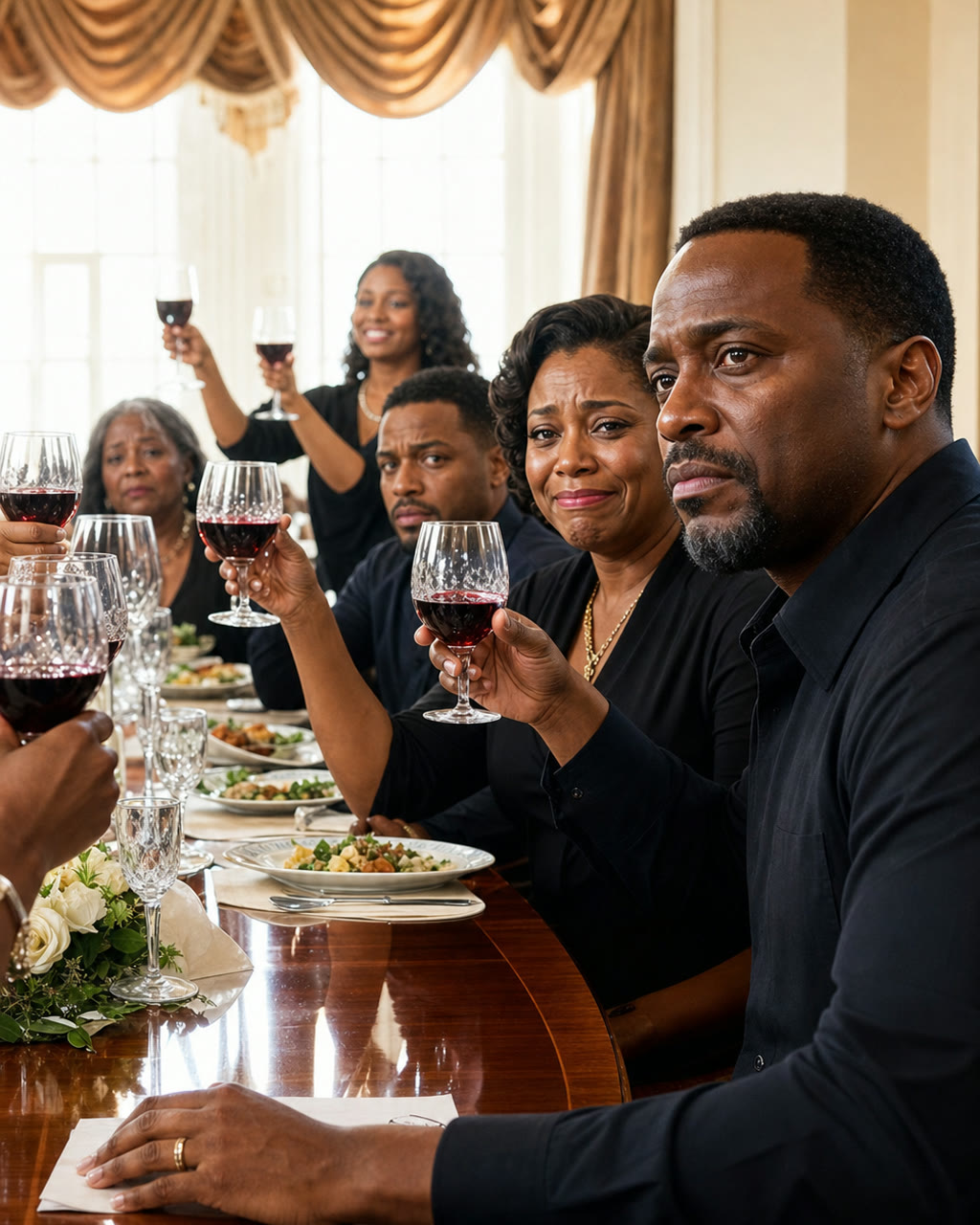
They raised their glasses to me and said "To Marcus, the good son," and I smiled back like I didn't already know they'd met with a lawyer the day before Daddy was even in the ground. My own sister squeezed my hand under the table. The same hand she used to sign papers meant to take everything Daddy left me.
Chapter 1
The chicken was still warm when they started planning to rob me.
I know that because I was the one who reheated it. Aunt Deborah had dropped off two foil pans after the repast, and somebody had to put dinner on the table for the family gathering that night. That somebody is always me.
My name is Marcus Whitfield. My father was Nathaniel Whitfield, and eleven days ago I watched the monitor beside his hospital bed go flat while I held a Styrofoam cup of coffee I never drank.
We buried him on a Tuesday. This dinner was the following Saturday.
Daddy owned an auto shop on Delmar Boulevard for thirty-one years. Whitfield & Son, the sign said, even though I was the only son and I never once turned a wrench for a living. He put my name up there when I was seven. He said a man should see his name somewhere and know it means he belongs.
I teach middle school history now. Eighth graders. I am, by every measure my family uses, the one who "didn't do nothing with himself."
That's fine. I made peace with that a long time ago.
I made peace with a lot of things being the one who stayed. When Daddy's knees gave out, I moved back into my old room to help. When he couldn't drive at night, I drove him. When the diagnosis came, I was the one in the room, because I was always the one in the room.
Nobody thanked me for it. In my family, doing right by somebody just means you've volunteered to keep doing it.
What I hadn't made peace with was the sound of my sister's voice through a bathroom door.
Let me back up.
The house was full that night. My sister Renée came with her husband, Terrell. My brother Dominic drove in from Kansas City. Aunt Deborah, Daddy's baby sister, came with her son, my cousin Jerome. Even Daddy's old friend Mr. Otis stopped by, though he left early because funerals sit heavy on old men.
I want you to know these people, because that's the only way any of this makes sense.
Dominic is the oldest. Forty-one. He was Daddy's first, and there was a time he was Daddy's favorite, back when he played ball and colleges called the house. Then the knee went, and the scholarship went, and Dominic went to Kansas City to be angry somewhere else. He's loud. He fills a room. But he's been broke for fifteen years and too proud to say why.
Cousin Jerome is quiet, the way people are quiet when they've decided nothing is their fault. He mostly does what his mother tells him and eats whatever's on the table.
And Aunt Deborah. Daddy's baby sister. She loved my father. I believe that even now. But Deborah has spent her whole life keeping score of who owes her, and grief just gave her a new ledger to open.
I cooked. Renée arranged the flowers people had sent. Dominic sat in Daddy's recliner like it was already his.
I noticed that. Him in the recliner. I told myself it didn't mean anything. Grief makes you sit where the person used to sit. That's normal.
I told myself a lot of things that night that turned out to be wrong.
Nobody talks about how loud a house gets after a death. Everybody performs. The laughter is too quick and lands too hard. People tell the same three stories about the person because the fourth story might make somebody cry, and crying is not what this is for.
This was a business dinner wearing a funeral's clothes. I just didn't know it yet.
I was in the kitchen fixing plates when Renée followed me in. She wrapped her arms around me from behind and put her cheek on my shoulder blade.
"You holding up, big brother?"
Renée is thirty-five. She's the pretty one, everybody says so, and she learned early that pretty opens doors that hard work has to knock on. She's warm. She remembers birthdays. She'll drive four hours to sit with you in a hospital.
She also owes forty thousand dollars she has never once mentioned to anybody who might ask her to pay it back.
"I'm alright," I told her. "Grab the greens."
She grabbed the greens. She kissed my cheek. She told me Daddy was proud of me, and I believed her, because that part was true.
I want to be fair to Renée. Whatever comes later, I want that on the record first.
When we were kids and Momma passed, Renée was nine and I was twelve, and it was Renée who crawled into my bed for a month so neither of us had to be scared alone. She has a good heart under everything. That's what makes it so hard.
A good heart and a weak spine are a dangerous thing to put in the same person. Somebody's always leaning on the spine, and it's always the heart that pays.
That's the thing nobody tells you about betrayal from your own people. The love is real. It sits right next to the knife, and both of them are looking at you with the same face.
Dinner went the way those dinners go. We ate. We said Daddy's name a lot. Dominic told the story about Daddy chasing a raccoon out the garage with a broom, and everybody laughed like it was the first time.
Then Terrell tapped his glass.
Terrell is my brother-in-law. He sells cars — used, mostly, over in Fairview Heights. He has a smile that could sell you back your own watch and a handshake he practices in the mirror. I have never in fifteen years heard that man say a single thing he didn't calculate first.
Daddy never liked him. Daddy was too polite to say it outright, but I noticed he always found a reason to be busy in the garage when Terrell came around. Once, years ago, he told me, "That boy talks to you like you're already agreeing with him." I didn't understand it then. I understand it now.
He stood up with his wine glass and looked at me.
"I want to say something," he said. "To Marcus. The good son. The one who stayed. The one who took care of Nate when the rest of us couldn't be here every day."
The table went warm with agreement. Aunt Deborah dabbed her eyes.
"To Marcus," Terrell said, and lifted his glass higher. "The good son."
They all raised their glasses. Renée. Dominic. Jerome. My whole family, smiling at me across my dead father's table.
I raised mine too. I said thank you. I meant it, God help me, some small part of me meant it.
I looked around that table at the toast and I felt, for one warm second, like I had a family. Like all the cooking and all the driving and all the staying had finally been seen.
That's the cruelest part. They gave me the exact thing I'd wanted my whole life, and they did it as bait.
I didn't know yet that the toast was a rehearsal.
After dinner, plates got cleared and the wine kept pouring and the house settled into that loose, heavy hour when people either go home or start telling the truth.
I went down the hall to use the bathroom by Daddy's old bedroom. The door to that bedroom was cracked, and the light was off, and I heard voices inside.
Renée and Terrell.
I should have kept walking. I want you to understand that I know that. A better man keeps walking. But my father's shirts were still hanging in that closet, and I froze in the hallway of the house I grew up in, and I listened.
"He signed nothing yet," Terrell was saying, low. "That's the whole point. The will names him executor. We move before he understands what that even means."
"He's not stupid, Terrell."
"He's grieving. Grieving people sign what you put in front of them. Deborah's got the lawyer lined up for Monday. We get him to agree to sell the shop, split it four ways even, and put the house in a trust we all control. He'll think it's fair. He'll think it's family."
A pause. I heard my sister breathe.
"And the account?" she said. "The one Daddy kept separate?"
"Nobody's supposed to know about that account but Marcus," Terrell said. "So we make sure Marcus doesn't know we know. Deborah saw the statement in the hospital drawer. There's real money in there, Renée. Enough to make everybody's problems go away."
"Dominic knows?"
"Dominic's the one who needs it worst. He's about to lose the house in K.C. Deborah's behind on everything. And you and me, baby — we both know where we stand."
I stood in that hallway and did the math on my own family. Everybody at that table was drowning. Everybody except me. And instead of asking me for a rope, they'd decided to use my father's body as one.
"Marcus's problems too," Renée said, and for one second I loved her, because she said it.
"Marcus doesn't have problems," Terrell said. "Marcus has a job and no wife and no kids and no debt. Marcus doesn't need it. We do. This is family taking care of family. He'll see it that way if we frame it right."
I stood in that dark hallway with my father four days in the ground and I understood three things at once.
They knew about the account.
They had a lawyer.
And they had already decided I was the kind of man who would hand over his father's life because they smiled at him and called him good.
I want to tell you my hands shook. They didn't. Something in me went very still, the way the house gets still right before the heat kicks on.
I looked down the hall at the light spilling from the kitchen. I could hear Aunt Deborah laughing at something. I could hear a glass being set down on the counter I'd wiped an hour before.
I thought about my father in that hospital bed, grabbing my wrist. Don't let them take what I bled for. I had thought it was the morphine talking. He wasn't on morphine. He was watching the same movie I was just now walking into, except he'd seen how it ended.
I walked back to the dinner table. I sat down. Renée and Terrell drifted back out a few minutes later, laughing about nothing, and Renée refilled my wine and squeezed my shoulder.
"You look tired, Marcus," she said. "Go rest. We'll clean up."
They wanted me tired. They wanted me soft.
So I let them think I was.
I smiled at my sister. I thanked her for the greens. I told my family I loved them, and I went upstairs to my childhood bedroom.
Then I sat on the edge of the bed in the dark and I did the one thing they never once imagined I would do.
I opened Daddy's phone.
Chapter 2
Daddy gave me his phone the day before he died.
Nobody knows that. Not Renée, not Dominic, not Aunt Deborah. In the hospital, when the nurses stepped out, he pressed it into my palm under the blanket and told me the passcode was the day Momma died, and I should keep it and not tell anybody I had it.
I thought he was confused. He wasn't. My father was never once confused in his life, not even at the end. He was ahead of everybody. That's where I got it from, though it took me thirty-eight years to find out.
I'd put the phone in my sock drawer and hadn't touched it since the funeral. It felt like a thing I wasn't ready to open. A dead man's phone is full of a dead man's plans, and I wasn't sure I could stand to see all the things he'd meant to do.
But that night, after what I'd heard through that door, I went and got it.
I sat in my old bedroom that Saturday night and I typed in the date my mother passed, and the phone opened like it had been waiting for me.
The lock screen was a photo of the shop. Of course it was. Not a photo of us. The shop, in morning light, before the cars came. That's who my father was. His work was his love letter, and we were all supposed to be smart enough to read it.
I sat there a second longer looking at that empty shop in the gray morning light. He must have taken it himself, early, alone, before he opened up. I could see him doing it — an old man proud of a building, standing in an empty lot, taking a picture of the one thing in his life that never let him down.
I almost put the phone back in the drawer. Some part of me knew that once I looked, I couldn't un-look.
Then I thought about the toast, and Terrell's raised glass, and I opened it anyway.
The first thing I found was a folder of photos. Not of us. Of paper.
The folder was named, in his careful two-finger typing, "FOR MARCUS."
I sat there and looked at those two words for a long time before I opened it.
Daddy had photographed every document he owned. The deed to the house. The title to the shop. Bank statements. A life insurance policy I didn't know existed. And a will.
Not the will everybody thought they knew about.
The old will, the one Terrell was counting on, was five years old. It named me executor and split the estate between the four of us — me, Renée, Dominic, and a share set aside "for family need," which everybody assumed meant a free-for-all.
But there was a second document, photographed and dated seven weeks before he died.
A new will.
I read it three times sitting on that bed. My father, who left school in the tenth grade, had gone to a lawyer downtown — not Aunt Deborah's lawyer, a stranger, a woman named Patrice Ellison whose card was tucked in the same folder — and he had rewritten everything.
The new will left the house to me. Only me.
I read that line and I heard my father's voice behind it, plain as day. He never wasted a word in his life. Everything he wrote was a decision he'd already argued out with himself and won.
It left the shop to me, "to sell or keep as my son sees fit, because he is the only one who never asked me for a dime."
And the account, the separate account, the one Terrell's whole plan revolved around — Daddy had moved it. Weeks before he died, he'd retitled it as a payable-on-death account with one name on it.
Mine.
A P.O.D. account doesn't go through the will. It doesn't go through the executor. It doesn't get split, argued over, or trusted away. The day my father died, that money became legally mine, no lawyer required, no signature from anybody at that dinner table.
I didn't fully understand all that yet, sitting on the bed. I'm a history teacher, not a lawyer. But I understood enough to know my father had built a wall, and he'd built it quiet, and he'd built it in the last weeks of his life when he could barely walk to the mailbox.
I thought about that. Him dragging himself downtown to a lawyer's office, sick as he was, so his children wouldn't devour each other over what he left behind.
That's how much he already knew.
I sat there and I didn't feel triumphant. I want to be honest about that.
I felt sick.
Because the next thing in the folder was a note. Not typed. His handwriting, the same crooked print that used to sign my report cards.
"Marcus. If you reading this, they came for it like I said they would. I'm sorry, son. I raised them and I couldn't fix them. Do what's right but do it smart. Don't let them take what I bled for. And don't let them turn you into somebody I wouldn't know. Love, Daddy."
I read that note until the words stopped being words.
There's a certain kind of pain in reading a dead man apologize to you for something that wasn't his fault. He said he was sorry. Sorry. For what — for loving me enough to protect me? For raising children who'd rob their own brother?
He carried that. Even dying, he carried the shame of what his family had become, and he tried to hand me the money without handing me the shame. He couldn't do it. The shame came with it. It always does.
I'm sorry, son. I raised them and I couldn't fix them. My father, who fixed everything. Who could hear a bad transmission from across a parking lot. Who never met a broken thing he couldn't take apart and set right. And the one thing he couldn't fix was his own children.
I put the phone down on the bed. I sat with my elbows on my knees and my head in my hands, and I stayed like that a long time.
Downstairs, my family was laughing. Somebody put music on. Low, respectful, but music. They were relaxing now. The hard part was over. They'd made the toast, planted the seed, softened me up. As far as they knew, everything was going to plan.
Then I heard Renée laughing downstairs, and I closed the phone.
Here is what I understood by the time the house emptied out that night.
My father had seen the whole thing coming. He'd watched his own children circle him like weather, and instead of confronting them — because you can't shame greed out of grown people — he had quietly, legally, made sure they could not touch what mattered.
And here's the thing that kept me up. He could have told me all this before he died. He could have sat me down in that hospital room and laid it out. Instead he gave me a locked phone and a passcode and let me find it myself.
I understand now why. If he'd told me, I'd have spent his last days arguing with him, telling him he was being too hard on his own kids, begging him to give them a chance. Because that's who I am. I'd have talked him out of protecting me.
So he didn't give me the choice. He gave me the finished thing and trusted me to be smart enough not to undo it.
And then he'd handed the last move to me.
The will was airtight, but it wasn't public yet. Nobody knew it existed except me and a lawyer named Patrice Ellison. Aunt Deborah's Monday meeting was built on a will that had already been replaced. Terrell's whole plan was a house built on a document my father had bulldozed seven weeks before.
I could have stood up at that dinner table and told them.
I could have thrown the new will down like a winning hand and watched their faces fall.
I thought about it. Lord, I thought about it. Every wound I'd ever swallowed came up my throat at once — every time Dominic called me soft, every time Renée borrowed money she called a "loan," every family dinner where I cooked and cleaned and got called the good son like it was a consolation prize.
I thought about the Christmas Dominic told the whole family I "never took a real risk in my life," and everybody nodded, and I passed the potatoes because that's what the good son does.
I thought about the time Renée cried in my kitchen about money and I gave her three thousand dollars I was saving to fix my car, and she never mentioned it again, and neither did I, because mentioning it would've made me small.
All of it came up at once. It would have felt so good to stand up and let it out.
But then I heard my father's voice. Don't let them turn you into somebody I wouldn't know.
So I didn't throw anything down.
I decided to let them play their whole hand first.
See, if I confronted them now, they'd call me a liar. They'd say I forged the will. They'd say I manipulated a dying man. Aunt Deborah would cry, and Renée would cry, and somehow, the way it always went in my family, I would end up being the villain for the crime of being robbed.
But if I let them go all the way — if I let them go to that lawyer, put their plan in writing, make their move where a record could catch it — then their own greed would be the evidence.
I needed them to commit the betrayal on paper.
I barely slept that weekend. I'd lie down and my mind would run the whole thing forward, all the ways it could go wrong. What if the will got challenged? What if they said Daddy was manipulated? What if, at the end of all of it, I still came out looking like the thief?
Sunday morning I drove to the shop, alone, and let myself in with Daddy's keys. It smelled like him in there — oil and coffee and that hand cleaner he used. His work boots were still by the door. I sat on the stool at his workbench where he taught me nothing, because I never wanted to learn, and I wished so bad that I had.
I put my hand flat on the bench and I made him a promise. I said it out loud, to an empty shop. I told him I'd do it smart. I told him I wouldn't become somebody he didn't know.
Then I went home and I got ready for Monday.
So Monday morning, I put on my good shirt, and I went to Aunt Deborah's lawyer's office, and I sat down at the table with my whole scheming family, and I did the hardest thing I have ever done.
I acted like I didn't know.
The office was one of those strip-mall lawyer setups, fake plants and a water cooler and diplomas that looked printed at home. Everybody was already there when I arrived. That told me something. They'd come early to get their story straight.
Renée hugged me too long at the door. Dominic gripped my hand and called me "my brother" the way he only does when he wants something. Deborah had brought a coffee cake, like this was a bake sale and not a robbery.
I sat down and folded my hands and let my face be tired and sad, which wasn't hard, because I was both.
Terrell slid the documents across the table. A proposal to sell the shop and split it four ways. A trust agreement putting the house under "family management." A power-of-attorney-flavored authorization that would let them access "estate accounts" — meaning Daddy's money — with my cooperation as executor.
"It's the fair thing, Marcus," Deborah said, patting my hand. "It's what Nate would've wanted. Family taking care of family."
I looked down at the papers.
I picked up the pen.
And I asked the one question that made every smiling face at that table stop smiling.
Chapter 3
"Before I sign anything," I said, "I want to make sure I understand what I'm signing."
Aunt Deborah's lawyer was a heavy man named Mr. Coates with a gold pinky ring and a way of talking that was all warmth and no information. He smiled at me like I was a slow child.
I've spent my whole career in front of thirteen-year-olds who think they're smarter than me. I know exactly what it looks like when somebody's decided you're not paying attention. Mr. Coates had that look. So did everybody at that table. They'd all decided the same thing about me a long time ago, and it had never once occurred to them to check if it was still true.
"Of course, son. Take your time. It's all very standard."
"Then help me understand it," I said. "This first document sells the shop. To who?"
Terrell answered too fast. "We list it. Market rate. Split the proceeds four ways, even. You, me and Renée, Dominic, and Deborah's household."
"That's five households in four shares," I said. "But alright. And this second one puts the house in a trust. Who controls the trust?"
Mr. Coates spread his hands. "The trust is managed by the family collectively. There's a managing trustee for administrative purposes."
"Who's the managing trustee?"
A pause.
"Myself," Terrell said. "For convenience."
I nodded slowly, like that made sense. "For convenience. And this third document. This one gives you all access to the estate accounts. What estate accounts?"
Deborah's smile flickered. "Whatever your daddy left, baby. His savings. So we can, you know. Handle the bills. The funeral costs. Distribute it fair."
"There's a specific account you're thinking of, though," I said. "Isn't there."
The room did that thing where nobody breathes and everybody keeps their face perfectly arranged.
"I only ask," I said, "because you'd have to know an account exists to write a document giving yourselves access to it. And I never told anybody about any account."
Renée looked at the table. Dominic looked at Terrell. Terrell looked at me with that car-salesman calm, and I watched him decide to bluff.
I have to hand it to him. Most people, caught like that, would've stumbled. Terrell just shifted lanes, smooth, the way he probably does when a customer catches the price climbing.
"Marcus. Nobody's hiding anything. Deborah saw a statement at the hospital. We're all just trying to do right by Nate. Why are you making this into something?"
And there it was.
Deborah saw a statement at the hospital. Said out loud. In a lawyer's office. With a lawyer taking notes.
I put the pen down.
"I need a few days," I said. "It's a lot. I just buried my father. I'm sure y'all understand."
They understood. They had to. A man asking for time to grieve is not a man you can push without looking exactly like what you are.
Terrell smiled and clapped my shoulder. "Take all the time you need, brother. We're family. There's no rush."
There was, of course, an enormous rush. I could see it in Renée's leg bouncing under the table. Forty thousand dollars of rush.
Dominic walked me out to the parking lot. He put his big hand on the back of my neck the way Daddy used to, and for a second I almost forgot what he was.
"You're doing the right thing, little brother," he said. "Daddy would be proud. We stick together, this family. Always have."
We had never once stuck together. But I nodded, because that's what you do when a drowning man is holding onto you and pretending he's the one keeping you afloat.
"I know, Dom," I said. "We always have."
He believed me. That was the moment I knew I could go all the way through with it. If Dominic could look me in the eye in that parking lot and believe I still trusted him, then none of them would see it coming.
I drove straight from that office to a different one.
Patrice Ellison had an office on the ninth floor of a building downtown, the kind of quiet, clean office my father would have felt out of place in and walked into anyway. She was younger than I expected, maybe forty-five, with reading glasses pushed up in her hair and a handshake like she meant it.
"You're Nathaniel's son," she said when I sat down. "Marcus. The teacher."
"He told you about me?"
"He talked about you every time he came in." She folded her hands. "He was a careful man, your father. Do you know how rare that is? Most people put off their affairs until it's an emergency. Nathaniel walked in here seven weeks before he passed and said, 'I need to protect my son from my family, and I need it done so tight a judge couldn't loosen it.'"
I had to look out the window for a second.
Seven weeks before he passed, he could barely get up the stairs. I remembered those weeks. I remembered him telling me he had "a thing downtown" and didn't need me to drive him, and I remembered being a little hurt that he'd take a cab instead of asking his son.
He hadn't wanted me to know. Because if I'd driven him, I'd have asked what the thing was, and then I'd have carried the secret, and my father did not want me carrying anything I might one day have to lie about at that dinner table.
He protected me even from knowing he was protecting me.
"He knew," I said.
"He knew," she said gently. "He told me your aunt had already started asking questions about his money. He told me your brother-in-law had been by the shop 'just looking' three times. He said, and I wrote it down because it stayed with me — he said, 'They think Marcus is soft. Soft ain't the same as stupid. But he won't fight them, so I got to fight them for him.'"
I sat in that office and I grieved my father properly for the first time. Not the public grief of the repast. The real kind, the kind that comes when you finally understand somebody loved you more than they ever knew how to say.
Patrice let me sit with it. She didn't rush me. She got me a cup of water from the cooler and she waited, and I appreciated her more in that quiet minute than I could tell her.
"He wasn't an easy man to help," she said finally, and there was a small smile in it. "He argued with me about my own fees. He brought in his own notary because he didn't trust mine. He made me explain payable-on-death three separate times because he wanted to be sure there was no crack in it."
"That's him," I said. My voice came out rough. "That's exactly him."
Then Patrice Ellison walked me through exactly what my father had built.
The new will was executed properly — signed, witnessed, notarized, dated, with a physician's letter from that same week attesting that Nathaniel Whitfield was of sound mind. No one could claim he was manipulated. No one could claim he was confused. He had built his own defense.
Patrice slid the physician's letter across to me and let me read it. It was two paragraphs, dry and medical, and it might as well have been my father's fingerprints. He'd anticipated the exact accusation Dominic would throw — that woman got in his head, he was too sick to know what he was doing — and he'd killed it before it was ever born.
"He told me they'd say he wasn't in his right mind," Patrice said. "He said, and I'm quoting him, 'They'll try to make me crazy to make themselves right. Don't let them.' So I brought his doctor in the same week. Belt and suspenders. Your father didn't leave loose threads."
I ran my thumb over the signature at the bottom of the will. His signature. The same one that used to sign my report cards and my permission slips and the back of every check that ever kept a roof over our heads.
He'd signed it with a hand that could barely hold a pen anymore. You could see it in the letters, how they wobbled. He'd pushed through that just to protect me one last time.
The house passed to me by the will. The shop passed to me by the will. And the account — the account had been converted to payable-on-death with me as sole beneficiary, which meant it had never entered the estate at all. It was already mine. It had been mine since the moment his heart stopped.
Every single document my family had put in front of me that morning was designed to give them control of assets that legally did not belong to the estate they thought they were carving up.
"They can't touch any of it," Patrice said. "But Marcus — I'd advise you to let the will speak for itself. File it. Make it public through probate. Don't confront them first."
"Why not?"
She took her glasses down from her hair and cleaned them, slow, the way people do when they're choosing words.
"Because right now, they don't know they've already lost. And people who don't know they've lost will keep showing you exactly who they are. If you warn them, they'll go quiet and lick their wounds and blame you. If you let the record show up on its own — the new will, the P.O.D. account, the meeting they held with a lawyer to divide money that was never theirs — then it's not you against them. It's just the truth, and they walked into it themselves."
I thought about my father's note. Do what's right but do it smart.
"Let me ask you something," I said. "If I wanted to give some of it back. To one of them. Later. On my own terms. Could I?"
Patrice looked at me over her glasses, and something in her face softened.
"It's yours," she said. "Once it's yours, you can do anything you want with it. Give it away, burn it, hand it to a stranger on the street. Your father made sure of that. What you can't do is let them take it. There's a difference between giving and being robbed, Marcus, and your daddy went to a lot of trouble to make sure you'd get to choose which one it was."
I sat with that. It felt like the most important thing anybody had said to me in years.
Giving and being robbed. My father hadn't left me money. He'd left me the power to decide.
"There's one more thing," Patrice said. "Your father left instructions with me. A letter to be read to the family, by you, once the will is filed. He was very specific. He wanted it read out loud. At the house. To all of them."
She slid a sealed envelope across the desk. My name was on the front in his crooked print.
"He said you'd know when."
I took the envelope home and I put it on the kitchen table and I looked at it for a long time.
Then I called Aunt Deborah, and I told her I'd made my decision, and I wanted the whole family together at Daddy's house on Sunday so we could "do this right, as a family."
She was so happy. She told me I was a good son. She told me Nate was smiling down.
She told Renée. Renée told Terrell. Terrell told Dominic.
By Sunday, every one of them arrived at my father's house believing they had won.
I met them at the door. I'd cooked, of course. I always cook.
And when they were all seated at the table where they'd toasted me — Renée, Terrell, Dominic, Aunt Deborah, cousin Jerome — I set the sealed envelope in the middle of the table, next to a folder from a lawyer named Patrice Ellison whose name none of them recognized.
"Before we eat," I said, "Daddy left something he wanted me to read out loud."
Terrell's smile didn't move. But his eyes went to the folder, and stayed there.
Chapter 4
I opened the folder first. I wanted them to see it before they heard a single word.
I had cooked the whole day. Daddy's smothered chicken, the way he made it, though I've never gotten it quite right. I set the table with Momma's good plates, the ones that only came out for holidays. I wanted it to feel like a real dinner. I wanted them comfortable.
I wanted them exactly where they'd put me the night of the toast.
"This is Daddy's will," I said. "His real one. Signed and notarized seven weeks before he passed, by an attorney downtown named Patrice Ellison."
The table was very quiet. Not the dramatic kind of quiet. The kind where you can hear the refrigerator.
"Marcus." Terrell kept his voice easy. "What is this? We already got the will. Coates has it."
"Coates has a will from five years ago," I said. "Daddy replaced it. This one's dated in the spring."
Aunt Deborah's hand went to her chest. "That's — Marcus, baby, was your father even in his right mind by then? He was so sick. Somebody could've—"
"There's a doctor's letter attached," I said. "From that same week. Says he was of completely sound mind. Daddy thought of that. He thought of everything."
I slid a copy of the will across the table so it sat in front of Renée. She didn't touch it. She looked at it like it might bite.
"You want me to read you the important parts," I said, "or you want to read them yourselves?"
Nobody moved. So I read.
"The house on Aldine goes to me. The shop on Delmar goes to me. Everything in his name goes to me, because — his words — 'my son Marcus is the only one who never asked me for a dime.'"
Dominic pushed back from the table. "That's not — he wouldn't cut us out. We're his kids too. That woman got in his head."
"What woman, Dom? You never met her. You didn't even know she existed until thirty seconds ago."
He didn't have an answer for that. He sat there with his mouth working and nothing coming out. Big Dominic, who filled every room he ever walked into, and I watched the room get bigger than him.
"You can contest it," I said. "You've got that right. But I'd think hard before you do, because when you contest a will in court, everything comes out. Every meeting. Every document. Every reason."
I let that sit.
"Everything," I said again, quieter. "Including a meeting where five people hired a lawyer to divide up their brother's inheritance while the brother was still deciding what casket to bury their father in."
Terrell finally moved. He set his fork down, careful, like it might make noise.
"Marcus," he said. "Let's all slow down."
"I've been slow this whole time, Terrell. That was the point."
Then I picked up the second thing, the account statement, and I laid it face up.
"This is the account you all were talking about," I said, quiet. "The separate one. The one Aunt Deborah saw in the hospital drawer."
Deborah made a sound. A small one, from the back of her throat, and she pressed her napkin to her mouth.
"I didn't — Marcus, I only looked in that drawer to find his glasses," she started. "I wasn't—"
"You told Terrell there was real money in it, Aunt Deborah. That's a lot of detail for somebody who was just looking for glasses."
She stopped. Her hand was shaking around the napkin. And I felt it then, the thing I'd been dreading — I felt sorry for her. This old woman who carried my father to school on her back, sitting at his table having the worst part of herself read out loud.
I almost stopped. I want you to know that. I almost let it go right there.
But I thought about the drawer. My father, dying, and his baby sister going through his things looking for money instead of holding his hand. And I kept going.
"Daddy converted it to payable-on-death seven weeks ago. One beneficiary. Me. That means it was never part of the estate. It was never anybody's to split. The second his heart stopped, it was already mine, and no lawyer on earth could've changed that."
I looked around the table at my family.
"Which means the papers you put in front of me last Monday — the ones selling his shop, and trusting away his house, and giving you access to 'estate accounts' — every one of them was trying to hand you money that was already legally mine and never yours to begin with."
Renée finally spoke, and her voice was small. "How long have you known?"
I could have lied. I didn't.
"I heard you," I said. "That first night. In Daddy's bedroom. You and Terrell. I heard the whole thing. About the lawyer, and framing it right, and how I'd think it was family."
She closed her eyes.
"I heard you say 'Marcus's problems too,'" I told her. "You were the only one who said my name like I was still a person. I want you to know I heard that part too."
A tear went down her face. She didn't wipe it. Terrell put his hand over hers, and I watched her not pull away, and I understood something about my sister that made me tired more than angry.
"You could've stopped this," she whispered. "That first night. You could've just told us."
"I know."
"Why didn't you?"
That was the question. The whole story lives in that question.
"Because if I'd stopped you that night," I said, "you'd have spent the rest of your lives telling people I stole from you. You'd have believed it. Deborah would've cried at Thanksgiving about how Nate's money broke this family and it was Marcus's fault. I'd have been the villain in a story where I was the one getting robbed."
I looked at Terrell, and for the first time all night, his salesman face was gone. There was just a man who had gambled and lost.
"So I let you go all the way," I said. "I let you get a lawyer. I let you write it down. I let you say it out loud in an office with somebody taking notes. Because I needed the truth to have witnesses. Not my word against yours. Just — what you did. On paper. In your own handwriting."
I picked up the sealed envelope with my name on it.
"Daddy wrote something. He wanted it read tonight, out loud, to all of you. I hadn't opened it yet. I wanted us to hear it together."
My hands were steady when I broke the seal. I want that on the record. After everything, my hands were steady.
I read my father's last words to his family.
"To my children, and my sister, and whoever else is sitting at my table tonight. If Marcus is reading this, then you did the thing I prayed you wouldn't do. You came for what I built instead of building your own. I'm not writing this angry. I'm writing it sad.
"I love every one of you. I changed your diapers, Renée. Dominic, I taught you to drive in that shop lot. Deborah, you're my baby sister and I carried you to school on my back. That love is real and it don't go away because you did a low thing.
"But I worked thirty-one years with my hands so my children wouldn't have to fight over scraps like dogs. And you did it anyway. You did it before I was cold.
"So I gave it to Marcus. Not because I love him more. Because he's the only one who never once made me count my money after he left the house. A man learns who his children are by what they ask him for. Marcus never asked me for nothing but time.
"Marcus. Son. You don't owe them a dollar. But you were never the kind of man to let your sister go hungry, and I'd be lying if I said I wanted you to change that. Do what's right. You always did. That's the whole reason it's yours.
"I'm proud of you. I should've said it more when I could still say it out loud.
"Love, Daddy."
I folded the letter. Nobody at the table was performing anymore. Aunt Deborah was crying the real way, the ugly way, with her whole face. Dominic had his hand over his mouth.
I sat down. I was so tired.
Here's what I did, and I've made my peace with it.
I kept the house. I kept the shop — I run it now, weekends and summers, with Mr. Otis helping. The sign still says Whitfield & Son, and for the first time in my life it's telling the truth.
I kept the account. All of it was legally mine and I didn't give a dime of it to Terrell, or Dominic, or Aunt Deborah. They planned to take everything from me, and they got exactly what they planned to leave me. Nothing.
Nobody contested the will. I think they knew better. You don't take a fight into a courtroom when the other side is holding your own confession and a dead man's letter. Mr. Coates never called. Aunt Deborah's whole plan folded the way a card table folds, all at once, quietly, and everybody just stepped back from it and pretended it was never standing.
For a few weeks I waited for the anger. The phone calls. The family war. It never came. That's the strange thing about being caught doing something low — most people don't rage about it. They just go silent and hope you'll be kind enough to never bring it up again.
I decided to be kind enough. Mostly.
But I called Renée a week later. I told her that the day she stops letting that man plan her life, there's a door open. I paid off the forty thousand — not to Terrell, to the debt directly, so it went where it was supposed to go and not into his hands. I did it because my father asked me to, and because she said my name like I was a person, and because I am my father's son and I would rather be robbed by my sister than turn into somebody he wouldn't know.
Terrell doesn't speak to me. That's the cleanest thing to come out of all this.
Dominic sent a text three months later. Two words. "You're right." I don't know if he meant about the money or about himself. I didn't ask.
Aunt Deborah still comes to Sunday dinner. She doesn't mention it. Neither do I. Some families burn it all down. Mine just sets an extra plate and pretends the fire never happened, and I've decided that's a kind of mercy too.
The first Sunday she came back, she stood in my doorway a long time before she stepped inside. She'd made her coffee cake. Her hands were shaking a little when she held it out to me. She didn't say sorry. Deborah has never said sorry to anybody in her life. But she looked at me like she was asking me to let her stay, and I took the cake, and I said, "Come on in, Auntie, it's getting cold."
That was as close to forgiveness as either of us knows how to get. I think Daddy would've understood. He kept her in his life for sixty years knowing exactly who she was. Maybe that's what love in a real family looks like — not pretending the knife isn't there, just deciding not to hand it back.
People ask me if I'd do it different. If I'd have just confronted them that first night and saved everybody the ugliness.
No.
Because that night, they toasted to me with knives behind their smiles, and they believed I was too soft to notice. My father spent his last strength making sure they were wrong. The least I could do was let him be right.
I still have his phone. The passcode is the day my mother died. Sometimes I open it just to see his handwriting in that folder, and I read the last line of his note, the one he wrote for nobody but me.
Don't let them turn you into somebody I wouldn't know.
I didn't, Daddy.
I let them win for one night. And you taught me that's the only night that ever costs you nothing.
You may also like
The Silent Truth Behind My Daughter's Accident
The call came at 11:47 at night.…
Read the full story →The Night Evelyn Harper Took Back Her Power
My husband's mistress openly mocked me while my husband smiled… While they laughed at my pain, they never realized that I was the one in control. The moment I whispered, "Everythin…
Read the full story →He Fired the "Cleaning Lady" in Front of the Whole Office — Nine Minutes Before the Board Handed Her the Company
My name is Eleanor Reyes, and for eighteen months the people at Meridian Textiles thought my name was "hey" or "the cleaning lady" or, on a good day, "Ellie, could you get the brea…
Read the full story →