They Had Me Escorted Out of the Courtroom and Called Me Unfit — Eighteen Months Later I Walked Back In and Set My Folder on the Table
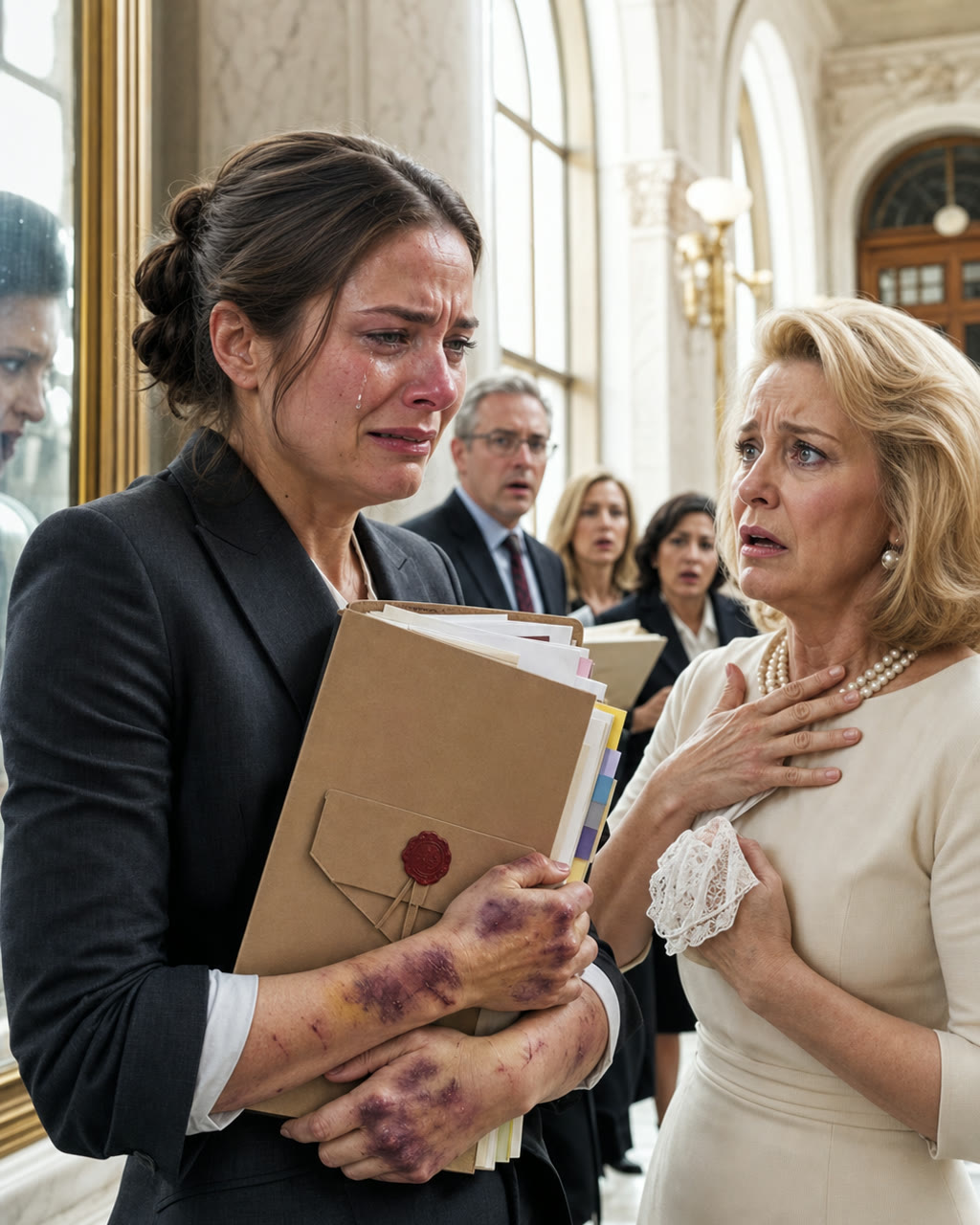
They stood up in that courtroom and called me unfit. My ex-husband's mother wore pearls and dabbed her eyes and told the judge I was unstable, unemployed, a danger. They had a lawyer who cost more per hour than I made in a week, and they had a folder of half-truths thick enough to drown me. The bailiff walked me out of the room while they were still shaking hands. That was eighteen months ago. Yesterday I walked back through those same doors — new suit, new lawyer, a company with my name on the wall, and a folder of my own. This one had every lie they'd ever told, dated and signed. They didn't recognize me at first. Then they did. FULL STORY IS IN THE COMMENTS BELOW 👇
Chapter 1
The last thing the bailiff said to me was, "Watch your step, ma'am," because there was a lip in the marble by the courtroom doors and he didn't want me to trip. It's a strange thing, the kindness people show you while they're removing you from your own life. He had a hand near my elbow, not holding, just hovering, the way you'd guide an old woman across ice, and I let him, because if I had had to hold myself up in that moment I don't think I could have.
Behind me, on the other side of the doors as they swung shut, my ex-husband's family was already relaxing. I could hear it, that particular sound a room makes when the tension goes out of it — chairs shifting, a low laugh, the click of a briefcase. Colton's mother, Marguerite, had a laugh like a spoon against crystal, and I heard it once, muffled, before the doors sealed. They had won. They had stood up in a court of law and taken my daughter and they had won, and now they were gathering their coats.
I need to explain how it happened, because from the outside it looks impossible. How do you lose a child you have never harmed? You lose her the way I did: slowly, and then all at once.
The slowly part took years and I didn't feel it happening, which is the whole trick of it. If someone had come to me on my wedding day and said, in eight years these people will have your daughter and a judge will call you unfit, I would have laughed, because I was not a woman anything like that could happen to. I had a career. I had a spine. I had opinions and I stated them at dinner. But that woman got dismantled so gradually that she never noticed a single piece leaving. The career went first — quit for good reasons, present reasons, loving reasons, each one sensible on its own, and only monstrous when you laid them end to end and saw the pattern. Then the friends, slowly, because the Vane social world had a gravity and I orbited it and my old life fell away the way anything falls away when you stop feeding it. Then, without my ever deciding it, my confidence, because a person surrounded by people who treat her as a lovely mistake will, eventually, in some deep unwilling place, begin to suspect they're right. By the time the marriage ended I was not the woman who'd married Colton. I was a hollowed-out version who photographed the same, and the hollowing had been done so gently, over so many years, with so much apparent kindness, that I could not point to a single moment and say: there, that's where they did it. That is how the powerful take things from you. Not in a moment you can name. In a thousand moments too small to fight.
That was the slowly. The all-at-once came in a courtroom, in a single morning, and I will get to it.
I married Colton Vane when I was twenty-four. His family had money — old money, the kind that doesn't talk about itself, the kind that owns things you don't find out about for years. Marguerite ran the family the way some women run a business, with charm on the surface and a ledger underneath, and she decided within about six months of the wedding that I was a mistake her son would eventually correct. I was a girl from a town she'd never visit, with a community-college degree and a job I loved, teaching art to middle schoolers. I was not a Vane. I was never going to be a Vane. She was polite to me for four years and I mistook the politeness for acceptance, which was my first real mistake.
Let me tell you what I understood too late about the Vanes, because it's the hinge the whole thing turns on. Money like theirs doesn't fight you the way ordinary people fight. Ordinary people argue, they raise their voices, they say the cruel thing and then regret it. The Vanes never raised their voices. They didn't need to. Money like theirs fights you the way water fights a stone — patiently, without malice, from every direction at once, for as long as it takes. Marguerite never once said an unkind word to me that another person could have overheard. She would simply arrange things. A comment to a mutual friend, delivered as concern. A dinner I found out about afterward. A slow, steady, deniable campaign to establish, in the minds of everyone who mattered, that poor Colton had married beneath himself and was making the best of it. By the time I understood I was in a fight, I had already been losing it for years.
We had a daughter. I'm not going to put her name in this, or her face, or the small specific things about her that made her mine, because she is a child and she did not choose to be in this story, and I have spent eighteen months learning the difference between telling the truth and putting a child on display. So I will say only this: I had a daughter, and I loved her the way you love the thing that reorganizes your whole life, and everything that happened, happened because they understood exactly how much I loved her and decided to use it.
The marriage came apart the way marriages do when one person is quietly being managed by their mother. Colton was not cruel, exactly. He was weak, which in the end did more damage than cruelty could have, because cruelty at least announces itself. When I finally left — and I left, I want that on the record, I was not left — Marguerite moved with the speed of someone who had been waiting.
I had, at that point, quit my teaching job. I'd quit it during the marriage, at Colton's urging, "so you can be present," and I'd spent three years being present, which is a thing our culture praises right up until the moment it needs to call you unemployed. I had no income of my own because I had been persuaded not to have one. I had a prescription for anxiety medication because the last two years of that marriage had given me panic attacks in grocery-store parking lots. I had, once, in the worst week of the separation, checked myself into an outpatient program for four days because I was frightened of my own thoughts, and I had done it responsibly, and I had done it before there was ever a court date, and it was the most sensible thing I did that whole year.
In the folder Marguerite's lawyer brought to court, all of that became something else. Unemployed. Medicated. Institutionalized. Unstable. Present became dependent. Responsible became evidence. They had a private investigator's photographs of me crying in a car — my car, in my own driveway, because I had just dropped my daughter for a custody exchange and it had gutted me — and in the folder those photographs were labeled emotional volatility. They had my four days of outpatient care rendered as a psychiatric history. They had a family friend who was also a judge in a different county, and they had a lawyer named Prescott who charged more per hour than I used to make in a week, and they had Marguerite in pearls with a lace handkerchief, dabbing.
And I had a legal-aid attorney who was doing his honest best across nineteen other cases, and I had the truth, which turns out to be a very thin coat in a very cold room.
I keep coming back to how orderly it all was. That's the part nobody warns you about. You imagine, if you ever imagine it, that having your child taken would be violent, loud, a thing that leaves marks. It isn't. It's the quietest room you'll ever sit in. It's a man in a good suit reading dates off a page in a bored voice. It's your own four days of getting help — the most responsible thing you did all year — read back to you as evidence of your danger, in a tone so reasonable you almost believe it. It's watching a woman in pearls you once called family dab at eyes that are perfectly dry and thinking, with a kind of awe, so this is how it's done. This is how you take a person's child and keep your manicure. I sat in that quiet orderly room and I felt myself being converted, sentence by sentence, from a mother into a case, and I did not know how to stop it, because everything they said was built on something that had once, in some smaller truer form, been real.
There is one more thing I need you to understand about that folder, because it's the thing that took me longest to forgive myself for. It worked because it wasn't entirely a lie. That is the poison at the center of what the Vanes did. If they had simply invented things, I could have fought invention with truth. But they didn't invent. They took true things — real days, real prescriptions, real four days in a real program — and they bent each one a few degrees, the way you'd bend light through water so the straight stick looks broken. Every single item in that folder had a seed of fact in it, and so every time my legal-aid attorney stood to say that's not what happened, he was half wrong, because the thing had happened, it had just been photographed from the one angle that made a responsible woman look like a danger. I sat there and listened to the worst two years of my life read back to me as a rap sheet, and the terrible thing, the thing that kept me up for months afterward, was that I couldn't fully deny it. I had cried in that car. I had been in that program. I was medicated. Yes, and yes, and yes — and every yes was a nail, because the truth, told coldly and out of order and by a man paid to destroy you, is the most powerful lie there is.
The judge said the word unfit. I remember thinking it was such a small word for what it did.
Chapter 2
I lived, for a while, in the flat gray country on the other side of that word. I'm not going to pretend I was strong. There were weeks I did not open the curtains. There was a specific hour — the hour I used to do the school pickup — that I learned to sleep through, because being awake for it was unsurvivable. I saw my daughter on a schedule that Marguerite's lawyer had designed to be humiliating, supervised, in a beige room with a woman holding a clipboard, and I smiled the whole time because I would not let my daughter see the gray country. That smiling took everything I had. I would get to my car afterward and I would sit in it, in the driveway, and I would come apart, and I no longer cared who photographed it.
And then, sometime in the second month, something happened that I have never been able to fully explain, except to say that grief, if it doesn't kill you, eventually gets bored of sitting on your chest and stands up to look around.
I have thought a lot about why the anger came when it did, and I think it was the beige room that finally did it. Not the courtroom, not the ruling, not being walked out — the beige room, the supervised visits, week after week. Because in the beige room I had to be the mother my daughter deserved for exactly the length of a visit, and then hand her back and drive away, and that impossible arithmetic — be whole for an hour, be nothing for six days — could not be sustained by grief. Grief wanted me to lie down. But the beige room demanded I stand up, again and again, and stand up smiling, and something in me finally understood that if I had to keep standing up anyway, I might as well stand up all the way. That if I could hold myself together for one hour a week for her sake, I could learn to hold myself together for the other hundred and sixty-seven hours too. The strength was already in me. The visits proved it. I'd just been spending it in the wrong place, one hour at a time, letting the rest of the week take it back.
I got angry. Not the loud kind. The other kind. The kind that does math.
I sat down at my kitchen table one night with a legal pad and I wrote, at the top, in block letters: WHAT DO I ACTUALLY HAVE. And underneath it I wrote the truth, the real one, not the courtroom one. I had a degree. I had eleven years of teaching art to children, which is to say eleven years of managing a room, holding attention, explaining things to people who don't want to hear them, and staying calm while everything is on fire — which, I was starting to understand, is most of what any leadership is. I had, from my teaching years, an entire self-taught fluency in design software, because I'd built every worksheet and every classroom mural and every fundraiser flyer myself. I had a friend named Deepa who ran a small marketing firm and who had told me, more than once, before all this, that I had a good eye and she'd hire me in a heartbeat.
And I had a rage that needed somewhere to go that wasn't the driveway.
I want to be careful not to make that sound like a lightning strike, because it wasn't, and the lie of these stories is that they compress the turning into a single clean moment. There was no single moment. There was a legal pad and a bad night and a colder resolve that I woke up with the next morning and, crucially, did not lose by noon, which is how you can tell the difference between a feeling and a decision. A feeling is gone by lunch. A decision is still there, waiting, when the light comes back. I checked it against the window every morning for a week — is it still there — and it was, so I knew it was real, and I started to build on it the way you build on any foundation you're not sure of at first, one careful brick, testing your weight.
I called Deepa the next morning. I did not ask for a job. I asked for two hours of her time and I brought coffee. I told her I wanted to build something and I needed to know if the something was real. She looked at the ugly little logo I'd designed on my kitchen table the night before — a brand identity for a local bakery that didn't know yet it wanted one — and she was quiet for a while, and then she said, "You should not work for me. You should start the thing you're describing, and I should send you my overflow, because I turn away small clients every week and I hate it."
That was the whole beginning. That was the seed. A woman turning away work, and another woman with nothing left to lose to take it.
I have thought a great deal since about why it worked, because on paper it shouldn't have. I had no capital, no runway, no safety net, no name in the industry, and a court record that called me unstable. What I had, it turned out, was the one advantage nobody puts on a résumé: I had already lost the thing I was most afraid of losing. Most people build carefully because they're protecting something — a salary, a reputation, a comfortable life they can't imagine risking. Fear makes them small. But the Vanes had already taken from me the only thing I truly couldn't bear to lose, and a strange, cold freedom comes with that. There was no failure left that could frighten me. A client saying no was nothing; I had heard a judge say unfit. A bad month was nothing; I had lived in the gray country. I moved through that first year with a boldness that looked, from the outside, like confidence, and was really just a woman who had already survived the worst thing and therefore had nothing left to flinch from. They meant to break me. What they actually did was remove every smaller fear I might have used as an excuse.
I want to be careful here, because I have read a lot of these stories now, in the long nights, and they always compress the middle. She built a fortune, they say, as if you can build a fortune the way you microwave a meal. It was eighteen months of work that would have broken a person who had anything else to do. But I had nothing else to do. That was the terrible gift of what they'd taken. My days were empty in the shape of a child, and I filled that shape with work because the alternative was the gray country, and I was never going back there.
I did small-business branding, first. Logos, then whole visual identities, then the websites to hang them on, then — because I could hear, in every client meeting, what the client couldn't say — the strategy underneath all of it. I was good at hearing what people couldn't say. Eleven years of teaching thirteen-year-olds will do that. I hired Deepa's overflow, then my own overflow, then a designer, then two. I was good at hearing what people couldn't say, and I have thought about why, and the answer is not flattering to the people who taught me. I learned it in the Vane house. Eight years of living with people who never said the cruel thing out loud, who communicated everything by arrangement and implication and the thing left unsaid at dinner, had made me fluent in the language underneath language. I could sit across from a small-business owner who said I just want a fresh logo and hear, under it, my competitor is younger than me and I'm terrified of becoming invisible. I could hear the fear inside the brief, the pride inside the budget, the marriage inside the family-business dispute. Marguerite had spent eight years teaching me to read what people wouldn't say, believing she was teaching me my place. She was actually teaching me my trade. Every skill she'd used to make me small, I turned around and rented out by the hour, and clients paid a premium for it, and not one of them ever guessed it was a weapon forged in the very house that had tried to bury me.
I named the company after my grandmother, who raised chickens and feared no one, and I put that name on the wall of a rented office and then, ten months later, on the glass door of an office I wasn't renting anymore.
There were nights I want you to know about, because otherwise this sounds like a montage and it was not a montage. There was the night a client's payment didn't clear and I couldn't make my first payroll and I sat on the floor of my little rented office and cried the ugly, hiccuping way, and then wiped my face and called the client and worked it out, because the two designers who depended on me had rent too, and self-pity is a luxury for people who don't have a payroll. There was the night I got a cease-and-desist over a logo that turned out to be nonsense, sent by a competitor to scare me, and I stayed up until four learning enough trademark law to write back a letter that ended it. There was the beige-room afternoon I had to leave straight from a pitch meeting in my one good blouse, and I sat with my daughter and the woman with the clipboard and smiled and asked about her week, and then went to my car and did not fall apart, for the first time, because I had somewhere to be, a proposal due at nine, and I understood in that car that the work was not just rebuilding my finances. It was rebuilding my floor. The gray country had no floor. Now I had one, and it had my grandmother's name on it, and it held my weight.
I made money. Real money, the kind Marguerite would recognize, which was the point, though I didn't fully admit that to myself yet. But money was never actually the thing. The thing was that I was becoming, in public, in provable, tax-documented, invoice-stamped reality, the exact opposite of every word in that folder. Unemployed became founder. Unstable became a woman who made payroll for nine people on the first of every month without fail. Dependent became a woman who owned the door with her grandmother's name on it.
I was building an argument. I just hadn't hired the lawyer to make it yet.
Chapter 3
The lawyer found me before I found her, in a way. Her name was Renata Osei and she'd done family law for twenty-two years and she came recommended by a client whose divorce I'd redesigned a company around. We met, and I brought her not a story but a system — a binder, indexed, tabbed — because by then I thought in systems.
Before I found Renata I met with three other lawyers, and I mention them because each one taught me what I didn't want. The first saw the Vane name in my file and got a hungry look and started talking about the press, about how a case like this could be a story, about angles. He wanted a spectacle, and a spectacle would have my daughter in the papers by spring. I left before the coffee came. The second was gentle and honest and told me, kindly, that these things almost never get overturned and I should manage my expectations. He wasn't wrong, exactly, but he'd already decided how it ended, and I did not need a lawyer who'd conceded the case in the consultation. The third quoted me a retainer that assumed I was still the woman in the old folder — broke, desperate, grateful — and was visibly startled when I said yes without flinching and asked about his win rate; a man that surprised by a prepared woman would be surprised by too many things. Then I sat across from Renata, and Renata did not look hungry and did not look resigned and did not look surprised. She looked, from the first minute, like a builder assessing a structure for its load-bearing walls.
She read for a long time without speaking. When she looked up, she said, "You understand that a modification isn't a re-trial. We're not re-fighting the last one. We're showing a material change in circumstances, and we're showing it so completely that the court has no choice but to look again." She tapped the binder. "This is a material change in circumstances. This is the most documented material change in circumstances I've ever been handed. But I want to ask you something before we file, and I want you to answer it honestly." She folded her hands. "Do you want your daughter back, or do you want to win?"
I sat with that. It was the truest question anyone had asked me in two years.
"Both," I said finally. "But if I have to choose — if there's a version of winning that costs her something — then I don't want to win. I want her back, and I want her whole, and I don't care what it does to their pearls."
Renata nodded slowly. "Good," she said. "Because I've watched parents win these and lose the child in the process. Scorched-earth is very satisfying and very expensive, and children pay the tax on it for the rest of their lives. So here's how we're going to do it. We are not going to smear her father in open court. We are not going to make your daughter watch her family burn." She leaned forward. "We are going to be so calm, and so prepared, and so relentlessly documented, that they defeat themselves. The pearls will do the damage. You just have to be the person in the room who doesn't need to."
I thought about that answer for weeks afterward, do you want your daughter back or do you want to win, because it kept unfolding into more of itself. I had spent eighteen months in a rage that did math, and math is cold, and I had let myself believe the coldness was strength. Renata's question showed me the danger in it. If I built this whole thing to win — to see Marguerite broken, to see Colton exposed, to hear a judge say the word unfit about them the way one had said it about me — then even total victory would leave my daughter with a mother made of ice, and a family turned into a battlefield she'd have to grow up standing in. Renata was telling me, in her twenty-two-years-of-this way, that the child always pays the tax on the parent's revenge. I decided, sitting in her office, that my daughter would not pay a single cent of a tax I ran up for my own satisfaction. Whatever I did, I would do coldly enough to be effective and warmly enough to be worth coming home to.
So that is what we built. Not a bomb. A mirror.
Renata filed for modification and requested that the original custody evaluation be reopened, and here is where the folder — my folder — became something more than a personal vindication. Because when Renata's investigator, a soft-spoken retired detective named Wallace, started pulling the threads of the original case, the threads pulled back.
The private investigator who'd photographed me crying in my driveway had, it turned out, done work for the Vane family for years, and had been paid through a shell that also paid the "family friend" judge's re-election committee. That was not a coincidence you could survive in daylight. The four-day outpatient program that had been rendered as a psychiatric history in the original folder had released those records without a valid authorization — the signature on the release was not mine, and Wallace found the notary who'd stamped it, and the notary, facing her own problems, remembered exactly who had brought it to her. Prescott's own folder, the one that had drowned me, had been built on a foundation of documents obtained the way the Vanes obtained everything: by paying people who should have said no.
Wallace was the one who taught me the thing I'll carry the rest of my life. He was sixty-some, soft-spoken, retired from a career of the kind of patience I was only beginning to learn, and one afternoon over the case files he said, almost to himself, "People who buy justice always leave a receipt. They can't help it. The whole reason they buy it is they think they're untouchable, and untouchable men get sloppy, because sloppiness is a thing you can afford when you've never once been caught." He tapped the folder with the forged release in it. "This," he said, "is a receipt." And I understood that the Vanes' greatest weapon — their certainty that money made them exempt — was also the exact reason they'd left a paper trail a retired detective could follow with reading glasses and a legal pad. They had never imagined a version of me that would come back. Their arrogance had been so total that they hadn't bothered to cover the tracks, because covering tracks is something you only do if you believe the person you wronged might someday matter. They had made very sure I would never matter. That was the flaw in the whole design.
I did not have to lie about a single thing. That is the part I hold onto. Every fact in my folder was true, dated, and signed, and every lie in theirs had a fingerprint on it, and the fingerprints were not mine. Renata used to say that the truth is slow but it has excellent balance. It doesn't need to shout. It just needs to be allowed, finally, into the room.
And here is the part I did not expect, the part that changed how I understood the whole ordeal: the mirror we built didn't only reflect the Vanes. It reflected the machinery around them, the small paid people who had said yes when they should have said no. The private investigator who took the photographs. The notary who stamped a signature that wasn't mine. The clerk somewhere who released records without a valid authorization. Each of them, alone, had done a small deniable thing for money, the way the champagne gets set down without a second glance, and each of them had assumed — correctly, for a while — that the woman on the other end of the small thing would never have the resources to come asking. Wallace found them one by one, and one by one, faced with a prepared woman and a soft-spoken retired detective and their own signatures, they remembered a great deal. I did not hate them either. They were what the Vane money made possible: a whole quiet economy of people willing to bend a small rule for a family that would never be held to account. My case, in the end, wasn't only about getting my daughter back. It was about being, for the first time, an account that came due.
Renata gave me one rule for those eight months and made me repeat it back to her: we do not touch the child. Not in the filings, not in the strategy, not in a single conversation. My daughter was not evidence and she was not leverage and she would not be told a word of any of it, not by me, not by anyone, until it was long over. When I wanted, in a low moment, to have Wallace document the ways I suspected she wasn't thriving, Renata shut it down flat. "You will not build your case on your child's pain," she said. "Even if it would help. Especially if it would help. The whole reason you're doing this is so she gets a mother who doesn't do that. Start now." So I did. Every visit in the beige room, I kept the war entirely off my face. I never asked her a leading question, never fished, never let her see the machine turning behind me. She got an hour of a calm, whole, ordinary mother, week after week, while a foot away in my chest the eight-month campaign ran silent. Holding those two things apart — the war and the hour — was the hardest work I did in the whole eighteen months, harder than the payroll, harder than the law. But it was the work that mattered most, because it was the proof, to myself, that I was rebuilding the right woman.
We took eight months building it. Eight months while I made payroll and saw my daughter in the beige room and smiled and did the math. And when it was ready — indexed, tabbed, notarized, unassailable — Renata set a date, and I bought one suit, exactly one, charcoal, sharp, the suit of a woman who owns a door, and I did not buy pearls.
Chapter 4
They did not recognize me at first. That is the detail I keep returning to, because I understand now that it was the whole story in miniature.
I came through the same courthouse doors, past the same lip in the marble the bailiff had once warned me about, and I walked into the corridor outside the courtroom where the Vanes were assembled with Prescott. Marguerite was in pearls, of course, and Colton was beside her looking like a man being held upright by his mother's posture, and Prescott had the same crocodile briefcase. And they looked at me — the founder, the suit, the woman with Renata Osei at her shoulder and a folder under her arm — and for one long second Marguerite's eyes passed over me the way you pass over a stranger, a lawyer maybe, someone else's problem.
Then she found my face inside the suit. And I watched it happen, the recognition, the way you watch weather come across a field. Her chin lifted first, that reflex of hers, ready to be charming at whatever this was. And then the charm couldn't find its footing, because the woman she remembered was the one the bailiff had walked out, gray and shaking, and this woman was not shaking. This woman was early, and prepared, and calm in a way that money recognizes because money manufactures that calm in its own children and knows exactly what it costs.
I had thought a great deal, in the weeks before, about how I would feel in this exact corridor. I had expected triumph. I had expected the hot, rising thing you feel when the tables turn, the thing the fantasy promises you. But what I actually felt, standing there watching the recognition break over Marguerite's face, was something much quieter and much steadier, and it took me a moment to name it. It was the absence of fear. That was all. For eighteen months, and really for the eight years before that, some part of me had been braced, flinching, waiting for the next quiet arranged blow. And now I stood in the corridor where I had once been walked out shaking, and I searched myself for the flinch, and it was gone. They could not frighten me anymore. There was nothing left of me for them to reach. I had built, brick by brick, a woman they had no leverage over, and she was standing in a charcoal suit in a marble corridor watching an old woman in pearls realize it.
"Marguerite," I said. Just her name. Nothing else. I had practiced saying nothing else.
Her handkerchief was in her hand. It stayed there. It did not go to her eyes.
I'm not going to walk you through the hearing chamber, because I promised myself and I promised Renata that I would keep the room where my daughter's future was decided a private room, not a stage. So I'll tell you only what I can tell you without turning a child into a scene, which is the promise I made and the promise I'm keeping even now, writing this.
I will tell you one image from that morning, though, because it's mine and it holds the whole thing. At the moment it became clear which way the ruling would go — I could read it in the set of the judge's shoulders before a word of it was said — I did not look at Marguerite, and I did not look at Colton, and I did not look at Prescott's thinning face. I looked down at my own hands, folded on the table over the closed folder. And I noticed they were steady. Not white-knuckled, not clenched. Just resting there, still, the hands of a woman who had made payroll ninety times and signed a lease on a door with her grandmother's name and learned trademark law at four in the morning to protect two employees' rent. Eighteen months earlier, in this same building, my hands had shaken so badly I couldn't sign the visitation schedule and the clerk had to steady the page. Now they were still. I sat there and looked at my own steady hands and I understood that whatever the judge said next, I had already won the only thing I could truly win, which was myself. The ruling was just paperwork catching up to a fact I could already read in my own hands.
I'll tell you that Renata was as calm as she'd promised, and I was as calm as I'd become, and that the folder did what folders do when everything in them is true. I'll tell you that the material change in circumstances was not really the company or the money, in the end — those just made me impossible to call unfit. The thing that turned the room was the notary, and the shell company, and the release with my forged signature on it, and the slow, balanced, unshoutable truth walking in and taking off its coat. I'll tell you that at one point Prescott objected to something and his own voice betrayed him, went thin, because a lawyer knows the exact moment his folder stops being a wall and starts being a confession.
And I'll tell you what happened in the corridor afterward, because that part is mine to tell.
Marguerite came to me. Colton hung back — he always hung back, it was the organizing principle of his life — but Marguerite came to me, and for the first time in the eight years I'd known her she did not have a plan for her own face. The pearls were still there. Everything else was gone.
"You've changed," she said. She meant it as the last small knife she had left. She wanted it to land as you're not the same, you're hard now, look what you've become.
"Yes," I said. "You did that. I want you to know that. Everything I am now, standing here — you built it. You took a woman who thought being present was enough, and you left her with nothing but time and rage, and you should be more careful, Marguerite, about what you leave a person with nothing but." I let that sit. "But I didn't come back to be hard. I came back for the same reason I quit my job all those years ago. To be present. You just made me learn a much more expensive way to do it."
She had no spoon-against-crystal laugh for that. She had nothing. She looked, for the first time, like what she actually was, which was an old woman who had spent a fortune making sure a young one felt like nothing, and who had just discovered that it didn't take.
Colton did come forward then, finally, at the end, when it was safe. He stood a little apart from his mother and he looked at me with an expression I had spent years mistaking for love and had only recently learned to read correctly: it was relief. Relief that someone else — his mother, a lawyer, a judge, anyone — would decide the hard thing so he wouldn't have to. He opened his mouth and I already knew the shape of what would come out, some soft useless thing, some I never wanted it to go this far, and I found I did not need to hear it. I had spent the best years of my youth waiting for Colton Vane to find his spine, and I was done waiting. Not with anger. Just done, the way you're done with a book you've outgrown. I gave him a small nod, the kind you give a stranger holding a door, and I turned back to his mother, because she was the one who had actually done this, and she was the only one worth the last words I had.
I did not gloat. I want that written down too, because the fantasy version of this ends with a speech that levels her, and I had that speech, I'd written it in the gray country months ago. But standing in the corridor with the ruling behind me and my grandmother's name on a door across town, I found I didn't want to spend it. I thought about my grandmother in that moment, the one whose name was on my door. She raised chickens on a hard piece of land and buried a husband young and feared no one I ever saw her meet, and when I was small and someone had been unkind to me she used to say the same thing every time, in the same flat voice, while she scattered feed: Don't you waste your good years teaching a mean person a lesson. They already know what they are. It's you who forgets. I hadn't understood it as a child. I understood it now. Marguerite already knew exactly what she was. My leveling speech would teach her nothing; it would only cost me an afternoon of my good years, spent becoming, for one satisfying minute, precisely as cold as she'd always been. Revenge is a thing you buy and then own forever, and I had decided, somewhere in those eighteen months, that I would not fill my daughter's mother with anything I didn't want my daughter to inherit.
So I gathered my folder, and I found Renata's eyes across the corridor, and she gave me the smallest nod, the nod of a woman who has watched a lot of people win the wrong way and had just watched one win the right one. And I walked back out through the same doors I'd been walked out of eighteen months before — past the lip in the marble, no one's hand at my elbow now, because I didn't need it — a woman who had gone into the gray country with nothing and come back out with a company, a lawyer, a folder, and the one thing they'd bet their entire fortune I'd never be able to build again.
Standing.
You may also like
The Silent Truth Behind My Daughter's Accident
The call came at 11:47 at night.…
Read the full story →The Night Evelyn Harper Took Back Her Power
My husband's mistress openly mocked me while my husband smiled… While they laughed at my pain, they never realized that I was the one in control. The moment I whispered, "Everythin…
Read the full story →He Fired the "Cleaning Lady" in Front of the Whole Office — Nine Minutes Before the Board Handed Her the Company
My name is Eleanor Reyes, and for eighteen months the people at Meridian Textiles thought my name was "hey" or "the cleaning lady" or, on a good day, "Ellie, could you get the brea…
Read the full story →