The Nanny Ate In The Kitchen For A Year — Until The Lawyer Read The One Name On The Trust
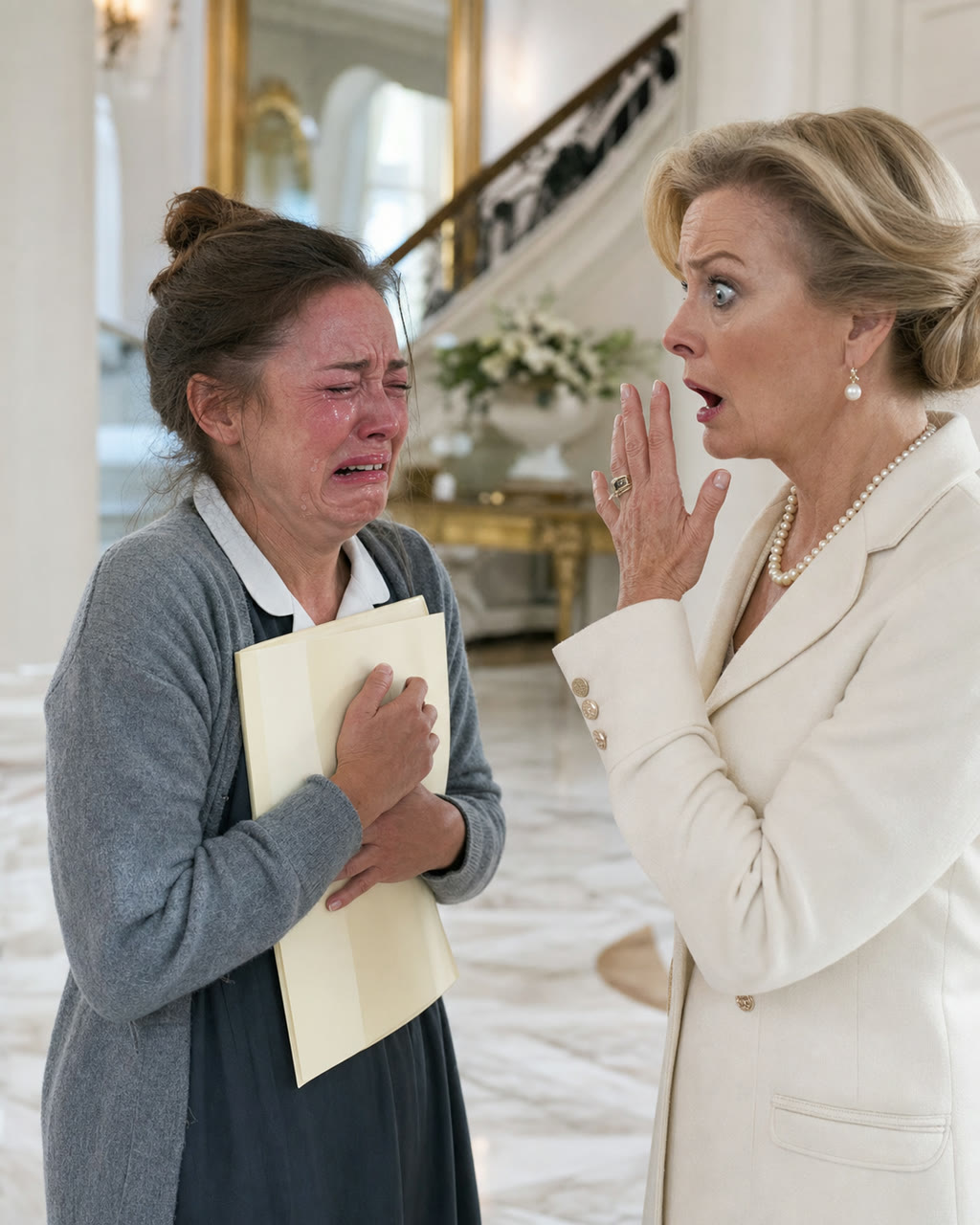
They hired me to raise their son and told me to eat in the kitchen with the staff. For a whole year I bit my tongue while they redecorated wings of a house I'd never seen the deed to, while they toasted with wine older than their marriage, while they called me "the help" in front of guests. I said nothing. I folded their laundry and read bedtime stories and swallowed every small humiliation like a stone. They never once asked why a nanny drove a fifteen-year-old sedan but never worried about money.
Chapter 1
The first thing Diane Ashford ever said to me was, "You'll take your meals with the kitchen staff. We find it keeps boundaries clear."
She said it the way you'd tell a plumber where the shut-off valve was. Practical. Not cruel, exactly. Just certain. She was standing in the foyer of the Ashford house in Bellhaven with her hand resting on the newel post of a staircase that curved up like something out of a movie, and she looked at me over the top of her reading glasses as if I were a slightly disappointing delivery.
"Of course," I said. "Whatever works best for the household."
My name is Ruth Calloway. I was thirty-four years old, and I had come to that house to be a nanny to a four-year-old boy named Theo. I had references from two families, a bland résumé, and a manner that made wealthy people comfortable — quiet, competent, invisible when I needed to be. That was the point. I had chosen to be exactly what Diane Ashford expected, and she expected very little.
What she did not expect, what none of them ever suspected in the fourteen months I lived under that roof, was that the deed to the ground she stood on, the trust that wrote the checks for her caterers and her landscapers and her son's tuition, had been signed by my hand before she ever met her husband.
But I'm getting ahead of myself.
Let me tell you how a woman ends up as a servant in a house she quietly owns.
Twelve years earlier, I had a different last name and a different life. My grandfather, Harlan Voss, built a company out of a single warehouse of industrial fasteners — screws and bolts, nothing glamorous — and turned it, over forty years, into something worth more than most people can imagine. He was a hard man in a lot of ways, but he loved me with a fierceness that frightened people. My mother, his only daughter, died when I was nine. After that it was just the two of us, and I learned the business the way other kids learn to ride bikes.
When Harlan got sick, he did something that lawyers argued about for months. He put the bulk of his fortune — the company, the real estate holdings, the whole tangled empire — into a trust. And he made me not just the beneficiary but a signatory, a trustee with authority. He wanted me protected. He wanted, in his words, "the money to answer to blood, not to bloodsuckers."
I signed those papers at a mahogany table in a law office downtown, twenty-six years old, my hand shaking, my grandfather's oxygen tank hissing beside me. I signed my full name, Ruth Voss Calloway, in blue ink on line after line. I didn't understand everything I was signing. I understood that he was dying and that he trusted me.
He died six weeks later.
And then the vultures came, and I found out that being rich when you're young and grieving and alone is its own kind of poverty.
I won't tell the whole ugly story of the years that followed. Cousins I'd never met. A man I loved who loved my portfolio more. Lawsuits, threats, a stalker who put my address on the internet. I had money coming out of my ears and I could not sleep, could not eat, could not walk into a coffee shop without wondering who was watching. So I did something my advisors thought was insane. I stepped back. Way back. I set the trust up so that professional managers ran the holdings day to day, with strict rules I had written myself. I took a modest allowance. And then I disappeared into an ordinary name and an ordinary life.
The Ashfords, you see, were tenants of a kind. The Bellhaven house was one of the trust's residential properties — Harlan had bought a portfolio of luxury homes as investments decades ago. The trust leased that particular house, furnished and staffed, to families who could pay a small fortune for the privilege of pretending it was theirs. Diane and her husband, Gregory, leased it three years ago. They filled it with their own art and their own arrogance. And they never once looked past the granite countertops to ask who actually held the paper.
I knew all this because I still got the reports. Quietly, through my managers, I saw every property the trust owned, every lease, every tenant. And when I decided — for reasons I'll come to — that I needed to be inside that particular house, it was the easiest thing in the world to arrange a glowing reference and let Diane Ashford believe she had found herself a bargain of a nanny.
"The kitchen staff eat at six," she told me that first day. "You'll find they're perfectly nice."
"I'm sure I will," I said.
I carried my one suitcase up the back stairs to a small room off the nursery, and I unpacked, and I began the strangest year of my life.
Why did I do it? That's the question, isn't it. Why would a woman who owned the roof choose to sleep in the servants' wing beneath it?
Because of the boy. Because of Theo.
But even that isn't the whole truth, and I promised myself when I started writing this down that I would tell the whole truth. So here it is. I came to that house for two reasons, and I'm not proud of both of them.
The first reason was Theo. And the second reason was Gregory Ashford — because eleven years earlier, before he was anyone's husband, Gregory Ashford had been the man I loved who loved my portfolio more. The man whose betrayal sent me into hiding. And I had come, God help me, to see what he'd become. To see if the wound had healed or only scarred over. To stand in a room with him and find out whether I was finally free.
I did not know yet that the boy upstairs, the little boy I'd been hired to raise, would turn out to be the one who set me free — not from Gregory, but from the ghost of the girl who signed those papers with a shaking hand and thought money would keep her safe.
That first night, I ate at the long steel table in the kitchen with Marta the cook and a housekeeper named Pilar. They were kind. They asked where I was from and I gave them the gentle lies I'd rehearsed. And through the swinging door I could hear the Ashfords in the dining room, laughing, the clink of good silver on Harlan's old china — because they'd leased that too, the china, without ever reading the maker's mark or wondering whose initials were etched, faint and gold, on the underside of every plate.
HVC. Harlan Voss Calloway.
My grandfather had them made the year I was born.
I ate my soup and I said nothing.
Chapter 2
Theo Ashford was a serious little boy with his father's dark hair and none of his father's ease. He didn't run to me the way some children do. He watched. On my third morning he stood in the nursery doorway in mismatched socks and studied me for a full minute before he said, "Are you going to leave like Miss Coraline?"
"Who was Miss Coraline?"
"The last one. She cried in the pantry and then she left."
"I'm not planning to leave," I said. "But if I ever have to, I'll tell you first. I won't just disappear. That's a promise."
He thought about that. Then he came and sat next to me on the window seat, not touching, just close, and that was the beginning.
I want to be careful here, because it would be easy to make the Ashfords into cartoon villains and they weren't. Diane was cold but not stupid; she ran that household like a small nation and she was genuinely bewildered by her son, whom she seemed to regard as a project that kept failing to launch. Gregory was charming in the specific way of men who have never had to be anything else. He traveled a great deal for a firm that did something with private equity that I understood better than he knew. When he was home he was expansive, generous with the staff in the loud way that costs nothing, and utterly incapable of sitting still with his own child for more than five minutes.
They loved Theo the way you love a beautiful thing you've been told is yours. From a distance. Through glass.
And Theo was drowning in it.
He had night terrors. He'd wake at two in the morning screaming about a man in the corner, and Diane's standing instruction was that the nanny should handle it so that "everyone can be fresh in the morning." So I handled it. I learned that if I sang low and off-key — really badly, so bad it was funny — he'd stop crying to correct me. I learned he was afraid of the dark not because of the dark but because that was when the house was quietest and he felt most forgotten. I started leaving my door open. I started, without asking anyone, being the person who came.
By the second month I had stopped thinking of him as the boy I'd been hired to raise and started thinking of him as Theo, just Theo, a small frightened person in an enormous cold house that — I could not stop knowing this — belonged to me.
The humiliations, meanwhile, were small and constant, and I catalogued them without meaning to.
At Diane's spring luncheon I served coffee to a woman who looked right through me and said, to Diane, "It's so hard to find help who understand discretion." At Gregory's birthday, forty guests in the garden, I was told to keep Theo "presentable but out of the way," and I stood with him at the edge of the lawn like two people watching a party through a fence — a party paid for, though no one there knew it, by the trust that answered to my blood. Once, Diane found me reading in the library after Theo was asleep and told me, not unkindly, that "staff generally use the back sitting room." I put the book back. It was a first edition. It was, technically, mine.
I say all this not for sympathy. I say it because I want you to understand the thing I learned in that year, the thing worth more than the trust and the china and the whole cold house: I learned who I was when I had no power in the room.
For years I had believed that Gregory betrayed me because I was rich — that the money made me a target, that if I'd only been ordinary I'd have been loved for myself. In the Ashford house I got to run the experiment. I was ordinary. I was, as far as anyone knew, nobody — a woman who ate in the kitchen and drove a dying sedan. And I found out that I was still, at the core of me, someone. Someone who could love a lonely child fiercely and expect nothing. Someone who could take an insult and keep her spine. Someone Harlan Voss would have been proud of.
The girl who signed those papers with a shaking hand had thought the money was the thing. It was never the thing.
Then came the night that changed everything, and it started, as these things do, with Gregory.
He came home late from a trip, jet-lagged and loose with airport wine, and he found me in the kitchen at eleven at night warming milk for Theo, who'd woken with the terrors. And he leaned in the doorway and looked at me — really looked, for the first time in fourteen months — and something moved behind his eyes.
"Do I know you?" he said slowly. "You seem — there's something —"
My heart stopped. I turned back to the stove. "I have that kind of face, sir."
"No." He came closer. "No, I never forget a — " and then Theo's cry came down the back stairs, thin and frightened, "Ruth? Ruth?" — and Gregory's face changed, curdled almost, at the sound of his son calling for the nanny instead of him. "He's supposed to be asleep," he said, suddenly cold. "This is exactly the problem. He's attached to you. It's not healthy. Diane and I have discussed it."
"Children get attached to the people who show up," I said, before I could stop myself.
It was the wrong thing to say. His face closed like a door.
"We'll be reevaluating your position," he said, and walked out, and I stood there with the milk scalding on the stove and Theo crying upstairs and I understood, with a cold clear certainty, that they were going to send me away. That I was going to become another Miss Coraline. That I would have to break the only promise I'd made the boy — I won't just disappear.
Unless.
I went up and I held Theo until he slept. And then I sat in the dark of the nursery, in a house I owned, and I made a decision I'd been avoiding for fourteen months.
I picked up my phone, and I called my lawyer.
Chapter 3
His name was David Okafor, and he had been my grandfather's attorney and then mine, and he was the only person on earth outside a handful of trust managers who knew that Ruth Calloway the nanny and Ruth Voss Calloway the heiress were the same woman.
He answered on the second ring even though it was past midnight, because that's the kind of relationship we had.
"Ruth. Is it the stalker again? Are you safe?"
"I'm safe, David. I need you to do something, and I need you to do it fast, and I need you to do it exactly the way I say."
I told him. And there was a long silence on the line, and then he said, in the careful voice of a man who has spent decades protecting me from myself, "You're sure. You've hidden for eleven years. You're going to walk back into a room as yourself, for a four-year-old you've known for a year."
"I'm not walking back in as myself," I said. "I'm walking back in as what I always was. There's a difference. I finally understand the difference."
Here is what I asked David to do, and here is where I have to explain a thing about the Ashfords' lease that they never bothered to understand.
When Gregory and Diane leased the Bellhaven house, they signed a standard trust residential lease — the kind Harlan's managers had used for decades. Buried in that lease, in a clause about "occupancy and household arrangements," was a provision that gave the trust broad rights over the property and, crucially, an annual review at which the trust could terminate the lease and require the tenants to vacate on ninety days' notice. It was boilerplate. Nobody ever exercised it. The managers just renewed everybody automatically.
But the annual review for the Bellhaven house was in eleven days.
And the trust — the trust that answered to my blood — could send a representative to conduct it in person.
"I want to be the representative," I told David. "I want it done properly, in the open, with the lease documents and the trust instrument on the table. I'm not going to lie to them anymore. I'm not going to sneak out. I'm going to sit down across from those people as myself and I am going to tell them the truth."
"And Theo?" David asked. Because David is a good man, and he'd heard me talk about the boy.
"That's the other thing," I said, and my voice cracked for the first time. "That's the whole thing, actually. I'll tell you when you get here."
The eleven days were the longest of my life.
I kept being the nanny. I made Theo's breakfasts and read him his stories and pretended I didn't know that Diane had already interviewed two agencies for my replacement — Pilar told me, whispering, furious on my behalf. I watched Gregory watch me with that half-recognition flickering and dying and flickering again, and I gave him nothing, and I waited.
And I thought about Harlan.
My grandfather used to say that money was a language and that most people spoke it badly. "They think it says look how much I have," he'd tell me. "It doesn't say that, Ruthie. It says look what I'm responsible for." He'd built an empire out of screws and bolts and he never once let anyone eat in the kitchen. His secretary of thirty years had a chair at his own table. His warehouse foreman came to Christmas dinner. He would have loathed the Ashfords — not for their money, but for how small they were with it, how they used it to build walls instead of tables.
He would have loved Theo.
On the tenth night, I sat on the window seat with the boy and I told him a version of the truth, the version a four-year-old could hold. "Something's going to change soon," I said. "In this house. Things are going to be different. And I need you to remember what I promised you. What did I promise?"
"You won't disappear."
"I won't disappear. I keep my promises. Even the hard ones. Especially the hard ones. Can you remember that no matter what happens tomorrow?"
He nodded, solemn, and put his small hand flat against my cheek the way he did when he wanted to make sure I was real.
"You're the realest one," he said.
I didn't sleep that night.
In the morning, David Okafor arrived in a dark suit with a leather portfolio, and behind him two trust officers I'd chosen myself, and he rang the front bell of the Bellhaven house — the front bell, not the service entrance — and asked to see Mr. and Mrs. Ashford regarding the annual lease review of the trust property they occupied.
Diane received them in the drawing room, gracious and unsuspecting, in her armor of pearls. Gregory came down in his good shirt, all firm handshakes, the master of the house. They had no idea. Why would they? They thought they were the ones being reviewed on their own turf. They thought they were about to renew.
David opened his portfolio. He laid the lease on the table. He laid the trust instrument beside it — the one with all those blue-ink signatures on line after line.
"Before we begin," he said, "the trust's principal beneficiary and co-trustee has asked to be present. She's already here in the household. If you'll permit me."
And he looked toward the doorway, and Diane and Gregory turned, expecting some stranger.
I stepped in from the hall in my plain nanny's clothes, with Theo's night-milk still faintly on my sleeve, and I stood in the marble foyer of the house I owned, and I watched Diane Ashford's face as she began — slowly, horribly — to understand.
Chapter 4
For a moment nobody spoke. Diane's eyes went from me to David to the papers on the table and back to me, and I watched the arithmetic happen behind them — the nanny, the trust, the review, the nanny — and I watched it fail to add up because it was, on its face, impossible.
It was Gregory who spoke first, and what he said was my whole name.
"Ruth Voss," he said. Not a question. A ghost, surfacing. "Ruth Voss Calloway."
Eleven years fell out of his face all at once. I watched him find, under the lines and the tan and the good shirt, the young man who had sat across a different table from me and told me he loved me and been thinking, the whole time, about my portfolio. I watched him remember.
"Hello, Gregory," I said.
"You — " Diane's head snapped toward her husband. "You know her? Gregory, what is happening. Who is this woman. She's the nanny. She eats in the — " and she stopped, because even she could hear how it sounded now, the sentence she'd said on my first day, coming out of her mouth like something rotten.
David, mercifully, is a professional. "Mrs. Ashford," he said gently, "the woman you know as Ruth Calloway is Ruth Voss Calloway, the sole surviving heir of Harlan Voss and the co-trustee and principal beneficiary of the Voss Family Trust. The trust owns this house. It owns, in fact, the furnishings, the china, and the artwork you've been living among. Ms. Calloway signed the trust instrument that is on the table in front of you." He turned the pages toward them so they could see the signatures, line after line, in a young woman's careful blue ink. "She has been in residence for fourteen months. She asked to be here in a personal capacity, and I'll let her explain that herself. But as a legal matter, I'm here to inform you that the trust is exercising its right under Section 9 of your lease to terminate your tenancy. You'll have ninety days."
Diane sat down. She actually sat down, all at once, on the arm of a chair, her pearls rising and falling.
"You've been spying on us," Gregory said, and there it was, the reflex — to make himself the wronged party. "You've been living in my house, watching my family, some kind of — what, revenge? You crawled in as a servant to — "
"I crawled in," I said, and my voice was shaking now, and I let it shake, "because eleven years ago you took a frightened twenty-three-year-old girl who trusted you and you left her when the money got complicated, and you told your friends I was paranoid and difficult, and I believed you. For eleven years I believed there was something wrong with me — that I was only ever going to be loved for what I had. I came here to look at you. To see if you'd become something worth being afraid of. That's the shameful part, Gregory, and I'll own it. I came for you."
"Then take your revenge and go," Diane said, low and vicious, rallying. "Throw us out. You've clearly won."
"But that's the thing," I said. "That's what I came to tell you. I've been in this house for fourteen months and I stopped caring about Gregory somewhere around the second week. Do you want to know why?"
Nobody answered. Upstairs, faintly, I heard a door, and small feet on the landing.
"Because of your son," I said. "Because you have a little boy in this house who wakes up screaming at two in the morning, and neither of you has ever once been the person who comes. You handed him to the help and you told the help to eat in the kitchen. And that little boy is worth more than this whole trust. He is worth more than everything my grandfather ever built, and you have been walking past him for four years."
Theo appeared in the doorway in his mismatched socks. He looked at all the grown-ups, at his frozen mother and his gray-faced father and the strangers with the papers, and then he looked at me, and his whole small body relaxed.
"Ruth," he said. "You didn't disappear."
I knelt down on the marble floor of the house I owned, and I opened my arms, and he ran into them, and I held him while I cried — not the calm tears of a woman making a point, but the ugly, shaking, red-faced crying of someone who has been holding something for eleven years and is finally, finally setting it down. And over his dark head I looked at his parents, and I said the last thing I had come to say.
"You have ninety days to leave this house. That part is done. But I am not going to pretend it's about revenge, because Theo will read this someday and I want the truth on the record. This is not me taking something from you. This is me refusing, for the first time in my life, to eat in the kitchen while a child I love cries in the dark."
Here is what happened after.
The Ashfords left in seventy-one days, not ninety; Diane couldn't bear the house once she knew. Gregory tried, twice, to call me — once to apologize and once, when that failed, to threaten a lawsuit that David dismantled in a single letter. I never spoke to him again. The wound I'd come to examine turned out to be, when I finally looked at it in the open, just an old scar. Nothing there could touch me anymore. I had been free of him for months and had only needed to stand in a room to know it.
Theo is the harder story, and the better one. I do not have some tidy fairy-tale ending where the nanny adopts the neglected child; the world doesn't work that way and neither does the law. He is his parents' son and he went where they went. But I did not disappear. I kept the promise. Through David, quietly, patiently, over years, I became the constant thing at the edge of that boy's life that I'd been at its center for fourteen months — the birthday call, the summer visit, the person who always, always comes. Diane, humbled in ways I did not expect, allowed it; I think somewhere she knew he needed it. I think somewhere she was grateful.
And me? I stopped hiding. I brought the trust back under my own hand. I took Harlan's old china out of storage and I set a long table in a house of my own, and the first person I invited to eat at it was Marta the cook, who'd shared her soup with me on my first cold night in the kitchen and never once looked through me.
"They think it says look how much I have," my grandfather used to tell me. "It says look what I'm responsible for."
I understand him now.
I ate in the kitchen for a year. It was the richest year of my life.
You may also like
The Silent Truth Behind My Daughter's Accident
The call came at 11:47 at night.…
Read the full story →The Night Evelyn Harper Took Back Her Power
My husband's mistress openly mocked me while my husband smiled… While they laughed at my pain, they never realized that I was the one in control. The moment I whispered, "Everythin…
Read the full story →He Fired the "Cleaning Lady" in Front of the Whole Office — Nine Minutes Before the Board Handed Her the Company
My name is Eleanor Reyes, and for eighteen months the people at Meridian Textiles thought my name was "hey" or "the cleaning lady" or, on a good day, "Ellie, could you get the brea…
Read the full story →