The Nurse They Sat At The Children's Table
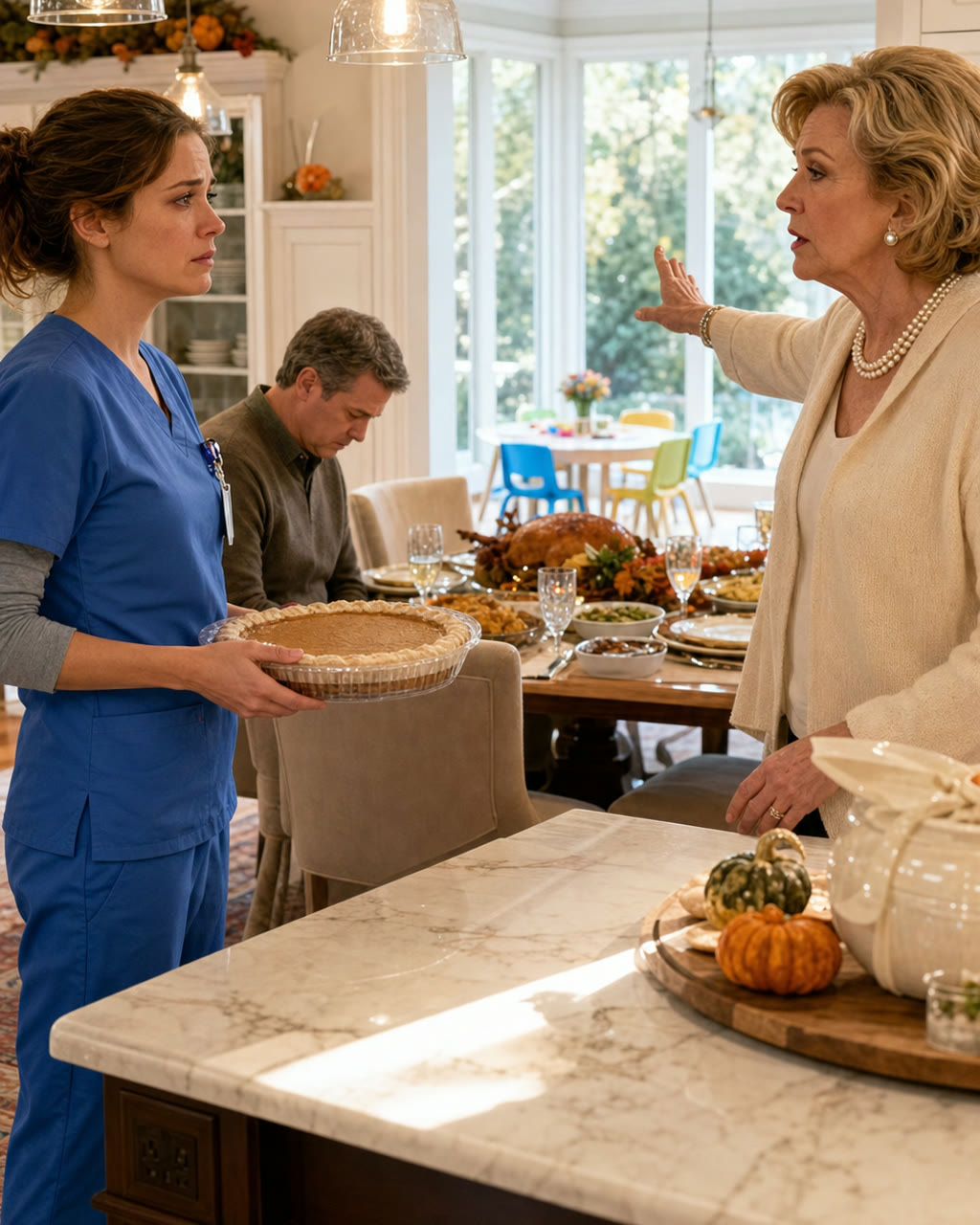
"You're Just A Nurse, Delaney. Let The Adults Talk About Real Careers." My mother-in-law said it across her marble kitchen island, and the whole table laughed like she'd told a joke. I had come straight from a fourteen-hour shift. There was still a faint outline on my wrist where the ID badge strap had dug in. I hadn't slept in twenty hours because a nineteen-year-old had coded twice on my unit the night before and I'd held his mother's hand in the family room at 4 a.m.
Chapter 1
The first thing you should know about the Whitmores is that they measured people by the parking lot.
Colleen would stand at the front window of that big house in Fairhaven and watch the cars pull up the circle drive, and you could see her doing math behind her eyes. My brother-in-law's Range Rover earned a wave from the porch. My sister-in-law's husband, the orthodontist, got the good bottle of wine opened before he even took his coat off.
I drove a nine-year-old Honda with a cracked cup holder and a stethoscope coiled on the passenger seat.
I always parked on the street.
That Thanksgiving I got there late because a patient's oxygen had crashed at shift change and you don't leave a room like that just because your husband is texting *where are you.* I'd texted back *coming,* which was a lie, because I was standing at a bedside watching numbers I didn't like.
The patient was a woman named Josephine, eighty-one, with pneumonia and a Do Not Resuscitate order and a daughter who lived in Arizona and couldn't get a flight until Friday. Her oxygen was drifting down and there wasn't a great deal to do about it except make her comfortable and stay. So I stayed. I held her hand while the day shift nurse got report from me in the doorway, and I said the things you say, which are mostly just the person's name and *I'm right here.* Her saturation came back up on its own the way it sometimes does, like a tide deciding not to go out just yet. By the time I peeled my gloves off and washed my hands, I was forty minutes late for a dinner I didn't want to go to, and my hands smelled like the pink hospital soap that never quite comes off.
I changed in the staff bathroom out of scrubs and into the one nice sweater I keep in my locker for exactly these ambushes. In the mirror I looked like a woman who had been awake since the previous afternoon, because I was. I put on lipstick anyway. You learn to armor up for certain houses.
By the time I pulled up to Fairhaven the driveway was full and the windows were gold and I could hear laughing from the street.
I brought a pie. I want to be honest about the pie, because I've thought about it a hundred times since. It was from the grocery store. I'd meant to make one. I'd bought the butter and the cans of pumpkin and they were still sitting on my counter at home because I had worked a stretch of nights and days that ran together like water, and somewhere in there the making of a pie had quietly become impossible.
So a store pie it was. In its plastic clamshell. I remember peeling the sticker off in the car so it would look a little more like mine.
Colleen met me at the door.
"Oh," she said, looking at the clamshell. "You didn't have time."
"Long week," I said.
"Mm." She took the pie the way you take a coat from someone you don't like, holding it out from her body, and set it at the very end of the dessert counter behind her own three from-scratch pies, where it would not be seen.
Inside, the house smelled like sage and money. Everybody was already at the table. Richard sat at the head in a cardigan, glasses down his nose, holding court about the stock market. He glanced up when I came in.
"There she is," he said. Not warmly. Just marking my arrival, the way you'd note that the last chair had finally been filled. He had never once, in nine years, called me Delaney. It was always "there she is" or "your wife" when he spoke to Grant.
Grant. My husband. He half-stood, kissed my cheek, and I felt how relieved he was that I'd come, and how much he wished I'd come earlier and better. He smelled like his father's brandy already. He'd been here since noon, absorbing them, and by the time I arrived he'd gone soft and apologetic the way he always did in that house, a grown man shrinking back into a boy at his own parents' table.
"Sorry," he whispered against my ear. "Work?"
"Work," I said.
"You look tired."
"I am tired."
He squeezed my hand under the general noise of the room, and I loved him and I resented him in the same breath, which is a thing married people don't talk about but all know how to do. He was kind. He was a coward at this one address. Both of those were true and I had learned to hold them at the same time.
Marissa waved a wineglass at me from the middle of the table. Trent wasn't there that year — he'd stayed in Chicago — so the table was Richard and Colleen at the ends, Marissa and her orthodontist husband on one side, an empty stretch of good china where the important people sat, and, at the far edge, a single place that never got set for me.
"You can sit in the sunroom," Colleen said brightly. "We're a little tight in here."
The sunroom held the kids' table. A folding six-footer with a paper cloth, four children under ten, a bowl of crayons, and one empty adult chair that had my name on it in the way these things did.
I was thirty-four years old. I had, that morning, made three separate decisions that kept a human being alive.
I went and sat with the kids.
My nephew Owen, who was seven and my favorite person in that entire house, slid the crayon bowl toward me. "You can have the good green," he said, and it was the kindest thing anyone said to me all day.
From the main room I could hear them. That was the thing about the sunroom — it was close enough to hear.
"—still doing the night shifts?" That was Marissa, my sister-in-law, the interior designer. "God, I don't know how you do it, Del. I'd d1e." She laughed. "The hours. The, you know. The bodies and everything."
"It's not really bodies," I said, loud enough to carry. "It's mostly people."
A pause. Then Colleen: "Well, we just worry, don't we, that it's not going anywhere. You're so smart, Delaney." That was the compliment that always came wrapped around the knife. *You're so smart.* Meaning: for someone doing that. Meaning: what a waste. "When are you going to get into something with a real future? Grant makes plenty. You could go back to school for something."
"Nursing is something," I said.
"You know what I mean, honey."
I did know what she meant. She meant something you could say at the club. Something with an office. Something that would look right in the Whitmore Christmas letter, which went out every year on heavy cream paper and never, in nine years, mentioned me by name. *Grant and his wife.* One year they misspelled it *Delany.* Grant said it was an honest mistake.
The orthodontist chimed in from the good table, in the loud helpful way of a man who thinks he's being generous. "You know, Del, my cousin went from nursing into pharma sales. Cleared two-fifty last year. Company car. You'd crush it, personality like yours." He said it like he was handing me a gift, and everyone murmured approval, and nobody at that table could have told you the difference between a central line and a Wi-Fi router.
"I like where I am," I said.
"Sure, sure," he said, already looking at his phone.
That was the whole shape of it. Not cruelty exactly. Just a room full of people who had decided long ago what a nurse was, and who found it easier to keep me small than to be curious about me for one minute.
I colored with Owen. He was working on a whole flock of turkeys, each one a different color, and he narrated their names to me under his breath. I helped his little sister write her name at the top of her turkey drawing — she was four and got the letters in the wrong order and I told her it was perfect, because it was. I ate my Thanksgiving dinner off a paper plate balanced on my knees while the adults used the wedding china, and I told myself what I always told myself, which was that I knew who I was even if they didn't, and that was supposed to be enough.
Owen looked up at me halfway through his fourth turkey. "How come you always sit with us?" he asked. Not mean. Just a seven-year-old noticing.
"Because you're the fun table," I said.
He thought about that. "Yeah," he decided, satisfied, and slid me the good green again. Kids will tell you the truth about a house if you let them. He didn't yet know that being sent to the fun table could be a way of telling someone they don't count. I hoped he'd never learn it. I hoped it about him more than I hoped most things.
Here is the part I've never told anyone.
At the end of the night, when the kids were watching a movie and the adults were on the good sofa with brandy, Richard found me in the kitchen where I was rinsing the crayon bowl.
He didn't come to talk. He came for ice. But he stopped, and looked at me, and for one second I thought — I actually thought — he might see me.
"You know," he said, jiggling ice into his glass, "my father always said you can tell everything about a person by whether they ever made something of themselves." He looked at me over his glasses. "Grant made something of himself. He's a good boy. He could've married up, is what I mean. But he's loyal."
He patted my shoulder like I was a horse that had run a decent race for a mediocre stable.
"He could've married up," he said again, pleased with the line, and walked back to his brandy.
I stood at the sink with the water running.
What none of them knew — what I had decided, six years earlier, they would never know, because the one time in my life someone had loved me for what I could do instead of who I was had ended so badly that I'd built the whole rest of my life to make sure it never happened again — was that Richard Whitmore had just insulted a woman who could buy Fairhaven twice and never notice the money leave the account.
I turned off the water.
I dried the crayon bowl and set it on the rack.
And I drove home in my nine-year-old Honda, and I did not say a single word, because the thing about a secret is that the moment you use it, it stops being yours.
I did not know, that night, that in three weeks I would have to choose whether to keep it — while Richard Whitmore's life ran out of the room, one number at a time.
Chapter 2
The call came on a Tuesday, at 6:40 in the morning, which is a terrible time for a phone to ring because it's never good.
I was already awake. I'd just come off nights and I was standing in my own kitchen in my socks eating cereal over the sink, which is what nurses do at 6:40 a.m. — we eat like raccoons and we call it dinner even though the sun is coming up.
Grant answered on the second ring, mumbling, and then I watched his whole body change. He sat up. His free hand went flat against the counter like the floor had tilted. There's a particular way a face goes when the news is about a father — it gets younger and older at the same time.
"What — okay. Okay. When? Is he —" He listened. His voice dropped to almost nothing. "Okay, Mom. We're coming. We're coming right now."
He set the phone down and stared at it.
"That was Mom," he said. "Dad collapsed. In the kitchen. He couldn't — Mom said his face went wrong on one side and he went down. They're taking him to St. Auburn."
St. Auburn. My hospital. Not my unit — I worked the medical ICU across the sky bridge — but my building. My people. I knew every hallway of that place better than I knew the rooms of my own house.
"Get dressed," I said, already moving. "I'll drive. Don't call anyone yet, we don't know anything yet." That was the nurse in me talking — the part that knows the family always calls the whole world in the first ten minutes and then has to un-tell them the first wrong thing they heard.
I was in the car before Grant found his keys. I sat in the driver's seat with the engine running and my hands at ten and two, breathing the way I breathe before a code, and when he climbed in beside me still buttoning his shirt I put my hand on his knee for one second and then pulled onto the road.
I want to tell you about the next four hours the way they actually happened, because I have replayed them and I know exactly where the ground shifted.
Richard had had what looked at first like a stroke. It wasn't. By the time I got to the ED, they had him behind a curtain in bay four with a line in each arm and a look on his face I'd seen a thousand times and never on him — the loose, frightened look of a proud man who has just learned his body can overrule him.
He grabbed my sleeve when I came in. Mine. He'd never reached for me for anything.
"They won't tell me what's happening," he said. His voice was thick on one side. "Nobody will tell me anything."
"You're at St. Auburn," I said. "This is a good place. I work here. I'm not going anywhere." I don't think he even registered that first part. I checked the monitor over his head out of habit, reading it the way you read a face, and I did not like what it said.
My friend Nadia — charge nurse, twenty years, hands like she was born knowing where the vein was — pulled me aside by the supply cart while a resident took over the room.
"That your father-in-law?" she said. "Whitmore?"
"Yeah."
She looked at me a second longer than she needed to. Nadia knew things about me that the Whitmores didn't. Not everything. But things. We'd worked nights together for years; there are things you tell a person at 4 a.m. that you never tell anyone in daylight. "Del," she said quietly. "It's not a stroke. His head CT's clean. But his counts came back and they're a mess. His platelets are on the floor and his smear looks ugly. They're calling hematology, not neuro."
Hematology. Not neuro. My stomach dropped an inch, because I already knew what kinds of things send a seventy-one-year-old man to the floor looking like a stroke and turn out to be blood — the kinds of things that don't get better with rest and don't care how much you have in the bank.
"How ugly," I said.
Nadia just looked at me. That was answer enough. Two nurses don't need the whole sentence.
By noon they had a name for it. A rare, aggressive marrow disorder — the kind with an alphabet abbreviation that means the same thing in every language, which is: *this is very bad and there is one narrow road out.* The kind I'd watched take people before. The kind where the body simply stops making the parts of the blood that keep you alive, and you have a window, and the window is not wide.
They admitted him upstairs. The family assembled the way that family assembled — with logistics and volume.
Colleen sat in the family waiting room in a camel coat, clutching a leather purse in her lap like it was a life vest. She kept opening it and closing the clasp, open and closed, a small metallic sound, not looking for anything, just needing her hands to do a thing. Marissa was there, redoing her lipstick in a compact she wasn't really using. Grant's brother Trent flew in that evening from Chicago in a suit that cost more than my car and walked into the waiting room like he was there to acquire it. They gathered in a knot by the window and they did what wealthy, frightened people do — they started trying to buy their way out of it.
"We want the best," Trent kept saying to anyone in scrubs. "Whatever it costs. We want the top guy. Money is not an object here."
I sat a little apart, in my off-duty clothes, and I watched the doctors' faces while the family talked about money, because I know how to read a doctor's face and the family did not.
The hospitalist was kind and careful. He explained that Richard's specific disease had a standard treatment path, and that on the standard path, at his age, with how aggressive his markers were, the odds were not good. He used the honest numbers. Colleen's hand tightened on the purse.
"But," the hospitalist said, "there is a newer approach. There's a targeted therapy — it's still in trials. It's showing real results for exactly this subtype. The problem is access."
"We'll pay for it," Trent said instantly. "Just get it."
The hospitalist shook his head gently, and this is the sentence that changed everything, so I'll give it to you exactly:
"It's not about paying, sir. The therapy isn't for sale. It's controlled through a single research consortium. Compassionate-use spots are extremely limited and they're not allocated by price. They're allocated by the review board. And the board's enrolling site for this region — the only one that can even submit your father — is Halloran Bio's program at the university. Enrollment there is closed to new patients right now. I'm sorry. I can put in a request through normal channels but I have to be honest, the wait is long, and your father may not have long."
The room went quiet in that particular way — not dramatic, just deflated, like a thing losing air. Colleen looked at her purse. Trent, for the first time all day, had nothing to say. Money, the family's one true language, had just been told at the door that it was not spoken here.
I sat very still.
Because I knew that word. *Halloran Bio.*
I knew it the way you know your own maiden name.
Let me tell you the thing I'd been carrying.
Nine years before I ever met Grant Whitmore, when I was a twenty-five-year-old ICU nurse who couldn't sleep after watching too many patients die from the same stupid, fixable failure — a delay in getting the right infusion to the right vein at the right rate on collapsing bloodstreams — I had spent three years of nights sketching a thing. A vascular access and monitoring device. Nurse-designed, because I was the one at the bedside at 3 a.m. watching the old way fail.
I'd partnered with a biomedical engineer named Sam Halloran, who was quiet and brilliant and who, for a while, I thought I'd marry. We built it in his garage and then in a lab and then in a company. The device worked. It saved people. It got bought by a bigger company for a number with a lot of zeros, and Sam and I — co-inventors, co-founders — held founding equity and, in my case, a permanent seat.
That company grew into Halloran Bio. The same Halloran Bio whose research consortium now controlled the one door Richard Whitmore needed to walk through.
Sam and I hadn't married. That's a different story, and a sadder one, and it's the reason I left. When it ended I didn't want to be *the nurse who invented the thing.* I didn't want to walk into rooms and have people love me for the money or the story instead of the work. I wanted to go back to a bedside where nobody knew, and just be good at the one thing I'd always been good at, which was staying calm while a stranger's heart tried to stop.
So I signed the documents, kept my board seat and my quiet equity, told no one, and went back to night shift under my own name — my mother's name, Reyes, that I used at work.
The Whitmores never connected *Delaney the nurse* to any of it, because it never occurred to them that Delaney the nurse could be connected to anything.
I still sat on the board. I still got the quarterly reports. I still had the private cell number of Priya Anand, who ran the consortium and who had trained under me, in a manner of speaking, back when we were both young and building something in a garage.
I had, in my phone, right there in the waiting room, the direct line to the exact door the hospitalist had just told my in-laws was closed.
And I had, in my chest, nine years of every Thanksgiving I'd spent at the kids' table.
Grant sank into the chair beside me. He took my hand. His father was dying and he didn't know I could reach the one thing that might stop it, and I sat there feeling the phone in my pocket like it weighed forty pounds, and I understood that I was about to find out exactly what kind of person I was.
Colleen's voice, small and cracked, from across the room:
"There has to be someone we can call."
She wasn't looking at me. She was never looking at me.
But I had my thumb on the edge of my phone.
Chapter 3
I didn't call that night.
I want to be honest about that, because it would be a prettier story if I'd stood up in the waiting room and saved everyone before the vending machines finished humming. But I'm not a movie. I'm a tired woman with nine years of small cuts, and I went home and I lay awake and I fought with myself in the dark.
Part of me — a part I'm not proud of and won't pretend I don't have — said: *let it play out the normal way. Let them find out that all their money and all their contempt hits the same closed door as everyone else. Let them sit at the little table for once.*
That part of me was loud around 3 a.m.
I lay there and I let myself imagine it in detail, because I think you have to be honest with yourself about the version of you that wants revenge or you'll do something worse pretending it isn't there. I imagined Colleen at the club, having to explain that no, actually, there was nothing they could do, that money didn't reach this one. I imagined Trent hearing the word *no* for the first time in his soft, upholstered life. I imagined all of them finding out, the hard way, that the door was closed — and never knowing I'd been standing next to the key the whole time, at the folding table, with a paper plate on my knees.
It was a satisfying thing to imagine. I'm not going to lie and say it wasn't.
But there's another part, and it's older, and it was built at a lot of bedsides. It's the part that has held the hands of people I didn't like, drunks and abusers and men who'd been cruel their whole lives, and cared for them anyway, at 4 a.m., because that's the job and because a body in a bed is just a person who ran out of road. That part doesn't care about the Christmas letter. That part doesn't get to pick who deserves the medicine, and I've come to think that's the only part of me worth keeping.
I thought about Grant, too. Whatever his father was, whatever cowardice lived in him at that address, my husband was going to lose his dad, and I could stop it, and I could not build a life on top of the fact that I'd let a man die to win an argument about a pie.
That part won. It always wins with me eventually, and I've made a kind of peace with that. It's not virtue. It's just the shape I got worn into.
I got up around four and stood in my dark kitchen and looked at the butter and the cans of pumpkin still on the counter from a pie I'd never make, and I thought about Josephine, eighty-one, whose daughter couldn't get a flight, and I thought: everybody's somebody's father. Even the ones who never learned your name.
But I had a condition, and it wasn't about being thanked. It was about the door itself. Because here is the thing the family didn't understand: I couldn't just *buy* Richard a spot either. That was the whole point. The board seat didn't let me skip the medicine. What it let me do was call Priya and ask her to *look* — to have the review committee actually evaluate whether Richard's specific markers made him a real candidate, not a favor, and if they did, to open one of the compassionate-use slots that were sitting unfilled because the enrollment paperwork bottleneck was administrative, not medical.
I could get his case *seen.* I couldn't get the disease to cooperate. Nobody could. And I needed the family to understand that, so that if it didn't work — and it might not — they wouldn't think a nurse had failed them the way they already thought a nurse had failed at life.
So the next morning I did two things.
First I called Priya. I stood in the ambulance bay at 7 a.m. in my coat, and I heard her pick up, and her voice went warm the way it always did. "Del Reyes. My God. Are you finally coming back to us?"
"No," I said. "I need a case reviewed. Fast and real. Not a favor — a real look. It's personal, Priya, and I'll tell you why later, but I need you to treat it like it's mine."
I gave her Richard's numbers, reading them off the photo I'd taken of his chart on my phone, and I heard her stop being social and start being the smartest person I'd ever worked with. Keys clicking. A breath held. "Okay," she said. "Okay, read me the platelet trend again." I did. She was quiet for a moment. "Del, who is this to you?"
"My husband's father," I said.
"The one you never talk about? The family with the —"
"Yes. That one. Priya, it's complicated, and I'll buy you dinner and tell you the whole thing, but right now I just need his case in front of the committee and I need it looked at straight. Not a favor. If he's not a candidate, he's not a candidate, and I'll live with that. But if he is, I don't want him dying on a waitlist because of paperwork."
She said she'd have the committee pull it that afternoon. She said, quietly, "If the markers are what you're saying, he's exactly who this is for. I'll fight for the slot. But you know I can't promise the disease."
"I know," I said. "Nobody knows that better than me."
There was a pause, and then she said, in a different voice, the voice of the young woman she'd been when we built things in a garage: "It's good to hear you, Del. We miss you out here. You should have never left."
"I didn't leave the work," I said. "I just took it somewhere quieter." I looked back through the sliding doors at the ambulance bay, at the medics unloading a stretcher in the gray morning. "I'm still doing it. I'm just doing it one bed at a time."
The second thing I did was harder.
I drove to Fairhaven, in the daylight, and I parked in the driveway. In the *driveway,* for the first time in nine years, and I noticed my own small defiance and was almost ashamed of how good it felt.
Colleen answered the door in a robe, without her armor, and for a second she didn't have a single sharp thing to say. She just looked exhausted and old and afraid, and I felt the anger go out of me a little, because that's what a person actually looks like when the money stops working.
"Grant's at the hospital," she said.
"I know. I came to talk to you."
I sat at her kitchen island — the same marble where she'd told me to go sit with the children — and I told her the truth. Not all of it. But enough.
I told her that I knew the program. That I'd worked in that world before nursing. That I had a relationship — a real one, an old one — with the people who controlled access to the therapy Richard needed. That I had already made a call, and that a real committee was reviewing his case that day, on its merits, and that if his disease was the right shape for the treatment, I could get him through the door that had been closed to Trent's checkbook.
She stared at me.
"You," she said. Not cruel this time. Just stunned, rearranging nine years in real time. "How would *you* —"
"Because I'm not just a nurse," I said, and then I stopped, because that wasn't right either. "No. I *am* a nurse. That's the whole thing, Colleen. I'm a nurse who once built something so nobody's grandfather would d1e waiting for a line to run. And it worked. And I kept it quiet because I was tired of being loved for the wrong reasons." I looked at her. "Which, I guess, in this family I never had to worry about."
She flinched. It landed. I hadn't quite meant it to, but I didn't take it back.
"Why would you help him," she said, very low. "After — the way we —"
And there it was. She knew. She'd always known. The kids' table wasn't an accident and we both understood that, finally, out loud, at the marble island.
"Because he's sick," I said, "and I can. That's the entire reason. It doesn't have anything to do with you."
She put her hand over her mouth. For a second I thought she might argue — nine years of habit is hard to break even in a kitchen at the end of the world — but instead she looked down at the marble between us, the same marble, and she was quiet for a long time.
"I put your pie behind mine," she said finally. It came out of nowhere and it was, I realized, the only apology she knew how to start with. "At Thanksgiving. I hid your pie so no one would see it was from the store. I've done things like that for nine years and I don't even know why anymore. I think I was afraid of you. Isn't that stupid. I was afraid you'd take him." She meant Grant. She meant her son. "And instead you're the one — you're the only one who can —" She couldn't finish it.
"I know," I said, gentler than I felt.
I stood up to go.
At the door she said my name. My real one. "Delaney." First time in nine years it came out of her mouth like a name and not a spelling error. "Thank you."
"Don't thank me yet," I said. "Thank the committee if they say yes."
They said yes.
Priya called me at 4:12 that afternoon — I remember because I was charting — and said the words that unlock a door: *He's in. Enrollment's opening him a compassionate-use slot. Get him transferred to the university site. He starts as soon as he's stable.*
I called Grant. I called him before I told anyone else, because whatever the Whitmores were, he was my husband, and he had been carrying his father's dying around all day.
"They found a spot," I said. "In the trial. Your dad's getting the targeted therapy. He's in."
There was a long silence on the line. Then Grant, in a voice I hadn't heard from him in years, said: "How?"
And I realized we had arrived at the exact moment I'd spent six years avoiding. The moment where I either kept the secret and let it be a miracle, or told the truth and let it be *me.*
I was so tired of being no one at that table.
"Grant," I said. "There's something about me you don't know. And I need you to sit down, because your family got it wrong for nine years, and I let them."
Chapter 4
Richard responded to the therapy.
I need to say that first, because everything else in this chapter is just people, and people only matter if the person in the bed lives. Not everyone in that trial did. He did. Six weeks in, his marrow started making the right cells again. Three months in, his hematologist used the word "remission" and had to look it up in his own notes because he hadn't expected to write it.
But that's the medicine. Let me tell you about the family, because you've come this far and you want to know what happened at the table.
Grant took it hard, at first — not the good news, but me. The knowing. He sat on the edge of our bed the night I told him and turned my old founding documents over in his hands, the ones with my name and Sam Halloran's on them, and he said, "Nine years. You sat at the kids' table for nine years and you could have —" and he couldn't finish it.
"I could have bought the house," I said. "Yes."
"I let them do that to you." He was staring at the papers but he was seeing something else. "Every year I watched my mother send you to the sunroom and I told myself it wasn't a big deal. I told myself you didn't mind. I told myself a lot of things so I wouldn't have to say one word to her at my own table." He set the documents down very carefully, like they might break, or he might. "You didn't need me to defend you. You could've bought and sold every person in that dining room. And I still should have."
"Yeah," I said. "You should have. That part was never about the money, Grant. I never needed you to know I was somebody. I needed you to act like I was somebody even if I was nobody. Those are different things."
He put his face in his hands. I let him sit with it. Some silences you don't rescue people from.
"Why didn't you ever say anything?"
And this is the part I'd never told him, so I told him then. About Sam. About being loved for the invention and not the woman, about the way the money and the story became the only interesting thing about me until I couldn't tell if anyone was in the room with *me* at all. About how I'd come to St. Auburn under my mother's name specifically so that I could find out whether I was worth anything without the thing attached.
"And then I married into a family that decided I was worth nothing," I said, "and honestly, Grant, it was almost a relief. At least I knew it wasn't the money talking."
He didn't have anything to say to that. But he reached over and held my hand, and for once he didn't look at his shoes. That was something. That was the beginning of something.
The rest of them found out the way families find out things — sideways, and all at once.
Trent, being Trent, tried to make it about business the first time he saw me at the university hospital. "So you've got — what, a stake in this Halloran outfit? Board seat? Del, that's *huge,* we should sit down, I know some people who'd —"
"No," I said. And I let it sit there, because "no" is a complete sentence and I'd spent nine years not getting to use it. He blinked at me like a man who'd found the emergency exit locked from the outside. I almost felt sorry for him. Money had always opened every door in his life, and he genuinely didn't know how to stand in front of one it couldn't.
Marissa cried, which I did not expect. She caught me by the elevators on the oncology floor, all her polish gone, mascara gone soft under her eyes, and said, "I said awful things to you. About the bodies. About the shifts. I thought — I don't know what I thought. I thought I was better than you." She wiped her face with the back of her hand like a kid. "You saved him and I used to make jokes about what you do."
"I didn't save him," I said. "The medicine did. I just opened a door."
"You know that's not what I mean." She laughed, wet and awful. "God, listen to you. You still won't take the credit. Nine years I watched you take everything we threw and never once throw anything back, and I thought that meant you were weak. I actually thought that." She shook her head. "It's the opposite, isn't it. It was the opposite the whole time."
I did know. I let her hug me. She held on a little too long, and I let her do that too, because I've learned that when someone is finally ashamed of the right thing, you don't have to make it worse. Life does that on its own. She smelled like the same expensive perfume she'd worn to every dinner where she'd made me small, and I stood in the middle of the hallway in my scrubs and let my sister-in-law cry on my shoulder, and a passing patient's family gave us a soft, knowing look, the kind you give strangers you assume are grieving together. In a way we were.
Colleen was last, and Colleen was different.
She came to my house. She had never once, in nine years, come to my house. She stood on my small porch in her camel coat and she looked at my nine-year-old Honda in the driveway and something moved across her face — I think she was doing the parking-lot math one last time, and getting a different answer.
I let her in. I made her coffee in a mug that didn't match its saucer because I don't own matching things.
"I owe you an apology," she said, "and I'm not going to make it a small one. So sit down, please."
And she did it. The whole thing. The Christmas letters. The kids' table. The *you're so smart* with the knife in it. She named them one by one, and she didn't cry to make me comfort her, and she didn't say *but* even once. At the end she said, "I told my son he married down. I said it in this very — I said it a lot. And you're the reason his father is alive, and I don't understand how a person keeps being kind to people who were unkind to her, and I would like to learn it, because clearly I got the whole thing backwards."
I sat with that.
"You want to know the truth?" I said. "I almost didn't help. There was a night I sat in the dark and thought, let them find out their money doesn't open every door. Let *them* sit at the little table for once." I turned my coffee cup a quarter turn on the saucer. "I'm not a saint, Colleen. I helped because I could, and because he was sick, and because I've held the hands of a lot of people who were worse to me than you were, and it turns out I don't know how to stop being a nurse. That's all it is. It's not forgiveness. It's just the job I can't put down."
She nodded slowly, like I'd handed her something heavy.
"My mother was a nurse," she said, out of nowhere, staring into her coffee. "Did you know that? Of course you didn't. I never told anyone. She worked nights at a county hospital and she came home smelling like this — " she gestured vaguely, and I knew exactly the smell she meant, the pink soap, the antiseptic underneath — "and I spent my whole life climbing away from it. From her. And then my son married a woman who smelled like my mother, and I couldn't stand to be in the room with you." She looked up, and her eyes were wet in a way I'd never seen on that composed face. "I wasn't looking down on you, Delaney. I was running from myself. That's the ugly truth of it. It was never about you at all."
I didn't say anything. There wasn't anything to say that would be true and kind at the same time, so I let it stand.
Then she asked the question I think she'd driven across town to ask.
"Will you come to Thanksgiving? At the real table. I'll seat you next to Richard. He asked for you. He's been asking for you."
And here is where I got to decide, on my own terms, what my worth was — not the money, not the board seat, not the door. Just where I would sit, and why.
I thought about the little folding table. I thought about Owen sliding me the good green crayon, the one kind thing in nine years of that house, offered by a seven-year-old who hadn't yet learned to measure people by the driveway.
"I'll come," I said. "But I'm sitting in the sunroom. With the kids."
Colleen started to protest.
"Not as a punishment," I said. "And not for you. Owen's there. Owen was decent to me when nobody made him be, back when I was nobody worth being decent to. That's who I want to eat with. That's the seat I'd choose even if you gave me the head of the table." I smiled at her, and I meant it, and it didn't cost me anything. "Turns out the kids' table had the only good company in the house the whole time. I just needed you to figure out it was a demotion before I could tell you it was a gift."
She left. She hugged me at the door, awkwardly, a woman learning a new language at seventy.
On Thanksgiving I sat in the sunroom with the children. Richard, thin and gray and alive, insisted on carrying his own chair in and setting it at the folding table next to mine, and Colleen brought us the good china on paper plates, which is a joke you had to be there for, and Owen gave me the good green crayon before I even asked.
Grant sat down with us too. He didn't look at his shoes once.
And when Richard raised his water cup — no brandy anymore, doctor's orders — and cleared his throat to say something in front of everyone, he didn't call me "there she is," and he didn't say Grant could've married up.
He looked at me across a folding table covered in a paper cloth, and he said my name, my whole name, the way you say the name of the person who kept you here.
"Delaney," he said. "You saved my life, and I spent nine years not learning it."
I told him the truth, which was that the medicine saved his life and I just made a phone call.
But I let him keep the moment, because a man that old, saying a woman's name right for the first time — you don't correct that. You just pass the good green crayon down the table, and you stay for dessert, and you let the people who finally see you learn, slowly, how to keep looking.
You may also like
The Silent Truth Behind My Daughter's Accident
The call came at 11:47 at night.…
Read the full story →The Night Evelyn Harper Took Back Her Power
My husband's mistress openly mocked me while my husband smiled… While they laughed at my pain, they never realized that I was the one in control. The moment I whispered, "Everythin…
Read the full story →He Fired the "Cleaning Lady" in Front of the Whole Office — Nine Minutes Before the Board Handed Her the Company
My name is Eleanor Reyes, and for eighteen months the people at Meridian Textiles thought my name was "hey" or "the cleaning lady" or, on a good day, "Ellie, could you get the brea…
Read the full story →