The Coins My Mother Taught Me To Count
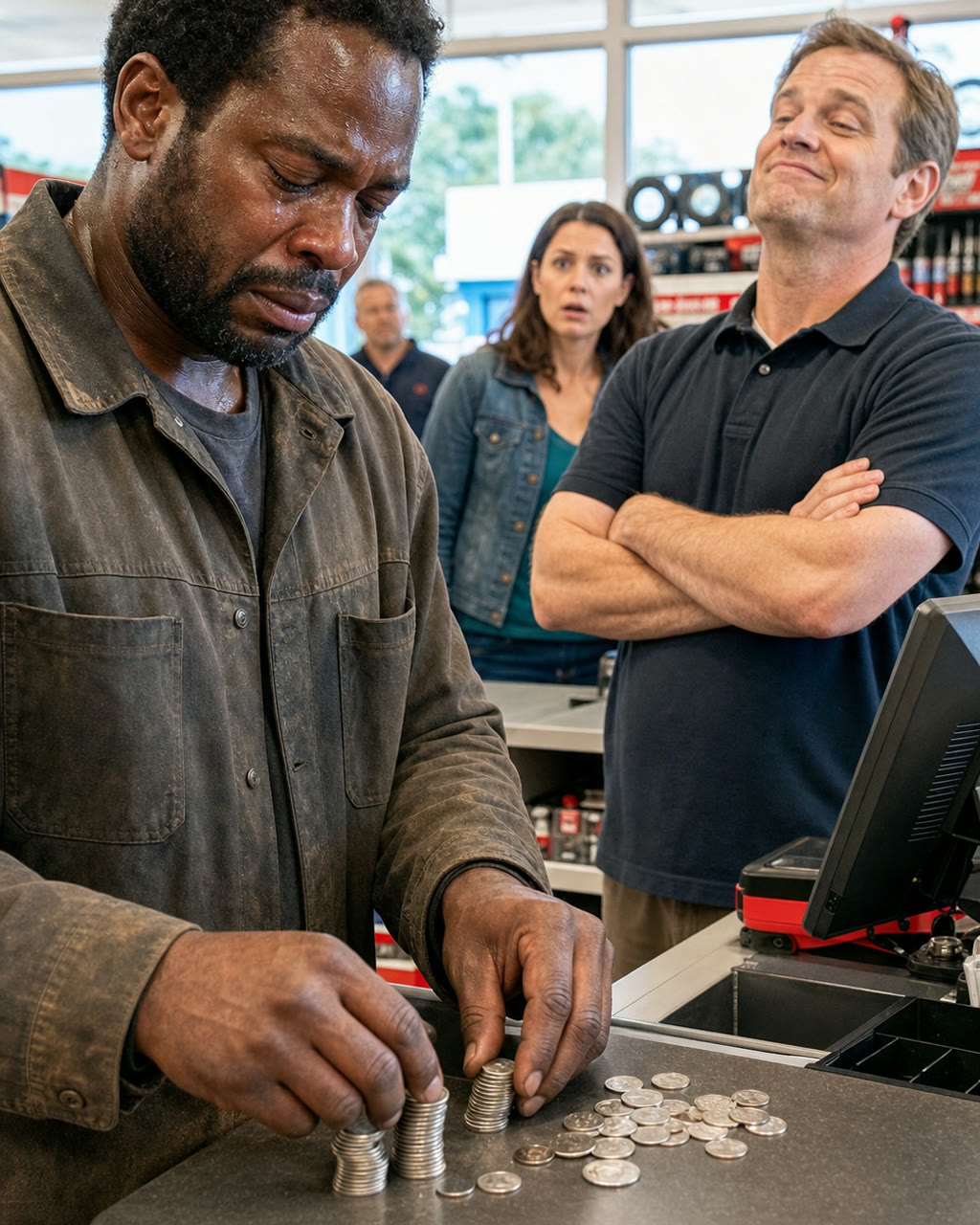
The manager laughed when I set my coins on the counter. "We don't take a piggy bank here, sir," he said, loud enough for the whole line to hear. I felt every eye land on my work boots. On the dust on my jacket. On my hands.
Chapter 1
I've paid in coins my whole life.
Not because I had to. Not always. Because of a coffee can on top of a refrigerator in an apartment on Delmar, in a part of St. Louis people drove around instead of through.
My mama kept that can. Folgers, red plastic lid, the label worn soft from her thumb. Every night she came home from cleaning offices downtown, she'd empty her apron pocket into it. You could hear the coins drop from the front door.
That sound meant we were okay. It meant tomorrow had something in it.
My name is Marcus Bell. I'm forty-three years old. And on a Tuesday in June, I drove my old F-150 into the parking lot of an auto-parts store off Route 9, with a Ziploc bag of coins in my jacket pocket and my daughter Nia in the passenger seat.
The truck was making a sound. A ticking that turned into a knock, then into a stumble every time I let off the gas. I knew what it was. I've been fixing my own vehicles since I was fourteen.
Idle air control valve. I needed the part, and I knew this store had one, because I'd called ahead and a young man read me the number off the shelf.
What I didn't tell the young man on the phone was how I'd be paying.
"Daddy, why do you always pay with the change jar?" Nia asked me in the lot. She's nine. She has her grandmother's forehead and my stubbornness and a way of asking questions that go straight to the bone.
"Because your great-grandmother did," I said. "And because it's mine. Every one of these I earned or saved. Nobody handed me these."
She turned the bag over in her lap, watching the coins slide. She looked at it like it was something out of a museum. In a way, it was.
I want to be honest about something before I go any further. That morning I could have paid with a card. I want you to hold onto that, because it matters more than anything else in this story.
I have a card. I have several. I have accounts I don't check because I don't need to.
But I was carrying my mama with me that day. She'd passed eleven months before, in a hospice bed on the third floor of a building I now own, though I didn't own it then. The last real thing she gave me, before the words stopped coming, was that Folgers can. She pushed it across the blanket at me with both hands, and it was heavy, and it rattled.
"You count it," she said. Her voice was down to almost nothing. "You count every one. Don't let nobody rush you."
Those were some of the last words my mother said to me. Count every one. Don't let nobody rush you.
So that's what the coins are. They're not poverty. They never were. They're a promise I make to her every time I set them on a counter.
We walked in and the store was bright and cold, all that fluorescent light and the parts-store smell of rubber and clean metal. A young guy stood behind the register, maybe twenty-two, tall, with a careful fade and a name tag that said DEVON.
Behind him, leaning in the doorway to the back stockroom, was an older man in a manager's polo. STORE MANAGER, his tag said. RICK.
Rick was watching me before I got halfway to the counter. I know that look. I've been collecting that look my whole life. It's the look that finishes the sentence about you before you've opened your mouth.
Boots. Jacket. Skin. Coins. He'd done the arithmetic on me from twenty feet.
Devon was fine. Devon was more than fine. He found the part fast, set the box on the counter, told me the total in a easy voice. Fifty-one dollars and change.
Then I reached into my jacket and pulled out the bag, and I heard Rick push off the doorframe.
"Oh, we got a live one," Rick said, walking up, wiping his hands on a rag he didn't need to wipe. He was smiling. It was not a kind smile. "Devon, hold up. Sir — what is that."
"Coins," I said. "It's money."
"It's a mess is what it is." He reached over and picked up the box of parts, like he was protecting it from me. "You know how long that takes to count? We got a line."
There was one person behind me. One woman with a wiper blade in her hand, and she took a small step back like she wanted no part of what was starting.
"I'll count it myself," I said. "You won't have to touch a single one."
I set the bag down and started laying them out. Quarters first, in stacks of four. The way my mama did on our kitchen table under that yellow light, her tired hands moving fast and sure, her lips barely moving as she kept the count.
And Rick laughed.
It's a specific kind of laugh, the one that isn't really for you. It's for the audience. He turned his head toward the woman in line and rolled his eyes, pulling her in on the joke.
"We don't take a piggy bank here, sir," he said.
Nia went still beside me.
That's the thing I keep coming back to. Not what he said to me. What his words did to the air around my daughter, who had never once in her whole life seen anybody talk to her father like he was less than.
I kept stacking. Four. Eight. Twelve. My hands stayed steady. I made them stay steady, the way you make your hands do things they don't want to do because a child is watching them.
"Come on, man, this is embarrassing," Rick said. He was warmed up now, enjoying his own performance. "You couldn't scrape together a card? A phone? Everybody's got a phone." He waved a hand up and down at my jacket, my boots, all of me. "I mean. Look at you."
Look at you. There it was, the whole thing in three words.
I set down a quarter, careful, so the stack didn't tip. And I looked at him. Really looked, the way my mama taught me to look at a man before you decide whether he's worth your temper.
"My money spends the same as anybody's," I said. Quiet.
"Not here it doesn't." And he reached out one finger and dragged the coins I'd already stacked back across the counter toward me, knocking the little towers flat. Quarters spun off and rolled. "Come back when you got real money."
Devon said, "Rick—" and stopped. Just the name, half out of his mouth, then swallowed back down. He was young and he was scared of the man who wrote his schedule, and I understood that even in the middle of it.
Nia's hand found my sleeve. She wasn't crying. She was doing the thing I do. She'd gone still and gone watchful, filing it all away, learning a lesson I had spent nine years trying to make sure she'd never need.
I need you to understand my exact situation, because it's the reason I couldn't simply walk out with my dignity and my daughter.
That part was the only one within thirty miles. I'd called four stores that morning. Nia had a recital the next evening. She plays cello. She's first chair in her youth orchestra, and she'd been working a Bach piece since March, the Prelude from the first Suite, the one everybody knows and almost nobody plays clean.
The recital was three hours away, in Kansas City, where my sister Renita lives. I'd promised Renita, I'd promised Nia, and most of all I needed that truck running by morning because I don't break promises to my child.
So walking out wasn't pride against convenience. Walking out meant my daughter didn't play.
I looked down at the scattered coins on the counter. A quarter had rolled all the way to the edge and I put my finger on it before it fell.
Then I looked back up at Rick's face, which was still enjoying itself, still waiting for me to gather up my little bag and shuffle out so he could tell the story later.
And I did something that I have to explain to you before I tell you what it was.
Three weeks earlier, I had signed papers on a commercial real estate deal. My second one that spring. I don't look like a man who buys buildings, and that is precisely the point of me. I built a small company doing exactly that — buying up tired strip retail that nobody else wanted, the kind of properties that need a man who knows every trade to walk them and see what's actually there.
I learned those trades on my back under cars, on ladders, in crawl spaces, because when you grow up counting a coffee can you learn to do everything yourself.
The paperwork on my newest acquisition had closed eleven days before that Tuesday. A little five-unit commercial strip off Route 9. I'd bought it sight-mostly-unseen off a spreadsheet and a good inspector, the way I buy most things now.
I hadn't even walked all five units yet. I had it on my calendar for that Thursday.
I looked up from the coins, and I looked at Rick, and I asked him a question in a voice so calm it surprised even me.
"What's the address of this store?"
He frowned. The smile faltered for the first time. "The— why?"
"Just tell me the address," I said.
Chapter 2
He didn't tell me. He laughed again, but the laugh had a hitch in it now, a little skip where the confidence used to sit smooth.
"Sir, are you gonna buy something or are you gonna waste my whole afternoon?"
I didn't answer right away. I looked past him, at the wall behind the register, because in every store I have ever bought there is a framed business license on that wall, next to the fire extinguisher, in a cheap black frame nobody dusts.
There it was. I couldn't read the fine print from where I stood. But I could read the top line, and the top line of a business license is always the street address.
It was my street number. It was my street name.
I read it three times to be sure, the way I read every document three times, because my mother taught me that a man in a hurry signs things a careful man wouldn't. And it was right. It was mine.
I want to tell you how I ended up owning a building like that one, because it matters to what I did next, and because Rick's whole mistake lived in the gap between what I looked like and what was true.
I started with one house. A burned-out shell on Cote Brilliante that the city practically gave away, back when I was twenty-nine and had exactly nothing but a truck, a tool belt, and a coffee can I'd inherited a philosophy from. I did every bit of the work myself. Framing, wiring, plumbing, roof. I slept in it while I fixed it. I sold it, bought two more, did it again.
Fourteen years of that. Two thousand nights under houses and inside walls, learning that a property will tell you the truth about itself if you know how to listen, the same way a person will.
I don't wear it. That's a choice. I've watched men put on the watch and the shoes and the car so a stranger will do the math correctly at a glance, and I decided a long time ago I wasn't going to spend my life dressing for the benefit of men who shouldn't get a vote. I show up in my work clothes because half the time I'm doing work. And because a man who only respects you once he sees the watch was never going to respect you at all.
So there I stood. Boots, dust, a bag of coins, and a business license on the wall with my own address on it.
I want to describe exactly what happened in my chest, and it wasn't triumph. I'll be straight with you, because I promised myself I'd tell this true or not at all. What I felt first was closer to grief.
Because for one second I was standing at that kitchen table again, and my mother was there, counting the can after a fourteen-hour day. Licking her thumb. Straightening the bills that never came, so it was always the coins, always the slow ones.
And I saw, clear as the fluorescent light, some man — a landlord, a store clerk, a man in a good tie — treating her the way this man was treating me. I saw how she took it. How she folded it small and put it away in the place where she kept all the things she couldn't afford to feel, and how she kept counting so her children could eat.
She never got to slide anything back across a counter. Not once in her whole life did the arithmetic ever run in her favor in front of somebody laughing at her.
I did. Right then, I did.
I set my finger down on the coins to still them.
"Nia," I said. "Baby, go sit in that chair by the door for me. Two minutes."
She looked up at me. "Are we leaving?"
"No," I said. "We're staying. Go sit down for me."
She went. She's a good girl. She sat in the plastic chair by the door with her hands folded in her lap and her back straight, watching everything, the way I taught her without ever meaning to teach her this.
I turned back to the counter and I picked up my scattered quarters, and I started stacking them again. From the beginning. Calm. Four at a time.
Rick threw his hands in the air. "You're seriously— Devon, get me a bag, I'm not standing here for this circus."
"I'd like to speak with whoever owns this location," I said. I didn't look up from the coins.
That landed different. I heard it land. Devon's eyes came up off the register. Rick's smile changed shape, got tight at the corners.
"I'm the manager," Rick said. "Anything you got to say, you say it to me."
"I don't have anything to say to you," I said. "I want to speak with the owner of the building. The landlord."
"The—" Rick laughed, but it was thinner now, stretched out. "Man, the landlord's some company. A LLC. You think a LLC is gonna care about your quarters? You think anybody cares that you got embarrassed today? Buy the part or get out. Those are your two choices."
I set down the last stack. Fifty-one dollars, with the change balanced neat on top. The towers stood straight as fence posts. My mama's hands, working through mine after all these years.
"The company," I said, "is called Delmar Holdings."
The number on that framed license, the exact figure — I'd seen it eleven days before, on a closing document I'd signed with a pen my mother gave me. I named that company for a street. For a can. For a woman who never once got her turn at a counter.
Rick's mouth came open and nothing came out of it.
"How do you—" he started.
I reached into my back pocket. Not for a wallet. For my phone, because I'd left the closing folder in the truck like a fool, and I was going to pull the deed up right there and turn the screen around.
But before I could unlock it, the front door chimed.
A woman came in fast, in a gray blazer, with a leather folder tucked under her arm, scanning the store like she was looking for one particular person. She found me. Her whole face changed into relief.
"Mr. Bell," she said. "I'm so sorry — I saw your truck in the lot. I was next door doing the Unit 3 walkthrough. You said Thursday, I would have met you here—"
Rick's head was moving between us now like he was watching a ball he'd lost track of. The woman with the wiper blade had stopped even pretending she wasn't listening.
"It's alright, Angela," I said. "I ended up needing a part today."
Angela. My property manager. Twenty-six years old and sharp as a fresh blade, first in her family to finish college, works twice as hard as anybody on my payroll and never once tells me she does. She'd been managing my acquisitions since the spring, and Angela does not miss things. It's the whole reason I hired her.
I'll tell you Angela's weakness too, because everybody in this story has one and I'm not going to pretend otherwise. Angela can't let a slight go. She keeps a ledger of every person who ever underestimated her, and she checks it. I know that about her because I have the same ledger, and mine is longer, and it took me a lot of years to stop reading from it every morning.
I could see the ledger open behind her eyes right then. She'd walked into a room and found her boss being laughed at by a man in a polo, and part of her wanted to end his whole life on the spot, and I knew it because I wanted the same thing and I outrank both of us at wanting it.
She stepped up beside me at the counter. Her eyes went, in about a second and a half, over the neat towers of coins, over Rick's face, over the woman in line, and all the way to my little girl sitting stiff in the plastic chair by the door.
I watched her read the entire room and understand it before anybody said another word.
"Is there a problem with Mr. Bell's purchase?" she asked. Cool. Level. The voice she uses on contractors who try to pad an invoice.
"No," Rick said. Too fast. "No. He's — we're good. He's paying."
"He's paying in coins," I said, "and your manager called it a piggy bank. Told me to come back when I had real money. In front of my daughter."
Angela didn't react big. That's her gift. She simply opened her leather folder, slid out a single sheet of paper, and set it on the counter next to my quarters. She turned it so it faced Rick, so he could read it right side up.
I watched his eyes go down the page.
I watched them stop.
Because the page was the executed lease assignment. The document that says, in language that even a man in a rising panic can understand, that as of eleven days prior, the landlord of that exact retail unit — the building he was standing in, the floor he swept every night, the counter he leaned on to laugh at me — was Delmar Holdings LLC.
And under the signature line, in dark ink, was a name.
Marcus J. Bell.
Rick looked up at me. The color was leaving his face in real time, the way water drains out of a sink when you pull the stopper, all at once and then gone.
"You're—" he said. He couldn't finish it.
"I'm the man paying in coins," I said. "Count them. Every one. Don't rush."
The woman in line set her wiper blade down on the end of the counter, very quietly, and did not pick it back up.
Angela slid the paper an inch closer to Rick, so it sat right against the coins. Two things touching that he never in his life expected to see side by side. A deed with my name on it. And a pile of quarters he'd called a piggy bank.
"Mr. Bell owns this center," Angela said, gentle, almost kind, which was somehow worse for him than if she'd been sharp. "All five units. He closed on it last week."
Rick's hands came up off the counter and then didn't know where to go. He put one on the register, then took it off, like even the register wasn't his to touch anymore.
"Sir," he said. "Mr. Bell. I— the part's on us. Whatever you— it's on the house, I'll ring it up as—"
"Don't," I said. Quiet. "Don't do that. Don't get generous the second you find out who I am. That's the same disease. It just points the other way."
He shut his mouth.
Because that's the thing I want you to sit with. A man who's kind to you only after he learns you own the building isn't kind. He's careful. He was always going to be one or the other, cruel or careful, depending on the math. What he was never going to be, until something forced it, was decent to a stranger for no reason but that the stranger was a person.
I've spent my life on the wrong side of that math. And I know the exact sound a man's voice makes when it flips — when the sneer turns to sir in the space of a single breath — because I've heard it flip a hundred times, at bank counters and car lots and closing tables, the moment somebody figured out I wasn't who they'd decided I was.
It never once felt like respect. It felt like watching a man get caught.
The woman with the wiper blade was still standing there, and I glanced at her, and she gave me the smallest nod, the kind one stranger gives another when they both know they just watched the same true thing.
Nia had turned in her chair by the door. She was watching her father, and she was watching the man who'd made the whole store laugh, and she was old enough to understand that something had turned all the way over. But she was young enough not to know yet what her father was going to do with it.
The truth is, in that second, I didn't fully know either.
Chapter 3
I have thought about the next ten minutes more than any ten minutes of my life, because they were the ones where I got to find out what kind of man I actually am.
It's easy to know who you are when nobody is small in front of you. It is a whole lot harder when they are, and it was your foot that made them that way, and every eye in the room is waiting to see if you'll press down.
That's what it felt like. Rick didn't move for a second. Then he set the box of parts down gently in front of me, both hands, like he was setting down something breakable. And he started, with shaking fingers, to count my coins.
He got to "four" out loud, and his voice cracked in the middle of it, and he stopped. Started again. "Four. Eight." His hands were unsteady and the stacks kept tipping.
"Sir," he said. "Mr. Bell. I didn't— I was just—"
"Keep counting," I said. Not cruel. Just even, the way you'd tell a man to keep his hands where you can see them, only softer.
And here's where I have to be honest with you about the ugly thing that was in me right then, because a version of this story where I'm all grace from the start is a lie, and I don't tell those.
Part of me wanted to watch him drown.
Part of me wanted to make him count every single quarter out loud with the whole store watching, wanted him to feel the exact size of the floor under his feet, wanted him to learn the precise temperature of being made small in front of strangers by a man who's decided you're nothing.
I wanted to hand him back the identical thing he handed me. Measured out even. To the coin.
And my mama was in that want, too. Not just me. Every landlord who ever raised her rent the week after she got current. Every foreman who timed her breaks. Every man who ever looked at her apron and her tired hands and decided her whole life in a glance and moved on. I could pay all of it back, all of it, through this one scared twenty-eight-year-old in a polo shirt who'd handed himself to me.
I could feel my whole family leaning on that scale.
Nia was watching from the chair by the door.
That's the thing that stopped me. Same reason I couldn't leave, same reason I couldn't stay small. She was watching to find out what her father does when he finally has the power in the room.
Because that's what I had now. Not coins. Power. The clean kind, the kind with paper and a signature behind it, the kind my mother never held for one hour of her life. And my daughter was about to learn, right there in a bright cold store off Route 9, exactly what a man does with it when the man is her father.
I set my hand flat on the counter.
"Stop counting," I said.
Rick stopped. His hands stayed flat on the counter too, on either side of the coins, like he was holding the whole thing down so it wouldn't float away.
"Devon," I said.
The young man jumped. "Sir."
"You said something earlier. You started to say his name, and you stopped. What were you going to say?"
Devon looked at Rick, then at me, then down at the counter. He was scared, but it was a different scared than Rick's. It was the scared of a decent kid who watched something wrong happen right next to him and didn't feel he had the standing to put his body in front of it.
"I was gonna say he shouldn't—" Devon swallowed. "That your money's good, sir. That it's just money. I should've said it louder. I— I've seen him do it before. To other people. And I never said it loud enough."
"Yeah," I said. "You should have. Remember exactly how that feels right now. That feeling in your chest, the one telling you that you already knew better. That's the one that tells you who you actually want to be. Don't lose it."
Devon nodded. His eyes were wet. He was going to remember this, I could tell. That mattered to me more than anything I was about to say to Rick.
I want to stop here and tell you about my sister Renita, because she was on the phone in my ear the whole drive up the day before, and everything I was about to do, she'd have argued me out of.
Renita is the strong one in our family. Stronger than me, and I'll say that anywhere. She raised two boys alone in Kansas City on a nurse's salary, and she doesn't have my patience because she's never had the room for it. When I told her that morning I might stop for a truck part on the way, she said, "Marcus, you let one of those men talk crazy to you and you own his whole world, you sit on him. You hear me? For Mama. Sit on him."
That was Renita's voice in my one ear.
And in the other ear was my mother, eleven months gone, who used to pull Renita back by the elbow and say, low, "Baby, don't let them make you into them. That's how they win. They don't beat you. They turn you into what beat you."
Two women. Two truths. Both of them right, in their way, and both of them standing in that store with me.
Renita's weakness is that she's never once let anybody off a hook, and it's cost her people who deserved a second chance. My mother's weakness was that she forgave too much, too easy, and let men keep her small who should have been made to pay. I have both of them in me, pulling opposite directions, and standing at that counter I had to decide, in front of my daughter, which one of them I was going to be today.
I turned back to the manager.
"I'm not going to fire you standing here," I said.
His eyes came up, red and confused and half-hoping.
"Not because you don't deserve it," I said. "Maybe you do. That's not something I get to decide in ten minutes with my blood up and my daughter watching. That's a decision for a process, with your whole record, with somebody a lot calmer than I am right this second. That's the difference between justice and revenge, and I've paid too much to learn it to throw it away on you."
I took a breath. My mother's breath. The slow one she used to take before she said the thing that actually mattered, the one that made you go quiet and lean in.
"But I'm going to tell you what you actually did today," I said. "You didn't insult a poor man. And even if I were exactly what you thought I was — dusty truck, work boots, a bag of coins and nothing behind it — you would still have been just as wrong. All the way wrong. Because that man on the phone this morning, the one who ordered this part, is a man whose mother cleaned office buildings downtown for thirty years and paid for every single thing she ever owned in coins she could hear drop. And she was worth more than this whole store and everything on every shelf in it."
The woman in line was crying now. Quietly, one hand over her mouth. I didn't look at her long. This wasn't for her.
"You looked at me," I said to Rick, "and you ran a math problem. Boots plus coins equals nothing. People have been running that exact math on my family for a hundred years and more. And it comes out wrong every single time. Every time. And the reason it comes out wrong is not because every now and then the man in the boots turns out to own the building."
I put my hand flat on the counter again, next to the coins, next to the deed.
"It's wrong," I said, "because it was never the building that made me worth your respect. It was her. It was a coffee can with a red lid. It was a woman you will never get to meet, who would have stood right here at this counter and counted her change with you laughing at her back, and taken it home, and fed her son, and never once let you see it cost her anything. The building doesn't make me somebody. She did. And she'd have deserved every ounce of what you owe me even if I'd walked out of here with nothing but a broke-down truck."
Rick was crying openly now. Not performing it. The other kind, the kind where a person finally meets the true shape of the thing they did and can't look away from it.
"I'm sorry," he said. "I am so sorry. I don't have an excuse. I know that's not— I know it's not an excuse."
"Say it anyway," I said. Because I'd heard something starting in his voice, underneath, and I wanted to know if he'd tell me the truth of it or hide behind an apology.
"My dad ran this store," Rick said, low, so low the woman in line leaned in. "Twenty years. Before the last owner bought it. Then they cut his hours, and then they cut his benefits, and then they cut him, right before his pension vested, and he— he was never the same after. And I've been so scared my whole life of ending up—" He stopped. Dragged the back of his hand across his face. "I look at guys who come in here and I think, don't be that, don't slip, don't be the one people feel sorry for. And I just did the exact thing that was done to my father. To you. Standing in the same store. I don't even know why I—"
"I know why," I said. "Fear makes a man cruel to whoever's beneath him, so he can tell himself he's not the next one down. I know that math too, Rick. I've had it done to me and I've felt it try to come up in me. I just decided, a long time ago, at a kitchen table, that I wasn't going to be the man who runs it."
Angela stood quiet beside me, her folder still open, the deed still on the counter. Devon hadn't moved. The woman in line was wiping her eyes with the heel of her hand.
And I realized, with a start, that Nia had gotten up from the chair by the door without my noticing. She was standing a few feet back from the counter, watching her father decide.
I looked down at my coins. Fifty-one dollars, mostly in stacks, some knocked flat and rolled. My mama's hands. Eleven months in the ground and still standing right there beside me, still teaching me, still counting.
I slid the box with the part in it toward myself.
Then I gathered up every last coin — the stacks and the loose ones and the quarter that had rolled to the edge — and I slid all of it back across the counter to Rick.
"Ring it up on the store account," I said. "The part's on the house. I own the house."
And I turned to go. But I stopped, because there was one more thing, and it was the thing that was going to matter tomorrow, and the day after, long after Rick had forgotten the exact shape of my face.
"Rick."
He looked up.
"You're going to keep your job through the review," I said. "But there's one thing you're going to do first, and it's not for me. It's for you."
I nodded toward my daughter, standing there in the middle of the aisle.
"Apologize to her," I said. "Not to me. To the nine-year-old who just stood in a store and watched a grown man teach her what the world thinks of people who look like her father. You put that in her today. Now you're going to try and take some of it back out."
Rick came around the end of the counter. And he did something I hadn't asked for and didn't expect. He got down on one knee in front of my little girl, so his face was level with hers.
And what my daughter said back to him is the whole reason I'm writing this down at all.
Chapter 4
Nia looked at him for a long moment. Long enough that Rick, down on one knee, started to drop his eyes.
"You made my daddy count his money slow so people would laugh," she said. She wasn't yelling. She said it the way children say true things, flat and clean and without any of the softening we spend our whole adult lives learning to add.
"My great-grandma counted money slow because she was tired," Nia said. "She counted it slow because she worked all day and it was all she had and she wasn't gonna lose any of it."
Rick, on one knee, put his hand over his mouth.
"My daddy told me a dollar you can hear is a dollar you respect," she said. "You heard the change. But you didn't hear the dollar. You just heard the noise it made."
I don't know where she got that. I never said it exactly like that. That was hers.
"I'm sorry," Rick said to her. His voice was gone almost to nothing. "You're right. I'm really, really sorry."
"Okay," Nia said. Just like that. Because children forgive faster and cleaner than we do, and it's one of the first things the world takes from us, and I stood there and watched my daughter still have it. "Okay. You can get up now."
He got up.
I want to tell you what I didn't do next, because so many of these stories end with the boot coming down on the neck, and everybody cheers, and I understand exactly why they cheer. Lord knows I've wanted that ending for myself more times than I could count on all the coins in that can.
I didn't fire Rick that day.
I turned the whole thing over to a real process. His actual record, a real HR review, and a woman named Delphine who runs my operations and who does not play games and does not care whose feelings get bruised. I told her every word of it. And I told her, plainly, that I did not want my anger to be his sentence. I wanted the truth to be his sentence. There is a difference, and I have paid in full to learn it.
Delphine looked at me across my desk for a long time. Then she said, "You're a better man than I am, Marcus."
And I told her the only true thing I know about that. "No," I said. "I just had a better teacher."
Here's what the process turned up, over the following weeks, once people knew it was safe to talk.
Rick had two prior complaints in his file. Both quiet. Both about the exact same thing — the way he spoke to certain customers, and you can imagine which customers, because I don't have to spell it out for you. The store's previous owner had buried them both, because Rick's sales numbers were strong, and a certain kind of owner will forgive a man almost anything if the numbers are strong.
And there was a fourth thing, one that came up not in the file but in the store, from the people who worked there. Devon told Delphine, and two others backed him up, that Rick had a name for customers like me. A word he used in the break room, under his breath, when a certain kind of person came through the door. I'm not going to write it here. My daughter might read this one day, and she stood in that store already, and she doesn't need the word too.
But I'll tell you it landed on me like a hand on the back of the neck. Because it meant the Tuesday I saw wasn't a bad day. It was the true face, and I'd only caught it because for once the man behind it didn't know to hide it.
So no. In the end, he did not keep his job. Not because of one bad Tuesday. Because of a pattern, four entries deep now, that a previous owner had chosen not to see and I chose to see.
I want to be careful here, because people are going to read this and cheer that he got fired, and I understand it, but I need you to hear the difference. I did not fire him because he made me feel small. If I fired every man who ever tried to make me feel small, I'd spend my whole life doing nothing else, and I'd become a man who goes looking for it. I let the process fire him because he had a documented habit of doing it to people who couldn't slide a deed across the counter. People with no Angela walking through the door. People like my mother was, every day of her life, at every counter she ever stood at.
That's who the review protected. Not me. I was fine. I was always going to be fine. It protected the next tired woman with a coffee can who was going to walk into that store on a Tuesday and get the version of Rick that I only saw by accident.
That's what ownership is actually for, if you do it right. It's not for sliding the deed across the counter to win an argument. It's for making sure the counter is safe for the people who'll never own it.
But before he left, I did one more thing, and I'll tell you why I did it.
I sat down with him. In the back office of a store he no longer worked in, I sat across a desk from Rick and I told him the whole thing about my mother's coffee can. The Folgers lid. The apron. The hospice bed on the third floor. The heavy can she pushed across the blanket with both hands when she couldn't hardly talk anymore. Count every one. Don't let nobody rush you.
I don't fully know why I told him. Maybe because I kept seeing his father in him. The man who gave a store twenty years and got cut the week before his pension vested. I know what that does to a family. I know what it does to the son who watched it happen and swore in his own scared heart that it would never be him, and then spent his whole life making sure it was somebody.
"I could hate you, Rick, and it would be the easiest thing in the world," I told him. "You gave me every reason a man could ask for. But I have spent my whole life being the one other men decided about at a single glance. And on the one day I finally get to be the one who decides, I do not want to do it the way it was always done to me. That's the only thing I've got that they never had. So I'm not going to spend my turn becoming you."
He couldn't talk for a minute. Then he said, "What do I even do now?"
"You go be your father's son," I told him. "The good part of him. He held this store together for twenty years, Rick. That doesn't come from nothing. That's in you too, somewhere under the scared part. I saw the scared part today, plain as day. Now go find the other part he left you."
I gave him a reference. A real one — not for the man he'd been in front of me, but for the man he could still decide to become. I don't know if he ever became him. That's his to carry now, not mine, and I've made my peace with not knowing.
Devon, the young man behind the register — I promoted him. Not that same day. That would have been theater, and Devon deserved better than to be a prop in my lesson. But when the assistant manager slot opened up, Delphine put his name forward, and I signed off on it before she finished the sentence, and I told her exactly why.
Because a kid who half-says the right thing when it's the scariest moment to say it is a kid who will one day fully say it, out loud, when he's got the standing to be heard. I have built my entire company on people exactly like that. I would rather have a hundred Devons than one man with perfect numbers and a buried file.
Devon runs that store now.
There's a coffee can on the counter next to his register. Folgers. Red lid. Customers drop their extra change in it, and once a month all of it goes down the block to the food pantry two blocks over, the one that fed families in that neighborhood back when nobody else would.
That was Devon's idea, all of it. He never met my mother. He only heard about the can from the story, the way you're hearing it right now. And he took a story and built something real out of it that feeds people I will never meet.
That's what she'd have wanted. That's the whole thing, right there.
I did one more thing with that store, and I'll tell it quick because it's the part I'm proudest of and the part nobody claps for.
I found out where Rick's father was. The man who gave twenty years and got cut before his pension vested. He was seventy-one, living in a small apartment in Florissant, and I drove out there one Saturday and I sat with him on his little balcony and I told him his son had worked in his old store, and that his son had made a bad mistake, and that his son had, in the middle of it, spoken his father's name with love.
I didn't tell the old man the ugly parts. That wasn't mine to give him. I told him the store had a coffee can on the counter now that fed the neighborhood, and I asked him about the twenty years, and he talked for two hours, and he cried when I left, and he shook my hand with both of his the way my mother pushed that can across the blanket, with everything he had left.
I don't know if that fixed anything between Rick and me, or Rick and his father, or Rick and himself. Some things don't get fixed. But my mother used to say you don't do the decent thing because it works. You do it because it's decent, and then you let go of the working.
The truck ran fine the next morning. Turned over on the first try, no knock, no stumble. I'd fixed it myself in the driveway that night while Nia practiced her Bach through the open kitchen window.
We drove three hours west to Kansas City. Nia played her Prelude in a church basement with metal folding chairs and terrible acoustics and a piano that was slightly out of tune, and she was first chair, and she was clean, and she found the low notes she'd been missing since March, and when she finished she looked out into the crowd, past all the parents and the grandmothers and the folding chairs, and she found me.
I had a Ziploc bag of coins in my jacket pocket. I keep some on me now. Always. Not because I ever need to pay with them.
Because my mother told me to count them, every one, and not let anybody rush me, and it took me most of my life and one bad Tuesday in a parts store to finally understand that she was never really talking about money at all.
She was talking about people.
Count them slow. Every single one. Don't let the world rush you into deciding who somebody is before you've heard what they're actually worth.
The manager laughed when I paid in coins. He thought he was counting a poor man, and he thought he already knew how that story ended.
He never once learned to hear what money is actually worth. But my daughter did, standing in that store, watching. And she's the one who's going to be counting, slow and careful and hearing every one, long after I'm gone.
You may also like
The Silent Truth Behind My Daughter's Accident
The call came at 11:47 at night.…
Read the full story →The Night Evelyn Harper Took Back Her Power
My husband's mistress openly mocked me while my husband smiled… While they laughed at my pain, they never realized that I was the one in control. The moment I whispered, "Everythin…
Read the full story →He Fired the "Cleaning Lady" in Front of the Whole Office — Nine Minutes Before the Board Handed Her the Company
My name is Eleanor Reyes, and for eighteen months the people at Meridian Textiles thought my name was "hey" or "the cleaning lady" or, on a good day, "Ellie, could you get the brea…
Read the full story →