She Made Me Sign Away Her Family's Fortune — Not Knowing I Already Owned It
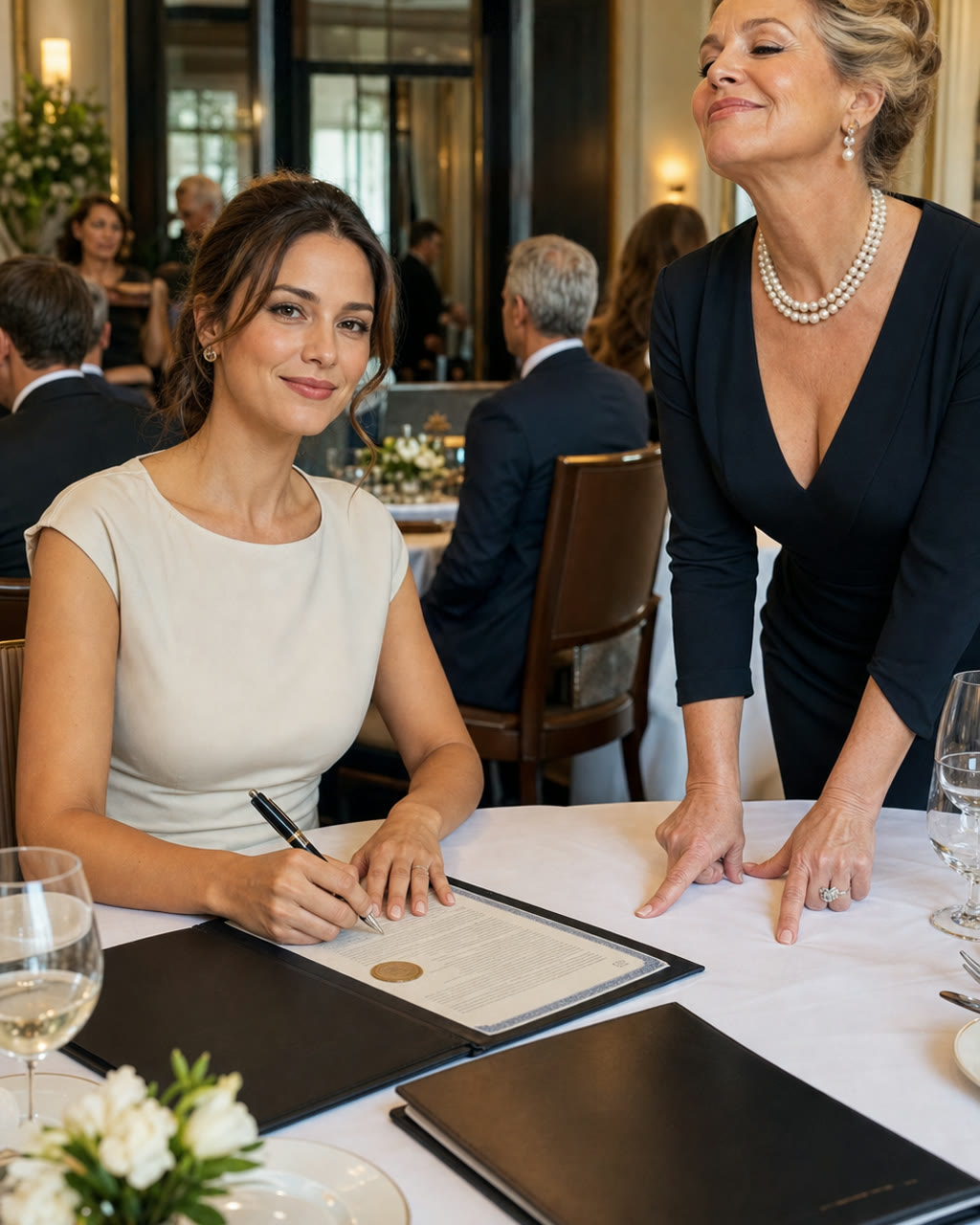
At the engagement dinner his mother slid a document across the table, smoothed it flat with two manicured fingers, and said loud enough for the whole restaurant to hear: "Sign away any claim to this family's money, you gold-digger. Before you embarrass my son any further." Everyone at the table went quiet. My fiancé stared at his water glass. His father cut into his steak like nothing was happening.
Chapter 1
My name is Priya Menon, and I want to tell you about the night I signed away my claim to the Aldridge family fortune with a smile on my face, because it is the best decision I ever made and the funniest, and because I have never once regretted letting Vivian Aldridge think she had won.
But to understand the dinner, you have to understand how they saw me, and to understand that, you have to understand how I let them.
I met Daniel Aldridge eighteen months before the engagement dinner, at a conference for supply-chain executives that I was attending under a name that wasn't quite mine. Not a fake name — Menon is my mother's name, and I have every legal right to it — but not the name printed on the badge I usually wear. I was there quietly, watching a panel about mid-market logistics consolidation, and Daniel was there because his family's company, Aldridge Distribution, had been invited to present and he'd drawn the short straw of attending in his father's place.
He was nervous. He fumbled a question from the audience about margin compression, a softball question, and I watched him blush all the way to his ears — a real blush, the kind that starts at the collar and climbs — and something about a grown man in a very expensive suit blushing because he didn't know an answer made me like him before I knew a single other thing about him. Most of the men in that room would have bluffed. They would have produced forty confident seconds of syllables that meant nothing and called it leadership. Daniel just stood at the podium and said, honestly, "That's a better question than I have an answer for, and I'd be lying if I pretended otherwise," and a few people laughed, not unkindly, and I thought: there he is. That's a man who would rather be caught not knowing than be caught faking. In my family that is the rarest currency there is.
I found him afterward by the coffee urns, jacket off, tie loosened, staring at his phone like it owed him money. I bought him a coffee — I paid for it, a fact I have teased him about a great deal since — and told him the answer to the question he'd flubbed, gently, in a way that let him keep his dignity. It's a margin question about mix, I said. Your cheap freight is subsidizing your premium freight and hiding the fact that your premium freight isn't actually premium. He stared at me. "How do you know that about my company?" he asked, and I said, truthfully, that it was true of half the companies in the room. He asked me what I did. I said I "worked in the industry." It was true. It was also the beginning of eighteen months of the most honest dishonesty of my life.
We talked for two hours. He was funny in a self-deprecating way that people from real money almost never are, because real money teaches you that you are the joke's author and never its subject. He told me he hated the conference, hated the suit, had wanted to be a high school history teacher until his father made "being an Aldridge" sound like a moral obligation. He asked me nothing invasive and listened like the answers mattered. When we finally stood to leave, he shook my hand — formally, sweetly, a little too long — and said, "I don't know what you actually do, Priya Menon, but you know more about my family's business than I do, and I find that either terrifying or wonderful and I'd like to buy you dinner to figure out which." I said the coffee was on me so dinner could be on him. He blushed again. I was, I think, already gone.
Here is the thing I have to confess, the thing that makes this story what it is. I was not a poor girl who lucked into a rich man. I was Priya Menon-Aldridge, though nobody in Daniel's family had heard that hyphenate, because his branch of the family and my branch of the family had not spoken in twenty years.
Aldridge Distribution was founded by two brothers: Walter Aldridge and my grandfather, Thomas Aldridge. Walter ran the visible company — the trucks, the warehouses, the name on the building. My grandfather Thomas was the quiet one, the money one, the man who structured the ownership. When the brothers fell out over a woman and a contract in a fight so old nobody living remembers the details straight, they split the way families split: loudly, permanently, and with lawyers. Walter kept operational control and the family name and the house and the reputation. Thomas kept something that looked, at the time, far less impressive.
He kept the holding company.
I grew up on the far side of that split, and I want to be clear that "the far side" was not poverty. Cardinal Holdings paid dividends, and my mother invested them carefully, and I had a comfortable childhood in a modest house with good schools and a mother who worked anyway — she taught high school chemistry for thirty years — because she believed that money you didn't work for rotted you from the inside, and she'd watched it rot her father. What I did not grow up with was the name. We were Menons. My grandfather had let the Aldridge name go to Walter in the settlement the way you'd hand a snarling dog to the man who wanted it most, and he never spoke it again. There were no photographs of the other side of the family in our house. There were no Christmas cards. Twice a year a thick envelope arrived from Alice Okonkwo's predecessor, and my mother would read it at the kitchen table with her reading glasses down her nose, and sign something, and mail it back, and that was the entire visible footprint of the fact that we controlled a company worth several hundred million dollars.
I asked her once, when I was maybe fourteen and had finally pieced enough together to be dangerous, why we didn't just take it. Take our seats. Live in a house like the ones I imagined the Aldridges lived in. She put down her glasses and looked at me for a long moment and said, "Because your grandfather wanted exactly that, every day, for forty years, and wanting it is what killed him. Not the split. The wanting. He died furious in a chair, Priya, with more money than God, hating a brother who'd been dead for six years and couldn't even hear it anymore. I'm not going to raise a girl who dies in that chair." I didn't understand it then. I understand it completely now, which is the only reason this story ends the way it does and not the way a colder woman would have written it.
My grandfather kept Cardinal Holdings, the parent entity that actually owned fifty-two percent of Aldridge Distribution's equity — a controlling stake he'd structured himself, back when Walter didn't care about paperwork because he was too busy being the face of things. For twenty years, Cardinal Holdings sat quiet and patient in the hands of my grandfather, then my mother, and finally, when my mother died four years ago, in mine. Cardinal Holdings took its dividends, said nothing, appointed no directors, and let Walter's side of the family run the company they believed they owned outright.
They did not own it outright. They owned forty-eight percent and a magnificent, load-bearing delusion.
My mother made me promise, near the end, in a hospice room that smelled of antiseptic and the lilies she'd asked me to stop bringing, that I would never use it as a weapon. She held my hand with a grip that had gone birdlike and thin and she said, "The money is real, Priya. But the grudge is dead. Your grandfather carried it for forty years and it ate a hole in him you could put your fist through, and I watched it, and I swore I wouldn't hand it to you. So I'm handing you the shares and burying the grudge in the same box. Don't dig it back up." She made me repeat it. "Don't inherit the grudge. Just watch. Make sure they don't run the thing into the ground, because it's half yours and it was your grandfather's whole heart. But don't be your grandfather. Don't let a fight from before you were born decide how you treat people who never wronged you." Those were nearly her last coherent words to me, and I have organized my entire adult life around them.
So I watched. I attended, by proxy, the shareholder communications no one read. I hired Alice Okonkwo — a careful, unhurried attorney my mother had trusted — to administer Cardinal Holdings and to be, in her words, "a very good dead end" for anyone who came asking who owned the controlling stake. I voted my shares to keep the company stable and never once to interfere. Twice in four years I quietly blocked bad decisions — an overleveraged acquisition, a plan to sell off warehouses that were worth more than the family understood — and I did it invisibly, routed through nominees, so that Walter Jr. simply believed he'd talked himself out of two mistakes. I protected them. They never knew. And I fully intended to live my whole life as the invisible fifty-two percent, a landlord of a family that didn't know it had one, until the afternoon a blushing man named Daniel Aldridge fumbled a question about margin compression and I bought him a coffee.
I didn't tell him who I was. At first because I wanted to be liked for myself — a thing that, when you are a majority owner, you can never fully trust again. You would not believe how much a person can second-guess a compliment once they own something people want. Every "you're brilliant" gets an asterisk; every kindness comes with a question. So I gave myself one relationship in my whole life where the question couldn't exist, because the answer was invisible. Daniel liked me across a coffee urn believing I was a woman who worked in the industry and drove a Honda, and every single day that he kept liking me was a day I could actually believe. And then, as I fell in love with him and got to know his family, the silence hardened into a much more careful reason.
Because his mother, Vivian, was watching me the way a hawk watches a field.
Chapter 2
Vivian Aldridge had married into money and spent thirty years terrified of anyone else doing the same. She was, to be fair to her, not entirely wrong to be careful — I have since learned the two cases that haunted her. Daniel's cousin Bethany had married a man who charmed the whole family for two years, ran up four hundred thousand dollars against a joint account, and vanished to a country with no extradition treaty. And Daniel's cousin Marcus had a fiancée who, three weeks before the wedding, was discovered to have a husband she'd never gotten around to divorcing and a pattern of exactly this. Vivian had been in the rooms where both of those wounds were dressed. She had held Bethany while she shook. So when I tell you she was cruel to me, I want you to also know that she was cruel out of a scar, and that the difference between us — the entire difference — was that I could see her scar and she could not see mine, because I had spent my whole life keeping mine invisible.
But knowing where cruelty comes from does not make it kindness. Vivian didn't have a careful person's instinct for danger; she had a frightened person's instinct for cruelty, and the two look alike from a distance and nothing alike up close. A careful person investigates. A cruel person convicts. Vivian convicted me at the soup course of our first dinner and spent eighteen months gathering evidence for a verdict she'd already delivered, which is a thing frightened people do, and a thing I have tried very hard, since, to forgive.
From the first dinner, she made her assessment of me and never revised it. I was Priya Menon. I "worked in logistics" — which she heard as some clerical job, a girl in a headset in a room full of headsets, the kind of woman her family employed by the dozen and learned the names of never. I dressed simply, in clothes that were well-made but quiet, because I have never in my life felt the need to wear my bank account, and because my mother taught me that people who need you to know they have money have usually just gotten it. I drove a six-year-old Honda, because it runs perfectly and I loathe waste, and I watched Vivian clock the Honda in the valet line the way another woman might clock a stain on a tablecloth. I let her believe every bit of it. Every bit of it was even true, in the narrow way that the most misleading things usually are.
That first dinner was at their house, a great pale mansion with a lawn like a golf green and a foyer with a chandelier the size of a car, and Vivian gave me the tour the way you'd give a tour to an appraiser you suspected of planning a burglary — naming the provenance of things, the artist of this, the auction house of that, a running valuation disguised as hospitality. This is a family that measures its worth in objects, I thought, following her from room to room, and it has no idea that the only object that matters — the fifty-two percent — isn't in any of these rooms and never was. I said the things you say. Beautiful. Stunning. You have such an eye. She warmed a half-degree and cooled again the moment she remembered the Honda.
"And your family, dear?" she asked, that first dinner, in the tone of a woman checking a résumé.
"My mother passed a few years ago," I said. "My father wasn't in the picture. It was just us."
"Mm." A world of judgment in a single syllable. "No siblings? No family business?"
"No," I said, which was true, because Cardinal Holdings is not a business, it's a fact.
I watched her file me under gold-digger before the soup course was cleared, and I understood, with a strange cold clarity, that whatever I did from that point forward would be read as proof. If I was humble, I was scheming to seem humble. If I was generous, I was spending Daniel's money. If I asked a smart question about the business, I was casing the joint. If I asked no questions, I was hiding my real interest. There is no move a woman can make, once a certain kind of mother has decided she is a threat, that will not be read as an attack. It is a closed loop, a trap with no exit, and the only way I have ever found to survive one is to stop trying to escape it and simply refuse to let it hurt you. So I stopped trying to be read correctly and decided, quietly, to just be kind to Daniel and let his mother be wrong at me for as long as she needed to.
I told myself it cost me nothing. That was not entirely true. There were nights I drove the Honda home from that pale mansion and sat in my own driveway with the engine ticking as it cooled and cried, not because Vivian had gotten to me — she hadn't, she couldn't, the river was too wide — but because I was lonely in a way that had nothing to do with her. I was about to marry into a family that would spend years believing I was less than I was, and the only person on earth who knew the truth about me was a lawyer I paid by the hour. My mother was gone. My grandfather was a cautionary tale. I had no one to tell, no one to laugh with about the sheer absurdity of it — that the "gold-digger" being lectured about the family's precious assets in a marble powder room owned more of those assets than the woman doing the lecturing. Some nights the secret felt like power. Some nights it just felt like being alone in a very large room, holding something heavy, with no one to hand it to.
Daniel knew none of this — not who I was, and not, at first, how badly his mother was treating me, because Vivian had the practiced skill of doing her cruelty in the gaps: the moment he left the table, the aside in the coat room, the "advice" delivered in the powder room while she reapplied lipstick she didn't need. "You seem like a nice enough girl," she told me once, blotting her lips, not meeting my eyes in the mirror. "But you should understand what this family is. We're not the kind of people who marry down. It always ends in tears. Usually the girl's."
I could have ended it right there. Three sentences. Priya Menon is also Priya Aldridge. Cardinal Holdings owns fifty-two percent of the company that bought that lipstick. Say one more word to me and I will vote your husband off his own board.
But my mother's voice was in my ear. Don't inherit the grudge. And besides — and I'll be honest, because this story isn't about how good I am — a part of me had started to enjoy it. Not the cruelty. The knowing. There is a very particular peace that comes from being underestimated by someone who thinks they are humiliating you, because their words simply cannot reach you. Vivian was throwing punches at a woman standing on the far side of a river she couldn't see. Every insult landed in the water.
There was, too, a harder reason I stayed quiet, and it took me months to admit it to myself. I was watching how Daniel handled his mother. Not to test him — I would never have proposed a test I hadn't told him the rules of — but because you learn everything about a man from how he sits between the woman he's chosen and the woman who raised him. And Daniel, when he finally started to see it, did not disappoint me. He caught Vivian mid-aside one evening, a comment about my "modest little job," and he set down his fork and said, quietly, "Mom. Priya is the smartest person I've ever met and she is going to be my wife, and if you can't be kind to her, we'll host our own holidays." He didn't shout. He didn't perform it. He just drew a line in a soft, immovable voice, and Vivian went white, and I fell a little further in love, because a man who will not defend you costs you everything eventually, and a man who will costs you nothing at all. I never told Daniel that in that moment I decided, whatever else happened, I would marry him. He thought the decision came later. It came then.
Daniel proposed on a Tuesday, in the parking lot of the diner where we'd had our first real date, because he said he wanted the moment to be ours and not a production. He was shaking. He got down on one knee on the cracked asphalt between a pickup truck and a dumpster, which he later apologized for and which I told him, truthfully, I would not trade for the Taj Mahal. He'd bought a ring he could afford, not one his family would have chosen — a small, clean stone he'd saved for himself rather than putting on the family account, because, he said, "I wanted it to be from me, not from them." He had no way of knowing that this was the single most romantic thing he could have said to a woman who owned more of the family than the family did, and who wanted, more than anything on earth, to be chosen by someone who thought she had nothing. It was perfect, and I cried, and I said yes, and I meant it with my entire heart.
Then he said, "My parents want to host an engagement dinner. To make it official. Mom's been planning it for weeks." He looked so hopeful, so certain that a formal blessing from his family was a gift he was giving me. "She wants to do it right."
I knew exactly what "do it right" meant in Vivian Aldridge's vocabulary.
"That sounds wonderful," I said, and squeezed his hand, and started, quietly, to prepare.
Chapter 3
The dinner was at Ferrante's, the kind of restaurant where the menu has no prices and the waiters move like they're afraid of waking someone. Vivian had booked the private back room and then, I noticed when the reservation was confirmed to Daniel's phone in front of me, requested a table in the main dining room instead — which told me everything. A private room is where you protect a family from embarrassment. A public table is where you inflict one. She didn't want privacy. She wanted an audience. Whatever she was planning, she wanted witnesses, and a woman only wants witnesses when the thing she's planning is a verdict. I spent the two days before that dinner in a strange calm, the way you're calm walking into an exam you've somehow always known was coming.
There were nine of us. Daniel and me. His father, Walter Jr. — Big Walter's son, a heavy quiet man who ran Aldridge Distribution as CEO and communicated mostly through the medium of steak. Vivian. Daniel's two cousins, the ones who'd been burned, brought along like character witnesses for the prosecution. An aunt. And the family lawyer, a nervous man named Colson who kept a leather folder on the empty chair beside him like it was a ninth guest.
I want you to understand: I had not planned to do anything at that dinner. My intention, walking in, was to smile, endure whatever Vivian had built, marry Daniel, and reveal the truth about Cardinal Holdings slowly, privately, years down the line, on my own terms, in a way that spared everyone's dignity — including hers. I had told Alice Okonkwo, the lawyer who administered Cardinal Holdings for my family, exactly that. "I'm not going to weaponize it," I'd said, two days before, in her quiet gray office. "I just want to marry the man. His mother thinks I'm a gold-digger. Let her. She'll come around, or she won't, and either way I'll be married and happy and it won't have cost anyone their pride."
"Of course," Alice had said, in the tone of a woman who has watched a great many people not do the thing they planned to do. Then, after a pause, she'd said something I didn't understand until Ferrante's: "Priya. If it goes another way — if she forces your hand in public — I'd like to be nearby. Not to act. Just to be a fact you can point to." I'd told her that was dramatic. She'd smiled the smile of a woman who had administered a twenty-year secret and knew that secrets do not stay buried on the schedule you pick for them. "Humor me," she'd said. "I'll have a quiet table." And I'd said fine, and forgotten about it, right up until the moment I needed it.
The dinner itself was a performance and everyone but Daniel knew the script. The two cousins — Bethany and Marcus, burned once each and carrying it like a badge — kept asking me pointed little questions dressed as small talk. "And you two split things evenly? Financially?" Bethany asked, over the salad, and Daniel, oblivious, said "we're figuring it out," and I said nothing and let the silence do its work. Walter Jr. barely spoke; he ate his steak with the grim concentration of a man who'd been told to be present and had negotiated himself down to merely being there. Colson the lawyer did not touch the leather folder on the empty chair, and I did not look at it, and we both knew the other knew it was there. It was, I understood, a room that had been assembled the way you assemble a jury, and I was the defendant, and the only person at the table who thought it was a celebration was the man who loved me.
The dinner was fine, then strained, then quiet in the particular way a room goes quiet when everyone knows something is about to happen except one person. Vivian ordered no dessert. She set down her fork. She nodded, once, at Colson.
The lawyer opened the leather folder, withdrew a document, and passed it to Vivian, who took it in both hands like a communion wafer. And then, with the whole restaurant as her congregation, she slid it across the white tablecloth toward me, smoothed it flat with two manicured fingers, and delivered the line she had clearly rehearsed.
"Priya. Before this goes any further. I need you to sign this." Her voice carried. Heads at nearby tables turned. "It's a prenuptial waiver. You will sign away any and all claim to this family's assets, this company, and this family's name, in perpetuity. Sign it, and you can marry my son with my blessing." A pause, sharpened to a point. "Refuse, and everyone at this table will know exactly what you came here for. Sign away your claim to this family's money, you gold-digger, and prove me wrong."
The word gold-digger landed in the silence like a dropped glass.
Daniel's head came up. "Mom—"
"It's alright, Daniel," I said quietly, and put my hand on his arm, because his face had gone white with a fury I'd never seen in my gentle, blushing man, and I did not want him to spend it here. "Let me read it."
And I read it. Every clause. Colson had drafted it well — Vivian had spent real money to be cruel. The document waived any claim I might make, as a spouse, to Aldridge Distribution equity, to Aldridge family assets, to the Aldridge name and any goodwill therein. It was airtight. It was also, I realized as I read, one of the most beautiful documents anyone had ever handed me, because of a single load-bearing word its expensive lawyer had used without knowing what it meant.
The document waived my claims as a spouse.
It said nothing — it could say nothing — about the fifty-two percent of Aldridge Distribution that I already owned, in my own name, through Cardinal Holdings, as a fact that had nothing whatsoever to do with marrying Daniel. Vivian was demanding I surrender a door I would gain by marriage, never once imagining I already held the keys to the entire house, and had held them since before I met her son. You cannot waive a claim to a thing you already own outright. Ownership isn't a claim. It's a fact. And facts don't sign away.
I want to tell you what went through my mind in the ten seconds I sat there with that document under my hands, because it was not what you'd expect. It was not triumph. It came in a rush, all at once, the way cold water finds every gap. First I thought of my mother in the hospice bed: don't inherit the grudge, don't be your grandfather, don't let a fight from before you were born decide how you treat people who never wronged you. And I understood, holding Vivian's cruel beautiful document, that I had reached the exact fork my mother had warned me about, and that she had somehow foreseen it from a bed that smelled of lilies four years before this restaurant existed. Down one path, I signed and stayed silent and let the humiliation stand, and married Daniel a quieter, smaller person. Down the other, I detonated the whole table, took my grandfather's revenge in a single sentence, and watched the wanting move into me like a tenant taking a lease on my chest.
And then I saw the third path, the one only my mother's daughter could see. I could tell the truth — the whole truth, right here, right now — without the grudge. I could let Vivian understand exactly what she'd done, not to punish her, but because the truth was going to come out eventually and it would be kinder, in the end, to let it out in the light than to let her keep swinging at a river forever. I could reveal that I owned the company and, in the same breath, refuse to use it as a weapon. That was the move my grandfather never found in forty years of looking. That was the move that buried the grudge instead of feeding it. And the strange, giddy thing I felt, sitting there, was not the satisfaction of winning. It was relief. After eighteen months, I was finally about to get to be honest.
I looked up at Vivian. She was flushed with anticipation, leaning forward, certain she was about to watch me either sign in humiliation or storm out in disgrace — a win either way, in her arithmetic. Across the room, at a small quiet table near the window, a woman in a gray suit set down her water glass and folded her hands. Alice. I hadn't seen her come in. She caught my eye for a quarter of a second and did not nod, did not signal, simply was there — a fact I could point to, exactly as she'd promised.
Colson slid a pen across the table.
I picked it up. And for the first time all night — for the first time in eighteen months of Vivian Aldridge's careful, gap-timed cruelty — I smiled a completely genuine smile.
"I'd be delighted to sign this," I said. And I did. Priya Menon, in clear looping letters, waiving every claim I could possibly make as Daniel's wife to a fortune that was already, quietly, more than half mine as its owner.
Vivian's face lit with triumph. She actually clasped her hands. "There," she said to the table, to her audience, to the whole restaurant. "There, you see? A gold-digger doesn't sign. I told you. I told all of you."
"You did," I agreed, capping the pen. "Now. Since we're doing family business at dinner, and since we have Mr. Colson and the whole family here — there's a document of mine I'd like the family to see, too. Alice?"
And Alice Okonkwo, who had been sitting two tables away in a quiet gray suit for the entire dinner, drinking a glass of water and waiting for a signal I had genuinely, at the start of the evening, hoped I would never have to give, stood up, walked over, and set a second folder on the white tablecloth in front of Vivian Aldridge.
Chapter 4
"This is Alice Okonkwo," I said. "She's the managing attorney for Cardinal Holdings. Some of the family may recognize the name."
Walter Jr. — Daniel's father, the silent steak-cutting man — went very still. He was the only person at that table old enough to have heard the name Cardinal Holdings said aloud in his lifetime, and I watched the color drain out of his heavy face as a twenty-year-dead ghost sat down at his son's engagement dinner.
"Cardinal Holdings," I continued, evenly, "is the parent entity founded by Thomas Aldridge — Walter Senior's brother — when the family split in the nineties. In the settlement, Walter Senior took operational control and the name. Thomas took the equity. Cardinal Holdings owns, and has continuously owned for over twenty years, fifty-two percent of the voting shares of Aldridge Distribution." I let that sit for one full breath. "It's a controlling stake. Whoever owns Cardinal Holdings owns this company. Not by marriage. Not by claim. Outright."
Vivian's triumphant smile was still on her face, but it had begun to look like something painted on a wall behind a fire.
"Thomas Aldridge left Cardinal to his daughter. My mother." I opened Alice's folder and turned it to face Vivian, so she could read the top sheet — the ownership certificate, the trust succession, the name at the bottom of the chain. "My mother left it to me. Four years ago. My name is Priya Menon-Aldridge. Menon is my mother's name. Aldridge is my grandfather's. I'm Thomas's granddaughter. I have owned the majority of this company since before I bought your son a coffee at a conference eighteen months ago."
The restaurant, our little audience of strangers, had gone silent. Colson the lawyer was staring at the document with the specific horror of a man realizing he has just, with great professional care, drafted and executed a prenuptial waiver of a claim his client's target does not need and never had.
Daniel was looking at me. Not with anger. Not with betrayal. With a kind of dawning, stunned tenderness, because — and this is the part I had been most afraid of, all eighteen months — the first thing my gentle man said, into that terrible silence, was not you lied to me. It was, softly: "That's why you knew the answer. About margin compression." And he almost laughed. "You've probably owned the margins."
"I've owned the margins," I agreed, and under the table, out of everyone's sight, I found his hand and held it, and he held mine back, hard, and I knew then that the one thing I'd risked everything to protect had survived.
It was Walter Jr. who broke, in his own heavy quiet way. He set down his knife — the man communicated in steak, and the setting-down of the knife was, for him, a speech — and he looked at me with the stunned recognition of someone seeing a family resemblance he'd spent a lifetime pretending didn't exist. "You have his eyes," he said. "Thomas. My uncle. I met him twice. My father never let him in the house after the split, but I met him twice, and you have his eyes exactly." He looked, in that moment, not like a CEO who'd just learned he ran a company he didn't control, but like a boy who'd finally been told the truth about a fight the adults had always changed the subject to avoid. "The blocked acquisition, two years ago," he said slowly. "And the warehouse sale that fell through. That was — that was you. Somebody kept stopping me from making mistakes and I could never find out who." He almost smiled. "I used to think I had a guardian angel with very good financial instincts."
"You did," I said. "She just didn't want a plaque."
Colson the lawyer, meanwhile, had gone the specific gray of a man doing malpractice arithmetic. He would spend the rest of the evening, and I suspect the rest of the year, understanding that he had drafted an exquisite prenuptial waiver of a marital claim against assets that his client's target already owned outright as their controlling shareholder — a document as legally impeccable as it was completely, cosmically beside the point. I did not envy him. But I did not rescue him, either. Some silences a man has to sit in himself.
I could have burned them all down. I want to be honest about that, the same way I've been honest about everything. I had the votes. Sitting at that table, I could have removed Walter Jr. as CEO, dissolved the board, stripped the family that had spent eighteen months treating me like a thief of the company they believed defined them. Vivian had just demanded, in front of a restaurant full of strangers, that I sign away my claim to their money. I owned their money. The symmetry was so perfect it ached.
But my mother's voice was there, the way it is always there. Don't inherit the grudge. Don't be your grandfather. Don't let a fight from before you were born decide how you treat people who never wronged you.
Daniel had never wronged me. And Vivian — cruel, frightened, wrong-at-me Vivian — had, I finally understood, spent thirty years terrified of exactly one thing: that someone would take from this family the security she'd married into and never felt she truly deserved. She'd been swinging at a gold-digger who was going to steal the Aldridge fortune. She had never once imagined the woman across the table was its quiet guardian, keeping it stable, voting every proxy for twenty years to make sure her family's company was never run into the ground.
I closed both folders. Mine and hers.
"Here's what's going to happen," I said, to the table, to Walter Jr., mostly to Vivian, whose two manicured fingers were pressed flat against the tablecloth now as though she needed it to stay upright. "Nothing. Nothing is going to happen. I've owned the majority of this company for four years, and in four years I have never once interfered, because it's well run and because it was my grandfather's whole heart and I want it to thrive. I'm not here to take anything. I never was. I fell in love with your son at a conference before either of us knew who the other really was, and the fact that I own the company he'll inherit is the least interesting true thing about us." I looked at Vivian, and I made my voice as gentle as I could, because gentleness was the one weapon she'd never once used and would therefore never see coming. "You spent a year and a great deal of money trying to protect this family from me. Vivian — I've been protecting it the whole time. You just couldn't see the river."
I picked up the prenuptial waiver I'd signed with such pleasure, the one that surrendered every marital claim to the Aldridge fortune, and I slid it back across the tablecloth to her — flat, smoothed with two fingers, exactly the way she'd given it to me.
"Keep it," I said. "It's binding. I'll never take a dollar of this family's money by marrying Daniel. I don't need to. It's already mine, and one day it'll be his, and I'd have signed it a hundred times over just to watch you understand what you actually asked me to give up." I smiled again, that same real smile. "Which was nothing. You made a gold-digger sign away her claim to a fortune, and the joke, Vivian, is that the only thief at this table tonight was the one who came here to rob me of my dignity in front of strangers. I signed. You may notice I still have it."
Vivian Aldridge put her face in her hands and wept — the full, humiliated, publicly witnessed weeping of a woman who has spent a year being wrong at the top of her voice and has just learned it all at once, in a restaurant, in front of the very audience she'd assembled to see her win. Her son moved to comfort her, and I let him, because he is a kind man and it is one of the reasons I love him. I want to be honest that a small, ungenerous part of me enjoyed the sight of it for exactly as long as it took me to remember Bethany shaking in that same woman's arms, and the husband who vanished with four hundred thousand dollars, and the fact that Vivian's cruelty had grown, like most cruelty does, out of a wound somebody else had made. The enjoyment lasted about four seconds. Then it curdled into something closer to pity, and then into something closer to family, which is a thing I have learned is mostly just pity you've decided to keep.
Bethany, the cousin who'd asked whether Daniel and I split things evenly, was crying too, though I don't think she fully understood why. Marcus stared at his plate. The strangers at the neighboring tables had the decency to pretend to resume their meals. And Alice, at her quiet table by the window, lifted her water glass an inch off the cloth — a toast so small only I could see it — and mouthed two words: your mother. I had to look away, then, because that was the thing that nearly undid me, more than any of it: the knowledge that somewhere my mother was being proven right, that the daughter she'd raised not to die furious in a chair had just chosen the third path in front of nine witnesses, and buried the grudge in the light instead of feeding it in the dark.
We married that autumn. Small ceremony, at the diner, because Daniel wanted the moment to be ours and not a production, and this time I agreed for reasons he now fully understood.
Vivian came. She wore too much lipstick and she cried again, quieter this time, and near the end of the night she found me by the coats and did not look at me in a mirror. She looked me full in the face. "I don't know how to apologize for something that large," she said.
"You don't have to find the words tonight," I told her. "We've got a long time. That's the thing about family, Vivian. Even the half of it you didn't know you had."
I still drive the six-year-old Honda. I still work in the industry. And every so often, at a family dinner, I catch Vivian watching me across the table — not like a hawk anymore, but like a woman who has finally understood that the person she feared would take everything was, the whole time, the only reason there was anything left to keep.
She signed nothing to earn that peace. Neither did I.
I just smiled, and picked up the pen, and let her think she'd won — right up until the moment I let her see the river.
You may also like
The Silent Truth Behind My Daughter's Accident
The call came at 11:47 at night.…
Read the full story →The Night Evelyn Harper Took Back Her Power
My husband's mistress openly mocked me while my husband smiled… While they laughed at my pain, they never realized that I was the one in control. The moment I whispered, "Everythin…
Read the full story →He Fired the "Cleaning Lady" in Front of the Whole Office — Nine Minutes Before the Board Handed Her the Company
My name is Eleanor Reyes, and for eighteen months the people at Meridian Textiles thought my name was "hey" or "the cleaning lady" or, on a good day, "Ellie, could you get the brea…
Read the full story →