The Champagne Toast I Heard From My Own Deathbed — And The Year I Got Back To Ruin It
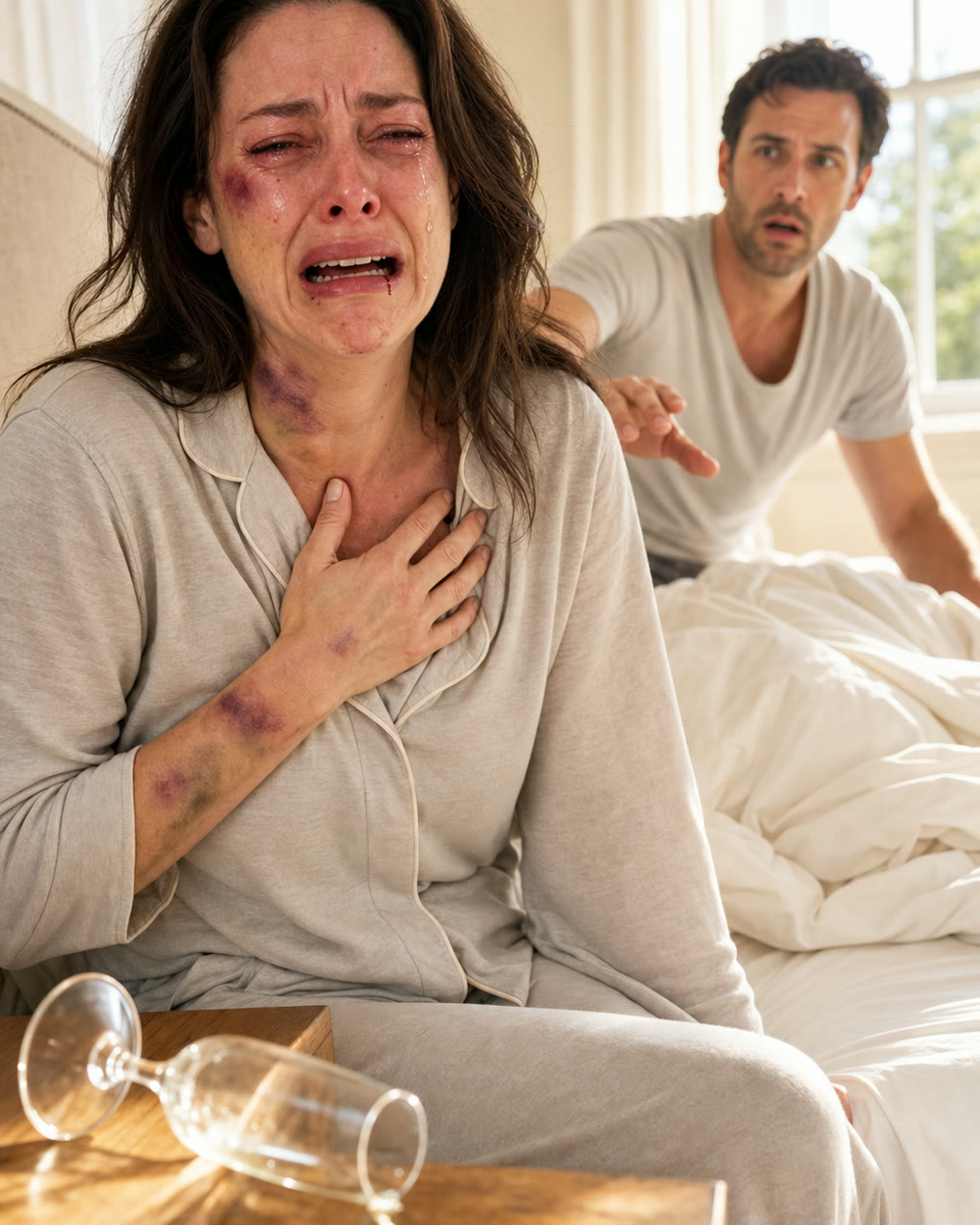
The night I died in that hospital bed, I heard two people laughing in the hallway. My husband. My little sister. They were clinking champagne glasses over the sound of my heart monitor flatlining — toasting the wife who signed everything over to them because she trusted them both. Then I opened my eyes.
Chapter 1
The last thing I heard before I died was laughter.
Not the crying I expected. Not a nurse's voice, not the beeping I'd learned to hate. Laughter — bright and loose, the kind that comes after the second glass of champagne, when people forget to be quiet in a hospital corridor.
I knew both of those laughs. I had known them my whole life.
One belonged to Marcus, my husband of six years, the man who had held my hand in the ER three weeks earlier and told me he couldn't do this without me. The other belonged to Delia, my little sister, twenty-six years old, the girl whose braces I paid for, whose college applications I proofread at two in the morning, whose rent I covered the year she "found herself."
They were standing just outside my room, and they were celebrating.
I couldn't move. The cancer had taken almost everything by then — the strength in my hands, the feeling in my legs, my voice most of all. But my hearing stayed sharp to the very end, cruel and clear, and so I lay there in the dark with the morphine humming through me and I listened to them toast each other over my body.
"To new beginnings," Marcus said.
"To finally being free," Delia answered, and they laughed again, and glass touched glass with that soft expensive ring.
Free. As if I were a debt. As if the last six years had been a sentence they were serving.
I wanted to scream. I wanted to tell the nurse, tell anyone, tell the whole world what I had figured out too late — that the "investors" who had drained our savings were a story Marcus invented, that the paperwork Delia had walked me through when I was too sick to read the fine print had quietly signed my house and my father's insurance settlement and the business I built from nothing over to the two of them, that they had been circling me like patient birds since the day the doctor said the word terminal.
But I had no voice left. I had nothing left. That was the whole point.
The heart monitor changed its tone — I heard it flatten into that long, terrible note — and somewhere down the hall Delia said, "Should we go back in?" and Marcus said, "In a minute. Let her rest."
Let her rest.
Then the note filled the whole room, filled my whole head, and the dark folded over me like water.
And then my coffee was warm.
I want to be precise about this, because for a long time I thought I had lost my mind, and maybe you'll think the same. But it happened exactly like this.
I opened my eyes and I was not in a hospital. I was in my own kitchen, standing at the counter I had renovated myself two summers before, sunlight coming through the window over the sink. My hands — I looked at them first, always my hands — were strong and steady and full of feeling. My hair was long again. There was a mug of coffee in front of me, steam still curling off it, and a phone lying face-up beside it showing the date.
One year and eleven days before the night I died.
I remembered that date. It was a Tuesday. It was the Tuesday I first noticed the lump and told myself it was nothing, that I'd get it checked after the quarter closed, that I was too busy. It was the day everything had quietly started to end, and I had not even known.
I stood in my kitchen with my heart slamming and I understood, with a certainty I have never been able to explain, that I had been given the year back.
Every single thing they had taken from me was still mine.
The house was mine. The business was mine. My savings sat untouched in an account they had not yet learned to bleed. My body was whole. My father's settlement money hadn't been signed anywhere. Delia's name was on nothing. Marcus still slept in my bed thinking he had all the time in the world to be patient.
And I knew the whole shape of the trap, because I had already walked all the way into it and felt it close.
I did not cry. That surprised me. I thought I would fall apart, and instead I felt something hard and cold and clean settle into the center of my chest, like a stone dropping into still water.
I picked up the coffee. My hand did not shake. I drank it slowly and I looked out the window at the yard I loved, and I made myself a promise in the plainest words I could find.
Not this time.
Marcus came down the stairs twenty minutes later in his running clothes, and when he kissed the top of my head and said "morning, babe," I smiled up at him like nothing in the world was wrong.
That was the first thing I learned about my second life. I could smile at the man who toasted my death. I could smile at him and mean it, because a smile is a door you decide whether to open, and I had decided to keep mine shut behind my teeth.
"Big day?" I asked.
"Just a run and then the office," he said. "Same old."
Same old. He had no idea. He kissed me again and jogged out the door, and I stood there holding my empty mug and thinking, with a calm that frightened even me: I know exactly how this ends. And I am going to change every single step.
The first step was the lump. I called the doctor before Marcus's shoes had finished crunching down the driveway.
Chapter 2
If you have ever been given a second chance at anything — a conversation, a decision, one ordinary day — then you know the strange, dizzy feeling of standing inside a moment you already lived. Everything looks the same and means something completely different.
I got the biopsy done that same week. I told the receptionist it was urgent, and when she asked why, I said, "Because I have a very strong feeling," and something in my face made her stop arguing and find me a slot.
The results came back exactly as I already knew they would. Early. Small. Treatable — if it was caught now, this month, this version of now, instead of the version where I waited until after the quarter closed and let it grow in the dark for half a year.
The oncologist, a soft-spoken woman named Dr. Anwar, told me I was one of the lucky ones. "Most people ignore this," she said. "You caught it so early. What made you come in?"
I looked at her for a long moment. I could not tell her the truth. So I said, "I dreamed I didn't."
She nodded slowly, the way people do when they think you're being poetic. She had no idea I was being literal.
I scheduled the surgery quietly, under my maiden name, at a hospital two towns over. This was the second thing I learned about my second life: I did not have to tell anyone anything. In my first life I had told Marcus everything the moment I was scared, and my fear had been the doorway they used. My illness had made me dependent, and my dependence had made me easy. This time I would keep my body's business to myself until I was strong again, until the story was one I controlled.
I told Marcus I was going to a wellness retreat for a week. He thought that was hilarious.
"You? A retreat?" He laughed, buttering his toast. "You'll be back in a day, bored out of your mind, running spreadsheets from the sauna."
"Maybe," I said. "People change."
He didn't hear it. He was already scrolling his phone.
I had the surgery on a Thursday. I recovered in a quiet room with a view of a parking lot, alone, and it was the most peaceful week of my life, because for the first time I was not waiting to be rescued by people who wanted me gone. I was rescuing myself.
While I healed, I made lists.
In my first life I had run a small but genuinely successful company — a logistics software business I had bootstrapped out of my spare bedroom and grown into something with forty employees and contracts I was proud of. Marcus had never worked a day inside it. He liked to call it "your little thing," with a smile, at dinner parties, and I had let him, because I loved him and I thought love meant making yourself smaller so a man could feel tall.
I did not think that anymore.
I remembered, from the bad year, the exact mechanism of how they took it. It hadn't been dramatic. There was no forged signature, no midnight heist. It was patience. Marcus had spent that year slowly convincing me to bring on a "financial partner" to "protect the business" in case my health got worse. That partner was a shell — I looked it up during that first life, too late — controlled quietly by an old friend of his. Delia, meanwhile, had positioned herself as my caretaker, the loving sister who handled my mail and my calendar and eventually my accounts, because I was too sick to hold a pen. Between the two of them, by the time I was dying, they held the keys to everything, and I had handed those keys over one small trusting gesture at a time.
Now I knew every gesture before it came.
So I began, very quietly, to build a wall.
I met with a lawyer — not our family lawyer, who golfed with Marcus, but a sharp, expensive woman named Priya Nair who specialized in exactly the kind of quiet asset protection I needed. I restructured the ownership of my company so that no partner, financial or otherwise, could ever be brought in without a supermajority vote that I alone controlled. I moved my father's settlement into a trust in my own name, untouchable, with a clause that automatically excluded any spouse in the event of divorce. I changed the beneficiaries on everything, one form at a time, and I did it all under my maiden name, at that hospital two towns over, in the weeks while I quietly recovered from a surgery my husband thought was a spa vacation.
Priya asked me, near the end of our second meeting, why I was doing all of this now, when nothing was wrong.
"Because," I said, "I love my husband, and I want to make it very easy for him to prove I'm wrong about him."
She looked at me for a long time. Then she said, "In my experience, the ones who prove you wrong don't need this much protection built around them."
"I know," I said. "That's why I'm building it."
By the time I came home from my "retreat," I was three weeks healed, cancer-free, and quietly, completely armored. And I walked back into my own house wearing the same soft, trusting smile I'd worn my whole first life — the smile they had learned to read as weakness.
Let them keep reading it that way. A smile is a door. Mine was locked now, and they didn't even know it had a lock.
Delia came for dinner that Friday. She hugged me at the door and told me I looked amazing, so rested, so glowing, and I hugged her back and smelled her perfume and thought about champagne in a hospital hallway.
"To new beginnings," she'd said.
I smiled at her over the wine I did not drink. "You know," I said, "I've been thinking the exact same thing."
Chapter 3
The hardest part of my second life was not the plotting. It was the tenderness.
Because here is the thing nobody tells you about betrayal: it doesn't erase the love. I still loved Marcus. That was the wound. When he made me coffee in the morning, some animal part of me still warmed to it. When Delia laughed at one of my jokes, some old sisterly reflex still reached for her. My heart had not gotten the memo my memory carried. Every day I had to sit at the same table with two people I loved and remember that they had toasted my death, and hold both truths at once without letting either one show on my face.
I got very good at it. I'm not proud of that, exactly. But I got good.
The trap, when it came, came exactly on schedule.
It was a Sunday in early autumn, and Marcus made a big lunch, and halfway through he set down his fork and said, casually, the way he always delivered the important things casually, "Babe, I've been thinking. With everything — I mean, God forbid, but with your health being something we should take seriously now — maybe we should think about protecting the business. Bringing in a partner. Someone who can steady the ship if you ever need to step back."
In my first life, this sentence had made me cry with gratitude. He's thinking about me, I'd thought. He's planning for me.
This time I set down my own fork and I let my eyes fill — because I can cry on command now, it turns out, when I picture a heart monitor — and I said, "Marcus. That means so much. I've actually been worried about the same thing."
His face flickered. Just for a second. A flash of something quick and hungry, gone before most people would catch it. But I wasn't most people. I had all the time in the world to watch his face, because I had already seen how the movie ended.
"Yeah?" he said. "I know a guy. Old friend. Really solid with this kind of financial structuring. I could set up a meeting."
"I'd love that," I said. "Bring him by. Let's do it properly, with paperwork and everything. I want to feel safe."
He smiled, and there it was — the smile I remembered from the hallway, the one that came out when he thought he was winning. "That's my girl," he said. "Always so smart."
Delia was there. Of course she was. She'd started coming around more, positioning herself, offering to "help with the boring admin stuff" so I could "focus on getting healthy." In my first life I'd handed her my logins with a grateful heart. This time I handed her a different set — a clean, monitored, decoy set that Priya and I had built, accounts that looked exactly like my real ones and touched nothing that mattered, wired instead to record every single thing that was done with them.
They thought they were tunneling into the vault. They were tunneling into a stage set I had built for them, with cameras in the walls.
Over the next two months, I watched them rob me in real time, and I documented every second of it.
I watched Marcus's "old friend" send over partnership papers designed to give a shell company creeping control of the business. I watched Delia log into the decoy accounts at odd hours and quietly try to move money, redirect statements, change contact addresses so I'd stop seeing what was happening. I watched them text each other — because the second thing I did, after the trust, was make very sure I still had access to the family phone plan Marcus had forgotten was in my name.
"She's completely on board," Delia wrote one night. "She actually thanked me."
"Told you," Marcus wrote back. "Patient wins the race. Once the partner's in and the trust from her dad clears to us, we're set."
"And if she gets sicker?"
"Then we don't have to wait as long. 🥂"
I read that on my phone, alone in my kitchen, at one in the morning. The champagne emoji.
I want to tell you I felt rage. I didn't, not right then. I felt the stone in my chest go very cold and very still, the way it had the morning I woke up. I saved the screenshot. I forwarded it to Priya. Then I made myself a cup of tea, and I drank it slowly, and I looked out at the dark yard I loved, and I thought: You already toasted me once. Let's find out what you're toasting when I toast back.
I signed nothing. That was the whole trick, in the end. In my first life, my mistake had been trust; my mistake had been signing. This time I stalled the partnership paperwork with a hundred gentle, reasonable delays — I want my lawyer to glance at it, I want to wait until after this contract closes, I've just been so tired, let's do it next month — and every delay drove them a little more frantic, and frantic people get sloppy, and every sloppy thing they did, I saved.
By December I had a folder. Priya called it, dryly, "the most thoroughly documented attempted fraud I have seen in twenty years of practice." I called it my second chance.
And then, three days before Christmas, Marcus poured two glasses of champagne after dinner, handed me one, and said, "To us. To getting everything set up in the new year."
I took the glass. I looked at the bubbles rising in it. I thought of a hospital hallway I was the only living person who remembered.
"To us," I said, and I clinked my glass against his, and I smiled my locked-door smile. "To getting everything you deserve."
He never heard the difference. He never did.
Chapter 4
I did not confront them in a burst of screaming. I had imagined that, in the bad year, lying awake — the movie version where I storm in and throw the truth in their faces and they crumble. But rage like that is a gift you give the other person; it lets them call you crazy, unstable, sick. I did not want to be right in a way they could argue with.
I wanted to be right in a way that was already finished by the time they found out.
So I let them have their Christmas. I let them have New Year's, both of them at my table, laughing, so sure the year ahead was theirs. And on the second Monday of January, I invited them both to a "family meeting to finalize the business partnership" at Priya's office downtown, in a glass conference room high above the city.
Marcus wore a suit. Delia wore the earrings I'd bought her for her twenty-first birthday. They arrived holding coffees, relaxed, triumphant, ready to sign the papers that would begin the slow theft of everything I owned.
Priya was there. So was a second lawyer I'd hired, a forensic accountant, and — sitting quietly in the corner where they didn't notice him until it was too late — a detective from the financial crimes unit, a patient man named Ruiz who had spent three weeks reading my folder and had told me, at our first meeting, "Ma'am, in most of these cases the victim comes to us after everything's gone. I've never had one come to me before, with the whole thing gift-wrapped."
"I'm organized," I'd said.
We sat down. Marcus reached for the partnership papers with an easy smile. "Should we get started?"
"Actually," I said, "I brought some documents of my own."
I slid the first folder across the table.
It was the screenshots. Every text. She's completely on board. Then we don't have to wait as long. The champagne emoji, printed in black and white, sitting on a glass table in a room forty floors above the city.
I watched the color leave Marcus's face the way I had once watched the color leave a heart monitor.
"This is—" he started. "Where did you—"
"The phone plan is in my name," I said gently. "It always was. You forgot."
I slid the second folder. The decoy accounts, every login timestamped, every attempted transfer logged, every redirected statement traced back to Delia's own laptop. The third folder: the shell company his "old friend" had set up, its ownership unmasked, the whole architecture of the partnership laid bare as exactly what it was — a machine built to strip a dying woman of everything she owned before she noticed.
Delia's hands started to shake. "Where is this coming from?" she whispered. "You— you thanked me. You said—"
"I know what I said." I looked at her, and for one moment I let all of it show on my face, all of it, the whole year and the year before it and the hallway and the flatline and the sound of glass touching glass. "I heard you, Delia. In the hallway. I heard both of you."
She didn't understand it. She couldn't. She thought I meant some ordinary overheard thing. She would never know I meant a night that, in this life, would now never come.
That was the only revenge that mattered, in the end. Not the detective. Not the charges — though there were charges, and they were real, and they took a long, grinding, public year to resolve. Not the divorce, which Priya had built to be airtight, which left Marcus with exactly what he'd brought into the marriage, which was nothing. Not even the look on his face when Ruiz stood up from the corner and introduced himself.
The revenge that mattered was quieter than all of that. It was that I lived.
It was that the surgery worked, and the follow-ups were clean, and a year later Dr. Anwar shook my hand and used the word cured. It was that I kept my company, and it grew, and I stopped letting anyone call it my little thing. It was that I woke up every ordinary morning in the house I loved, with steady hands and long hair and feeling in my legs, in a life that was entirely, unmistakably mine — a life they had planned to spend without me, and now would spend without so much as a key to my front door.
I saw Marcus one more time, months later, at the courthouse, on the last day of everything. He looked smaller than I remembered. He caught my eye across the marble floor and for a second I thought he might say something — an apology, an accusation, I couldn't tell. He didn't. He just looked at me with a kind of bewildered exhaustion, like a man who had run a race he was sure he'd already won and couldn't understand how he'd ended up so far behind.
I understood, though. I'd had a head start he could never imagine. I had started the race already knowing where the finish line was, and who had been waiting there to toast over my body.
I didn't say anything to him either. I just walked out into the bright cold afternoon, alive, and free — genuinely, finally free, in the way they had only pretended to be — and I went home to a warm cup of coffee and a life I would never again hand to anyone who saw my kindness and mistook it for something they were allowed to take.
I still hear that champagne toast sometimes, late at night. To new beginnings. To finally being free.
They were right about one thing. It was the beginning of something. It just wasn't the beginning they thought.
It was mine.
You may also like
The Silent Truth Behind My Daughter's Accident
The call came at 11:47 at night.…
Read the full story →The Night Evelyn Harper Took Back Her Power
My husband's mistress openly mocked me while my husband smiled… While they laughed at my pain, they never realized that I was the one in control. The moment I whispered, "Everythin…
Read the full story →He Fired the "Cleaning Lady" in Front of the Whole Office — Nine Minutes Before the Board Handed Her the Company
My name is Eleanor Reyes, and for eighteen months the people at Meridian Textiles thought my name was "hey" or "the cleaning lady" or, on a good day, "Ellie, could you get the brea…
Read the full story →