The Envelope They Never Meant To Hand Me
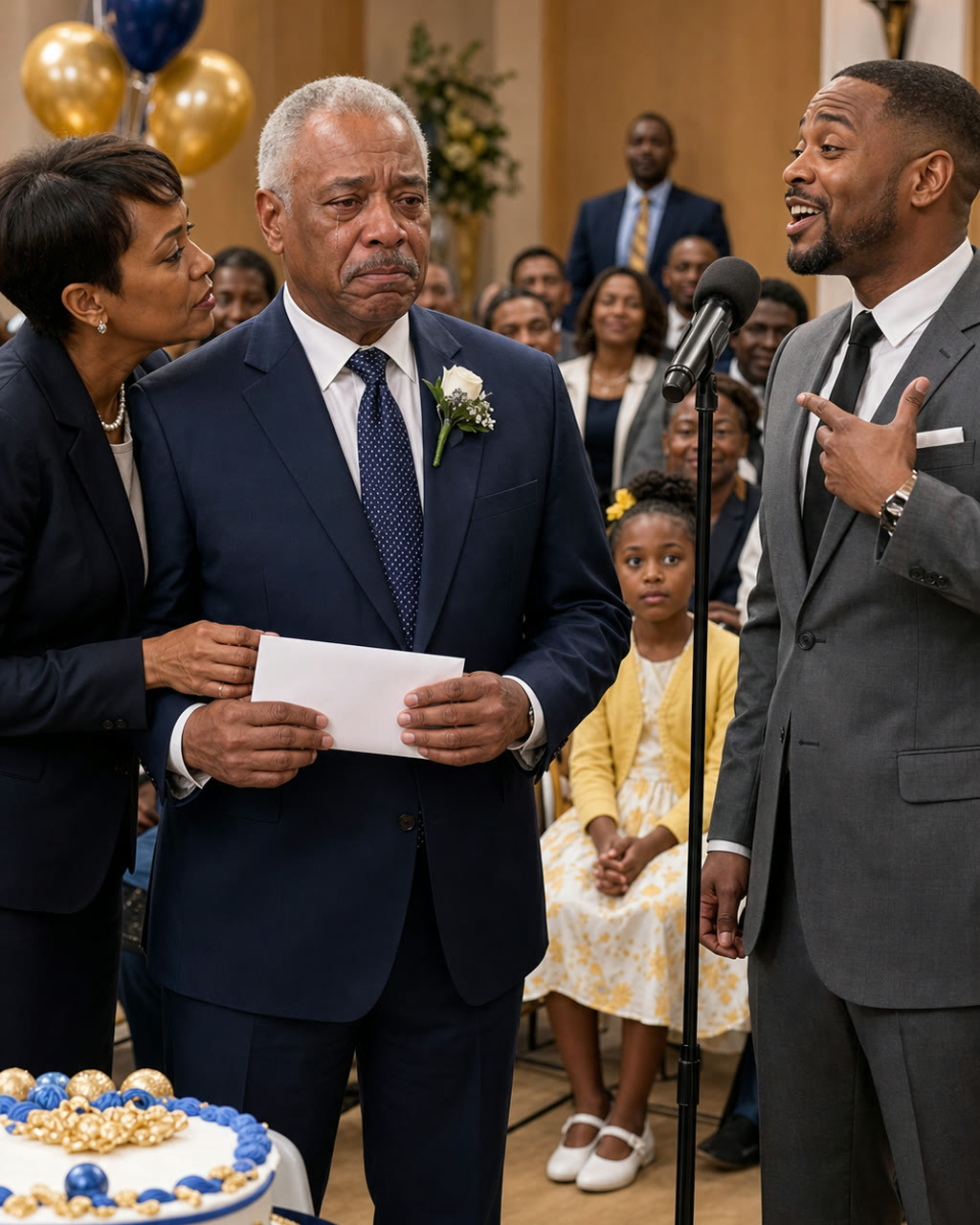
Forty-one years. I gave that company forty-one years, and I stood there in a rented banquet hall holding a paper plate of dry chicken while my boss told two hundred people that the system I built was his idea. My hands were shaking so bad the plastic fork rattled. I put it down so nobody would see.
Chapter 1
My name is Eugene Whitfield, and for forty-one years I ran the shipping floor at Halvorsen Logistics like it was my own house.
I came in the year my daughter was born. I planned to leave the year my granddaughter graduated college. That was the deal I made with myself a long time ago.
The party was on a Friday in October, in a banquet hall off the interstate with maroon carpet and a chandelier that buzzed if you stood under it too long.
They put my name on a little cake. WHITFIELD, in blue frosting, spelled right, which surprised me.
I got there early because I always got there early. Forty-one years of clocking in before the sun does something to a man's bones.
My granddaughter Nia came with me. She's eleven, and she'd asked me three times that week what I did at work, because a kid at school told her retirement meant you were too old to be useful.
I told her retirement meant they finally let you rest. She said, "But you're not tired, Papa." And I didn't have an answer for that.
She wore a yellow church dress and white shoes she kept looking down at. She sat in the third row and folded her hands like she was in service.
My daughter Renata couldn't come. She works nights at the hospital, a nurse's aide on the geriatric ward, and she'd already switched two shifts that month to make a school thing of Nia's. She told me on the phone that morning, "Daddy, you walk in there like you own it, because you do."
Renata is my only child. Her mother, my wife Denise, passed six years ago. Breast cancer. She was there for thirty-five of my forty-one years and she was the one who told me, way back, to write the system down instead of just carrying it in my head.
"Put your name on it, Eugene," Denise used to say. "A man ought to leave something behind with his name on it."
I never did put my name on it, not the way she meant. I just wrote the memos and let the work speak. I've thought a lot about what she'd say about how the rest of this went. I think she'd have been out of her chair before Dale finished his first sentence.
I wore the navy suit I bought for Renata's wedding. It still fit if I didn't button the middle.
They pinned a corsage on me at the door. A young man from the front office did it, and his hands shook worse than mine.
His name was Marcus. Marcus Ellison. He'd been with the company two years and I'd trained him myself on the dock, back when he didn't know a bill of lading from a bus ticket.
"Mr. Whitfield," he said, low, "you good?"
"I'm retiring, Marcus. That's about as good as it gets."
He didn't smile back. He looked past me at the head table like there was something over there he didn't want to say.
I should have paid more attention to that look. I've thought about it a hundred times since.
The room filled up slow. Drivers, dispatchers, the girls from billing, a couple of the old-timers who came out of retirement themselves just to see me off.
Roosevelt came in his church suit, which I'd only seen twice before, both times at funerals. He didn't say much. He put a hand on my shoulder, heavy as a sandbag, and left it there a second, and that was Roosevelt's whole speech.
Anthony came in with his wife and both his boys, one of them driving for us now too. The billing girls — Denise's word for them, and mine, though they're grown women — brought a card the size of a placemat that everybody had signed.
Curtis was there. Old Curtis. The very same driver who got stuck on the dock for six hours nineteen years ago, the night that started everything I ever built. He's got a bad hip now and he walks with a cane and he still came. He hugged me and said, "You know I only stayed six hours 'cause I knew you'd fix it," and we both laughed like it wasn't a little bit true.
Sheila from HR was there, standing against the back wall with a folder held against her chest like a shield. I didn't know her well. She kept to the corporate side, up on the second floor where the carpet was nicer, where they had a machine that made real espresso and we had a machine that made brown water.
And then Dale walked in.
Dale Renner. My boss. Regional Operations Director, the placard on his door said, though he spent more time on the golf course than the dock.
He came in loud, shaking hands, gripping shoulders, calling men by nicknames he'd made up himself because he never learned the real ones.
He was maybe forty-five, tan in October, wearing a gray suit that cost more than my first car. He'd been at Halvorsen six years.
Six years. To my forty-one.
He found me by the cake and put his arm around my shoulders like we were brothers. His cologne was the kind that arrives before the man does.
"Gene! There he is. The legend himself." He squeezed. "You ready for the big send-off?"
"I'm ready for whatever's next, Dale."
"That's the spirit." He lowered his voice, still smiling for the room. "Keep it short in your remarks, huh? People got weekends."
Then he was gone, working the tables, and I stood there holding a plastic fork over a paper plate.
I want to tell you something about the system, because it matters for the rest of this.
When I started, the dock was chaos. Trucks backed up to the interstate. Product sitting so long it spoiled. Men working doubles for nothing.
I built a routing method over about fifteen years. Wrote it out by hand first, in composition notebooks I still have in a box in my garage.
A way to sequence loads and stage inventory so nothing sat still. Cut our turnaround by more than half. Saved the company millions, and I mean that as a number somebody actually calculated, not as bragging.
It wasn't magic. It was just paying attention for fifteen years to things nobody upstairs ever had to look at. Which dock doors backed up at which hours. How long a certain product could sit before it turned. Which drivers you could stack early and which ones you had to spread out.
I figured out a buffer rule the night Curtis got stuck. I figured out the staging sequence over a winter when we lost two men and had to do the same work with fewer hands. Every piece of it came from a real problem and a real night I stayed late instead of going home.
For years it didn't even have a name. The men just called it "Gene's way." A new driver would ask why we loaded a certain order and somebody would shrug and say, "That's Gene's way. It works. Don't fight it."
Then about four years ago, corporate got wind of it. Dale came down to the floor with a laptop and a young consultant and had me walk them through it for two days.
I did. Gladly. I was proud. I thought, finally, somebody upstairs sees what we do down here.
They put it in a slideshow. They rolled it out to the other regions. Turnaround improved everywhere. There was a company newsletter about it.
The newsletter called it "The Renner Method."
I remember reading that in the break room with a cup of coffee going cold in my hand. I read it twice.
I told myself it didn't matter. The work was the work. My men knew whose way it was. That was enough.
I told myself that for four years. You can tell yourself almost anything for four years if you need the job.
So there I was at my own party, and the lights dimmed a little, and somebody tapped a microphone, and Dale climbed up on the little riser at the front of the hall.
Nia turned around in her seat and found my face and gave me a thumbs-up. Both thumbs. That yellow dress.
Dale started with a joke about how long I'd been there, that I'd been shipping product since before he was born, which wasn't even close to true but got a laugh.
Then he got what he probably thought was serious. He put a hand on his own chest.
"When I came to this region six years ago," he said, "I saw potential nobody had unlocked. A dock that could be so much more."
I set my fork down.
"So I got to work. I sat with the data. I built something. Some of you know it as the Renner Method — the routing system that put this company on the map."
My hands started going. I put them flat on the table.
"None of this," Dale said, sweeping his arm at the whole room, at all of it, "none of this would exist without my vision."
And they clapped.
I watched Marcus in the second row. He didn't clap. He was staring at his shoes.
I watched Nia. She was clapping too, because everyone was, because she didn't know. She looked back at me to check if she was doing it right, if this was a good part.
That's the thing that got me. Not Dale. Her little face turning around to make sure she was proud of me at the correct moment.
I felt myself getting small in the chair. Forty-one years and I was going to disappear right there under a buzzing chandelier and let a man who golfed while I worked take the only thing I ever built.
I don't know what I would have done. Stood up, maybe. Made a scene. Or worse, said nothing and driven home and never told a soul, the way I'd swallowed it for four years.
But that's when I saw Sheila moving.
She came off the back wall and started up the side of the room, past the tables, quiet, that folder still against her chest.
She wasn't looking at Dale. She was looking at me.
She reached my table while Dale was still talking, still saying words like leadership and legacy, and she leaned down close to my ear.
She put a white envelope in my hand. Sealed. Heavy. My name on the front in real ink, handwritten.
And she said one sentence, so soft only I could hear it.
"Don't open it here — but don't let him leave the building before you do."
Chapter 2
I put the envelope inside my jacket, against my chest, and I could feel my own heart going against the paper.
Sheila didn't wait for an answer. She turned and walked back the way she came, folder against her chest, like she'd just refilled a water pitcher. Nobody in that room knew a thing had happened. Nobody but me.
I sat there and looked at Dale still going at the microphone, and the envelope felt like it weighed more than my whole suit.
I want you to understand where my head was. Sixty-three years old. A pension I'd been counting on since the Reagan administration. A granddaughter's college I was quietly worried about. A daughter working nights so hard her hands had started to shake worse than mine.
A man in my position does not go looking for trouble at his own retirement party. A man in my position takes the cake and says thank you.
So my first instinct, God's honest truth, was to tuck that envelope away and pretend Sheila had handed me a card.
Dale wrapped up his speech. He said something about how the future was bright and the best was yet to come and how proud he was to have "mentored a whole generation on this floor," which would have been news to the floor.
Then he called me up to the riser to "say a few words," clapping his hands over his head to start the applause going.
I stood. My knees weren't what they were. I walked up the two steps and shook his hand because two hundred people were watching, and his grip was firm and dry and sure of itself.
"Congratulations, Gene," he said, close, just us. "Enjoy it. You earned it."
He meant the retirement. He did not mean the work. He genuinely did not understand there was a difference.
I got to the microphone. I looked out at the room.
I saw the old-timers who came back just for me. I saw the billing girls. I saw Marcus with his jaw tight. I saw Nia, both hands in her lap now, watching her Papa be somebody.
I had a whole thing planned. I'd written it on an index card the night before, at the kitchen table, with Nia asleep on the couch. About gratitude, and the years, and how a job is really just the people.
It was a nice speech. It was a small speech. It was the speech of a man who intended to disappear politely.
I looked down at the card. My own handwriting, careful, blue ink. Thank you for the memories. That kind of thing.
Then I looked at Nia.
She had her hands folded in her lap and her chin up, watching me the way you watch somebody you've decided is important before you have any evidence for it.
I thought about the kid at her school. Retirement means you're too old to be useful. I thought about her asking me three times what I did here, and me giving her a soft answer each time because I wasn't sure the true one would sound like much out loud.
And I folded the card back into my pocket.
"I started here forty-one years ago," I said. My voice came out steadier than I felt. "The dock was a mess. Good men, no system. Product spoiling on the floor."
The room got quiet in a real way, not a polite way.
"I spent about fifteen years fixing that. Wrote it out by hand first. My daughter used to do her homework at the kitchen table next to me while I worked on it."
I saw Dale's smile tighten at the edges.
"Some of you worked that system with me before it had a fancy name. Before it had anybody's name on it." I let that sit. "You know what it did. You lived it."
I saw a driver named Anthony in the back nodding. I'd hired Anthony myself twenty years back when nobody else would look at him because of a mistake he'd made as a young man. He'd never missed a shift since.
"When we started," I said, "product spoiled on the floor. Men worked doubles for nothing and went home to families they barely saw. We changed that. Not me. We."
A couple of the old-timers nodded slow. One of them, Roosevelt, who'd been on the dock nearly as long as me, said "Mm-hm" out loud, the way you do in church.
Roosevelt is a mountain of a man, quiet as a Sunday, with hands like catcher's mitts and a heart he keeps behind about six locked doors. His weakness is he'll never say two words when none will do, so people underestimate him. His strength is that when Roosevelt does speak, the whole floor stops.
He said "Mm-hm" again, louder, and it went through that room like a current.
"I'm proud of the work," I said. "I'm proud of every man and woman who ran it. And I'm going home tonight proud of that whether or not my name is ever on it."
I looked right at Dale when I said the last part. Just for a second. Then I looked away, because I'm not a cruel man and I wasn't sure yet what I was holding against my chest.
"Thank you for forty-one years," I said. "Take care of the floor. It's a good floor."
I stepped down. The applause was different this time. Warmer. Roosevelt stood up. Then Marcus stood. Then a few of the drivers.
Dale clapped too, but he was watching me now, really watching me, the way you watch a dog you thought was asleep.
I went back to my table. Nia grabbed my sleeve.
"Papa, you built the thing?" she whispered. "The whole thing?"
"I built the thing, baby."
"Then why did that man say—"
"Later," I said. "Eat your cake."
The party loosened up after that. Music came on — somebody's playlist, a little Frankie Beverly, a little Anita Baker, the kind of thing that makes a room of Black folks a certain age sway without deciding to.
People got in the buffet line. Nia found the cake and got herself a corner piece with a frosting flower, and I let her, because it was my party and my rules for one night.
Dale moved to the far corner with two men in polo shirts I didn't recognize. Not company people. Their shirts had a little logo I couldn't read from across the room, and they carried themselves like men who bill by the hour.
They were talking low with their heads together, and every so often one of them would glance at me and then glance away.
I excused myself and told Nia I'd be right back, go sit with the billing girls, they'll fuss over you. She went happy.
I went out to the hallway by the restrooms where it was quieter. My hands were still not right. The chandelier buzz faded behind me and there was just the hum of a soda machine and the muffled thump of Anita Baker through the wall.
I stood under an exit sign and took the envelope out.
I almost opened it right there. Sheila's voice stopped me. Don't open it here.
She found me before I could disobey her. She'd been watching for me.
"Mr. Whitfield." Up close she was younger than I'd thought, maybe thirty-five, with tired eyes and a wedding ring she kept turning with her thumb. "Not in the open. Come with me."
She walked me down the hall to a little coat room, coats on a rack, a folding table, one bare bulb. She shut the door.
She checked the hallway first, both directions, before she closed it. That told me something. HR people don't usually check hallways.
"I need to say some things fast," she said, "because I could lose my job for this and I've got a kid in braces."
"Then don't," I said. "Whatever it is. I don't want you hurt over me."
She looked at me for a second like that was the wrong answer, or maybe the right one, hard to tell.
"You don't even know what it is yet and you're already trying to protect me," she said. "That's exactly why I did it."
She sat on the edge of the folding table.
"I'm in HR. Three months ago Renner had me pull your file. Said it was routine, pre-retirement paperwork. It wasn't routine."
She turned the wedding ring on her finger, around and around.
"My name's Sheila Boykin," she said. "I've been here five years. You don't know me because I sit upstairs and you sit on the floor, and this company keeps those two worlds real separate on purpose. But I know you, Mr. Whitfield. Everybody in that building knows you. Half the good policies I administer, you fought for from the dock before I ever got here. Sick days. The bereavement rule. You don't remember, but I processed the paperwork the year you made them give the drivers real bereavement leave."
"I remember the fight," I said. "I didn't know who processed it."
"That's how I know you're not the kind of man who consults on somebody else's idea," she said. "You're the kind who builds it and then fights for everybody else to get paid fair on it."
She took a breath.
"What was it?"
"He was building a case," she said. "To classify your retirement a certain way. There's a bonus structure — a big one — tied to what he's been calling the Renner Method. An innovation payout. Six figures, spread over years, going to the person of record as the originator."
I stood very still.
"He listed himself as the sole originator," she said. "On corporate documents. And he needed your file to show you'd 'consulted' on implementation. A helper. Not the source."
The bulb buzzed. Somewhere down the hall the music thumped.
"And your file," Sheila said, and here her voice dropped, "had a problem for him. Because your file has the documentation memos. Every quarter for years you sent an internal memo describing the system you built. Dated. Logged. In the company server."
"I sent those to keep records," I said. "For the men. So the process wouldn't get lost if I got hit by a bus."
"I know why you sent them," she said. "But do you understand what they are? They're a paper trail. Fifteen years long. With your name on the origin, in the company's own system, dated before Renner ever set foot in this state."
I sat down on the folding chair by the coats. I had to.
"He asked me to delete them," Sheila said.
The word landed on me like a hand on the back of the neck.
"He said the old memos were 'cluttering the archive.' Asked me, real casual, leaning in my doorway with his coffee, to purge everything before oh-nine that was tied to your employee number. Said it'd help clean up the transition. Said, and I'm quoting him, 'Nobody's going to miss some old status reports.'"
"Did you?"
She looked me dead in the eye.
"No," she said. "I told him it was done. I told him the files were gone."
"Sheila." My voice came out rough. "You lied to a regional director. For a man on the floor you'd never met."
"I went home that night," she said, "and I couldn't eat dinner. My husband asked me what was wrong and I couldn't even say it out loud, how easy it would have been. Two clicks. A man's whole life's work, gone, and me the one who did it, and I'd have gotten a pat on the head for being efficient."
She wiped under one eye, quick, angry at herself for it.
"My mother cleaned offices for thirty years," she said. "Buildings full of men who took credit for what she kept running. She died before anybody ever thanked her once. I'm not doing that to somebody else. Not for a paycheck. Not for anybody."
I didn't say anything. I couldn't.
"They're not gone, Mr. Whitfield." She tapped the envelope in my hand. "I made copies. Everything. That's what's in there. And a printout of what he filed with corporate claiming it as his."
"Why give it to me tonight?" I said. "Why here, in the middle of all this?"
"Because tonight was the deadline," she said. "The innovation claim locks Monday morning. Once it's approved by the committee it's done — the originator of record is set and you'd be fighting the whole company to change it, with lawyers, for years you don't have to spend. If it was going to be stopped, it had to be stopped before Monday." She looked at me. "And because tonight he'd have his guard down. He thinks tonight is his victory lap. He thinks you're already gone."
The door handle turned.
We both froze. It rattled, stuck — the door had a bad latch — and a voice on the other side said, "Sheila? You in there? Renner's looking for the HR rep."
It was one of the polo-shirt men.
Sheila stood up fast and smoothed her jacket and put her HR face back on.
She opened the door halfway, blocking it with her body so he couldn't see me sitting there with the envelope open on my knee.
"Be right there," she said, bright as anything.
The man's voice, closer now: "Everything okay? Renner said something about wrapping up loose ends with Whitfield before he leaves tonight."
And I understood, cold all the way down, that Dale had said don't let him leave the building — the exact same words Sheila had used, aimed the opposite direction.
He wasn't done with me either. He had loose ends of his own.
Chapter 3
Sheila stepped out into the hall and pulled the door mostly shut behind her, and I sat in that coat room with the bare bulb buzzing and listened.
"He's around somewhere," she said to the polo-shirt man, light and easy. "Probably out front with his family. You want me to send him up?"
"Renner wants him in the manager's office off the lobby. Says it's about a form he needs signed before it's official. Ten minutes."
"I'll pass it along," Sheila said.
Their footsteps went off down the hall. I let out a breath I'd been holding so long my chest hurt.
I looked down at what was in my lap.
The first page was one of my own memos. I recognized it before I read a word — the format, the way I always headed them, PROCESS NOTE, then the date, then the summary. This one was from nineteen years ago.
The paper had that slightly gray look old server printouts get. But the date was right there in the corner, machine-stamped, undeniable. Nineteen years and four months ago.
My own words, describing the staging sequence, the load ordering, the buffer rule I'd figured out one night when a driver named Curtis got stuck for six hours and I decided nobody was ever waiting six hours again.
There were dozens of them. Copied clean. Dated across two decades. My employee number in the corner of every one.
I sat on the folding chair and read a few, and it was a strange thing, meeting my younger self on paper like that. The early ones were stiff, formal, a man trying to sound official for people who'd never read a word he wrote.
One from about fifteen years back had a note at the bottom I'd forgotten writing. "Recommend we credit dock crew if this rolls out region-wide — the idea is theirs as much as mine." I'd written that. Fifteen years ago I was already trying to make sure the men got their due.
I sat there and I thought about how the exact thing I'd worried about — the work getting taken, the men getting cut out — had happened, just not to the men. To me. And I was the one who'd left the paper trail that could undo it.
Denise. Put your name on it, Eugene. She'd been right the whole time and I was too proud or too humble, I still can't tell which, to listen.
And behind them, on different paper, a corporate filing. Clean and modern, with a logo. INNOVATION ORIGINATOR CLAIM.
Originator of record: Dale A. Renner. Date of innovation: about five years ago. Which was two years after he arrived and about thirteen years after I'd written the first memo in my lap.
There was a dollar figure. I won't say the exact number. But it had a comma in it that made my mouth go dry.
I sat there and I thought about Renata doing homework at the kitchen table while I filled composition notebooks. I thought about Curtis stuck six hours. I thought about Denise telling me to put my name on it. I thought about four years of telling myself it didn't matter.
It mattered.
Here's the part I'm not proud of. Even then, even holding proof in my two hands, part of me wanted to put it away.
Because I knew what a fight cost. I'd fought this company for the men a dozen times over forty-one years — for the bereavement leave, for the sick days, for a Christmas bonus one lean year. Every fight took something out of me I didn't get back.
And I was tired in a way I hadn't admitted to Nia. Not too old to be useful. Just tired of being the one who had to make them do right.
I almost put it away.
Then I heard, through the wall, Anita Baker giving way to Frankie Beverly, and a whole room of my people singing along soft to "Before I Let Go," and somewhere in that room an eleven-year-old girl in a yellow dress who thought her Papa built the whole thing.
I put everything back in the envelope, careful, corners lined up. Then I stood, and my knees held, and I walked out of the coat room.
I did not go find Dale in the manager's office. I went and found Marcus.
He was by the drink table, not drinking, arms crossed, watching the room like a man watching weather.
"Marcus."
He turned. Something in my face made him uncross his arms.
"You stopped clapping," I said. "During his speech. Why."
He looked away, then back. He's got a weakness, Marcus — he wants everybody to like him, wants to keep the peace, and it's cost him some spine over the years. But he's got a strength too, and I was about to find out how much.
"Mr. Whitfield," he said, quiet, "can we not do this here."
"He asked HR to delete my records," I said. "To take my system and put his name on a six-figure payout. Did you know?"
Marcus closed his eyes for a second. When he opened them they were wet at the corners.
"I didn't know about the money," he said. "I swear to you I didn't. But I knew about the meeting."
"What meeting."
"Four years ago. When you walked corporate through the system for two days." He wiped his mouth with the back of his hand. "After you went home the second day, Renner kept the consultant late. I was there because I was setting up the projector for the next morning. Nobody noticed me. I'm good at not being noticed, you know that about me, it's not a compliment."
That was true. It was Marcus's whole shape. He'd learned young to make himself small and agreeable and easy, and it had kept him safe and kept him stuck in equal measure.
"I heard him," Marcus said.
"Heard him what."
"He told the consultant, 'Leave the old-timer out of the deck. He's retiring in a few years anyway. This lands better as a leadership story than a tenure story.'" Marcus's voice cracked on it. "A tenure story. That's what he called your life."
I stood there.
"I should have told you," Marcus said. "Four years ago. I was scared for my job. I had a baby coming. I told myself it wasn't my business." He shook his head. "I've watched you train every man on that floor with more patience than I deserved when it was me. And I let that man call you a tenure story and I set up his projector."
"Marcus."
"I'm sorry, Mr. Whitfield. I'm so sorry."
"Marcus." I waited until he looked at me. "You just told me the truth when it cost you something. That's worth more than four years of quiet. Don't carry it anymore. Put it down."
He nodded, jaw working.
"You remember your first week?" I said. "You put a whole pallet on the wrong truck and you tried to fix it yourself at midnight so nobody'd see, and you nearly hurt your back?"
He let out a wet laugh. "I remember you found me. Two in the morning."
"I found you," I said, "because I stayed to fix it with you. I didn't write you up. You remember what I told you?"
"You said everybody breaks something their first week. You said the ones worth keeping are the ones who stay to fix it." His voice caught. "You said that's not about the pallet."
"It was never about the pallet, Marcus."
He wiped his face with the flat of his hand, once, hard, and something in him straightened up that I hadn't seen straighten in two years.
"Now I need to know one thing," I said. "That consultant. She got a name?"
"Priya. Priya Nandakumar. She left the firm, but—" Marcus pulled out his phone. "She friended a bunch of us on LinkedIn after. She hated Renner. I remember that. She thought he was—" he searched for the word — "she said he was a 'credit vampire.' Her words."
"Can you reach her? Tonight?"
Marcus was already typing.
While he typed, I felt a hand on my elbow. Small. Yellow sleeve.
Nia.
"Papa, a man told me to come get you." Her voice was careful. "He was nice but his smile was weird. He said tell your grandpa to come to the office and sign the form so he can be official."
I crouched down to her level, which my knees did not thank me for.
"Baby, listen to me. You did good coming to tell me. But I need you to go sit with Mr. Roosevelt — the big man who said mm-hm during my speech. Sit right by him. Can you do that?"
"Is something wrong?"
I looked at her face. That kid at school telling her retirement meant you were too old to be useful. Nia asking me three times what I did at work.
"No, baby," I said. "For once, something's about to be right. Go sit with Roosevelt."
She studied my face the way kids do, reading past the words. Then she nodded, serious, and went and climbed up next to Roosevelt, and that big man made room and put one arm around the back of her chair like a wall.
I felt better with her there. Roosevelt would keep the sky from falling on her if it came to that.
Marcus's phone buzzed. He looked at it and his eyebrows went up.
"She answered," he said. "Priya. She answered in like ninety seconds." He looked at me. "She says — Mr. Whitfield, she says she still has the original deck. The first one. The one before Renner made her take you out." He kept reading. "She says she kept it because it 'didn't sit right' with her. She's got the version with your name on every slide. Time-stamped. From the file's creation date."
The music was still going. Somebody was laughing over by the cake.
I had Sheila's envelope in my jacket. Now there was a consultant with the original slides. And a witness in Marcus who'd heard the man say it out loud.
"Ask her one thing," I said. "Ask her if she'll put it in an email. Tonight. To me and to corporate HR at the same time."
Marcus typed it out and read it back to me before he sent it, careful, like a man who'd finally decided to do a thing right and didn't want to fumble it.
"She wants to know if you're sure," he said. "She says once she sends it to corporate she can't un-send it. She could get named. Deposed, maybe, if it goes far."
I thought about that. Somebody else putting their neck out for me. First Sheila. Now a woman I'd met for two days four years ago.
"Tell her nobody's going to face anything alone," I said. "Tell her I'll be standing right next to whatever comes. And tell her — tell her thank you for keeping that file when it would've been easier to shred it."
Marcus typed. We waited. The little dots appeared, disappeared, appeared.
Then, across the room, the manager's office door opened, and Dale stepped out into the lobby, looking around for me. Looking, and not finding, and starting to frown.
His eyes swept the room and landed on me. On me standing with Marcus, both of us over a phone.
And I watched him understand, all at once, that whatever he'd planned to have me sign in that office was not going to happen.
He started walking toward us. Fast.
Marcus's phone buzzed one more time.
"She sent it," Marcus breathed. "She just sent it. To you, to me, and to the corporate HR inbox. Right now."
I felt my own phone buzz in my jacket. I pulled it out with a hand that wasn't steady and there it was, an email, subject line ORIGINAL DECK — WHITFIELD ROUTING SYSTEM (BEFORE EDITS), from a Priya Nandakumar I hadn't spoken to in four years.
I opened the first slide right there. My name across the top. My photo, even — they'd taken one of me on the dock that week, and I'd forgotten. Under it, a title. THE WHITFIELD METHOD. Not Renner. Whitfield. That's what it said before he had her cut me out.
Twenty feet away, Sheila had her own phone in her hand, looking down at it, and I watched her go still. The corporate HR inbox had received it too. It was in the system now. It couldn't be un-received.
Three of us, in three corners of that hall, holding three pieces of the same truth, all lit up at once.
And Dale Renner crossed the room with his hand already out, that party smile stretched wide and wrong, and said, "Gene. Buddy. We need to talk. Privately. Right now."
Chapter 4
I didn't take his hand.
"We can talk right here, Dale," I said. "I'm among friends."
The music had dropped low between songs. A few heads turned. Roosevelt stood up over by the wall, slow, and Nia's eyes followed him up.
His smile stayed up but his eyes went flat. He glanced at Marcus, at the phone, at the envelope-shaped bulge in my jacket that he couldn't have known the meaning of but clearly didn't like.
"Let's keep it professional," Dale said, low. "There's a form. Innovation acknowledgment. Standard for a retirement like yours. Sign it and your pension processes clean, no delays. Don't sign it and — well, these things can sit in review for months. You don't want that. Not at your age."
There it was. Not even hidden. Sign away my name or he'd choke my pension in red tape.
At my age. Second time that phrase had come at me through a stranger's mouth in one night.
"What's the form say, Dale?"
"It's boilerplate—"
"It says you're the originator," I said. "And I'm a consultant who helped implement your idea. That's what it says."
His jaw moved. "Gene, I don't know who's been filling your head—"
"Nineteen years ago," I said, "a driver named Curtis got stuck on the dock for six hours. I stayed all night and figured out a load-staging rule so nobody would ever sit six hours again. I wrote it down that same night. I've still got the notebook. It's got Curtis's name in it and a coffee ring and my daughter's third-grade spelling words on the back because we shared the table."
The room had started to notice us. The music was still going but people had stopped moving. Roosevelt had stood up. Nia was next to him, holding his sleeve.
"That was thirteen years before you filed this," I said, "claiming you invented it about five years ago."
By now the music had stopped altogether. Somebody had turned it off. The whole room was still, two hundred people holding paper plates, listening.
Dale felt them listening. He shifted his weight and pitched his voice for the crowd instead of for me, easy, reasonable, the voice of a man used to being believed.
"Folks, I think Gene's had a long emotional night, and that's understandable—"
"Don't," said Roosevelt.
One word. From the wall. That deep voice you almost never heard.
Dale stopped like he'd hit glass.
"Let the man talk," Roosevelt said. "You talked plenty."
Dale laughed, one short ugly note, and turned back to me, quieter, meaner. "You can't prove when you wrote anything in some notebook, old man."
"No," I agreed. "But the company can. Because I sent a process memo every quarter for nineteen years, into the company server, dated, with my employee number. You know that. That's why you asked Sheila to delete them."
I watched that land. I watched the blood leave his face in real time.
"You told her to purge everything under my employee number before oh-nine." I reached into my jacket and took out the envelope, but I didn't open it. I just held it. "She told you it was done."
His eyes went to the envelope and stuck there.
"It wasn't done, Dale."
Sheila had come up along the wall again. She wasn't hiding now. She stood where he could see her, arms at her sides, chin level. Scared — I could see her thumb going on that wedding ring — but standing.
"And the deck," I said. "The original slideshow. Before you had the consultant take my name off every slide because it 'lands better as a leadership story than a tenure story.'" I nodded at Marcus. "He heard you say that. Four years ago, setting up your projector. And Priya Nandakumar kept the original file because it didn't sit right with her. She emailed it ten minutes ago. To me. To Marcus. And to corporate HR."
Somebody in the crowd said, "Oh." Just, "Oh." Quiet.
Dale's mouth opened. Nothing came out. For the first time in six years I saw Dale Renner without a thing to say.
"You want to know what's in the envelope?" I said. "Everybody keeps handing me envelopes tonight." I opened it, finally, and fanned it a little so he could see it was thick. "Copies of every memo. And a copy of the innovation claim you filed with your name where mine should be. HR kept them safe. So did the consultant. So did a man I trained who was brave enough to tell the truth tonight even though it scared him."
I looked at Marcus. He was crying openly now and not ashamed of it.
"You built your whole story on the idea that I'd retire quiet," I said. "That I was a tenure story. That an old man would take a paper plate and a cake with his name spelled right and go home grateful and disappear." I put the papers back in the envelope. "You were almost right, Dale. I almost did. Twenty minutes ago I stood in that coat room holding all this and I almost put it away and went home. Ask me why I didn't."
He didn't ask. He couldn't.
I looked over at Nia, in her yellow dress, holding Roosevelt's sleeve, watching her Papa.
"But my granddaughter asked me three times this week what I do here. And a kid told her retirement means you're too old to be useful. So I'm not disappearing tonight. Not in front of her."
Dale tried one more time. He lowered his voice to almost nothing, leaned in.
"Gene. Whatever they're paying you in that payout, I'll — we can work something out. Privately. Nobody has to—"
"You just offered me money to be quiet," I said, at full volume, "in front of two hundred witnesses."
The room made a sound. Not a gasp. A murmur, low and hard, the sound a crowd makes when it decides.
One of the polo-shirt men — the consultants Dale had brought to witness his big night — quietly closed his laptop and started putting on his coat. The other one was already looking at the exit. Whatever they'd come to celebrate, they wanted no part of it now.
Dale looked around the room, and for the first time I think he actually saw it. Not an audience. Forty-one years of people. Curtis leaning on his cane. Anthony with his arms crossed. Roosevelt like a wall. The billing girls. Marcus standing tall. Sheila by the wall with her chin up. And down front, an eleven-year-old girl in a yellow dress, watching a grown man learn what it costs to steal from somebody good.
"This isn't over," Dale said, but it came out thin, and everybody heard how thin it was.
"No," I agreed. "It's not. It's just not going the way you wrote it."
He left. He didn't storm out. He just kind of came apart at the edges and walked toward the lobby, and the crowd opened to let him through and closed again behind him without a word, and that was the last most of us ever saw of Dale Renner in that building.
That was Friday.
Monday morning, corporate HR opened Priya's email and Sheila's file at the same time. By Wednesday there was an investigation. Two people from the company's ethics office drove out to see me. They sat at my kitchen table — the same table — and I showed them the composition notebooks. Curtis's name. Renata's spelling words on the back. The coffee ring.
One of them, a young woman, kept touching the edge of a notebook like it was something in a museum. "You wrote all this by hand," she said. "For years."
"Nobody told me to," I said. "It just needed doing."
By the end of the month the innovation claim was voided and re-filed. Originator of record: Eugene Whitfield. They spelled it right on that document too.
The payout — the one with the comma that dried my mouth — it came to me. Every dollar. Backdated. They called it a correction.
I put a chunk of it in an account for Nia's college the same week. The rest went to Renata, who cried on the phone and told me she still had one of those old composition notebooks in a box somewhere, with her spelling words on the back.
Dale Renner was gone by November. They didn't call it fired in the press release. They called it "pursuing other opportunities." But the drivers on the dock have a name for it that I won't print, and it isn't polite, and it's the truest thing anybody's called that man in six years.
I heard later he tried the same innovation-claim trick was part of a pattern — that he'd done a smaller version of it at his last company too, taking a warehouse manager's scheduling fix and putting his own name on it. That manager never had the paper to prove it. He'd never written anything down.
I think about that man sometimes. The one who didn't keep his memos. How close I came to being him. The whole difference between justice and just swallowing it came down to whether some tired man decades ago bothered to write things down at a kitchen table with his little girl doing homework beside him.
Denise. She knew. She always knew.
Sheila didn't lose her job. When it all came out, the company couldn't very well punish the one person who'd told the truth. She got a promotion out of it, and a thank-you note from me she says she keeps in her desk. Her kid's braces are almost off.
Marcus runs part of the floor now. He's got the spine he was missing. He tells the new hires the load-staging rule and he tells them whose it is, by name, every single time.
He called me the Monday after, before the investigators even came. He said he hadn't slept. Not from worry — from something else. "Mr. Whitfield," he said, "I've been small my whole life. I made myself small so nothing could land on me. And Friday I stood up and the sky didn't fall." He laughed, shaky. "The sky didn't fall."
"It never does as fast as you think," I told him. "That's the secret they don't want you to know."
Priya wrote me too. A long email. She said she'd left the consulting firm partly because of what Renner asked her to do, that it had bothered her for four years, and that hitting send on that original deck was the first full night's sleep she'd had in a long time. She signed it, "Thank you for letting me finally do the right thing." I keep that one.
Sheila and I have lunch every couple months now. She brings her kid sometimes. The braces came off in the spring and that girl's got a smile that could light a warehouse. I told Sheila once that her mother would be proud, and she had to look out the window a minute before she could answer.
And me? I go in one day a week, unpaid, my choice. They wanted to name the system after me on the official documents and I let them, but that's not why I go.
I go because Roosevelt's still there, and the coffee's still bad, and Curtis — old Curtis, who got stuck six hours nineteen years ago — brought his own grandson in as a driver last spring, and I like to be there when the boy clocks in before the sun does.
The boy asked me once why the loading order was the way it was. Somebody had told him, "That's just the Whitfield Method, don't fight it."
I almost told him the whole story. The party, the envelope, all of it. Then I decided he didn't need the ugly part.
"A driver named Curtis got stuck here for six hours a long time ago," I told him instead. "And a man decided nobody should ever wait like that again. That's all it is. Somebody paying attention."
Last month Nia's teacher had the class write about someone useful.
She wrote about her Papa, who built a thing with his own hands and his own name, and who waited forty-one years and one hard night to make them say it out loud.
She read it to me at the kitchen table, the same table, and when she finished she looked up and asked, "Papa, are you still not tired?"
And I told her the truth.
I told her I could rest now.
You may also like
The Silent Truth Behind My Daughter's Accident
The call came at 11:47 at night.…
Read the full story →The Night Evelyn Harper Took Back Her Power
My husband's mistress openly mocked me while my husband smiled… While they laughed at my pain, they never realized that I was the one in control. The moment I whispered, "Everythin…
Read the full story →He Fired the "Cleaning Lady" in Front of the Whole Office — Nine Minutes Before the Board Handed Her the Company
My name is Eleanor Reyes, and for eighteen months the people at Meridian Textiles thought my name was "hey" or "the cleaning lady" or, on a good day, "Ellie, could you get the brea…
Read the full story →