They Called Him "The Help" and Sat Him With the Kids — He Owned the House They Were Eating In
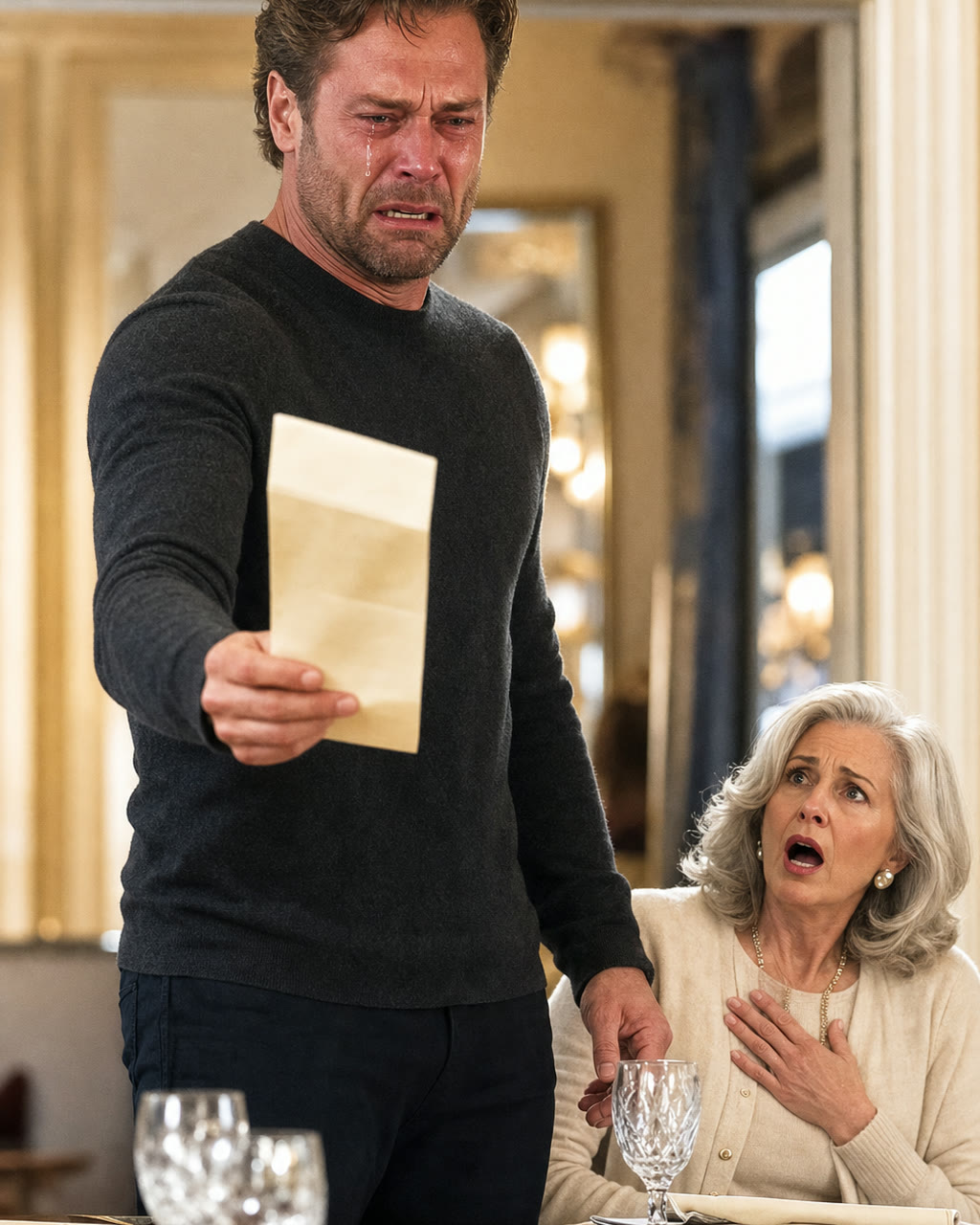
They sat my husband at the kids' table. Thanksgiving, my mother-in-law's house in Ridgefield, the good china out for everyone except him. When Daniel walked in with the pumpkin pie he'd baked himself, my brother-in-law Greg looked up from carving the turkey and said, loud enough for the whole room, "Oh good, the help is here." Everyone laughed. My own sister laughed.
Chapter 1
The thing nobody tells you about marrying a quiet man is that people mistake the quiet for weakness. I married Daniel Halstead eleven years ago in a courthouse in Danbury with two witnesses and a lunch afterward at a diner that had a chipped Formica counter, and for eleven years I have watched his family read his silence as failure.
I want to start with the drive up, because the drive up was the first sign that this Thanksgiving was going to be different, though I didn't know it yet.
Daniel makes the pie himself every year. It's a thing he does. His grandmother — the only person in that family who ever treated him like he was worth loving — taught him to make it before she died, and so every November he rolls the dough out on our counter at two in the morning because he says the butter behaves better when the kitchen is cold. That year I came downstairs at half past two and found him standing there in his undershirt with flour on his forearms, and he wasn't rolling. He was just standing, both hands flat on the counter, looking at nothing.
"You okay?" I asked.
"I'm thinking about selling the house on Winslow," he said.
I didn't answer right away, because I knew which house he meant. The house on Winslow Drive in Ridgefield is a four-bedroom colonial with black shutters and a maple tree in the front yard that turns the color of a stop sign in October. It is the house Daniel grew up being told he wasn't good enough for. It is also, though his mother did not know it, the house Daniel owned.
Here is the part I have to explain, because it's the whole spine of what happened.
Daniel is not a lucky man. He is a relentless one. When he was nineteen his father walked out and left Carol with a mortgage she couldn't carry, and instead of collapsing, Daniel got a job dispatching trucks for a regional freight outfit for eleven dollars an hour. He learned the business the way other people learn to breathe. By twenty-four he'd bought out a failing two-truck delivery operation with a loan he personally guaranteed and a stack of index cards where he tracked every route by hand. By twenty-nine he owned a logistics company that moved freight for grocery chains across four states, and he ran it through a holding company with a name so boring — Cardinal Structural Holdings — that no one in his family ever thought to look twice at it.
And they never looked, because Daniel never told them. That was the choice he made, and I understood it even when it cost me. The one time — the one time — he had let his guard down, at twenty-six, and told his mother he'd started "doing well," she had asked him for eight thousand dollars for a kitchen remodel within the hour. Not "I'm proud of you." Not "tell me everything." Just a number. Greg found out around the same time and started calling him with "opportunities." So Daniel closed the door. He decided that his family would know exactly as much about his life as they had ever bothered to ask about, which was nothing, and he would love them from behind that door, quietly, the way you feed a stray you know will never come inside.
I need to tell you what it was like to marry into that, because you can't understand the card table without it. When Daniel and I got engaged, I went to Winslow Drive for the first time for a Sunday dinner, and Carol spent the entire meal explaining to me, in the gentle voice people use when they think they're being kind, that Daniel had "always been the one who struggled" and that she hoped I was "going in with my eyes open." Greg, across the table, mentioned three separate times that he'd just been promoted to regional manager and that "somebody in this family has to be the success story." I was twenty-seven. I had just fallen in love with the most extraordinary man I'd ever met — a man who had rebuilt his mother's life from a scaffold she couldn't even see — and I sat at that table and listened to his own family eulogize him while he was still breathing. I remember driving home and asking him why he let them. He looked at the road for a long time and said, "If I correct them, they'll want something from the corrected version. This way, at least, they only want the pie." I didn't understand it then. I understand it now.
Because here is the thing about Daniel that took me years to see clearly: his silence was never fear, and it was never even pride. It was a kind of test he was too tender to admit he was running. Every year he came back to Winslow hoping — hoping the way a child hopes, uselessly, against all the evidence — that this would be the year his mother pulled out a real chair for him for no reason at all. Not because he'd earned it. Not because he'd proven anything. Just because he was hers. He never got that year. And rather than force it — rather than buy their respect by revealing the bank account that would have bought it — he chose to keep coming back and keep being disappointed, because a disappointed hope is still a hope, and the moment he told them the truth, the hope would be dead. The love would become a transaction. And he had watched, at twenty-six, exactly how fast the people who share your blood can turn into people who share your accountant.
I have three brothers of my own and a mother who calls me every Sunday, and I did not grow up in a house where love was rationed by achievement. So for a long time I could not fathom why Daniel didn't just tell them, dump the truth on the table, watch them choke. It took me until that Thanksgiving to understand that he wasn't protecting his secret. He was protecting a boy — the nineteen-year-old who'd answered the phone to hear his father was gone, who'd taken an eleven-dollar-an-hour job so his mother wouldn't lose the house the first time, and who had never, not once, been thanked for it. That boy was still in there. And the card table, every single year, was where they put him.
When Carol missed three mortgage payments on Winslow two years ago and the bank started making noises about foreclosure, she called Daniel — not for help, but to complain that "the bank was being unreasonable" and to ask if his "trucking friends" knew any lawyers. Daniel didn't lecture her. He didn't say I told you so. He simply called the bank himself, assumed the note through Cardinal, cleared the arrears, and had his attorney arrange for Carol to remain in the home "as a courtesy from the new owner." She thought a stranger had bought her debt and inexplicably let her stay. She bragged about it, actually. She told the whole family she'd "worked out a deal." She had worked out nothing. Her son had caught her before she hit the ground and let her believe she'd landed on her own two feet.
So when he stood in our kitchen at two-thirty in the morning saying he was thinking about selling the house, I knew what he was really saying was: I am tired of being invisible to keep them comfortable.
"Don't decide tonight," I said. I put the kettle on. "Roll the pie."
He rolled the pie. But he said something while he did it, low, almost to himself, working the rolling pin across the cold dough in even passes the way his grandmother had taught him. He said, "I keep waiting for it to stop mattering. I'm thirty-eight years old. I have four hundred people who depend on me. I could buy that whole street. And I still get in the car every November feeling like I'm nineteen, hoping." He stopped rolling. "That's what I want to sell. Not the house. The hoping."
I didn't have an answer for that, so I did the only thing I knew how to do, which was to stand next to him at the cold counter at two-thirty in the morning until the pie was in the oven and the kitchen smelled like his grandmother's kitchen, and neither of us said anything else, and that was its own kind of answer.
We got to Winslow Drive at one o'clock the next afternoon. The maple was blazing. There were six cars in the driveway and Greg's enormous black truck taking up two spots, the one with HALSTEAD LOGISTICS lettered on the door because Greg was a regional account manager there and never let anyone forget it. Greg did not know he worked for his brother. Greg thought he worked for a faceless corporation and that his brother worked, as he liked to put it, "some kind of warehouse thing." Daniel had made sure of the org chart layers between them years ago. It was cleaner that way. It was also, I would come to understand, a loaded gun that Daniel had been carrying around for a decade, waiting.
Carol met us at the door in a cream cashmere twinset. She kissed my cheek, looked at the pie in Daniel's hands, and said, "Oh, you brought the little pie again." Then she called past us into the house: "Greg, honey, Daniel's here, you can bring in the wine now, the good stuff's safe."
I need you to understand that phrase, the good stuff's safe, because it's the kind of thing that sounds like a joke and is actually a knife. It meant: now that we know it's only Daniel, we don't have to worry about impressing anyone. It meant: he doesn't count. Carol said it lightly, the way she said everything, already turning back into the house, already forgetting she'd said it. She had no idea that the man standing on her porch holding a pie he'd baked at two-thirty in the morning had personally kept the deed to the house she was standing in out of a foreclosure file. She had no idea that "the good stuff" — the wine, the china, the whole comfortable life she performed her resilience from — existed because of him.
Daniel smiled and said, "Happy Thanksgiving, Mom." He meant it. That's the part that used to break my heart and now just fills it. He meant it completely. There was no sarcasm in him, no held grudge in the smile. He kissed his mother's cheek and handed her the pie and stepped into the house that was legally his to be treated, for the eleventh year running, like a guest they'd been generous to invite.
I squeezed his free hand so hard I felt his knuckles shift. He squeezed back once, gently, and let go, and walked into the warm noise of a family that had no idea who had just come home.
Chapter 2
You could map the entire hierarchy of that family by the seating chart, and Carol drew that map every year like a general planning a war.
The dining room table was long and gleaming, set for ten with the wedding china and the cloth napkins folded into little fans. Greg sat at what was functionally the head, next to his wife Melissa and their two kids. My sister-in-law Dana was there with her husband, a dentist named Rob who talked about his boat. My own sister, Kim, had married into proximity with this family through a college friendship with Dana and somehow become a permanent fixture at their holidays, and she sat there too, in the warm light of the dining room, holding a glass of Rob's-boat wine.
I should describe these people to you properly, because a seating chart is only cruel if you know who's sitting where and why.
Greg is Daniel's older brother by four years, and he has spent his whole life being the designated success of a family that badly needed one and picked him more or less at random. He was the one who went to a state school and got a business degree and a firm handshake, and because Daniel dropped out at nineteen to save the house, the family locked in a story that Thanksgiving where Greg was the one who "made something of himself" and Daniel was the one they were kind enough to still invite. Greg is not evil. He's something more ordinary and more dangerous: a man whose entire identity is built on being better than his brother, who has never once questioned the foundation because questioning it would bring the whole house down. He drives a truck with the company name on it. He tells the same three stories about landing accounts. And he has no idea — none — that the ground he's standing on was poured by the brother he pities.
Melissa, Greg's wife, is worse in the specific way that people are worse when they think they're being helpful. She says cruel things in a soft voice and calls it honesty. Dana, Daniel's sister, is checked-out and pleasant and has never in her life defended anyone about anything. Rob talks about his boat. And my sister Kim — this is the part that still costs me — Kim had drifted into that family's orbit through a college friendship and, over years of holidays, had quietly absorbed their house rules without ever noticing she'd done it. Kim, who I grew up next to, who I shared a bedroom with until I was fifteen, had learned to laugh at Daniel because everyone at that table laughed at Daniel and she wanted to belong.
And then, off the kitchen, wedged into the little alcove by the coat closet where the stairs came down, sat the card table.
It was the kids' table. Paper placemats. A roll of paper towels instead of napkins. Two of Greg's children coloring turkeys with crayons. And when we walked in and the coats were hung, Carol turned to my husband — a thirty-eight-year-old man in a charcoal sweater, a man who employed four hundred and twelve people, a man who owned the roof over her head — and she pointed at that table and said the thing I will hear in my head for the rest of my life.
"You can sit there, sweetheart. The dining room's for people who, you know, contribute."
The room laughed. Not cruelly, exactly — that was the worst part. They laughed the easy, thoughtless laugh of people who have said the same joke so many times it's become a comfortable piece of furniture. Greg looked up from the turkey he was carving and said, "Oh good, the help is here," and Kim — my Kim — laughed into her wine.
I opened my mouth. Daniel caught my eye and gave me the smallest shake of his head. Wait, that look said. Not yet.
So he pulled out the little metal folding chair, the one built for a child, and he folded his tall frame down into it. His knees rose up near the tabletop. He looked, sitting there, absurd and enormous and humiliated, and he picked up a crayon that one of the kids handed him and said, "Thank you, buddy, I'll color the wattle."
Greg took a picture. I heard the shutter sound and then Greg saying, "Sending this to the group chat, hold on," and Melissa giggling.
I sat in the dining room because Carol had put me there — "you at least have a real job, Rachel," she'd said once, meaning my work as a hospital administrator, which was real and which I was proud of, but which paid a fraction of what my husband made in a single ordinary week. I sat in the good light and watched my husband eat Thanksgiving dinner at a card table with a paper towel in his lap, and I understood something about the years he had spent letting these people believe he was nothing.
It was not that he couldn't tell them. It was that telling them had never been the point. The point was that he had wanted, somewhere deep and young and unhealed, for them to be kind to him without a reason. For them to pull out a real chair for the boy whose father left, not because he'd made something of himself, but because he was theirs. Every year he came back to that table hoping they'd have grown. Every year they sat him with the children.
I want to try to make you feel what that afternoon was actually like, minute by minute, because "they sat him at the kids' table" is a sentence and what happened was a slow drowning. It wasn't one blow. It was a hundred small ones, spaced out over three hours, each one so minor on its own that objecting to it would have made me the crazy one. It was Carol asking me, warmly, whether Daniel had "found anything steady lately." It was Rob leaning over the good table to ask me, in front of everyone, whether it was "hard, being the breadwinner," and Dana adding that she "admired me so much for staying." It was Greg standing at the sideboard carving the turkey and announcing that he'd told his kids "you have to work hard or you end up—" and then catching himself and glancing, theatrically, toward the alcove, and letting the sentence hang while the table chuckled.
And through all of it, at the card table, my husband colored inside the lines with a six-year-old and said, "Nice job on that feather, buddy," and passed the little kids their juice boxes, and was — I will say this until I die — the single kindest, most present adult in that entire house. The children loved him. They always did. Kids are the last honest audience; they haven't learned yet to measure a man by his car. Greg's daughter, who is seven, leaned her whole head against Daniel's arm at one point, comfortable as a cat, while her father across the room explained to a table of adults why some men just don't have what it takes. Nobody at the long table saw the irony. Nobody ever did. That was the whole tragedy of Winslow Drive: the one adult worth being near was the one they'd exiled to sit with the only people honest enough to want to be near him.
Dinner went the way it always went, which is to say it went like a play everyone had memorized. There is a rhythm to a family that has decided who each person is, and it runs on rails. Carol says grace and thanks God for "this family's blessings, hard-earned." Rob asks about the market. Dana compliments the china. Greg waits for his moment and takes the floor, and the floor is always, in the end, about Greg.
Greg held court about Halstead Logistics, about a "big client" they'd landed — a regional grocery chain, he said, "biggest account in the division, basically saved my quarter." He didn't know that the client had been Daniel's client for nine years, or that the "division" existed because Daniel had built it. He talked about his boss, "some corporate guy named Merrick who signs off on everything," and complained that Merrick had recently frozen executive bonuses "for no reason." He said "for no reason" with real heat, the heat of a man who has never once been told the truth about his own performance because everyone up his chain was afraid of the last name he shared with the owner. He had no way of knowing that the reason was sitting eight feet away, in a folding chair meant for a child, having personally approved the freeze three weeks earlier because Greg's own region had missed its numbers.
Daniel, at the kids' table, said mildly, "Maybe the company wasn't performing."
Greg didn't even turn around. "What would you know about it," he said, and everyone laughed again, and one of the kids asked Daniel to help spell "turkey." And Daniel — I watched this happen — turned away from his brother without a flicker of reaction and gave the child his whole attention. "T," he said. "Then U. You know the trick for the middle? R-K, like two friends holding hands." The little boy laughed. Across the room, Greg was still talking about Merrick, about how underappreciated he was, about how "some people just get carried." Nobody but me saw the thing that was happening in that alcove, which was a man being genuinely, unrecoverably decent in the exact corner of the room his family had built to hold everything they'd decided didn't matter.
Carol brought up the house at some point, the way she always did, as a story about her own resilience. "When the bank tried to take this house from me," she announced, "I stood my ground. I made them a deal. Nobody handed me anything." She raised her glass. "Self-reliance. That's what this family runs on."
I looked at Daniel. He was helping a six-year-old color inside the lines. He didn't look up. But I saw the muscle in his jaw move, once, like something turning over deep underground.
Then Melissa, trying to be nice in the way that's worse than being cruel, leaned toward the card table and said, "Daniel, are you at least, like, looking for something better? Rachel can't carry you forever. It's a little sad, honestly, a man your age."
And Daniel set down the crayon.
He wiped his mouth with a paper towel, folded it, and set it on the table with a care that made the whole room go quiet without knowing why. He unfolded himself from the child's chair, one joint at a time, until he was standing at his full height in the doorway between the kitchen and the dining room, and the light from the good chandelier fell on him, and for the first time in eleven Thanksgivings, everyone at the long table was looking at him and no one was laughing.
"Before we do pie," Daniel said, "I have one small announcement about the house. I think you should all hear it while we're together."
Chapter 3
Carol's smile stayed on her face out of pure momentum, the way a struck bell keeps ringing after the hammer's gone.
"About the house?" she said. "What about the house?"
Daniel reached into the inside pocket of his sweater — he'd worn a blazer over it and had hung the blazer up, but he'd taken something out of it first, I realized, and slipped it into the sweater pocket before we walked in. He had come prepared. He had decided, somewhere between two-thirty that morning and one o'clock that afternoon, that this was the year.
He set a folded sheet of paper on the dining table, in the empty space in front of Carol's plate, and smoothed it flat with two fingers.
It was a deed.
I have to stop here and tell you about the quality of the silence, because in eleven years of Thanksgivings at that house I had never once heard the dining room go quiet. Winslow Drive was a loud house, a house of overlapping voices and performed laughter and Greg's stories landing on top of Rob's stories. And in the second after Daniel smoothed that piece of paper flat, every one of those voices stopped at once, the way a flock of birds turns without a signal, because some animal part of the brain recognizes a shift in the air before the mind does. Even the children stopped. One of them, sensing it, reached up and took Daniel's hand.
"This is the property record for 14 Winslow Drive," he said, in the same even voice he used to help the kids spell turkey. "The current owner of record is a company called Cardinal Structural Holdings. It has owned this house free and clear for a little over two years — since the note was assumed from Fairfield County Savings after three missed payments and a foreclosure filing." He paused. "The arrears at the time were eleven thousand, four hundred dollars. The company paid them. The company has paid the taxes every quarter since. The company has never collected a dollar of rent."
The room had gone very still. Greg put down his fork.
"I don't understand," Carol said. "Who — some company owns my house? I made a deal—"
"You didn't make a deal, Mom." He said it gently. That was what undid her, I think — not that he was cruel, but that he wasn't. "There was no buyer who felt sorry for you. The bank was going to take this house, and you were going to have thirty days to leave it, and you called me to complain that the lawyers were rude." He tapped the deed. "Cardinal Structural Holdings is my company. I own it. I have owned it since I was twenty-nine. I bought this house so you wouldn't lose it. And I let you believe you'd saved yourself, because I knew — I knew — that if I told you the truth, you'd never be able to sit in your own living room again without doing the math on what you owed me. So I didn't tell you. For two years I have watched you tell that story about your own resilience at this table, and I have let you have it, because it made you happy, and because I didn't need the credit."
Greg made a sound like a laugh that didn't land. "Okay, this is — Daniel, come on. You run a warehouse. You're going to sit there and tell us you own—"
"Cardinal owns Halstead Logistics too, Greg." Daniel turned to his brother, and his voice didn't change, and somehow that made it worse. "It's the parent holding company. I built the freight business at twenty-four. I've owned it outright since twenty-nine. The grocery account you 'saved your quarter' with — I signed that client in 2016. The bonus freeze you're angry about — I approved it three weeks ago, because the northeast region missed its numbers, and the region missed its numbers because of a staffing decision you made in August." He let that sit for exactly one second. "Merrick is my COO. He reports to me. You've been forwarding your complaints about your workload, for six years, up a chain that ends at my desk."
He didn't say any of it as an attack. I want to be precise about that, because it matters to who Daniel is. He wasn't landing blows. He was doing the thing he'd refused to do for eleven years, which was simply to describe reality out loud, and reality — once it was allowed into the room — was so much heavier than any insult he could have invented. He recited the facts of his brother's employment the way you'd read a map to someone who was lost: here is where you actually are, here is the ground under your feet, here is the direction you've been walking. And Greg's face, as the map unrolled, went through something I had never seen it do before. Greg's face had been set in one expression for as long as I'd known him — a kind of pleasant, unearned confidence, the face of a man who has never had to wonder if he's the fool in the room. I watched that expression crack down the middle and something young and frightened look out through it.
"That's not—" Greg started, and stopped. He tried again. "Merrick sends me the— I've talked to Merrick on the phone, he's a real—"
"Merrick is very real," Daniel agreed. "He's an excellent COO. I hired him. He's known who I am for six years and he's kept my confidence, which is one of the many reasons he has the job you'll never understand why you didn't get." Daniel wasn't cruel about it. He was just done. "Every performance review you've ever had was soft because everyone was scared of my last name. Every promotion came a little easier than you earned because nobody wanted to be the one who told the owner's brother no. You have spent your whole life thinking you were the success of this family, Greg, and the truth is you've been failing gently upward inside a company I built, cushioned by a name you didn't know was mine."
Nobody spoke. Melissa's hand had frozen halfway to her wine glass. My sister Kim was staring at me across the table with an expression like the floor had tilted, and I realized she was doing the same math everyone was: every joke, every "the help is here," every little pie.
"You're lying," Greg said, but his voice had no floor under it.
Daniel took out his phone, tapped it twice, and turned it around. It was an internal org page — the kind of thing Greg would recognize instantly, the company intranet he logged into every morning. At the top of the reporting tree, above Merrick, above the regional VPs, above everyone, was a single line: D. HALSTEAD — OWNER, CARDINAL STRUCTURAL HOLDINGS. And beside it, the small square photo of my husband in a charcoal sweater.
I watched it move through the room in a wave, the understanding, hitting each person at a different speed. Melissa got there first — Melissa, who had said it's a little sad, a man your age not ninety seconds earlier — and the blood left her face so fast I thought she might actually faint. Dana just kept looking from the deed to the phone to Daniel and back, her mouth slightly open, as if waiting for someone to tell her it was a joke. Rob, for once, said nothing about his boat. And Carol had gone absolutely rigid in her chair, her hand still frozen around her wine glass, because Carol was the one with the most to reassemble: eighteen months of a story she'd told at this very table about her own resilience, about the deal she'd made, about how nobody hands this family anything — all of it dissolving in front of her guests in real time, every telling of it revealed as a thing her son had let her have out of pity.
My sister Kim was staring at me from across the table, and I met her eyes, and I saw her understand, finally, that the man she'd laughed at for years to earn her place at this table was the reason there was a table at all. She put her wine glass down very carefully, as if it had become dangerous.
Greg looked at the phone for a long time. I don't think anything in his life had prepared him for the arithmetic that hit him then. Every promotion he'd bragged about, climbed on a ladder that ended at his brother's desk. Every "somebody has to be the success story." His entire adult identity had been built on a comparison, and the comparison had just been revealed as the exact inverse of what he'd believed since childhood. He didn't look angry, not at first. He looked lost, the way a man looks when the floor he's stood on his whole life turns out to have been a photograph of a floor. Then he looked at the card table. The little metal chair was still pulled out, at a child's height, where the owner of the company that signed his paycheck had sat all afternoon coloring a turkey's wattle while his family laughed.
"Daniel," Carol whispered. "Why didn't you ever say—"
"Because I wanted to know," Daniel said, and for the first time his voice caught, just slightly, on the edge of something eleven years deep, "if any of you would ever pull out a real chair for me before you knew I could buy the table."
The room didn't make a sound. There was nothing to say to it, because it wasn't an accusation you could argue with. It was just the truth, finally spoken, about a boy who had asked his family for one thing his entire life — to be loved without a reason — and had been told, every single November, to go sit with the children.
Carol's hand had come off her wine glass and was pressed against her mouth. Her eyes had filled. When she spoke, her voice came out cracked and small, nothing like the voice that had pointed at the card table an hour earlier. "All this time," she said. "The house. You've been — you let me tell that story. About the deal. In front of everyone. And it was you."
"It was me."
"Why would you let me look like—" She stopped, because she'd heard the shape of her own question, and I watched her understand the answer before Daniel could give it. He'd let her keep her dignity. He'd bought her house and then he'd let her believe she'd saved it, because taking the credit would have cost her something he wasn't willing to make her pay. He had protected the pride of a woman who had never once protected his.
"Because you're my mother," Daniel said simply. "And I'd rather you have the story than I have the credit. I've always felt that way. That never changed, even when you sat me back there." He nodded, once, toward the alcove, toward the little metal chair. "I didn't do this tonight to hurt you. I did it because I'm done being smaller than I am so the rest of you can feel bigger. That's all this is. I just wanted to stand up straight in this house one time."
Chapter 4
I have thought a great deal, since that afternoon, about the difference between revenge and truth. Daniel didn't take revenge. He simply stopped lying to make them comfortable, and the truth, once it was in the room, did all the work by itself.
He didn't gloat. That's what I keep coming back to. A lesser man — a man like Greg — would have thrown that org chart in everyone's face and demanded apologies and evictions. Daniel put his phone back in his pocket and sat down. Not at the card table. He pulled out the empty chair at the head of the dining table, the real one, the one no one had ever offered him, and he sat in it, and he served himself a slice of his own pie, and he ate it while his family sat in the wreckage of eleven years of assumptions.
I want to sit inside that moment a little longer, because it was the most powerful thing I have ever watched a person do, and there was no shouting in it at all. He could have said anything. Ninety percent of the men I've ever met would have said everything — would have listed every slight, itemized every humiliation, made them all say the words out loud. Daniel just ate the pie. He complimented his mother on the stuffing, again, and this time the compliment landed in the silence like a stone dropped down a well, because now everyone understood that the man they'd sat with the children had meant every kind thing he'd said all afternoon, that there had never been a drop of resentment performed for effect, that he had been exactly as gracious to them when they thought he was nothing as he was now that they knew he was everything. That was the devastation. Not that he was rich. That he had been good the entire time, and they had been cruel to a good man for eleven years for no reason but that they could.
Carol cried. It was not, I'll be honest, the good kind of crying, the kind that comes from remorse. At first it was the crying of a woman recalculating her entire understanding of her own life — of the "deal" she'd bragged about, the resilience she'd toasted, the roof she thought she'd kept with her own two hands. But then, somewhere in it, something real broke loose. She reached across the table and put her hand over Daniel's, the first time I'd seen her touch him with tenderness in the eleven years I'd known her, and she said, "I sat you with the children."
"You did," Daniel said.
"Every year."
"Yes."
"And you paid for all of it."
"I didn't do it so you'd owe me," he said. "I did it because you're my mother, and I couldn't watch you lose your home, even after everything. Those two things were always both true." He set down his fork. "But I'm done pretending to be less than I am so that you can feel like more. I love you. And I will never sit at that table again."
Here is what Daniel did in the weeks that followed, and it tells you everything about the kind of man he is.
He did not evict his mother. He transferred the deed to Winslow Drive into Carol's name outright, free and clear, as a gift, with one condition attached in writing: that the card table in the alcony be thrown away, and that no child in that family ever again be made to feel that a table decided their worth. Carol signed it. I'm told she cried again when she did.
He did not fire Greg. He did something Greg found far harder to survive: he had Merrick bring Greg into a real performance review, the honest kind Greg had never once received because everyone was afraid of the last name, and he had Greg told the truth about his August staffing decision and his frozen bonus and the six years of complaints that had gone up a chain to his own brother. And then Daniel offered him a genuine mentorship — quarterly meetings, real feedback, a path — and told him, "You can actually be good at this. You've just never had anyone tell you the truth. I should have started years ago." Greg, to his enormous and lasting credit, took it. The last I heard, his region had recovered. He calls Daniel now. Not for opportunities. Just to talk.
That first meeting between them, the one right after Thanksgiving, Daniel told me about on the drive home from the office and I've never forgotten it. Greg had come in braced for humiliation, expecting to be fired, maybe expecting his brother to finally return eleven years of contempt with interest. Instead Daniel slid a folder across the desk — not a termination, a development plan — and said, "I've been letting you fail because I was hiding, and that's on me, not you. You've been carrying a region with no real support and no honest feedback because everyone was too scared of my name to tell you the truth. That stops today. I'm going to be hard on you, and it's because I think you're worth it." Daniel said Greg didn't say anything for almost a full minute, and then his older brother — the family success story, the man who'd called him the help — put his face in his hands at the conference table and cried, and said, "I spent my whole life being the one who mattered, and you were the one holding all of us up the entire time, and I never even said thank you." Daniel said he got up and put a hand on his brother's shoulder and said, "You're saying it now."
My sister Kim apologized to me privately, and then to Daniel, and she meant it, and I forgave her, because she was young once at a table where cruelty was the house style and she'd never questioned the recipe. She called me the night after Thanksgiving, and she was crying, and she said, "I laughed at him for years so those people would like me. What does that make me?" And I told her the truth, which is that it made her human, and that the measure of a person isn't whether they ever went along with cruelty but whether they can stop the moment they see it clearly. Kim stopped. She's different now. She sat next to Daniel at our table this year and I watched her refill his coffee before he asked, and I watched her mean it, and I let the old thing go.
There's a version of this story where I hate all of these people forever, and I understand why someone would want that version. For a while I wanted it too. On the drive home from Winslow that night I was shaking with a rage Daniel didn't seem to share, and I asked him how he could be so calm, how he could just — forgive them, after everything. And he said something I've thought about every day since. He said, "I'm not calm because I forgive them. I'm calm because I finally stopped needing them to see me. That's the thing I was chasing all those years, the reason I kept going back. I wanted them to know who I was. And tonight they finally do, and it turns out that once someone actually sees you, you don't need them to anymore. The wanting was the whole prison. I just walked out of it."
And Melissa — the one who'd said it was "a little sad, a man your age" — sent Daniel a handwritten note that I know he keeps in his desk. I've read it. It says, I'm sorry I measured you with the only ruler I had. It wasn't long enough.
I keep the phone photo Greg took that day — the one of Daniel folded into the child's chair, coloring a turkey. Greg sent it to me himself, months later, with a message that just said, I can't stop looking at this. It's the most humiliated I've ever tried to make someone, and he looks more dignified than I've ever looked in my life. I don't want to delete it. I want to remember what I was. I didn't answer for a while, and then I wrote back, Keep it. He'd want you to be kind to the you in that photo too. That's who he is.
We spent this past Thanksgiving at our own home. Daniel made the pie at two-thirty in the morning, flour on his forearms, and this time he was smiling while he rolled it. We invited Carol. We invited Greg and Melissa and the kids. There was one long table and everyone sat at it, adults and children together, no alcove, no folding chairs, no help.
Before we ate, Carol stood up — Carol, who had never in her life apologized in front of an audience — and she raised her glass toward the head of the table, where her son sat in a real chair in his own home, and she said, "To Daniel. Who caught us all before we hit the ground, and let us think we'd landed on our own."
Daniel wiped his mouth with a cloth napkin, folded it, and set it down with that same terrible care. But this time, when he stood, he was smiling.
"Somebody help the kids reach the mashed potatoes," he said. "Everyone eats at this table."
And everyone did.
I think about that folding chair sometimes, the little metal one, and what it was really for. It was never about a chair. It was a family's whole theory of a person, made out of aluminum and set up in an alcove every November — the theory that a man is worth the size of the seat you're willing to give him. Daniel spent eleven years being handed the smallest seat in the house by the people who owed him the most, and he never once got smaller to fit it. He just sat down, knees up around his ears, and stayed kind, and waited for the year they'd see him. When it finally came, he didn't use it to make anyone else small. He pulled every chair up to one table and made sure the children could reach.
That's the ending I'd want you to take from this, if you take anything. The payback wasn't the deed, or the org chart, or the moment his mother went white. The payback was that after all of it, he was still exactly the man who bakes the pie at two-thirty in the morning because the butter behaves better in a cold kitchen. They tried for eleven years to make him small. They only ever managed to make him unmistakable. And now there's one long table, and no folding chairs, and a man at the head of it who spent his whole life learning that the seat was never the thing that made him.
You may also like
The Silent Truth Behind My Daughter's Accident
The call came at 11:47 at night.…
Read the full story →The Night Evelyn Harper Took Back Her Power
My husband's mistress openly mocked me while my husband smiled… While they laughed at my pain, they never realized that I was the one in control. The moment I whispered, "Everythin…
Read the full story →He Fired the "Cleaning Lady" in Front of the Whole Office — Nine Minutes Before the Board Handed Her the Company
My name is Eleanor Reyes, and for eighteen months the people at Meridian Textiles thought my name was "hey" or "the cleaning lady" or, on a good day, "Ellie, could you get the brea…
Read the full story →