The Woman They Seated By The Recycling Bins
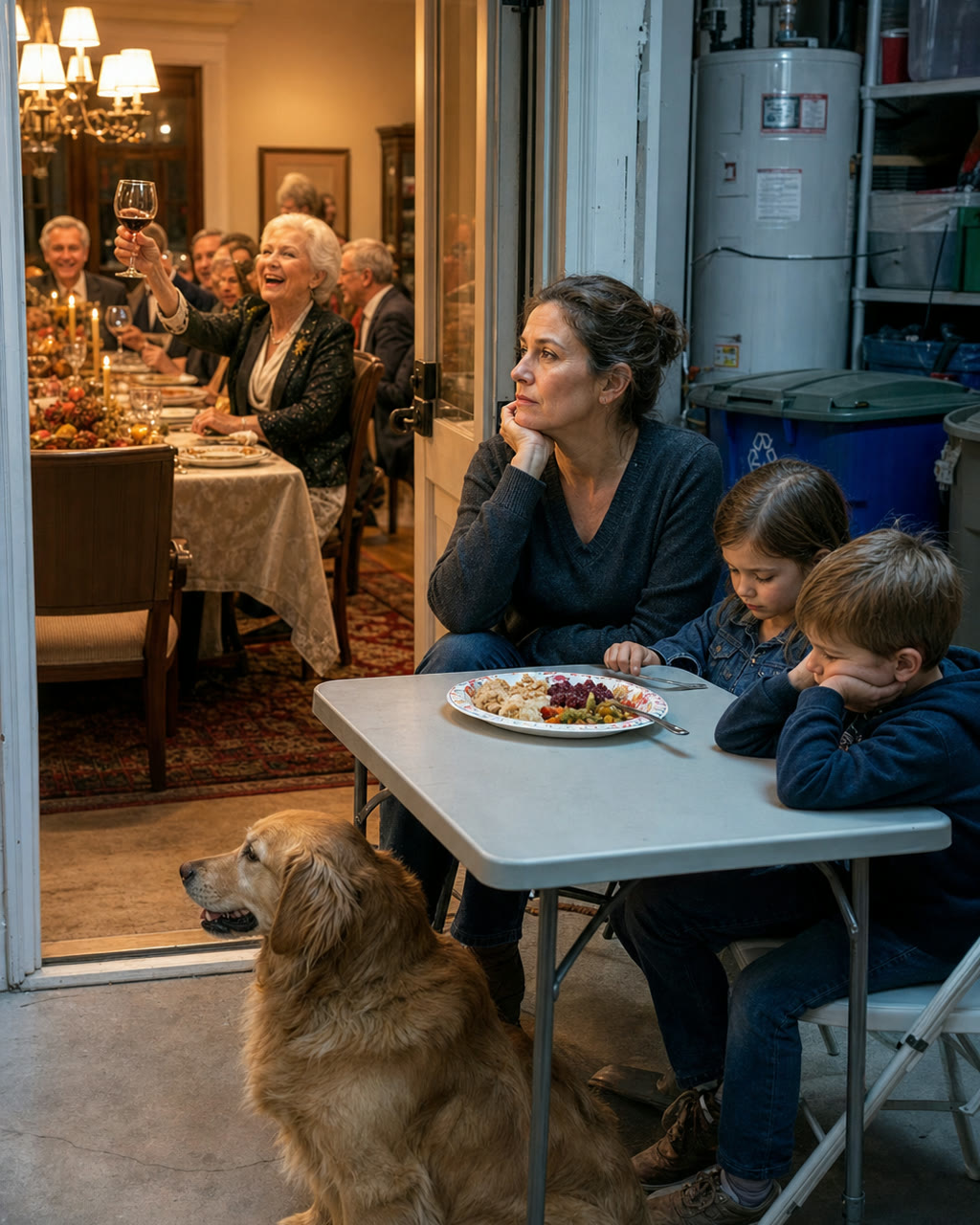
On Thanksgiving, my mother-in-law pointed a manicured finger at the garage and said, "You'll eat out there with the kids and the dog. The adult table is for real family." I was still holding the gravy I'd made from her mother's recipe. Twenty-two people watched me stand there in my good sweater. My husband looked at his plate and cut his turkey like nothing was happening.
Chapter 1
The gravy was still warm in my hands when Diane pointed at the garage.
I want you to understand that I made that gravy from her own mother's recipe. The one written on the index card gone soft and brown at the edges, the one Diane keeps in a little tin box in her pantry like it's a relic. She'd handed it to me the first year I married her son, back when she still pretended to like me, and she'd said, "Ellen used to make this. See if you can manage it." I managed it. I made it every year after that. I made it that morning at five a.m. in my own kitchen four hours away, and I drove it up in a mason jar wrapped in a dish towel so it wouldn't spill.
So when she looked at me across that beautiful crowded room and said, "You'll eat out in the garage with the kids and the dog. The adult table is for real family," I was holding her mother in my hands.
I didn't move at first. I thought I'd heard it wrong.
The dining room was loud and golden. Twenty-two people, if you counted the babies. Diane's long table with the good ivory cloth, the one that comes out twice a year, and the tall white candles she orders special, and the centerpiece of orange roses that must have cost more than my grocery budget for a week. Everyone was already seated. That was the thing I noticed a half-second late — everyone had a place but me.
"Diane," my sister-in-law Carla said, not to stop her, just to enjoy it. "The garage? Really?"
"There's a table set up," Diane said, smoothing her napkin. "It's perfectly comfortable. The children will love it. It's like a picnic."
I looked at my husband.
Rick was three seats down from his mother, in the chair he always takes, the one with the arms. He had his fork in his turkey. He was cutting it, careful, like the turkey required his full attention. He did not look up. I watched the top of his head, the gray coming in at the crown that I used to tease him about, and I waited for him to be the man I married.
He cut another piece.
"Rick," I said. Quiet. Just his name.
"It's fine, El," he said to his plate. "It's just easier. There's not enough room at the table."
There were two empty chairs at that table. I counted them while he spoke. Two chairs, pushed in neat, one on each end. But they weren't for me. I understood that now. Nothing at that table was for me.
My granddaughter Maddie was tugging my sleeve. She's six. "Grandma, are we having a picnic?"
And that's what broke it, honestly. Not Diane. Not Rick. It was Maddie's face turned up at me, hopeful, because a six-year-old hears the word picnic and thinks it's a treat. She didn't know she was being put out with the trash. She was excited.
I could have made a scene. God, I wanted to. I had a whole life of swallowed things rising up in my throat, eleven years of it, and I could have poured every drop of it out right there on Diane's ivory tablecloth.
But I looked around that room. I saw Carla already half-smiling, hoping I would. I saw Rick's brother Doug pretending to check his phone. I saw the aunts, the cousins, the family friends who'd known Diane for forty years and me for a decade, and I understood exactly how the story would be told at every funeral and wedding from now until I died. Ellen — no, they'd get my name wrong even — that woman Rick married, she made an ugly scene at Thanksgiving. Over seating. Can you imagine.
They wanted the scene. It would prove everything they already believed about me. That I didn't belong. That I was the wrong sort. That I'd married up and never quite scrubbed off where I came from.
So I gave them nothing.
"A picnic," I said to Maddie, and I made my voice light. "That sounds fun, doesn't it."
I set the mason jar of gravy down on the table in front of Diane. Gently. I didn't slam it. I set it down the way you'd set down something that mattered, because it did, it was her mother, and then I took my paper plate — they'd left me a paper plate, folded on the sideboard, next to a stack of the real china — and I walked out to the garage.
The concrete was cold through my shoes.
They really had set up a table. That's what I keep coming back to. This wasn't a spur-of-the-moment cruelty. Somebody had carried a card table out there, and three folding chairs, and put a plastic tablecloth over it with little cartoon turkeys on it, the kind you buy for a kids' party. There was a roll of paper towels standing in for napkins. The water heater ticked in the corner. The recycling bins were three feet away, full of wine bottles from the night before, and the whole garage smelled like cold cement and motor oil and, faintly, the good food happening on the other side of the wall.
Maddie came out with her little brother Theo, who's four, and Rick's dog, a golden named Biscuit who is the only member of that family who has ever been uncomplicatedly glad to see me.
"This is our special table," Maddie announced, climbing up on a folding chair.
"It sure is," I said.
I got them settled. I cut Theo's turkey into small pieces because he's four and he chokes if you don't. I wiped Maddie's chin. Biscuit put his big warm head on my knee and looked up at me, and I put my hand on his skull and felt the heat of him, and I looked at the door to the house, the door somebody had left open a few inches so we wouldn't feel completely shut out, I suppose, as if that were a kindness.
I want to back up, because I think you need to know how the morning started, so you understand this wasn't one bad moment. It was the shape of eleven years.
I'd left my own house at four-thirty in the dark, the gravy still warm in the passenger seat, the good pies I'd baked boxed and belted in like children. I stopped at the gas station off the interstate and got a coffee and stood in the cold pumping gas and told myself, the way I told myself every year, that this year would be easier. That I'd earned a place by now. That eleven years of showing up with pies had to add up to something.
Rick was already at his mother's when I got there. He drives up the night before, always. He stays in his old childhood room and I stay in a motel off the highway because Diane "doesn't have space," in a five-bedroom house. That's a thing I'd stopped mentioning years ago.
When I came in with the pies, Diane was arranging her orange roses, and she looked at the boxes in my arms and said, "Oh — did you bring dessert? I already ordered from the bakery. But we can put yours out too, I suppose, if there's room." She said it the way you'd talk to a child who'd made you a macaroni necklace.
I said thank you and put my pies at the far end of the counter where she pointed. Carla arrived at eleven with a store-bought veggie tray and got hugged like she'd delivered a kidney.
So when I say I sat in that garage and something let go, I want you to understand it had been fraying for a very long time, one small careless cut at a time. That's how it works. Each thing is small enough that if you object, you're the crazy one.
Through the gap I could hear them.
I could hear Diane's laugh, the high social one she uses for guests. I could hear the clink of the real silver on the real china. Somebody told a story and the whole table laughed at once, that big warm rolling laugh a happy table makes, and I sat on a folding chair in the cold and I ate a spoonful of stuffing that had already gone lukewarm, and I did not cry, because Maddie was watching me and I would not let her learn tonight what this was.
"Grandma, why isn't Grandpa Rick having the picnic?" she asked.
"He has to sit with the grown-ups," I said.
"But you're a grown-up."
I didn't have an answer for that. I gave her a roll instead.
Theo had gotten a smear of cranberry on his cheek and I reached over with the corner of a paper towel and wiped it, and he leaned into my hand the way little kids do, trusting, weightless, and I held still for a second so I wouldn't feel what I was feeling. Biscuit sighed and lay down on my feet. The water heater ticked. On the other side of the wall, somebody started carving a second turkey and the whole table murmured its appreciation.
I thought about the mason jar I'd set in front of Diane. I thought about her mother, whoever Ellen had been, making that same gravy in some other kitchen forty years ago, and I wondered if anyone had ever put her out in a garage. I doubted it. Some people are born into the warm room and never once have to wonder how they'd survive the cold one.
"Grandma, you're not eating," Maddie said.
I looked down at my paper plate. She was right. I'd been feeding them and wiping them and I hadn't touched my own food, which had gone from lukewarm to cold, the gravy — my gravy, made from the recipe of the very woman being honored inside — gone to a skin on top.
"I'm just full of love, baby," I said, which is the kind of thing you say to a six-year-old so she doesn't see the truth on your face. She grinned and went back to her roll.
That's the moment I hold onto, actually. Not the anger. Her grin. The fact that in a cold garage next to the recycling bins, my grandbabies were happy, because I made sure they were, because that's what I do — I make sure the people around me are warm, even when nobody's making sure I am.
Here is the thing I need you to know, the thing that was sitting in my chest the whole time I sat on that cold chair.
Diane thinks I'm nothing. She thinks I'm the woman her son settled for, the second wife, the divorcée from the wrong side of the county who does something with taxes and wears sweaters from the outlet mall. She thinks I should be on my knees grateful that her family let me in at all.
And every single person at that warm table believes the same thing, because Diane has spent eleven years teaching them to.
What none of them know — what Rick knows and has buried so deep he's half-convinced himself it isn't true — is that the house they were sitting in does not belong to Diane.
It belongs to me.
Not "sort of." Not "in a manner of speaking." My name is on the deed. It has been for eleven years. I paid off the note, I paid the taxes, I've quietly carried that entire family for over a decade — and they've spent every one of those Thanksgivings believing they were doing me a favor by letting me in the door.
I sat in that cold garage with my grandbabies and the dog, and I listened to them laugh in the house I own, and I made a decision.
I finished my stuffing. I wiped Theo's hands. And then I stood up, and I opened the door to the warm dining room, and I said, in a perfectly calm voice, "Diane. Before dessert. There's something the family should probably know about this house."
The laughing stopped.
Chapter 2
To understand the house, you have to understand the winter Rick's father died.
That was almost twelve years ago now, before Rick and I were married, back when we were just two middle-aged people who'd found each other late and were being careful about it. Rick was still living in the family home with Diane. His father, Walt, had run the family, run the money, run everything, and when Walt's heart gave out on a Tuesday in February, it turned out he'd run the money right into the ground and never told a soul.
I didn't learn the whole of it until later, and I only learned it because of who I am and what I do. I'm not "something with taxes," the way Diane says it, wrinkling her nose. I'm an enrolled agent. I've spent thirty years cleaning up other people's financial disasters — liens, back taxes, foreclosures, the whole ugly machinery of what happens when the money runs out. I am very, very good at it. It's the one thing in my life nobody ever gave me. I built it myself, at a folding table not unlike the one in that garage, back when I was a single mother doing other people's returns for forty dollars apiece.
So when Rick came to me that spring, gray-faced, and said his mother had gotten a letter she didn't understand, I knew exactly what the letter was before I read it.
It was a notice of default. Walt had borrowed against the house — twice — and stopped paying eighteen months before he died. He'd been juggling it, robbing one card to feed another, keeping Diane in her orange roses and her twice-a-year tablecloths while the ground opened under all of them. The bank had already filed. There was a date. The house Diane had lived in for thirty-five years, the house she'd raised her children in, the house she believed made her better than everyone, was ninety days from the courthouse steps.
Rick didn't have the money. Doug didn't have the money. Carla, God knows, didn't have the money. What they had was a mother who still floated through that house like the queen of the county, who had no idea she was about to lose everything, and three grown children too frightened to tell her.
"I don't know what to do," Rick said. We were sitting in my little kitchen. He had his head in his hands. "It's going to kill her. Losing this place. It's — El, it's her whole life. It's all she is."
I remember exactly how he looked that night. He'd come over straight from the lawyer's office with his tie still on, loosened, and he'd sat down at my little table where I did other people's taxes, and he'd spread the papers out with hands that weren't steady. He was fifty-three then and I'd never seen him cry, and he didn't cry that night either, but he did something worse, which was he got very quiet, and he kept smoothing the same corner of the same page with his thumb over and over like he could iron the numbers into something kinder.
"Doug says he can maybe do fifteen thousand," Rick said. "Carla's got nothing, she's underwater on her own place. I've got the retirement, but if I cash it out the penalty alone —" He stopped. "It's not enough. Even all of it together, it's not close."
I read the papers. I've read a thousand like them. The default, the acceleration, the sale date already set. I read the amount owed and I did the math in my head the way I always do, automatically, and I knew before he finished talking that I could cover it. That was the terrible part. I could actually fix this. There are very few disasters in this world you can fix with a checkbook, and I was sitting across from one of them, and the man I loved had his head in his hands.
"How long has your mother known?" I asked.
"She doesn't," he said. "She thinks the house is paid off. Dad told her it was, years ago. He told everybody it was." He looked up at me. "If she finds out he lied — that he'd been drowning all this time and smiling at church every Sunday — El, it'll break her. She built her whole life on being the woman who married the man who took care of everything."
I looked at this man I was falling in love with, undone at my kitchen table, and I made a choice that shaped every year that came after.
I had money. Not a fortune, but real money, the kind you build over thirty careful years when you've been poor and never want to be poor again. I'd sold my own late parents' small house. I'd saved with the ferocity of a woman who trusts no one to catch her. It was my safety net, the whole thing I'd promised myself I would never let anyone touch, because the one lesson my life had taught me over and over was that the moment you depend on somebody, they drop you.
And I offered it up.
I didn't offer it to save Diane. I want to be honest about that, even now. I offered it because Rick was hurting and I loved him, and because he loved his mother, and because I wanted — God help me — I wanted to belong to something. I wanted a family that big and loud and warm. I thought if I saved the house, they would open the door and let me in.
I bought the note from the bank. It's a thing you can do, if you know how, and I know how. I paid off Walt's debt in full. And because Rick and I weren't married yet, and because there were tax reasons and probate reasons and a dozen practical reasons I explained to him carefully across that kitchen table, the deed went into my name.
Mine. Ellen Marsh. Sole owner.
"Just until it's stable," Rick said. "Then we'll figure out how to move it back to Mom, or split it, or —"
"Of course," I said.
We never figured it out. That's the truth. Life happened. We got married. Diane kept living in the house, believing to this day that Walt had left it to her free and clear, that her husband had been the provider she'd always told everyone he was. Rick let her believe it because the alternative was telling his grieving mother that a woman she looked down on had saved her from the street.
And I paid.
I paid the property taxes every year, quietly, out of an account Rick doesn't fully understand. I paid for the new roof when the old one failed — Diane told everyone she'd "had it done." I paid for the furnace. When the water heater in that very garage died two winters ago, I'm the one who wrote the check, and I stood in that garage watching the plumber, and Diane came out and told me not to touch anything because I'd "just be in the way."
Let me tell you about the water heater, because I think it's the whole story in one afternoon.
It died in January, the coldest week of the year. Diane called Rick in a panic — no hot water, and she had a bridge luncheon coming — and Rick called me at work, because I'm the one who knows a plumber, I'm the one who handles the accounts, I'm the one who quietly makes the house keep working. I left the office and drove two hours in the snow. I met the plumber. I wrote the check for eleven hundred dollars while Diane watched from the kitchen doorway in her cardigan.
When it was done, when the new heater was ticking away warm in the corner where I'd sit two winters later on a folding chair, Diane came out to the garage. She looked at the plumber's boots on her floor. She looked at me standing there with my coat still on and snow melting off my shoulders. And she said, "You didn't need to come all the way up for this. Rick could have handled it." Then she went back inside to arrange her flowers, and at the bridge luncheon the next day, I later heard, she told her friends she'd "had to deal with the whole thing herself, it was such a production."
I paid eleven hundred dollars and drove four hours round trip in a snowstorm, and by the next afternoon I had done nothing at all. That's a kind of magic, if you think about it. That's how you make a person disappear while they're standing right in front of you.
For eleven years I have carried that family like a mother carries a sleeping child up the stairs — carefully, silently, so as not to wake them into knowing.
And in return, I have been the outsider at every gathering. The one whose casseroles get politely set aside. The one Carla calls "Rick's wife" instead of Ellen. The one who was never quite good enough for that dining room.
I told myself it didn't matter. I told myself I hadn't done it for thanks. I told myself a hundred kind, patient things, sitting in my car in their driveway before every visit, breathing, gathering myself, walking in with a smile and a dish.
But sitting on that folding chair in the cold garage on Thanksgiving, with Maddie asking me why I wasn't a grown-up, something in me that had been holding for eleven years quietly let go.
It wasn't rage. I want you to know that. If it had been rage I might have talked myself back down, the way I always had. It was something colder and clearer than rage. It was the feeling of finally seeing a thing exactly as it is.
They didn't want me. They were never going to want me. I could carry them for another eleven years, pay for another furnace, make another jar of gravy from a dead woman's recipe, and I would still be eating off a paper plate by the recycling bins.
So I stood up.
I have replayed the walk from that garage to that dining room a thousand times. It was maybe fifteen steps. My knee ached. Biscuit followed me to the door and then sat, the way he'd been trained to, at the threshold he wasn't allowed to cross into the good rooms. I looked down at that dog, who wasn't allowed in either, and I almost laughed.
I opened the door.
The warmth hit me first, and the smell of the good food, and the sound of them all — happy, sated, mid-story. Diane had a piece of pie already, because of course dessert had started for the real family while I was cutting a four-year-old's turkey in the cold.
"Diane," I said. "Before dessert goes any further. There's something the family should probably know about this house."
Twenty-two faces turned toward me.
Rick's fork stopped. I saw it stop. He knew — in that first half-second, before I'd said another word, he knew exactly what I was about to do, and I watched the color leave his face like water going down a drain.
"Ellen," he said. Just my name. The way I'd said his an hour ago. A plea.
Diane set down her pie fork with a little click. She looked at me the way you'd look at a stain. "Whatever it is," she said, "it can wait until we're finished. This is a family dinner."
"That's just it," I said. "It's about the family. And the dinner. And the house you're having it in."
Carla laughed, that little cruel laugh. "Oh, here we go. She's going to make a scene after all."
I looked at Carla. I looked at all of them. And then I reached into my bag — I'd brought it in from the garage without quite knowing why, I think some part of me had decided in the cold before the rest of me caught up — and I took out a folded envelope, worn soft at the creases from eleven years in a fireproof box, and I set it on the ivory tablecloth next to Diane's orange roses.
"Open it," I said.
Chapter 3
Nobody moved.
The envelope sat there on the tablecloth, cream-colored, ordinary, the kind of thing you'd throw away as junk mail. It looked small next to the roses. But everyone at that table was staring at it like it might come alive.
"What is this?" Diane said. Her voice had changed. She'd meant it to come out sharp, dismissive, and instead it came out thin.
"It's the deed to this house," I said. "Open it and read it. Read whose name is on it."
"That's absurd." She didn't touch the envelope. "This house has been in my family for thirty-five years. Walt and I —"
"Walt borrowed against it twice," I said. Quietly. I wasn't raising my voice. I'd learned a long time ago that the quieter you go, the harder people have to lean in to hear the thing that's going to hurt them. "He stopped paying almost two years before he died. The bank filed for foreclosure the March after his funeral. You were ninety days from losing everything, Diane. You didn't know because Rick and Doug were too afraid to tell you."
Doug's face had gone very still at the end of the table. Carla's smile was gone.
"That's a lie," Diane said. But she said it to Rick. Her head had turned to her son. "Richard. Tell her that's a lie."
Rick opened his mouth. Nothing came out.
I have been married to that man for eleven years and I have loved him through a great deal, and I will tell you that the worst thing he ever did to me was not staying silent when his mother pointed me to the garage. The worst thing he ever did was in that moment, with his mother's whole world balanced on what he'd say next — and he looked at his plate again. Same as at dinner. He looked at his plate and he couldn't do it.
"Richard," Diane said again. Sharper now. Frightened now. "Tell her."
"Mom," Rick said. And stopped. And that was the whole answer. That one word, and then nothing, and everyone at that table heard the nothing.
Doug spoke up then, from the end of the table. Quietly. "Mom. It's true." He wasn't looking at her when he said it; he was looking at his water glass. "Dad had it mortgaged to the ceiling. We got the letter after the funeral. We didn't know how to tell you." He swallowed. "Ellen fixed it. That's — that's what happened."
I hadn't expected that from Doug. In eleven years Doug had never once taken my side about anything; he'd mostly treated me like a piece of furniture that had wandered into the wrong room. But there's a difference, I've learned, between people who are cruel and people who are only cowards, and cowards will sometimes tell the truth when it costs them nothing anymore.
Carla turned on him. "You knew? All this time you knew, and you let Mom —"
"We all let Mom," Doug said, and that shut Carla up, because it was true, and because everyone at that table who'd ever whispered about me in that kitchen understood that they'd been standing on ground somebody else paid for.
I watched it move across Diane's face. She was not a stupid woman. Cruel, yes. Proud past all reason. But not stupid. And she understood, in that terrible unfolding second, watching one son go silent and the other go honest, that it was all true — every impossible word of it.
"Open the envelope," I said, one more time, gently, almost kind.
It was Carla, in the end, who reached out. Carla, who'd wanted the scene so badly, who now looked like she'd swallowed something cold. She slid the envelope across the cloth and lifted the flap and pulled out the papers, and she unfolded them, and I watched her eyes go down the page to the line that mattered.
Grantee. Sole owner in fee simple. Ellen R. Marsh.
Carla made a small sound. She looked up at me, and then at her mother, and then she set the papers down on the tablecloth very carefully, the way I'd set the gravy down an hour before, like it was something that mattered and might break.
"It says Ellen," Carla said.
"Read the date," I told her.
She looked back down. Her finger moved along the line. "Recorded... eleven years ago." She said it very quietly. Then she did the math that everyone at that table was doing, and I watched it hit her — that every Christmas she'd hosted here, every summer barbecue, every time she'd called me "Rick's wife" and set my casserole to the side, she'd been standing in a house that a woman named Ellen had bought and paid for and never once mentioned.
"Why didn't you ever say anything?" Carla asked. And for the first time in eleven years she asked me a real question, looking at my actual face, like I was a person.
"Because I wanted you to like me," I said. It came out simpler and sadder than I meant it to. "I thought if I didn't hold it over you, you'd let me in on your own. I kept thinking, next year. Next year they'll see me." I looked at the roses. "I was fifty-one years old tonight before I figured out that you were never going to."
The silence that came then was different from all the silences that had come before. It had weight. Twenty-two people, and you could hear the candles.
"I bought the note in the spring of the year Walt died," I said. My voice stayed level. I'd waited eleven years to say these words and I found I could say them slowly. "I paid off the debt in full. Two hundred and eighteen thousand dollars, and the arrears, and the penalties. The deed came to me. Rick knows all of it. He was at my kitchen table when I did it."
I looked around at them while I said it. At the aunts who'd never learned my name. At the family friend, Marjorie, who once asked me at a barbecue what "Rick's people" thought of me, as if I were a stray he'd brought home. At the cousin who'd told a story last Christmas, right in front of me, about how the family "almost didn't survive" the year Walt passed, and how Diane had been "so strong, holding it all together." I'd sat and eaten my pie and said nothing while she said it. I'd held it together. Me. And I'd let a room full of people give the credit to the woman who'd just sent me to the garage.
"Every Thanksgiving you've ever hosted here," I said, "you hosted because I stopped this house from being sold on the courthouse steps. Every one. Including this one."
"Because you tricked him," Diane said, and there it was, the queen surfacing even now, even drowning. "You saw a widow and a grieving family and you —"
"I saved you," I said.
I didn't raise my voice. But something in the room changed at that. Even Diane stopped.
"I paid the taxes on this house every year for eleven years," I said. "I paid for the roof you told the neighbors you had done. I paid for the furnace. I paid for the water heater in the garage — the one I sat next to tonight, Diane, on the folding chair, next to the recycling bins, while you told everyone the adult table was for real family." I let that sit. "You've been living in my house. You've been hosting Thanksgiving in my dining room. And every year you've made sure I understood that I was a guest you were tolerating."
Nobody defended her. That's the thing I noticed. Not one of the forty-year friends, not one of the aunts, not Doug. They all just looked at the tablecloth, or at their laps, the way people do when the person who's been the center of the room suddenly turns out to have been standing on air the whole time.
Maddie had come in behind me at some point. I hadn't noticed until I felt her small hand find the back of my sweater. She didn't understand the words. But children read rooms better than we give them credit for, and she'd read this one, and she'd come to stand behind the person she felt safest with, which happened to be the person the whole family had put in the garage. I reached back without turning and rested my hand over her little fist and felt her hold on.
"You made her eat in the garage," Doug said suddenly, and it wasn't a question. He was staring at his mother like he was seeing the whole evening again, in order, understanding it for the first time. "Mom. She paid for this table. She paid for the plates. And you made her eat by the recycling."
"I didn't know," Diane started.
"You never once wanted to know," I said. Quietly. And that landed harder than any number I'd said, because it was the truest thing in the room. She'd never wanted to know a single thing about me that might have made her have to be kind.
Diane's hands were flat on the table. I saw them trembling. She's seventy-four. And for one second — one — I felt something almost like pity, because I know what it is to have a thing you built your whole self on come apart in front of people. I know exactly what that costs. I've watched it happen to strangers across my desk and I've never once enjoyed it, not even when they deserved it.
But then she lifted her chin, and she looked at me down the length of that ivory table, past the orange roses, and she said the thing that ended it.
"Fine," she said. "You own the house. Congratulations. You bought your way into a family that will never think of you as one of us. You can put your name on all the paper you want. You'll still be exactly what you've always been."
And she looked at Rick.
"Tell her," Diane said. "Tell her, Richard, or I will. Tell her what you told me about her. The two of us, in the kitchen, at Easter."
I felt the floor tilt.
Because there was something under the deed. Under the money. Under eleven years of quiet paying. There was a marriage, and there was a man I'd trusted, and there was, apparently, a conversation in a kitchen at Easter that I was not in.
I turned to my husband. "Rick," I said. "What is she talking about?"
He looked up at me finally. And the look on his face — I'd seen that look on the faces of people across my desk for thirty years, people about to tell me the number was worse than they'd let on, people who'd been hiding the true size of the thing.
"El," he said. "I can explain."
Chapter 4
"I can explain" is the sentence people say when there is no explanation. I've heard it a thousand times. It never once meant what the speaker hoped it would.
"Then explain," I said.
The dining room was completely still. Whatever this was, it wasn't just mine now. It belonged to the whole table.
Rick pushed his chair back. He stood — I think he thought standing would help, would make him look less like a man about to be sick — and he came around toward me, and I stepped back, and he stopped.
"At Easter," he said. "Mom and I were in the kitchen. She was on me about — about the money. She's always suspected there was something she didn't know about the house. She was pushing. And I —" He dragged a hand down his face. "I told her the house was handled. That she didn't need to worry. That you'd — that you had it under control, and that it would come back to the family eventually. To me. That I'd make sure of it."
"Come back to the family," I repeated.
"El." He said my name like it could save him. "You have to understand what it's like. Being the only one who knew. She'd have died of shame if she'd found out a — if she'd found out the truth. I was protecting you both. I told her not to worry because I honestly believed that someday, once she was gone, we'd sort the estate out and it would all just — flow the natural way. To the kids. To the family."
I understood then. I understood all of it, standing in the warm room I owned, with the deed on the table between us.
He hadn't just let his mother look down on me for eleven years. He had promised her, in that kitchen, that eventually he'd fix the great embarrassment of it — the embarrassment that the house was mine. In his mind, in the story he'd told his mother to keep her calm, I was a temporary problem. A holding pattern. The woman who was keeping the house warm until it could be handed to the people it really belonged to.
"You told your mother," I said slowly, "that you'd get it back from me."
"That's not — that's not how I —"
"Is that why you didn't say anything tonight?" I asked. "When she put me in the garage? Because in your head, this was always going to be your house again anyway, so it didn't really matter where I sat?"
He didn't answer. His silence had become a language I'd finally learned to read.
I thought about all the times over eleven years he'd said "that's just Mom" and "don't let her get to you" and "you know how she is." I'd taken those as comfort. I'd thought he was on my side, quietly, in the ways a man can be when his mother is difficult. But you can't be quietly on someone's side while you promise the other side you'll eventually hand them everything. Those aren't two positions. Those are the same position wearing a kinder voice at home.
"When Theo was born," I said, because it had just risen up in me, "your mother didn't come to the hospital. Do you remember what you told me? You said she wasn't feeling well." I watched his face. "She wasn't sick, was she, Rick. She just didn't think it counted. Because they're my grandbabies. Not hers. Not real family."
He didn't answer that either. But Carla did, in a small wet voice from her chair, "She went to her book club that day." And then she put her hand over her own mouth like she couldn't believe she'd said it out loud.
So that was true too. All of it was true, all the small kind lies Rick had told me for eleven years to keep the peace in a house I owned.
I looked around that table one more time. At the orange roses. At the good ivory cloth. At the candles Diane orders special. At Carla, who was crying now, quietly, though I don't think even she could have told you why. At Doug staring at his hands. At all the aunts and cousins and forty-year friends who had watched a woman get sent to a garage two hours ago and said nothing, and were now watching her husband go down and still saying nothing.
And at the far end, Diane. Small suddenly. Seventy-four and ordinary, her power all spent, looking at me with an expression I'd never seen on her before, and it took me a moment to name it. It was fear. She was afraid of what I'd do. She was afraid of me for the first time in eleven years, now that she knew I could turn every one of them out onto the courthouse steps her husband had aimed them at.
And here is where you might expect me to do it. Where the story wants me to say: I told them all to get out. I sold the house. I watched Diane pack. That would be the satisfying thing. God knows I'd earned it.
But I've spent thirty years watching what money and revenge do to people, and I know that when you finally win a fight like this, the danger is that you become the thing you beat. I didn't want to spend the rest of my life as the woman who threw a grieving old queen out of her home on Thanksgiving. I didn't need them to suffer. I'd stopped, somewhere on that folding chair by the water heater, needing anything from them at all. That was the gift, though it didn't feel like one yet.
So I picked up the deed. I folded it back along its soft creases, and I slid it into my bag, and I took a breath.
"You can keep the house, Diane," I said.
Her mouth opened.
"I'm not going to throw a seventy-four-year-old woman out of her home," I said. "That was never who I was. That's who you thought I was. That's the difference between us, and it always has been." I looked at her steadily. "But I'm going to have my lawyer draft the paperwork to put it in a trust, in your name, so that it's really yours. Free and clear. The way you always told everyone it was."
I heard someone at the table exhale.
"On one condition," I said. "You'll know, every single day you live in it, that it came from me. From the outsider. From the woman who was never real family. You'll live the rest of your life in a house you got from the person you sent to the garage. And you'll have to decide, every morning, whether you can stand that. That's the only revenge I want."
Diane didn't say anything. But her chin didn't come up either. And I think that was the closest that woman had ever come, or would ever come, to knowing what she'd done.
And then something happened I didn't plan for. Marjorie — the family friend, the one who'd asked what "Rick's people" thought of me — stood up from her chair partway down the table, and she picked up her coat off the back of it, and she said, to no one exactly, "I think I'll head home." She wouldn't look at Diane. Then the aunt beside her stood too. One by one, quietly, coats came off the backs of chairs. Not because they were my friends. They'd never been my friends. But because there's a moment when people realize which story they've been sitting inside of, and they don't want to be at the table when the candles burn down.
Diane watched her guests reach for their coats and I saw the thing she feared even more than losing the house — losing the audience. The room she'd ruled for forty years, emptying out around her, over me.
Then I turned to Rick.
This was the hard part. This was the part I'd been not-thinking-about for eleven years, the part that had been waiting under the deed and the money and the garage, the real reckoning.
"I'm not signing the trust to your mother because I forgive you," I told him. "I want to be clear about that. I'm doing it because it's right, and because I decide what kind of person I am, not you, and not her." My voice was very steady. I was proud of that later. "But I heard what you said in that kitchen. You've been waiting for the day you'd get the house back from me. Waiting for me to stop being necessary."
"El —"
"So I'm going to make it easy for you," I said. "You don't have to wait anymore. You can have your family back tonight. All of them. The whole table."
He understood. I watched him understand.
"I'll be at my own house," I said. "The one with my name on it that I actually live in. The one I built with the thirty years of work your mother thinks is nothing. And it'll just be my name on that one, Rick. All the way through."
I bent down and I picked up Maddie, who had wandered in from the garage and was standing at my hip with her arms up, because six-year-olds know when something enormous is happening even if they don't know what. I settled her on my good hip, the one without the bad knee.
"Grandma," she said, "is the picnic over?"
"Yeah, baby," I said. "The picnic's over."
And I want to tell you the last thing, because it's the thing that stayed with me.
As I carried Maddie toward the front door, past the whole silent table, past the orange roses and the candles Diane orders special, Biscuit got up from where he'd been sitting so obediently at the threshold of the good room — the line he was never allowed to cross — and he crossed it. That dog walked right through the dining room, past all of them, and fell into step beside me, and out the front door into the cold, because he'd figured out, before any of the humans in that house, which side he belonged on.
I put Maddie down in the driveway. I could hear them starting to talk behind me in the warm house I'd given away, their voices rising, the family closing over the wound the way families do.
I didn't turn around.
I loaded the empty mason jar into my car, the one that had held a dead woman's gravy, and I drove the four hours home in the dark with the heat on and the radio low, and somewhere around the second hour I realized I was breathing all the way down to the bottom of my chest for the first time in eleven years — like a woman who had finally set down a sleeping child she'd been carrying up the stairs so long she'd forgotten it wasn't part of her body.
They can have the table.
I know what I'm worth now, and it was never for them to decide.
You may also like
The Silent Truth Behind My Daughter's Accident
The call came at 11:47 at night.…
Read the full story →The Night Evelyn Harper Took Back Her Power
My husband's mistress openly mocked me while my husband smiled… While they laughed at my pain, they never realized that I was the one in control. The moment I whispered, "Everythin…
Read the full story →He Fired the "Cleaning Lady" in Front of the Whole Office — Nine Minutes Before the Board Handed Her the Company
My name is Eleanor Reyes, and for eighteen months the people at Meridian Textiles thought my name was "hey" or "the cleaning lady" or, on a good day, "Ellie, could you get the brea…
Read the full story →