The Grandson Who Stayed When No One Else Did
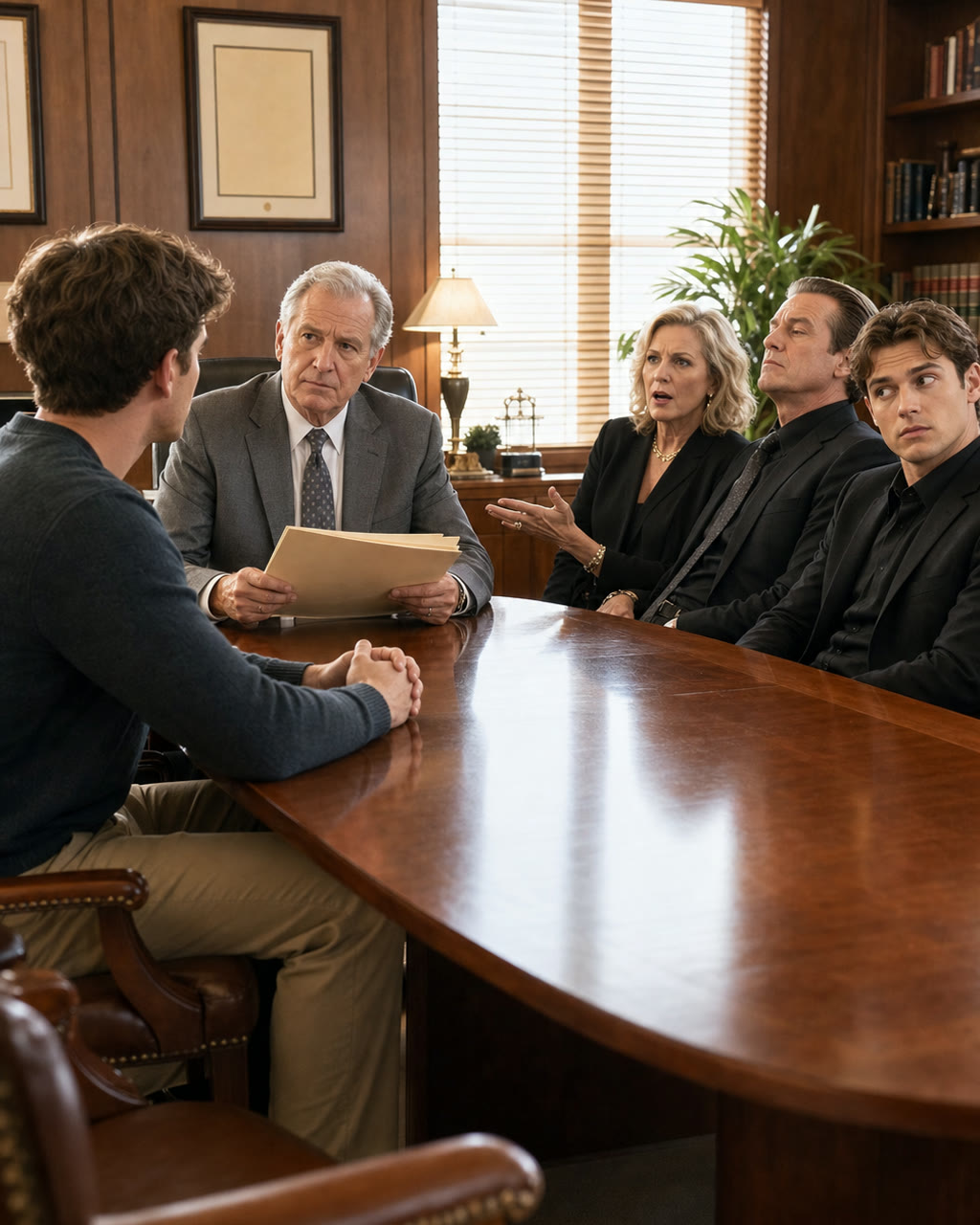
The lawyer hadn't even opened the folder yet, and my aunt was already asking which moving company handles pianos. She said it like I wasn't sitting three feet away. Like the eight years I spent driving my grandfather to dialysis, cutting his toenails when his hands shook too hard to hold the clippers, sleeping in a chair beside his bed so he wouldn't wake up alone — like none of that counted for anything in this room full of people wearing black they'd bought for the occasion.
Chapter 1
The office smelled like old paper and the peppermints in the glass dish by the door.
I remember that because I ate one while we waited, and it was stale, soft in the middle the way peppermints get when they've sat out too long. I don't know why I took it. My mouth was dry and I needed something to do with my hands.
The lawyer's name was Mr. Alcott. He was older than I expected, maybe seventy, with reading glasses that hung on a chain and a habit of lining up the edges of his papers with two fingers before he touched anything. Grandpa would have liked him. Grandpa liked people who were careful.
We were all there by ten. Aunt Denise came first, in a black dress that still had the fold lines from the box. Then Uncle Ray with his wife, Carol, both of them on their phones. Then my cousin Blake, who I hadn't seen since Christmas two years ago, when he'd stayed forty minutes and asked Grandpa if he'd "thought any more about the property."
And then me. Ethan. The one nobody saved a seat for.
I took the chair at the far end, near the window, where the radiator ticked. Nobody said hello to me except Carol, who said, "Oh, you came," in a voice that meant she was surprised I could afford the gas.
I said, "He was my grandfather."
She smiled the way you smile at a waiter. "He was everyone's grandfather, sweetie."
I let it go. I'd gotten good at letting things go. When you spend eight years in a sick man's house, you learn that most fights aren't worth the energy it takes to be right.
Mr. Alcott offered everyone water. Denise asked if he had coffee. He said no, and she made a small sound, like the office had personally disappointed her.
"We're waiting on one more," Mr. Alcott said, checking a legal pad. "Your grandfather asked that his neighbor, Mr. Owusu, be present as a witness."
Ray looked up from his phone for the first time. "The guy next door? Why does he need to be here?"
"Your grandfather requested it," Mr. Alcott said, and lined up his papers.
Mr. Owusu came in a minute later. I knew him. He'd shoveled our driveway a hundred times without being asked, and once, when Grandpa fell in the bathroom at two in the morning and I couldn't lift him alone, Mr. Owusu came over in his slippers and helped me get him back into bed and never mentioned it again. He nodded at me when he sat down. He was the only one in that room who nodded at me like I mattered.
He took the chair beside me, at the window end, the one no one else wanted. He smelled like the cough drops he was always sucking on and the cold outside air. He leaned over and said, low, "You holding up?"
I said, "I don't know what I'm doing here."
He looked at me for a second, and there was something in his face I couldn't read then. "You're here because he wanted you here," he said. "That's enough of a reason." Then he sat back and folded his big hands on the table and didn't say anything else, but I felt steadier with him there. It's a strange thing, how much one person in your corner can be worth in a room full of people counting your worth in dollars.
Denise was already talking about the house.
She didn't wait for the will. She just started, low, to Carol, the way people talk when they think the help can't hear them.
"The Sheridan Street house has got to be worth four-fifty now, maybe more with the yard. If we sell as-is we split it clean, but if I put twenty into the kitchen I could get us another eighty, ninety —"
"The floors are original oak," Carol said. "You'd be crazy to sell as-is."
"There's also the lake property," Ray said, not whispering anymore. "And whatever's in the accounts. Dad wasn't flashy but he wasn't broke. He had the pension, the railroad thing, thirty years of it."
Blake was looking at his phone. "Is the boat still up there? At the lake?"
"The boat's mine," Ray said. "I helped him buy the boat."
"You gave him four hundred dollars in 1998," Denise said. "That's not a partnership, Ray."
And on it went. The furniture. The rings that were Grandma's. Who got the truck. Whether they should "just have an estate sale and be done with it." Denise wanted the china. Carol wanted the china. Somebody's kid — Blake had brought his eight-year-old for reasons no one explained — was kicking the leg of the table, thunk, thunk, thunk, and no one told him to stop.
That table. Grandpa found it at a barn sale, took it apart in the garage, and spent a whole autumn sanding it down. I handed him the sandpaper. I remember the smell of the mineral spirits and the way he'd blow the dust off the wood and hold it up to the light and say, "See that? That was hiding under fifty years of ugly. You just have to be willing to do the work."
We ate every meal at that table for eight years. Toward the end, when he couldn't manage a fork, I cut his food into small pieces there, and he hated it, and one day he put his hand over mine and said, "I'm sorry you have to do this," and I said, "You cut my meat when I was little, I bet," and he laughed, the real laugh, the one that turned into a cough. He didn't remember cutting my meat. He never met me until I was grown. But he let me pretend, because he understood I needed to give him something back, and letting me was the something.
Thunk. Thunk. The kid kicked it like it was nothing.
I looked at my hands. There was still a callus on my right palm from the wheelchair. Eight years of pushing that chair down the ramp I built off the back porch, because the medical supply company wanted six hundred dollars for one and I could do it for ninety with lumber from the hardware store. I built it in a weekend. Grandpa sat in the doorway with a blanket over his knees and told me my angles were wrong until they were right.
None of these people had ever seen that ramp. None of them came.
I'm not saying that to be dramatic. I'm saying it because it's true, and because for eight years I told myself it didn't matter, that I wasn't doing it for them or for thanks, I was doing it for him. And that was true. But sitting in that office, listening to them measure his life in square footage, something in my chest pulled tight and wouldn't let go.
I put my keys in my fist. I thought, I'll just go. Let them have it. Let them have the china and the boat and the oak floors. I had the memory of his hand on my head the last morning he was really himself, when he pulled me down close and said something I hadn't told anybody, and that was worth more than the whole house.
I actually shifted forward in my chair to stand up.
That's when Mr. Alcott put on his glasses.
"Alright," he said. "Everyone's here. Let's begin."
Denise sat up straight and folded her hands like a woman about to be handed a check.
Mr. Alcott read the first will — the one they were expecting, dated four years ago. It was simple. The estate divided in equal shares among his three children: Denise, Ray, and their brother Tom, who'd died the year before Grandpa, which meant Tom's share went to Tom's kids. Blake. And me.
Wait. Not me. Blake and Blake's sister.
I wasn't in it.
I heard my own name skipped over like a stone across water. Denise's mouth curved up at the corner. Ray exhaled through his nose, satisfied.
"So it's thirds," Ray said. "Clean thirds."
"That's the document dated four years ago," Mr. Alcott said. He took it off, set it aside, squared the edges. "But that is not the reason your grandfather asked all of you to be in this room today."
He reached into the folder and took out a second envelope. Cream-colored. Sealed with a piece of tape, the way an old man seals something when his hands don't work well enough for the flap.
My name was on the front. Ethan. In handwriting I would have known anywhere, the letters leaning and shaking, the E too big, the way his writing had gotten in the last two years.
"Your grandfather came to see me eight months ago," Mr. Alcott said. "Alone. He drove himself, which his doctor tells me he should not have been doing." A small, sad smile. "He was a stubborn man."
"He couldn't drive eight months ago," Denise said sharply. "He could barely —"
"He drove himself," Mr. Alcott repeated. "And he made a new will. This one." He set a thicker document beside the envelope. "He also left instructions that before I read it, I was to tell all of you something he said he'd carried for forty years and could not take with him."
The radiator ticked.
The kid stopped kicking the table.
Denise's watch hand froze halfway to her face.
Mr. Alcott looked at me — not at them, at me — and slid the cream envelope across the table until it touched my cold fingers.
"He asked me to make sure you were sitting down," he said quietly, "when you heard the truth about who this family really is."
Chapter 2
I did not open the envelope.
I want to be honest about that, because later, when I told this story to my wife, she assumed I tore into it right away. I didn't. I sat there with my grandfather's handwriting under my fingertips and I couldn't make my hands work. It felt like the moment before you turn over a photograph you're not sure you want to see.
"Read the will first," Ray said. His voice had changed. The satisfaction was gone. "Whatever this is, read the actual will."
"I intend to," Mr. Alcott said. "But your father was specific about the order." He folded his hands on the table. "So I'll tell you what he asked me to tell you. And I'll ask you to let me finish before anyone speaks."
Nobody agreed to that. But nobody argued either.
Mr. Alcott took a breath. "In 1983," he said, "your grandfather, Walter, had a younger brother. His name was Sam. Most of you never met him."
Denise frowned. "Grandpa didn't have a brother. He had a sister, Eileen, who died —"
"He had a brother," Mr. Alcott said. "And a sister. Sam was the youngest. Sam got a girl pregnant when he was nineteen and left town before the baby came. Walter never forgave him for that. But Walter did something Sam didn't." He paused. "He found the girl. And when the baby was born, and the girl's family threw her out, Walter and your grandmother took her in."
The room was very still now.
"That girl had a son," Mr. Alcott said. "She named him David. And when she died two years later — she was young, it was pneumonia, it was a hard winter — Walter and your grandmother raised David as their own. They never told him he wasn't their biological child. They gave him their name. They put him on the birth certificate the way people could, in those days, in a small county with a sympathetic clerk."
I saw it before he said it. I saw it the way you see the ground coming up when you trip — too fast to stop, too slow to be anything but sure.
"David," Mr. Alcott said gently, "was Ethan's father."
Nobody looked at me. And then everybody did.
"That's not —" Denise started.
"Let me finish, please."
She closed her mouth.
"David grew up believing Walter was his father and that Denise, Ray, and Tom were his brothers and sister. And for the first years, they treated him that way. But children hear things. Somewhere along the line, one of the adults let it slip — Walter never knew which one — and by the time David was a teenager, he knew he was 'the cousin they took in.' He knew he wasn't really one of them." Mr. Alcott looked down at his papers. "He left home at eighteen. He worked construction. He married Ethan's mother. He never took another dollar from this family, and this family never offered one. When he died —"
"Twelve years ago," I said. My voice didn't sound like mine.
"Twelve years ago," Mr. Alcott agreed. "None of Walter's other children came to the funeral."
That was true. I was fourteen. I remembered the folding chairs and the rented room and how few of them there were. I remembered my mother, later, in the kitchen, saying, "They were his family and not one of them came," and my father — my quiet father, who never raised his voice — saying, "I stopped being their family a long time ago, honey. Let it go."
I did not know, until that office, that he'd meant it more literally than I understood.
I thought about my father a lot in that room. He'd been a big man, quiet, with hands like sandpaper from thirty years of framing houses. He never talked about his childhood. When I was little I asked him once why we never saw his brothers and sister, and he got a look on his face like a door closing, and he said, "Some families are the people who show up. That's the only kind that counts." Then he ruffled my hair and turned on the game and that was the end of it. I understood now that he'd been protecting me from the same cold he'd grown up in. He'd have hated that I was sitting in this room. Or maybe — I didn't know — maybe he'd have wanted me here, in his place, finally hearing it said out loud.
Mr. Alcott went on.
"So he's not blood," Ray said. He said it flatly, like he was solving a math problem. "David wasn't Dad's son. Which means Ethan isn't Dad's grandson. He's —" Ray gestured vaguely at me. "He's the great-nephew. Of a guy who ran off. He's barely related to us at all."
Something happened in Ray's face when he said that. Relief. He was doing the arithmetic and the arithmetic was coming out in his favor. If I wasn't really blood, then I wasn't really an heir, and the second will — whatever it said — could be fought.
"That is one way to hear what I just told you," Mr. Alcott said.
Denise had gone pale in a different way. She was looking at me, and I realized she was doing her own math, but it was older math, and it hurt her more. "You," she said slowly. "Your dad. David." She pressed her fingers to her mouth. "We used to — when we were kids, we used to lock him out of the fort. Tom and Ray and me. We'd say it was for family only." She let out a breath. "God. He was eight."
"He was," Mr. Alcott said.
"Nobody made us stop," she said, to no one.
Carol touched her arm. Denise pulled it away.
I finally spoke, and I heard how small my voice was, and I hated it. "Why did Grandpa want me to know this? Why now? Why make it — why make it public?"
Mr. Alcott took off his glasses and set them on the table, and for the first time he wasn't a lawyer, he was just an old man who'd known my grandfather a long time.
"Because he was ashamed," he said. "Not of David. Of himself. He told me the biggest failure of his life was that he let David feel like less. He said he never fought for him the way he should have. He watched his own children push David out and he was too tired, or too weak, or too afraid of the family coming apart, and he let it happen." Mr. Alcott's voice was steady but his eyes weren't. "And then David died, and Walter thought he'd lost his chance to make it right. Until his grandson — David's son — showed up on his porch eight years ago and said, 'I heard you're sick. I've got a truck and I know how to change a catheter. Where do you want me?'"
I didn't remember saying it exactly like that. But I might have. I was twenty-two and I'd just failed out of community college and I had nowhere to be, and I'd heard from a cousin's Facebook that the old man was sick and living alone, and something in me — I still don't fully understand it — said, that's your grandfather, blood or not, and he's alone, and you know how to do this. Go.
"He let David down," Mr. Alcott said. "He was not going to let David's son go unspoken for. Not this time. He said, and I wrote it down because he asked me to read it in his words —" Mr. Alcott put his glasses back on and found the line. "'I want them all in the room. I want them to hear what they never had to face. Ethan is not my blood. Ethan is my family. There is a difference, and I learned it too late, and I paid for it every day for forty years. Let the record show which one I chose.'"
Ray stood up.
"This is —" He was pointing at the papers now, at Mr. Alcott, at the air. "This is a sick man being manipulated. You said it yourself, he wasn't supposed to be driving, he wasn't right in the head —"
"I said the opposite," Mr. Alcott said calmly. "I said he drove himself here against his doctor's advice. I did not say he was incompetent. I have two witnesses to his capacity, one of whom is a licensed physician, and I have Mr. Owusu, who saw him nearly every day, and who will testify —"
"To what?" Ray snapped.
"To the fact," Mr. Owusu said quietly, "that in eight years I never once saw any of you at that house. But I saw that boy shovel the walk at six in the morning so his grandfather's home health nurse wouldn't slip. I saw the ramp he built. I saw the light on in that back bedroom at three, four in the morning, more nights than I can count." He looked at Ray, and there was nothing unkind in his face, which somehow made it worse. "I will testify to what I saw."
Ray sat back down. But he was breathing hard through his nose, and his jaw was working, and I knew this wasn't over in his head. Men like Ray don't lose an argument. They just wait for a quieter room to have it in.
Blake hadn't said a word the whole time. He was still holding his phone, but he wasn't looking at it anymore. He was looking at me, and when I caught him at it he glanced away, then back, and finally he said, quietly, almost to himself, "I called Grandpa once. Two years ago. You were probably there." He swallowed. "I only called to ask about the house. I didn't even ask how he was feeling." He rubbed his face with one hand. "He asked how my kids were. He remembered both their names. I couldn't have told you the name of his nurse."
"He didn't have a nurse most days," I said. "It was just me."
Blake looked at me like that hadn't occurred to him — that all those years, when they pictured Grandpa "being taken care of," there was no agency, no staff, no system. There was one guy. There was me.
"Yeah," he said. "I'm getting that now."
And Mr. Alcott picked up the second will, the thick one, the one my grandfather drove himself across town to sign eight months before he died, and he said, "Now. Shall I read what he actually left, and to whom?"
Denise was crying without making any sound, her hand flat over her mouth.
My grandfather's envelope was still under my fingers, unopened.
"Yes," I heard myself say. "Read it."
Chapter 3
Mr. Alcott read the will slowly, the way you read something you know is going to change a room.
I couldn't tell you every clause. I've read it since, many times, so now the parts blur between what I heard that morning and what I learned later. But I remember the shape of it, the way it moved, because it moved like a man setting things down one at a time, carefully, the way Grandpa set down a coffee cup when his hands were bad so it wouldn't spill.
The house on Sheridan Street — the one Denise had already renovated in her head — went to me.
Not split. Not shared. To me, with a single condition, which Mr. Alcott read in Grandpa's words: "So that someone who knows what that oak floor cost me will live on it, and not sell it to a stranger in a week."
The lake property was sold, per his instruction, and the proceeds divided — but not evenly. A third to a dialysis charity in my grandmother's name. A third to Mr. Owusu, "who was more of a brother to me in eight years than my blood was in a lifetime, and who never once asked for a thing." And the last third split among Denise, Ray, and Blake and his sister — the actual blood grandchildren — "because they are my children and my children's children, and I loved them even when they made it hard, and love does not keep a ledger, even when it should have."
Ray made a sound. I couldn't tell if it was relief or shame. Carol had stopped whispering to him. She was staring at Mr. Owusu, and I watched her realize that the neighbor — the man she'd probably never bothered to learn the name of — was about to walk away with more than her husband would.
"A third to the neighbor?" she said, not quite under her breath.
"Mr. Owusu declined it, actually," Mr. Alcott said mildly, "when I called him last week. He said, and I'm quoting, 'I didn't do it for a check.' Your grandfather anticipated that. There's a clause." He found it. "'If Kwame won't take the money for himself, he is to use it however he sees fit, and if that means giving it to the boy or to the dialysis fund, that's his business, and he was always smarter with a dollar than I was anyway.'"
Mr. Owusu looked down at his folded hands. His jaw was tight. "He was a good man," he said, to the table. "That's all I'll say."
The accounts — the pension money, the railroad money, thirty careful years of it — went into a trust. For me. To finish school, if I wanted, or to start something, or to keep, but structured so that "no one can talk him out of it, and no one can make him feel he did not earn it, because he did, every dollar, at three in the morning."
The truck was mine. The tools were mine. And the table — the barn-sale table Grandpa refinished the autumn I handed him the sandpaper — was mine, "and Ethan will know why."
I knew why.
Denise got Grandma's china. Grandma's rings went to Denise and Blake's sister, to be split "as the women of the family see fit, and I trust them to be kinder to each other than we were to David." Ray got the boat. Blake got a savings bond and a letter I never saw the contents of, though I saw Blake read it in the parking lot afterward, sitting in his car for a long time before he drove away.
And there was a life insurance policy. A big one. Bigger than any of them expected. Grandpa had been paying into it quietly for twenty years, and he'd changed the beneficiary eight months ago, and Mr. Alcott read the name.
Ethan.
Just Ethan.
I heard Carol whisper a number to Ray, and I heard Ray not answer.
When Mr. Alcott finished, he set the will down and squared its edges one last time and took off his glasses and folded his hands, and the office was so quiet I could hear the peppermints settling in the glass dish.
Then Ray leaned forward. "We're going to contest this," he said. "You understand that. He wasn't of sound mind, or he was pressured, or —"
"Ray," Denise said.
"No. This is insane. This kid — this basically stranger — walks off with the house, the money, the insurance, and we get a boat and some plates? He's not even —"
"Say it," I said.
The room turned to me. I don't know where the steadiness came from. Maybe from eight years of learning to speak calmly in a house where a raised voice could frighten a sick man. Maybe from my father, who never yelled. Maybe it was just Grandpa's hand on the back of my neck, the way it used to feel.
"You want to say I'm not blood," I said. "Go ahead and say it. It's true. I already knew it, actually. Not the details — I didn't know about Sam, or the girl, or any of that. But I knew Grandpa wasn't my dad's real father. My dad told me, before he died. He told me, 'They took me in and I'll always be grateful, but grateful isn't the same as belonging, and don't ever let anyone make you feel grateful for a chair at the table that should just be yours.'"
Denise closed her eyes.
"So I know I'm not blood," I said. "And you can contest it, and you can hire lawyers, and maybe you'll win, I don't know how these things go. But before you spend Grandpa's boat money on attorneys, I want to say something, and then I'll leave, because I've said everything I came to say by being here for eight years."
I stood up. My legs were shaking but my voice wasn't.
"None of you called him. In eight years. Not on his birthday. Not at Christmas, except Blake, once, for forty minutes, to ask about property. He had a stroke scare in 2019 and I called all of you and left messages and not one of you called back. He asked about you anyway. Every week. He'd say, 'Have you heard from your Aunt Denise? Is Ray still at the plant? I hope Blake's doing alright.' He never stopped asking about you. He never once said a bad word about any of you, and I want you to sit with that, because I couldn't have done it. I would have been bitter. He wasn't. Right up to the end he was hoping one of you would just walk in the door."
I heard my voice catch, and I let it, because I was past caring how I looked.
"The night before he lost the ability to talk, he was clear for about an hour. Real clear, like his old self. And he held onto my arm and he said — he said —"
I stopped. This was the sentence I had never told anyone. The one I almost couldn't say.
"He said, 'You were never the least of them, son. You were the best of them. I just didn't have the words in time.'"
The kid — Blake's kid — was staring at me with his mouth open. Carol was crying now too. Ray was looking at the table.
"You can have the boat," I told Ray. "You can have all of it, honestly, I don't care about the money, I never came for the money. But you don't get to sit in this room and call me a stranger to that man. I earned my seat at that table. He said so. And he built the table himself, so I think he'd know."
I picked up the cream envelope. I still hadn't opened it.
And I finally understood I wasn't going to open it in that room. Whatever my grandfather had written to me, it was mine, it wasn't a performance for these people, it wasn't evidence. It was a letter from him to me, and I would read it alone, on the porch of the house that was now mine, the way I'd read him his mail every morning for eight years.
I put the envelope in my jacket pocket, over my chest, and I turned to go.
"Ethan." It was Denise. Her voice broke on my name. "Wait."
I turned around.
She was standing now, both hands gripping the back of her chair, and she looked older than she had an hour ago, and she looked like she was about to say something that cost her everything.
"When I was seven," she said, "your father tried to give me his ice cream. At the county fair. I'd dropped mine. And I said —" Her mouth trembled. "I said I didn't want it because he'd touched it, because he wasn't really my brother." She was crying openly now, this woman in her new black dress. "He was six years old, Ethan. He held that ice cream out to me and I made a face and walked away, and I have thought about it — I have thought about it my whole life, and I never once said I was sorry, and now he's gone, and you're standing there with his eyes, and I —"
She couldn't finish.
And I stood in the doorway of that office, holding my grandfather's unopened letter over my heart, and I understood that the will hadn't just given me a house.
It had opened a door that had been shut in my family for forty years.
And I had to decide, right there, whether to walk through it — or slam it behind me the way it had always been slammed on us.
Chapter 4
I went home and I read the letter alone on the porch, exactly like I'd planned.
It was three pages. His handwriting got worse toward the end, the way it always did when he got tired, and I could picture him at the kitchen table with the good pen, the one Grandma gave him, stopping to rest his hand.
I won't share all of it. Some things you keep. But I'll tell you the part that mattered most, because it's the reason I made the choice I made.
He wrote: "Ethan, I've left you the house and the money and I know your aunt and uncle will tell you it should be theirs. Here is the truth, and I want you to have it in my own hand so no lawyer can take it from you. Blood built this family, but blood is not what held it together, and blood is not what tore it apart. Choices did that. I chose wrong for forty years — a hundred small times, I chose the easy quiet over the hard right. You chose different. You chose a dying old man over an easy life, when you owed me nothing, when I had never once been in the room for your father the way you were in the room for me. That is not blood. That is better than blood. Now here is the last thing, and it is the only thing I will ask of you, and you are free to say no. Don't become us. You have every right to be. Every right. But if you want to honor your father — the boy we let stand outside the fort — then be the door we never were. Not for them. For you. Bitterness is a house with no windows, and I lived in it too long, and I'm asking you not to move in after me. That's all. The oak floors are yours. Take your shoes off in the front hall, your grandmother hated scuff marks. I love you, and I said it too late, but I'm saying it now. — Grandpa."
I sat on that porch until it got dark. Then I went inside, and I took my shoes off in the front hall, and I stood in the quiet of the house that was mine now, and I made my decision.
I didn't fight them.
Ray hired a lawyer, at first. But the case was weak — Mr. Alcott had done his job carefully, there were witnesses, there was a physician's letter, there was Mr. Owusu, and there was the plain unbearable fact that not one of them could produce a single phone record or card or visit to show they'd been part of that old man's life. Ray's lawyer told him, I heard later, that contesting it would cost more than the boat was worth and he'd probably lose. Ray dropped it.
But that's not the part I'm proud of.
The part I'm proud of is this. About a month after the reading, I called Denise. Just called her, out of nowhere, on a Tuesday. She answered like she was afraid it was bad news.
I said, "The house has some of your dad's things. Photo albums, mostly. Some stuff of Grandma's. I thought maybe you'd want to come look through them. No lawyers. Just — if you want."
There was a long silence on the line. Then she said, in the smallest voice, "You'd let me do that?"
"He asked about you every week," I said. "I figure that means you should get to say goodbye to him in his house. That's not mine to keep from you."
She came the next Sunday. Ray came too, awkward, hands in his pockets, standing in the front hall he'd never once entered while his father was alive. Blake came. We sat on the floor of the living room — the oak floor — and went through boxes, and there were photographs none of us had seen, and there was my grandmother's laugh in some of them, frozen mid-laugh, and there was my father as a little boy, standing slightly apart from the other kids in every single picture, and Denise saw it too, that little boy always standing an inch outside the group, and she pressed a photograph to her chest and cried, and this time nobody told her not to.
We're not a healed family. I want to be honest about that. You don't fix forty years in one Sunday on a living room floor. Ray and I are careful with each other, still. Carol and I will probably never be close. But Denise calls me now, real calls, about nothing, about a recipe or a memory, and last month she said my father's name — David — out loud, easily, like a person she'd loved, and I heard forty years of shame let go of her a little when she said it.
There was one more thing, and I'll tell it because it's the part my wife says people don't believe.
About six months after everything, Ray showed up at the house. Alone. No warning. I opened the door and there he was on the porch, in his work jacket, holding a toolbox, looking like he'd rather be anywhere else.
"Your back gutter's coming off the fascia," he said. "I could see it from the street. It'll rot the whole board out if you leave it."
I stood there. I didn't know what to say.
"I'm not — I'm not here to talk about the will," he said fast. "I dropped the lawyer thing months ago. I just — Dad and I put those gutters up. In '91. He held the ladder." Ray's voice did something I'd never heard it do. "I don't have a lot of him. But I've got the gutters. Let me fix the gutters."
So I let him. We spent an afternoon on ladders, mostly not talking, and when we finished he stood in the yard looking up at the house for a long time. Then he said, "He really asked about us? Every week?" and I said, "Every week," and Ray nodded and got in his truck and sat there a while before he drove off, same as Blake had in the parking lot. It runs in the family, I guess — sitting in cars, feeling things too late.
He comes by now, a couple times a year. Always finds something to fix. I let him. I think it's the only way he knows how to say the thing he can't say.
I finished school. Grandpa's trust made it possible. I got my degree — social work, if you're wondering, which made my wife laugh and say, "Of course you did, you've been doing it for free your whole life." I work with families now. Sometimes with old people who are alone, and I always think, someone's coming for you, hold on, someone might still come.
I kept the house. I live in it. My kids will grow up on that oak floor, and I'll tell them about the man who found it under fifty years of ugly and was willing to do the work.
And I kept the table.
It's in my dining room now. Blake's kid — the one who kicked it in the lawyer's office — comes over sometimes with his dad, and he's older now, and gentler, and one day he ran his hand over the surface and said, "It's really smooth. Who made it like this?" And I said, "Your great-great-grandfather. And a kid he almost didn't have room for. Together." And the boy nodded like that made sense, and it did.
People ask me if I'm angry about the years they ignored us. The truth is I was, for a long time. But my grandfather handed me a choice with his own shaking hand, and I've decided that the last thing that man was ever afraid of was that the people he loved would keep punishing each other after he was gone.
I wasn't going to let him be right to be afraid.
So no, I'm not angry anymore. I'm the one who stayed. I'll always be the one who stayed. And it turned out that was never the small thing they made it feel like — it was the whole thing, the only thing, the thing that outlived every dollar in that will.
He said I was the best of them. I didn't believe it for a long time.
I take my shoes off in the front hall now, every day, and every day I decide to believe him a little more.
You may also like
The Silent Truth Behind My Daughter's Accident
The call came at 11:47 at night.…
Read the full story →The Night Evelyn Harper Took Back Her Power
My husband's mistress openly mocked me while my husband smiled… While they laughed at my pain, they never realized that I was the one in control. The moment I whispered, "Everythin…
Read the full story →He Fired the "Cleaning Lady" in Front of the Whole Office — Nine Minutes Before the Board Handed Her the Company
My name is Eleanor Reyes, and for eighteen months the people at Meridian Textiles thought my name was "hey" or "the cleaning lady" or, on a good day, "Ellie, could you get the brea…
Read the full story →