The Quiet Man Who Owned Everything
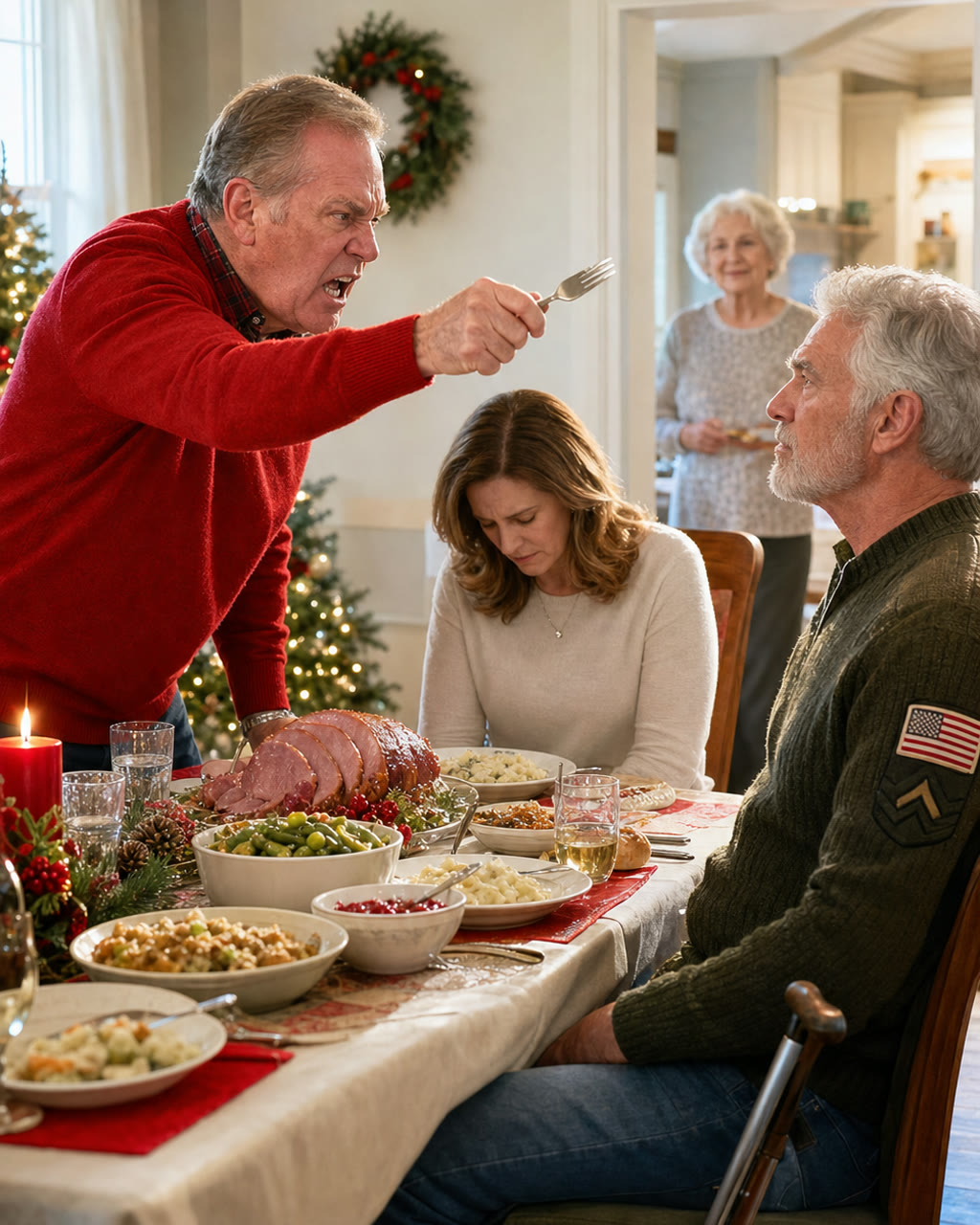
At the Christmas table, in front of my whole family, my brother-in-law pointed his fork at me and said, "Look at him. Grown man living off a government check while the rest of us actually w0rk." My hands were under the table so nobody would see them shake. My sister looked at her plate like there was something written on it.
Chapter 1
I want to be honest about something before I tell you the rest. I almost didn't go.
I sat in my truck outside my mother's house for a long time that afternoon, engine off, watching the Christmas lights blink on and off in her front window. She'd hung them herself, one strand, crooked, the way she always did. Half of them were the wrong color because she bought whatever was on sale at the pharmacy. I sat there and I thought about turning the key and driving back to my apartment and eating a can of soup and calling it a holiday.
Because I knew Ray would be there.
My name is Daniel. I'm sixty-one years old. I did two tours, and I came home with a knee that doesn't bend right and a back that files complaints when the weather turns, and something quieter than that, something that lives behind my eyes and makes crowds hard. I use a cane on the bad days. That week had been all bad days.
I get a check from the government. That part is true. Ray liked to say it like it was a slur.
My sister Carol married Ray twenty-two years ago. I was at the wedding. I stood up in a rented suit and I told a room full of people I hoped he'd take care of her, and I meant it. I try to remember I meant it, on the days it's hard.
I finally got out of the truck because of my mother. That's the truth. Not for Ray, not for Carol, not for the food. For her.
She met me at the door in an apron that said WORLD'S OKAYEST COOK, a gift from my nephew two Christmases ago that she wore every single holiday since. She put both hands on my face like I was still eight years old.
"You came," she said. "You always say you might not and then you always come."
"Wouldn't miss it, Ma."
She smelled like cinnamon and the same perfume she'd worn my whole life. Behind her the house was warm and too bright and smelled like a ham that had been in the oven since dawn. She held onto my arm going back to the kitchen, and I noticed she leaned on me more than she used to. I noticed her hand shook a little when she stirred the gravy. I filed those things away. I file everything away. It's a habit I picked up in places I don't talk about.
The house was the same house I grew up in. Same low ceilings, same worn spot on the hallway floor. She'd never moved. Now the staying was the only thing holding her memory together. She knew this house in the dark. Take her out of it and I think she'd come apart faster.
I set my cane against the coat rack and I helped her back to the stove and I watched her stir the gravy with a spoon she'd had longer than me. Her wrist trembled. I pretended not to see. She caught me pretending and swatted my arm with the back of her hand.
"Don't you look at me like that," she said. "I'm fine. Everybody's fine."
"I know, Ma."
"Your sister's here. Ray's here. Cody. You're here. Everybody I've got, all under one roof." She said it like a prayer she'd been saving. "That's all I want for Christmas, and I got it, so don't you go making a face."
My nephew Cody came skidding around the corner in socks and hit me around the middle like a linebacker. He's nine. He was smaller than nine should be, thin in the wrists, a little gray under the eyes, but he was grinning.
"Uncle Danny, I got a new inhaler that's blue now, wanna see it?"
"Course I do, bud."
He showed me the blue inhaler like it was a medal. I told him it was the coolest inhaler I'd ever seen. I didn't tell him I already knew about it. I didn't tell him I knew the exact copay on it, or the name of the specialist, or that a payment had gone out from an account he'd never trace to a man who'd never claim it.
I've been paying for Cody's medicine for a little over two years. His asthma turned into something with a longer name, and there were tests, and there were medicines that cost more than my rent, and one night I heard Carol on the phone in the garage crying about a bill, and I did the math on what my life actually costs versus what it could cost, and I made a decision.
I set it up so it comes through a nonprofit that helps families with sick kids. There is such a nonprofit. I just happen to be the anonymous donor who covers Cody's file. Nobody knows. Not Carol. Not my mother. And absolutely not Ray, who has spent two years telling anyone who'll listen how hard it is to have a sick kid, how the world doesn't help people like him, how he carries it all on his own back.
I let him say it. I always let him say it.
Ray was in the living room when I came in, in a red sweater with a reindeer on it, holding a beer, holding court. He's a big man, gone soft, with a laugh that fills a room and a way of looking at you like he's already decided how much you're worth. He runs a small landscaping and equipment business out of a lot on the east side of town. Trucks, a couple of storage barns, a gravel yard. He's proud of it. He talks about it like he built it with his bare hands.
Here's a thing Ray doesn't know that he thinks he knows.
He rents that lot. He's rented it for eleven years, from a holding company, through a property manager, a nice quiet arrangement, check goes out every month, nobody ever bothers him.
I own the holding company.
My father left me that parcel of land when he died. Just me. There'd been a falling-out years before between my dad and Carol over money, the kind of thing families do, and Dad, being stubborn the way I'm stubborn, left the land to me and told me to do something smart with it. So I did. I've quietly leased it to a landscaping business for eleven years, at a rate so fair the tenant brags about the deal, and I have never once told that tenant who signs the other side of the paper.
I could have told Ray a hundred times. I never did. Partly because I didn't want it to change anything. Partly, if I'm honest, because I liked knowing something he didn't. When a man calls you a freeloader every Thanksgiving, it's a small warm thing to know he writes you a check every month and calls it rent.
But I never planned to use it. I want to be clear about that. I'm not a man who plans revenge. I'm a man who keeps his own counsel and pays his own way and lets the rest go.
There's a photograph on my mother's mantel that I looked at while Cody talked about his blue inhaler. It's me and Carol as kids, sitting on the tailgate of my father's truck, her about six and me about ten. She's got her head on my shoulder in the picture. She used to do that. When Dad's voice got loud she'd come find me and put her head on my shoulder and I'd tell her it was fine, and she'd believe me because I said so.
I don't know exactly when she stopped believing me. Somewhere in the twenty-two years of Ray. One day you look up and the sister who used to put her head on your shoulder can't meet your eyes across a dinner table, and you can't point to the day it changed.
Dinner was almost normal, for a while.
My mother said grace and got the words a little scrambled, and nobody corrected her. She thanked God for the food and for the family and then she started thanking Him for people who I'm fairly sure had passed, my father, an aunt, and the table just let her, everybody looking at their laps, because you don't correct her, you let her finish, and you say amen. Cody said amen the loudest. He's a good boy.
Cody told a long story about a video game that had no ending, a story that also had no ending, and I listened to every word of it because he needed somebody to, and Ray kept saying "okay, bud, okay, wrap it up, the grown-ups are talking," even though nobody had been talking. Carol asked me twice how my knee was and both times looked away before I answered. I said it was fine both times. It wasn't, but that's not what she was asking, and we both knew it.
Ray talked about himself. He talked about a job he'd bid, a competitor he'd undercut, a truck he was thinking about buying, the price of diesel, the government, the way the world doesn't reward a man who works with his hands anymore. That was the weather of the evening: Ray, moving through, taking up the air. You learned to breathe in the gaps.
I watched him refill his beer twice before the plates were even full. I noticed that. I notice a lot of things I never say out loud.
Then he started in.
It started small, the way it always does. A joke about how I get to "sleep in every day." A joke about how nice it must be to have "the government as your boss." My mother laughed, not understanding, because she laughs when Ray uses the laughing voice. Carol didn't laugh. Carol had gone very still, pushing a green bean around her plate.
I ate my ham. I've eaten a lot of things I didn't want to. This was easy.
Then Cody, God bless him, said, "Uncle Danny was in the Army," in that proud kid way, wanting the table to be proud with him.
And Ray put down his fork and looked at me, and I felt the temperature of the whole thing change.
"Was," Ray said. "Long time ago. Now he's what, a professional patient? You know they got jobs for guys who can't do the hard stuff, Danny. Greeter. You'd be a great greeter."
A couple of the cousins down the table laughed the uncomfortable laugh, the one that just wants the moment to be over.
I set my fork down too. Slow. I felt that old flat calm come over me, the one that used to scare me and now just feels like an old coat.
And under the table, in my jacket pocket, I pressed the button on my phone.
I don't know why I did it. I've asked myself that a hundred times since. I think part of me had been waiting two years for Ray to say the thing out loud, the real thing, the thing under the jokes, with witnesses. I think part of me just wanted a record, so that on the nights I doubt myself I could play it back and know I hadn't imagined it.
I told myself it would just sit in my pocket. Just insurance. Just a quiet red light nobody could see.
I did not know yet that in the next twenty minutes, Ray would say something into that pocket that had nothing to do with me at all — something about my mother, and her bank account, and the memory she was so ashamed of losing — and that the little red light would catch every word.
Chapter 2
The thing about Ray is he can't feel a room. A man like my brother-in-law thinks silence is agreement. He heard those uncomfortable cousin-laughs and thought he had an audience, so he leaned back and settled in.
"I'm just saying," he said, spreading his hands like a man being reasonable. "We all pull our weight here. Carol works. I built a business from nothing. Even Cody's fighting his little fight, aren't you, champ." He pointed his beer at his own son. "Meanwhile Uncle Danny gets a check for existing. I gotta call it what it is. It's welfare. Nothing personal, Danny. Just, you know. Somebody's gotta pay for it."
"Ray," Carol said. Quiet. Not even a real sentence. Just his name, laid on the table like something she was ashamed to have brought.
"What? I can't say it?" He turned to her, and I watched her shrink an inch. "This is why the country's the way it is. Nobody can say anything true anymore."
One of the cousins, a young guy named Trevor who works for Ray part-time and laughs at everything Ray says because he wants the full-time hours, went "heh" into his mashed potatoes. His girlfriend didn't. She was new. She kept looking at me with something in her face I recognized, that new-person look when they realize the family isn't the family from the Christmas cards. I gave her a small nod, the kind that says *it's all right, I've got this, eat your food.* She looked away, embarrassed for me, or maybe for herself.
That's the thing nobody tells you about being the family scapegoat. Half the table hates it and says nothing. The silence isn't approval. It's just fear wearing a party sweater. Everybody at that table had their own reason not to cross Ray. Trevor wanted hours. The cousins wanted peace. Carol wanted — I still don't fully know what Carol wanted. To not be alone, maybe. To not have chosen wrong twenty-two years ago in front of a church full of people.
I want to tell you I was calm because I'm strong. That's not it. I was calm because I've been in rooms where the wrong move gets people hurt, and my body remembers, and it goes very still and very clear. My hands were under the table. I laced my fingers together so they wouldn't shake where anyone could see, and I kept my face flat, and I let him talk.
Here's the small thing I noticed, the detail I can't stop seeing. My mother had stopped humming.
She'd been humming along to the radio in the kitchen all night, an old carol, off-key, happy. And somewhere in the middle of Ray's speech she'd come to the doorway with a dish towel in her hands, and she wasn't humming anymore, and she was looking at the floor. She didn't understand the words. But she understood the shape of it. She understood that her son was being made small at her own table on Christmas, and she stood in the doorway and looked at the floor and twisted the dish towel like she was wringing water out of it.
That's the moment I decided I wasn't going to defend myself.
Because if I opened my mouth, if I said one word about my service or my back or the truth of any of it, it became a fight, and the fight would happen in front of her, and she'd remember the fight even after she forgot everything else. She's like that now. The bad feelings stick when the facts slide off. I wasn't going to hand her a bad feeling to keep.
So I said, "You're probably right, Ray." Mild. Almost kind.
It threw him. He wanted a fight too. Men like Ray need you to push so they can push harder. When you just step back, they stumble into the space where the resistance should have been.
"Well," he said. "Yeah. Okay then."
Cody was looking back and forth between us, that careful kid-look, trying to figure out if this was still a joke or if it had become something else. Nine years old and already an expert at reading a room, the way kids get when the room isn't safe. I gave him a wink. He didn't quite give it back.
I've thought a lot about that. About how a kid learns to read a room. You don't learn that skill in a house where the air is easy. You learn it in a house where you have to know, before you ask for something, what kind of mood is running the place. I learned it young too, in a different house, from a different loud man. It was my father, before the years softened him, before the sickness made him gentle. I know that flinch Cody has because I had it. I hate that he has it. I'd have paid any amount of money to buy it back out of him, and money's the one thing that can't.
So I sat there and I looked at my nephew learning the exact lesson I'd spent forty years trying to unlearn, and I decided, whatever else happened, that I wasn't going to add to it. Not tonight. Not at his table on Christmas.
Then my mother said, from the doorway, in a smaller voice than usual, "Ray, honey, did you take that envelope off my dresser? I had an envelope."
The table kept moving for half a second, the way it does, and then it caught, and stopped.
"What envelope, Ma," Carol said.
"I had money in an envelope for Cody. For his Christmas. I put it on the dresser and now it's not there and I thought maybe—" She stopped. She looked lost. That was the worst part, the lost look, a woman standing in her own home not sure of her own dresser. "Maybe I moved it. I move things. I probably moved it."
And here's where Ray made his mistake. Not the cruelty toward me. He'd made that mistake a hundred times and gotten away with it. Here's the one that mattered.
He laughed. Easy. Warm. The room-filling laugh.
"Ma, come on. You didn't have any envelope. You've been misplacing everything lately, remember? Last month it was your glasses in the freezer." He said it fond, but there was something under it, something quick, and I've been trained my whole adult life to hear the thing under the thing. "You gotta stop worrying about money. I handle all that for you now, remember? We set it up so I handle it. So you don't have to stress."
My mother nodded slowly. "You handle it," she repeated. Like she was learning it.
"I handle it," Ray said. "It's under control. Don't you worry about envelopes."
And Carol looked at her plate again. And I understood, all at once, several things I hadn't let myself understand.
I understood why my mother's account, which I'd glanced at once when I was helping her with a form, had seemed lighter than it should. I'd told myself I'd read it wrong. I understood why Ray had, about a year ago, so generously offered to "take the burden off everybody" and manage Mom's finances. I understood the new tone he used with her, that fond dismissive tone, the one that tells a frightened old woman that her own memory is the problem, over and over, until she stops trusting the one instrument that could catch him.
I didn't say any of this. I didn't have proof. I had a feeling and a lighter-than-it-should-be balance and the sound of a man being a little too smooth.
But my phone was still recording.
I want to describe the next few minutes carefully because they're the ones that changed everything.
Cody's inhaler slipped off the table and skittered under Ray's chair. Cody's a good kid. He hopped down to get it, disappeared under the tablecloth on Ray's side. And Ray, not knowing the boy was down there, not knowing anything, leaned toward Carol and dropped his voice — but not far enough, never far enough, because Ray genuinely believes the world is deaf to him — and said the thing.
"Relax about the old lady's money," he muttered to my wife's sister, my sister, his wife. "There's barely anything left in there anyway. I moved most of it over months ago. By the time anybody notices, she won't even remember she had it. That's the beauty of it. She thinks it's her head. Let her think it's her head."
I have listened to that recording more times than is healthy. I know every syllable. *Let her think it's her head.*
Carol didn't answer him. That's the part I can't forgive her for yet. She didn't gasp. She didn't pull away. She looked at her plate.
She already knew.
I've turned that over a thousand times. There are things you can hear from a stranger and survive. Then there are the things that only land right when you understand that the person who should have stopped them didn't. That was the whole weight of it, right there. Not Ray. I knew what Ray was. Ray being cruel to my mother was like the weather being cold in December. What broke something in me was my sister, six years old on a tailgate with her head on my shoulder, forty-something now, hearing her husband describe robbing her own mother — and reaching for her water glass.
She took a sip of water. That's what she did. She took a small sip of water and set the glass back down on the exact ring it had left on the tablecloth, careful, lining it up, the way you do a small ordinary thing when a big thing is happening that you can't look at.
I watched her line up that glass and I understood that whatever I did next, I'd be doing it partly for her and partly in spite of her, and that those two things were going to live in the same body for a long time.
And Cody's small voice came up from under the table, muffled, cheerful, holding his blue inhaler up like a prize as he climbed back into his seat.
"Found it!"
Nobody had moved. Nobody but me. My hand was in my jacket pocket, and I was pressing the phone flat against my chest so hard I could feel my own heartbeat through the case, and the little red light was still on, and I was thinking one clear cold sentence, over and over, the way you hold onto a rail on a rolling deck.
*He just said that with my mother twelve feet away.*
Ray sat back up, satisfied, and reached for another roll, and looked across the table at me with that smile.
"You're quiet tonight, Danny," he said. "Cat got your tongue? Or is that a government thing too?"
And I smiled back at him. I actually smiled.
Because I finally knew exactly what I was holding.
Chapter 3
I didn't do anything that night.
I want you to understand why, because I think it's the most important choice I made in this whole story, more important than the recording, more important than the land.
I didn't do anything because Cody was in the room. Because my mother was in the room. Because if I'd stood up and played that recording between the ham and the pie, the person it would have hurt most, right then, wasn't Ray. It was a nine-year-old boy who'd just found his inhaler, and an old woman in a WORLD'S OKAYEST COOK apron who'd just been told, one more time, that her own head was the thing betraying her.
So I finished my plate. I complimented my mother's ham until she smiled again and started humming. I helped clear the table. I let Cody show me the video game with no ending. I hugged my mother at the door and told her the envelope would turn up, and I felt her tremble a little, and I hated Ray in a clean, quiet, patient way I hadn't hated anything in years.
Then I drove home and I sat at my kitchen table and I listened to the whole recording twice, straight through, with the lights off.
My apartment isn't much. One bedroom, a kitchen table with two chairs, though it's only ever me in one of them. There's a shoebox on the top shelf of my closet with my discharge papers and some photos and a couple of things I brought home that I don't look at. I'm telling you about the apartment because I want you to understand: Ray thought I lived like that because I couldn't do better. He'd been to my place exactly once, years ago, and I'd watched him take inventory, the couch, the small TV, the lack of everything, and I'd watched him file me under *this is what a check gets you.*
He never once considered that a man might choose to live small so that a sick kid across town could keep breathing. That the math only worked because I kept my own life cheap. It never occurred to Ray, because it's not a thing that lives in Ray's head. You can't imagine a kind of quiet you've never once been.
*Let her think it's her head.*
I'm going to tell you what I did over the next three weeks, because it matters that I didn't do the loud thing. The loud thing is what Ray would have done. I did the quiet thing. I did the thing a man learns when he's spent his life cleaning up after loud men.
First, I went to see somebody. Not a lawyer with a billboard. A woman named Priya who'd handled my father's estate and the land trust for years, sharp as a tack, the kind of person who reads a document three times before she'll say good morning. I put my phone on her desk and played it. She listened without moving. When it was done she took off her glasses and set them down very carefully, and she said one word.
"Again."
I played it again. She wrote things on a legal pad. Then she asked me the question I'd been afraid of.
"Do you have any actual proof of the money, Daniel? Or just this?"
I didn't. Just this. Just a voice in a recording saying he'd moved it. So we set about getting the proof.
Here's the thing about my mother. About a year and a half back, before Ray "took the burden off everybody," Mom had made me a signed backup on one of her accounts — a just-in-case, a thing she did after a hospital scare, in case she ever couldn't get to the bank herself. She'd forgotten she did it. Ray never knew she did it. It was still active.
I didn't touch a dime. But I could see. And what I saw, once Priya walked me through the statements, was two years of small quiet withdrawals and transfers, patient as a leak, moving money out of my mother's life and into places that fed back to Ray. Not dramatic. Nothing that would trip an alarm. Just a slow bl:eeding of an old woman who'd been taught to believe it was her own faulty memory.
There was one line item that stopped me cold. A transfer, dated the week after my father's headstone was finally paid off, for almost exactly the amount my mother had set aside "for Cody's future," a little college fund she'd started the day the boy was born and mentioned to me maybe a dozen times over the years, proud of it, this small secret garden of money for her only grandchild. Gone. Moved. And I remembered Ray, at some cookout, telling the whole yard that he was "setting Cody up right" for school one day, that he had "a plan," and everybody nodding, and my mother beaming, not knowing she'd already paid for his plan without being asked.
I sat with that one a long time. That's the one that took the last of my doubt away. A man who'll steal a dead man's grandson's college money and then take a bow for it in front of the grandmother he stole it from — that's not a man in a hard spot. That's just what he is.
Priya photocopied everything. She made a timeline. She's very good at timelines. She has a way of laying pages side by side on a big table and standing over them with her arms crossed until the story tells itself. When she was done, she tapped the earliest page and the latest page and said, "Two years and four months. He's disciplined, I'll give him that. Disciplined people are the ones who think they'll never get caught."
"Will he?" I asked. "Get caught?"
She looked at me over her glasses. "That depends entirely on what you want, Daniel. There's the version where he goes to prison. And there's the version where your mother stays whole and your nephew keeps his father and this family survives. Those are usually two different roads. You're going to have to pick one."
I already knew which road I wanted. I'd known since Christmas night, watching Cody climb back into his chair with his blue inhaler, happy, safe, breathing. I just needed somebody to say it out loud so I'd know it wasn't weakness.
Then I did something I want to be honest about, because it wasn't strictly about justice. It was about leverage, and I'm not going to pretend it was pure.
I called the property manager who handles the east-side lot, the one Ray rents, the one Ray thinks he practically owns. And I told him that starting the following month, I'd be handling that account personally, and that I'd be in touch with the tenant directly about the lease.
For eleven years Ray had written a check to a name on a page. He was about to find out whose name was under it.
The property manager, a decent tired man named Hollis who'd handled that lot for a decade, asked me on the phone if there was a problem with the tenant. I told him no. I told him the tenant had been perfect, paid on time, kept the place up, never once caused me a minute of trouble. All of which was true, and none of which was the point. Hollis said, "Then if you don't mind me asking, why the change?" And I said, "Because it's time he knew who he's been talking to." Hollis was quiet a second and then he said, "Family?" and I said, "Yeah," and he laughed a small tired laugh and said, "Say no more." Everybody who's ever had one understands.
I didn't want to take his livelihood. I want to be clear about that. I've never once wanted Cody to go without. But I wanted Ray to sit across a table from me and understand, finally, with the ground literally moving under his business, exactly who he'd been calling a freeloader.
The last piece was Carol.
I drove to her house on a Tuesday when I knew Ray was out on a job. She opened the door and saw my face and knew, the way sisters know, that something had come to collect.
Her kitchen was clean the way a nervous person's kitchen is clean, everything squared, a magnet holding Cody's drawings to the fridge, a school calendar with a doctor's appointment circled in red. I looked at that red circle and I knew what it was for and I knew who was paying for it, and Carol saw me look, and something crossed her face that she pushed back down.
We sat down. She made coffee she didn't drink. She wrapped her hands around the mug for the warmth, the way our mother does. I told her I'd heard him, Christmas night, about Mom's money. I didn't say how. I just told her the words. *Let her think it's her head.*
Carol didn't cry. That's what I remember. She got very small in her chair, the way she did as a kid when Dad's voice got loud, and she wrapped both hands around a coffee cup she wasn't drinking, and she said, so quiet I had to lean in:
"I told myself it wasn't as bad as it looked."
"Carol."
"He said we'd pay it back. He said it was a loan against her care, that when she — that later, it would all come out even." Her voice kept getting smaller. "Cody's medicine, Danny. Do you know what Cody's medicine costs? Do you have any idea what it does to a person, watching your kid not be able to breathe and getting a bill you can't—"
And she stopped. Because I did know. I knew to the dollar. And something in my face must have told her more than I meant to tell her, because she looked at me hard, really looked, for the first time in years.
"Somebody's been paying," she said slowly. "The foundation. They said an anonymous donor covered Cody's whole file. For two years. Ray said it was luck. Ray said it was God." Her hands tightened on the cup. "Ray said *God.*"
I didn't answer. I've never been good at that kind of moment. I looked at her kitchen table.
"Danny," she whispered. "Was it you? All this time, was it—"
The back door banged.
Ray's job had ended early. He came into his own kitchen with mud on his boots and a beer already open, and he stopped when he saw me sitting there, and his easy face did something complicated — surprise, then that flicker, that quick calculating thing under the smile that I'd learned to read on Christmas night.
"Well," he said. "The greeter came to visit."
I stood up. Slow, because my knee. I picked up my cane. And I said, in the flat calm voice, the old-coat voice:
"Ray. We need to talk about the lot on the east side. And about your mother-in-law's bank account." I let it sit there one beat. "I've got a recording you're going to want to hear before you say another word to me."
And I watched the color go out of my brother-in-law's face for the first time in twenty-two years.
Chapter 4
Ray tried the loud thing. Of course he did. It's the only tool in his box.
"You've got a *recording?*" He put the beer down hard enough to slop it. "You recorded me? In somebody's house? That's illegal, Danny, that's — Carol, tell him. Tell him you can't just—"
"It's a one-party state, Ray," I said. "I was party to the conversation. It's legal. Priya checked. Priya checks everything."
He didn't know who Priya was. I watched him decide he didn't want to.
"Whatever you think you heard—"
"I heard you tell my sister you'd moved most of Mom's money out of her account and that you were letting her believe it was her memory." I kept my voice level. That's the thing about the flat calm; it's louder than shouting, in a room. "*Let her think it's her head.* That's what you said. I've got it three times over. And I've got the statements, Ray. Two years of them. Priya made a timeline."
That word again, *statements*, and something behind his eyes went from angry to afraid. Afraid is a different animal. Afraid gets quiet.
He sat down at his own kitchen table. Slowly. Like his knee hurt too.
"You don't understand the pressure I'm under," he started.
"Cody's medicine," I said. "That's the pressure. Right?"
"You have no idea what it costs—"
"Twenty-two hundred a month for the main script," I said. "Before the specialist. Before the tests. The blue inhaler he showed me is the cheap part."
The kitchen went very still. Carol had both hands over her mouth.
Ray stared at me. "How do you—"
"Because I've been paying it, Ray." I said it plain. No triumph in it. I didn't feel triumph. I felt tired. "For two years. Through the foundation. The anonymous donor you thanked God for. That was me. I'm the freeloader who's been keeping your son breathing."
Nobody said anything. Somewhere in the house a clock ticked. Ray's mouth opened and nothing came out, and for once, for the first time since I'd known him, my brother-in-law had no room-filling laugh, no easy line, nothing. He looked at his wife. His wife looked at me.
"And the lot," I went on, because I'd decided to say all of it, once, and then be done. "The east-side lot. The trucks, the barns, the gravel yard you built from nothing with your bare hands. You rent that from a holding company. You've rented it eleven years." I let it land. "It's mine, Ray. My father left me the land. I've been your landlord since before Cody was born. Every month you write a check to a company you don't know is me, and every Thanksgiving you tell the table I don't work for a living."
I have replayed his face at that moment about as many times as I've replayed the recording. Twenty-two years of a man's whole idea of himself coming apart at a kitchen table. The freeloader. The greeter. The guy who exists off a check. Paying for his son. Owning his ground. Holding, in one jacket pocket, the recording that could end him.
"So here's what's going to happen," I said. "And I want you to listen, because I'm only going to lay it out one time."
I sat back down across from him. I set my cane against the table. I've run a lot of hard conversations in my life. This was the one that mattered.
"You are going to put every dollar back into your mother-in-law's account. All of it. Priya has the number. If you don't have it in cash, you'll sign a repayment agreement she's already drawn up, secured, real, enforceable. You're going to sign over the power of attorney on Mom's finances — to me, with Carol as co-signer, with a bank overseeing it, so nobody can ever do to her again what you did."
"Danny—"
"I'm not finished." I didn't raise my voice. I didn't have to. "You're going to keep your business. The lot stays yours to rent, same fair rate, because I am not going to be the reason Cody's father is out of work. That's not for you. That's for him. But there's a new clause in the lease. If you ever — *ever* — take a dollar that isn't yours from anyone in this family again, if you ever make my mother doubt her own mind for your convenience, the lease ends and the recording goes to people who send men like you somewhere with bars. Do you understand what I'm telling you?"
He understood. I watched him understand.
"And the last thing," I said, and this was the one that had kept me up nights, the one I wasn't sure I'd have the nerve to say. "You're never going to call me a freeloader again. Not because it hurts my feelings. It stopped hurting my feelings a long time ago. But because Cody was at that table Christmas night. And someday he's going to be a man, and I need him to have watched how a man handles the truth. Not with a recording as a weapon. With a recording as a lock on the door, so the people who can't protect themselves stay safe. That's the difference between you and me, Ray. You use what you know to take. I'm going to use what I know to keep this family standing." I stood up again. "Including you. God help me, including you."
Ray put his head in his hands. And Ray, for the first time in twenty-two years, cried at his own kitchen table, and I did not enjoy it the way I'd once imagined I would. It's a strange thing to want a man's tears for years and then feel nothing but sorry for everybody in the room when they finally come.
"I never thought I'd get like this," he said, into his hands. "I want you to know that. I didn't set out to — the business almost went under two years ago, when Cody got sick, and I moved a little, just to cover, and I told myself I'd put it back before anybody—" His voice cracked. "And then it got easy. That's the part I can't— it got so easy. She never noticed. She'd apologize to *me* for losing track. She'd apologize."
"I know," I said. "I heard you say it."
"You must think I'm—"
"I think you're a man who found out he could take something and never got caught, and it changed him," I said. "It happens to a lot of men. It's the getting-caught that decides who they turn into next. So here's your chance, Ray. Right now. You don't get to be the man who almost got away with it. You get to be the man who paid it back. Nobody outside this room ever has to know which one you were. That's the only mercy I've got in me, and I'm giving it to you for Cody, not for you. Don't ever make me regret it."
He nodded into his hands. That was all. He nodded.
Carol walked me out.
On the porch she stopped me with a hand on my sleeve, and she didn't look away this time. She made herself look right at me.
"You paid for my son," she said. "For two years. And I sat at that table and let him call you—" She couldn't finish it.
"You looked at your plate," I said. It wasn't kind. But it was true, and she needed one true thing from me before I could give her the rest. "Christmas night. You knew, and you looked at your plate."
"I know."
"Don't do it again."
"I won't." And I believed her, because her voice didn't get smaller when she said it. For the first time in a long time, my sister's voice held its size. "Danny. Why didn't you ever tell us? About the land. About the money. Any of it."
I thought about it. About the years of holding it, the small warm secret, the pride I'd hidden even from myself.
"Because I didn't want to be somebody who needed you to know," I said. "I wanted to be somebody who did it whether you knew or not." I put my hat on. "Turns out those are two different men. I've been trying to be the second one my whole life."
Ray paid it back. Most of it in cash, the rest on Priya's ironclad paper. Mom's finances are safe now, watched, boring, the way an old woman's money should be. She never fully understood what happened. But she stopped saying *I probably moved it* in that lost little voice, because now when something goes missing, we find it, and I make sure she watches us find it, so she learns to trust her own head again, one envelope at a time.
Cody's medicine still gets paid. I still don't take credit for it. Some things you do quietly or they don't count.
Ray and I aren't friends. I want to be honest, because this isn't a movie and I'm not going to tell you the loud man became a good man overnight. We're careful with each other now. But careful is a kind of respect, and respect is more than I ever got from him before, so I'll take it. A few months after all of it, he showed up at my apartment with a case of the ginger ale I like and stood in my doorway not knowing what to do with his hands, and he said, "I never thanked you. For my kid." And I said he didn't have to. And he said, "I know. That's why I'm doing it." Then he left. It's the closest Ray gets to a whole sentence of the truth, and I decided it counted.
Carol and I are slower. Some things between a brother and a sister take longer than money. But she calls now. She checks on me. Last month she drove Mom over to my place for lunch and she stayed in the kitchen doing the dishes I told her to leave, and when I came in to argue about it she was crying quietly at the sink, and she said, "I keep thinking about that photograph. The tailgate." And I dried my hands and I stood next to her and I didn't say anything, and after a while she leaned over and put her head on my shoulder. First time in twenty years. I told her it was fine. She believed me, because I said so.
And this past Christmas, one full year later, I almost didn't go again. I sat in my truck outside my mother's house watching her crooked lights blink. Then Cody came out onto the porch in his socks, no coat, breathing easy, and stood there waving at my truck until I got out.
At dinner, Ray passed me the ham without a word and didn't meet my eyes, and that was fine. Carol said grace and got the words right and reached over and squeezed my hand on *amen*. My mother hummed her off-key carol in the kitchen.
And near the end, Cody stood up on his chair, the way nine-going-on-ten-year-olds do, and announced to the whole table that when he grows up he wants to be like his Uncle Danny, "because Uncle Danny is the strongest one and you can't even tell."
The table went quiet. Not the bad quiet. The other kind.
I didn't have a speech for that. I just reached up and helped him down off the chair before he fell, the way you do, and I told him to eat his green beans.
But I kept my hand on his shoulder a second longer than I needed to. And this time, there was no red light blinking in my pocket. There was nothing left to catch. There was just my family, at a table, safe — and a quiet man who'd finally learned that the strongest thing he ever did was the thing nobody ever saw.
You may also like
The Silent Truth Behind My Daughter's Accident
The call came at 11:47 at night.…
Read the full story →The Night Evelyn Harper Took Back Her Power
My husband's mistress openly mocked me while my husband smiled… While they laughed at my pain, they never realized that I was the one in control. The moment I whispered, "Everythin…
Read the full story →He Fired the "Cleaning Lady" in Front of the Whole Office — Nine Minutes Before the Board Handed Her the Company
My name is Eleanor Reyes, and for eighteen months the people at Meridian Textiles thought my name was "hey" or "the cleaning lady" or, on a good day, "Ellie, could you get the brea…
Read the full story →