The Sister Who Was Never Really Poor
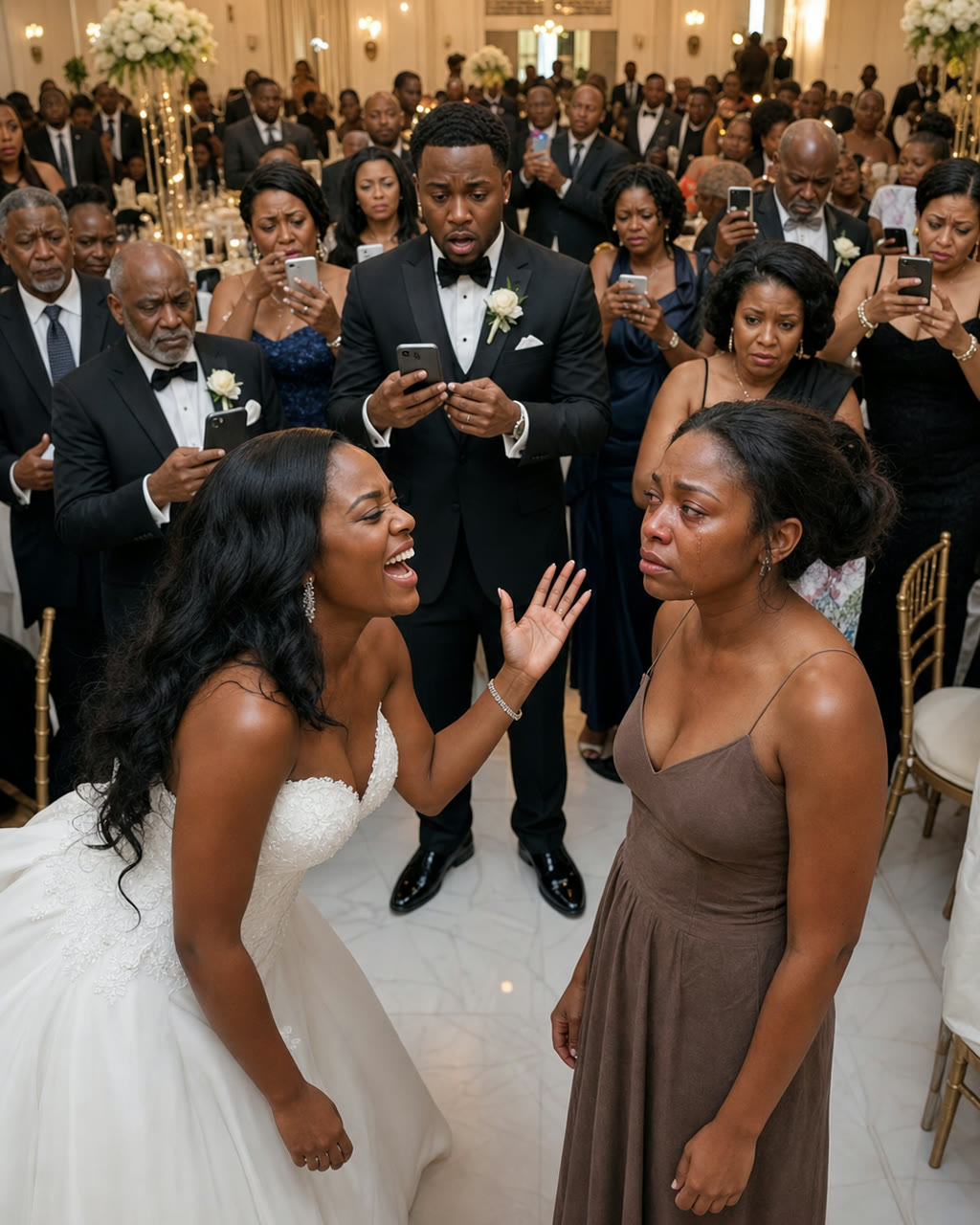
"Still working that warehouse job?" my sister asked, loud enough for her whole reception to hear, and then she laughed. Two hundred people laughed with her.
Chapter 1
They sat me at table nine.
Table nine is the one nobody plans for. It's the table with the folding chair that doesn't match the rest, tucked behind a pillar, close enough to the kitchen that you can hear the busboys stacking plates between the toasts. Every family has a table nine. Ours had me in it.
My place card said "Nia." No last name. Just Nia, in Yolanda's careful gold cursive, like an afterthought she'd made pretty so it wouldn't look like an afterthought.
Next to me was an empty chair with a card that said "Grandma Ruth." Our grandmother has been gone four years. Yolanda set her a place anyway, the way some families do, and I sat beside that empty chair the whole night.
I was grateful for it, honestly. It meant I wasn't entirely alone at that table.
The rest of table nine was cousins-of-cousins and a plus-one nobody could name and a man who introduced himself twice as "a friend of the groom from the gym." He spent the reception on his phone. He'd have plenty of company later.
I want to be fair to my sister. I do. I'm going to try to be fair to her the whole way through this, and you'll have to trust that I'm trying even when it doesn't sound like it.
Yolanda is thirty-one years old and she has been beautiful her entire life in the specific way that makes people forgive you for things. Teachers forgave her the homework. Boyfriends forgave her the temper. Our mother forgave her everything, right up to the end, and past it.
I'm forty-three. I was never the beautiful one. I was the one who was "so responsible," which is what a family calls a girl when they've quietly decided she doesn't need looking after.
She married a man named Marcus Bell that afternoon, in a church on the north side, and the reception was at a hall called the Grand Whitfield, the kind of place with a marble lobby and chandeliers the size of small cars.
I paid for one of those chandeliers. Yolanda doesn't know that. Keep it with you, because it matters later.
The hall was full. Two hundred and some guests, all of them dressed like the Lord Himself had RSVP'd. Perfume and cologne fighting in the air-conditioning. Somebody's baby crying and getting walked out. The regular music of a good Black wedding, warm and loud and packed with people who'd known each other since the church basement.
Our father, Reggie, sat up front at the head table in a rented tux that was a half-size too big in the shoulders. Every time somebody stopped to compliment the wedding, he'd stand halfway up out of his chair and shake their hand and say, "We did all right, didn't we? We did all right." Like a man who'd finally gotten something right after a long run of not.
I love my father. That's the thing that makes all of this hard to tell. If I hated him it would be a cleaner story.
I got there late. I'd flown in that morning and driven straight from the airport to the church, and I didn't want to walk in during the vows and make Yolanda's head turn, so I slipped into the last pew and I slipped into table nine at the reception and I kept my head down and my hands in my lap.
My dress was navy. Off the clearance rack at a store I won't name, forty percent off, because I'd learned a long time ago not to show up to my family looking like money.
That was a decision. I need you to understand that it was a decision, made cold, months in advance, standing in a closet in front of a row of clothes I could not wear in that room.
I have three suits that cost more than that entire wedding. They're beautiful. I wear them in a life that no one at table nine knew existed. I left every one of them on the hanger and I bought a clearance dress on purpose, because the alternative was answering questions I had spent eleven years making sure nobody would ask.
The first two hours were fine. Better than fine. People got up and people sat down and the caterers came around with little lamb chops on tiny sticks. A cousin I hadn't seen since childhood hugged my neck and said "Nia! Girl, where you been hiding?" and moved on before I had to answer.
Marcus's mother, Ms. Carolyn, cried into a lace handkerchief the whole first hour. When she passed my table she stopped, took my hand in both of hers, and told me I had "such a kind face."
She didn't know who I was. To her I was some quiet woman at the back table. I told her the wedding was beautiful and that her son looked so handsome, and she squeezed my hand and moved on, and I remember thinking she was the only person in that room who'd looked me in the eye all night.
Remember Ms. Carolyn. She comes back around.
Then Yolanda took the microphone.
She hadn't planned a speech. That was the whole problem. Yolanda is at her most dangerous when she's improvising, because that's when the real her comes out — the one who lives under the gold cursive, the one who's been performing for a room her entire life and can't tell anymore where the performance ends.
"I just want to thank everybody for being here," she said, and the room went warm and clappy, everyone lifting their glasses. "I got my whole family in this room tonight. My daddy right here. My aunties. My girls in the back — I see you, don't act shy now."
She was scanning while she talked. That's a thing performers do, scan a room for the exact seat they want to land on, the face that'll give them the biggest laugh.
She landed on me.
"And even my big sister flew all the way in," Yolanda said, and she smiled that smile, the one that always looks like sunshine and is sometimes a knife. "From wherever it is she's living now."
A few people chuckled, not sure yet whether it was a joke.
I lifted my glass to her. A little salute, nothing more. Let it pass, I told myself. It's her night. Let her have every inch of it. She earned this one.
But she'd tasted it now, that first ripple of laughter, and Yolanda has never in her life been able to leave a laugh alone.
"Nia's the responsible one," she said, and she leaned on the word "responsible" until it meant the opposite of itself. "Always working. Always so serious. Y'all, this is the one Mama used to worry about — 'you gotta help your sister figure it out, she's a late bloomer.'" She laughed at her own memory. "What is it you're even doing now, Nia? You still doing that warehouse thing?"
The room turned toward me. Two hundred faces, slow, like a field of sunflowers finding the sun.
"Still working that warehouse job?" she said, and she laughed, and it was a real laugh, a delighted one, her head tipping back. "My big sister, everybody. Twelve years older than me and she's still down there scanning boxes with a little beep-beep gun. See — that's exactly why I always tell you young folks, you gotta dream bigger than that. You gotta want more for yourself."
And two hundred people laughed with her.
I need you to understand what that sound is when it's aimed at you.
It isn't cruel, most of it. Most of those people laughed because a bride made a joke and you laugh at a bride's joke — it's a reflex, a kindness to her, not an attack on me. To them I wasn't even a person. I was a punchline with a face they'd forget by the parking lot.
But some of it was cruel. You can always hear the cruel ones. They laugh a half-second longer and they laugh at you instead of near you.
My cousin Denise, two tables over, laughed with her whole chest and looked dead at me while she did it. Denise has hated me since we were nine years old and I got the purple ten-speed she'd been begging for. She's carried it thirty-four years. Some people, that resentment is the only thing they own outright, so they hold onto it with both hands and won't put it down for anything.
I set my glass on the table. I did not drink from it. I never did, that whole night — you'll see why that matters.
My father was not laughing. I found his face at the head table and he was looking down at his plate, and his jaw was working slow, side to side, the way it does when he's chewing on something that isn't food.
Here is the small thing that undid me. Not the two hundred laughs. My father, not eating, staring at a slice of wedding cake he hadn't touched, ashamed — and I could not tell if he was ashamed of me or ashamed for me. Forty-three years old and I still could not read the difference on my own daddy's face. I realized, sitting there, that I never would. That the not-knowing was going to be the shape of the rest of our lives.
That's the thing nobody warns you about being the one who's "doing fine." Eventually even the people who love you stop looking closely. Why would they? You built the whole thing so they'd never have to worry. And then one day you look up and realize being unworried-about and being unseen are the same country, and you've been living in it alone.
I thought about my mother, because the dead show up at weddings whether you set them a chair or not.
Six years ago, in a hospice room that smelled like lemon cleaner and something underneath the lemon, my mother took my hand — her hand was so light by then, like a bird you're scared to hold too tight — and she made me promise her two things.
The first was that I would look after Yolanda, who "feels things too big and thinks things too small." Her exact words. She said them like a diagnosis she'd made peace with.
The second promise I have never told a living soul. I'll get to it. It's the whole reason I'm telling you any of this.
I kept my face still. I've had a great deal of practice keeping my face still. In my real life, the one none of them at that wedding knew existed, keeping my face still while a room studies me is a professional skill, and I am very, very good at it. People have paid me a lot of money for that exact skill.
Yolanda handed the microphone back to the DJ, glowing, gathering the room's love in her arms like flowers, and the music came up, and the moment was supposed to be over.
I stood up.
I hadn't decided to. My body just did it, the way a thing does when you've been sitting on it for eleven years and it finally shifts its own weight without asking you.
I want it on the record: I was not going to make a scene. I stood up because I needed to get to the ladies' room and run cold water over the insides of my wrists and remember who I actually was before I said something in that ballroom that I would never be able to take back.
I got three steps.
Three steps, in a clearance dress, past a dead woman's empty chair.
That's when the first phone buzzed on table three.
Chapter 2
I heard it before I understood it.
One phone, a small vibration against a china saucer. Then another, from a purse hanging off a chair back. Then Denise's phone lit up in her hand while she was still smiling from the joke, and her smile did a strange thing — it stayed on her mouth but drained out of her eyes.
I stopped walking.
You have to understand: I didn't do anything. I want to be very clear about that, because I've told this story to exactly one other living person, and the first thing she asked me was "what did you press," like I'd had a button under the table the whole time.
I didn't have a button. What I had was timing, and the timing was not mine. The timing belonged to a machine, and machines don't care whose wedding it is.
Let me back all the way up, because you cannot understand what happened in that ballroom without understanding the eleven years underneath it. I'll be quick. Then we'll go back into the room, and the phones will still be buzzing when we get there, because that's exactly how slow all of this happened and how fast it felt.
When I was thirty-two, I started a company.
I'm not going to make it sound like a movie. There was no garage, no lightning bolt, no mentor in a nice suit telling me I had something special. There was me, a used laptop with a crack in the corner, the spare bedroom of a rented duplex, and a very boring idea about how mid-sized shipping warehouses track their inventory and route their trucks.
Boring is where the money is. Nobody has ever put "boring" in a wedding toast, but boring built that chandelier.
I built software. Logistics software. The kind of thing that lives in the back office of buildings you drive past on the highway and never once think about, running quiet in the dark, saving companies millions of dollars a year that they never celebrate — because nobody throws a party for a problem that simply stopped happening.
And here's the part that matters for that ballroom, the part my sister put a microphone to.
To build the thing, I spent three years working inside actual warehouses.
I scanned boxes. I learned to drive a forklift. I worked the overnight dock at a distribution center off I-70, midnight to eight, in a hi-vis vest and steel-toed boots, so I could watch with my own eyes how the work actually broke down — where the bottlenecks lived, which shortcuts the men on the floor took at 3 a.m., all the things the guys in the front offices refused to hear from the guys on the floor.
You cannot fix a warehouse from a conference room. You have to smell the diesel. You have to feel your own feet after ten hours on concrete.
So yes. There was a warehouse job. My sister wasn't lying. She just didn't know she was standing inside the punchline instead of telling it.
She saw me once during that stretch. She came to visit — back when we still visited each other — and she caught me coming off a dock shift at six in the morning, gray-faced, a scanner still clipped to my belt, and she made a face I have never been able to forget.
It wasn't a cruel face. That's what's stayed with me. It was a frightened one. Like she'd looked over the edge of something and seen the bottom, and the bottom had her sister's face on it.
I told her I was "figuring some things out." She heard "failing." I let her hear it.
I let her because our mother was sick, and the money at home was thin, and Yolanda was the one who needed — desperately, all her life — to believe that somebody in this family had made it. And it clearly wasn't going to be her, my baby sister who feels things too big and thinks things too small. And I loved her. And it cost me nothing, I told myself, to be the family's cautionary tale for a little while.
That's what I told myself, standing on that dock. It cost me nothing.
It cost me eleven years. But I didn't know the bill yet.
The company grew. Slowly, and then all at once, the way these things do. I never moved back home. I never announced a single thing. My name is not on the building — I made sure of that in the first year, because I had watched what this country does to Black women whose names get big before their walls are thick, and I wanted the whole thing bulletproof before anyone could take aim.
Last spring we got acquired. I stayed on to run the division. The number involved has an embarrassing quantity of zeros, and I'm not going to type it, because I can feel my mother's hand on the back of my neck when I even think about it — and that reflex, that shame around bragging, tells you everything about how she raised the two of us. She raised us both not to boast. Only one of us listened, and it was the wrong one for a wedding toast.
Here's what I did with some of it, so you understand the shape of me before you judge what I did next.
Eighteen months ago I quietly paid off my father's house. The whole mortgage, gone, through a company he'd never trace back to me. To this day he believes "the bank made a mistake in his favor." He tells the story at cookouts. I let him. Watching my father brag about his good luck is one of the purest joys I have ever bought.
I set up a fund for Denise's oldest boy's college, anonymous, routed through a scholarship at his high school. Denise, who has hated me since the purple ten-speed. Her son doesn't know. She doesn't know. He starts at Morehouse in the fall. I did that for a woman who was, at that very moment, laughing at me with her whole chest.
And I paid for that wedding.
Not all of it. But the part that mattered.
Six weeks before the reception, my phone rang with a number I didn't have saved. It was Marcus. Yolanda's Marcus.
I'd met the man exactly twice. He's an eighth-grade science teacher on the south side. Soft laugh. Bad posture. A hole worn through the left elbow of the one good sweater he owns because he keeps leaning on the lab counter to help kids with their volcanoes. He is, genuinely and un-showily, one of the best men I have ever met, and I don't think my sister has any idea what she caught.
Marcus called me because they were seven thousand dollars short on the reception, and the deposit deadline was in four days, and Yolanda had been crying herself to sleep, and he had run all the way to the bottom of his list of people to ask.
He didn't know what I did for a living. He just knew Yolanda had an older sister who "worked a lot" and had "her own place, out of state," and to a man drowning at 11 p.m. that sounded rich enough to try.
I paid it. All seven thousand, that night, wired through the venue and logged in their books as an anonymous "family contribution." No name. No card. Nothing for Yolanda to trip over.
Then I made Marcus swear he would never tell her.
I told him it would mean more to her if she believed her daddy had pulled it off at the last minute, or that God had made a way, or that the venue had cut them a break. I told him a woman deserves to feel like her wedding was a gift from the whole universe conspiring in her favor — not a pity check written by the sister she's embarrassed to seat near the front.
There was a long quiet on the line. Then Marcus said, "You're a good person, Nia."
I sat in my office on the forty-first floor, city lights running all the way out to the black edge of the lake, and I realized I could not remember the last time anyone had said that to me and meant it. Not "you're so responsible." Not "you're doing fine, right?" A good person. Just that.
It's a strange thing, to build a life so successful that nobody in it needs anything from you — and then to discover you'd have traded a floor of that building just to have one person say a plain kind thing to you and mean it all the way down.
I cried a little, alone, at my own desk, with the whole lit-up city not knowing my name and my whole family a two-hour flight away thinking they knew it completely. Then I wiped my face and got back to work, because that's the other skill they pay me for. Composure is a product. I manufacture it and I ship it on time. I'm the market leader, and my own family didn't even know I was in business.
So that is what I was carrying when I walked into the Grand Whitfield in a clearance dress and let my baby sister tell two hundred people I was still down there scanning boxes.
I was the reason she had a room to stand in.
And I was going to let it go. I swear before God and my mother's memory, I was going to let it go, walk to the ladies' room, run the water, come back, dance one slow song with my daddy, and fly home Sunday still invisible and still whole.
But then the phones started, and I finally looked down at my own.
I'd felt it buzz in my clutch during the toast and ignored it. Now I opened it, standing three steps from a dead woman's chair, and I saw the exact same thing two hundred other people in that hall were seeing in the exact same thirty seconds.
A news alert. Regional business news, the syndicated kind that pushes to every phone that ever downloaded the app.
My company. My real one. There had been a filing that morning — a public, scheduled, legally-required filing, the kind lawyers lock in months ahead and cannot move for anything, not even your sister's wedding. A profile piece had been set to run alongside it. My full name. My photograph, the professional headshot, me in a blazer I would never in a hundred years have let anyone at table nine see me wear.
And some algorithm — blind, tireless, perfectly indifferent — had chosen this evening to push the story to every user within fifty miles who followed regional business news.
Half that ballroom worked in this city. A wedding on the north side pulls from every neighborhood, every industry, every church. Bankers. A realtor. Two men who ran their own trucking outfits. Half that room got the alert inside two minutes, sitting at their tables with cake in front of them, waiting for the dancing to start.
The headline had my whole name in it.
And it had a word beside my name that I had spent eleven years, three suits, one paid-off house, one anonymous scholarship, and seven thousand wedding dollars making absolutely certain my family would never, ever attach to me.
Denise was staring at her phone. Then up at me. Then back at her phone. Her mouth had come open.
At the head table, my father was patting his breast pocket for his reading glasses.
And Yolanda — still holding her bouquet against her white dress, still lit up from the top of her own toast — leaned over her brand-new husband's shoulder to see what on God's earth he was staring at so hard, and why he had gone so still.
Chapter 3
Marcus saw it first.
I watched it land on him. He was looking down at his screen, and his thumb had stopped scrolling, and his mouth came open just slightly, and then he lifted his head and looked at me across two hundred people the way you look at a stranger who's wearing a familiar face.
Because that's what I was to him in that second. A stranger.
He knew a piece of it. He knew a sister had sent money. But he did not know the shape of the thing he'd taken a favor from. You can hand a drowning man a rope and he'll grab it and thank God — he doesn't stop to picture the size of the ship you had to climb down from to reach the water.
Marcus looked at me. Then he looked at his brand-new wife. And I watched a good man have the worst thought of his wedding day arrive on his face, slow, like a bruise coming up.
He was doing the arithmetic. Seven thousand dollars. Anonymous "family contribution." Nia, who "worked a lot," who had "her own place, out of state." Nia, in the blazer, in the headline, on his phone.
He knew. In the space of one breath he knew exactly where the money had come from — and he knew that his wife had just spent her toast making a public fool of the one person who'd kept this whole room from falling apart.
He didn't say anything. Marcus is not the type to grab a moment. He just reached over and laid his hand flat and gentle between Yolanda's shoulder blades, the way you steady a person right before you have to tell them something.
Yolanda was still up in the clouds. Still floating table to table with her eyes, still gathering the room's love into her arms.
"What is it, baby?" she said to him, half-laughing, reaching for the phone. "Why's everybody down on they phone at my recep— "
She saw it.
I was close enough to watch her read it, and I have replayed her face maybe a thousand times since that night. People always want me to tell them it was satisfying. That I'd waited eleven years for exactly this and it tasted sweet.
It did not taste sweet. It was one of the hardest things I have ever had to stand and watch, and I stood and watched our mother die.
Yolanda read the headline. Then her eyes jumped back up to the top and read it again — the way you re-read a sentence that refuses to hold still, that keeps sliding out from under you.
My full name. My photograph, the blazer, the studio lighting, a version of me she had never once been allowed to see.
And the number. The big word in the headline was a number with the word "million" hung off the end of it, and beside it the fund's total with a "b" on the front, and my sister's mind simply could not fit those characters into the same sentence as the word "warehouse" she'd said thirty seconds before.
She looked up from the screen. She found me standing there, three steps from my chair, in my forty-percent-off dress.
And she laughed.
One more time. A small, confused, disbelieving little laugh, almost hopeful — like maybe it was still a joke, like maybe I'd shake my head and tell her no, silly, that's a different Nia, some other woman with Mama's cheekbones and Mama's name for a daughter.
I didn't laugh back. I didn't nod, didn't smile, didn't shake my head. I just held my sister's eyes across ten feet of parquet floor and let her see, without a single word, that every bit of it was true.
The laugh died in her throat. I actually saw it go.
Around the hall the whispering started. Not silence — the opposite of silence. That low electric hum of two hundred people all turning to the person beside them and saying the same thing at the same time, a sound like the room itself inhaling.
"That's her sister."
"The one she was just — on the mic — "
"That's the same Nia? Reggie's Nia?"
"Wait, hold on, read it again."
I heard Ms. Carolyn, Marcus's mother, three tables over. She'd put on her glasses and she said, soft, mostly to herself, "Lord, that's the young lady with the kind face." And she put her handkerchief to her mouth, but this time she wasn't crying about a wedding.
My father was on his feet now. He had his reading glasses pushed low on his nose and his phone held way out at arm's length the way he does, squinting, lips moving, and his hand was not steady. His hand was not steady at all.
He read it. My daddy stood at the head table and read it in front of every person he knew.
And then he did the thing I will carry with me into my own grave.
He set the phone down on the white tablecloth. He took the glasses off, slow, and folded them. He pressed the back of his hand hard against his mouth. His shoulders climbed up toward his ears. And my father — sixty-eight years old, a man I have watched cry exactly twice in my whole life, once at a casket and once at a christening — began to weep, openly, at his youngest daughter's wedding, with two hundred people watching him do it.
Not because I was rich. I need you to hear that plainly. My father has never in his life cared about money the way the world assumes a poor man must.
He was weeping because he understood, all at once and all the way down, that his oldest child had allowed him to believe she was struggling for eleven years. That every single time he had lain awake at night and worried about his Nia — quietly, the way fathers do, in the dark, where they think it doesn't count — I had known. I had known he was worrying and I had let him. I had chosen his peace over my own pride so completely that I had let my own daddy go to sleep believing I was the child who didn't make it out.
He was weeping because he had let them seat me at table nine, behind a pillar, next to a dead woman's chair, by the kitchen doors — and I had known exactly what I was worth the whole time, and I had walked back there and sat down in that mismatched folding chair without a word of complaint, and eaten my lamb chop, and lifted my glass to my sister's joke.
That's what broke him. Not the money. The years of being loved wrong by people who thought they were loving me right.
Cousin Denise had gone the color of ash. She was still gripping her phone in both hands like it might change if she held on. Thirty-four years of hating me over a purple ten-speed bicycle — and the little machine in her palm had just informed her, at a wedding, in front of everybody, that she had spent her entire adult life resenting a story that wasn't even the real one. I almost felt for her. Almost. Her boy's tuition was sitting in an account with my money in it and she'll go to her grave never knowing.
She caught me looking at her. For one second something passed between us across those two tables — not the old poison, something rawer. Something almost like a girl on a porch in 1991 who'd wanted a bike and gotten a lesson about the world instead. Then she dropped her eyes to the tablecloth, and her jaw set, and I watched her decide, even now, even here, that she would rather keep the hate than trade it for the truth. Some people, that resentment is the last warm thing they've got. I let her keep it. It was hers.
Off to the side, the man from the gym at table nine had finally looked up from his phone. He looked at his screen, then at me, then back at his screen, then he leaned over to the plus-one nobody could name and said, too loud in the quiet, "Yo — that's her? That's the same lady been sitting right here?" And the plus-one just nodded, slow, staring at me like I'd grown a second head at the leftover table.
That's the part they never tell you about a moment like this. It doesn't arrive all at once, clean, like in a movie. It arrives the way water finds the low places in a floor — one table, then the next, then the next, a slow flood of understanding rolling across two hundred people who had, ninety seconds ago, been laughing at the back of my neck.
I stood in the middle of that flood and I did not move. I want you to picture it. A woman in a clearance dress, standing very still on a parquet floor, while the whole idea of her rearranged itself in two hundred heads at once.
Then Marcus stood up.
He didn't reach for the microphone. He didn't make a speech. He just rose to his feet at his own head table, and he looked at me across the room, and in that quiet teacher's voice that somehow reaches the very back of a loud room, he said:
"You paid for all this."
It wasn't a question. He'd finished the math and he was setting the answer down on the table for everyone to see.
The hum stopped. That's the thing that got them — not the headline. The headline was gossip, and gossip is fun. This was different. This was the groom himself telling the room, on his wedding day, that the woman they had all just laughed at had quietly saved the wedding from collapse and let another man take the credit for it.
Yolanda turned to her husband. "What? Marcus — what?"
"The venue money." He wasn't looking at her. He was looking at me, and something was coming apart behind his eyes, some knot he'd been carrying for six weeks. "The seven thousand, Yo. When the deposit almost fell through. I told you it was your daddy who covered it — I let you think it was your daddy. It wasn't. It was her. She wired it that same night and she made me swear I'd never say."
Yolanda turned back to me.
And now her face was doing exactly what our father's had done a moment before. The pieces were landing one at a time, out of order, and every single one hit harder than the last.
She had mocked, from a stage, with a microphone, the sister who had paid for the stage. In front of that sister's photograph. In front of a headline. On every lit phone in the room.
She'd told two hundred people to dream bigger than me.
Her lips parted. Nothing came out. Her bouquet had started to shake in her hands, the little tremor traveling up the stems into the flowers, and I watched a rose petal come loose and fall onto the toe of her white shoe.
The DJ, God bless that man's instincts, faded the music down to nothing rather than let some love song play under this. So now there truly was nothing. No song. No toast. No laughter. Just my baby sister in her white dress, holding a phone with my face on it, in the exact center of a room that had turned all the way around and was now looking at her the way it had, ninety seconds earlier, been looking at me.
The whole wedding was holding its breath.
Waiting to see what I would do to her.
And standing there, three steps from a dead woman's empty chair, I understood that I had arrived at a choice I had spent eleven years making sure I would never have to make — and certainly never like this, never with two hundred witnesses and my mother's promise sitting in my chest like a stone.
Chapter 4
I could have destroyed her.
I want to be honest about that, because if I pretend the thought never crossed my mind, then nothing else I tell you means anything.
I had the room. I had the truth. I had eleven years of being the family's cautionary tale loaded up and ready to fire, and my sister was standing there disarmed in front of every last person whose opinion she had spent her whole life chasing. One sentence would have done it. I had the sentence written and waiting in my chest, had had it there for years without knowing it.
I could have said: "I paid for your dress too, baby. And the flowers. And I paid off Daddy's house. Now say that warehouse joke one more time."
The room would have gasped. Some of them would have been thrilled, the way people get thrilled watching a mighty thing fall. And Yolanda would never have recovered. Not that night, not ever. There are humiliations a person doesn't walk back from, and I had one in my hand, at the exact range where it does the most damage.
I looked at her instead.
Yolanda had started to shake in earnest now. Not crying yet — shaking, the way your body does when it figures out before your mind can that you've done something you cannot undo. The bouquet trembled against the white of her dress. She was clutching it to her chest like a shield, like a few flowers could stop what was already in the air.
And I thought about my mother's second promise. The one I've never told a soul.
In that hospice room, after she made me swear I'd look after Yolanda, my mother pulled me down close — close enough that I could feel how little breath she had left to spend, and she was spending it on me. She said:
"Promise me one more. Promise me you won't let being right turn you cold. You're gonna be right a whole lot in this life, Nia — more than your sister, more than most. And being right is easy. Any fool can be right and mean about it." She squeezed my hand as hard as she could, which by then was not very hard at all. "Staying warm while you're right. That's the hard part. That's the whole job, baby. Don't you dare put it down."
Staying warm while you're right. That's the whole job.
I hadn't understood it in that room six years ago. I understood it now, on a parquet floor, with a knife in my hand.
I walked over to my sister.
Two hundred people watched me cross that floor in my clearance dress, and I did not hurry, and I did not perform, and I did not look at a single one of them. I walked to her the way I walked to her when she was six years old and had fallen off the front porch steps and was too proud to cry until her big sister got there. Some things your body just remembers how to do.
I stopped in front of her. Up close I could see the mascara already breaking at the corners of her eyes, could see her chin working. I reached out and took the bouquet gently out of her hands, because she was crushing the life out of it, and I set it down on the table next to her.
Then I took both of her cold, shaking hands into both of mine.
She flinched. She was sure I was about to say it — the sentence, the killing one. Her eyes came up to mine, wide and wet and braced, a person standing still to take the blow because she believes she has it coming.
I leaned in, close, so that not one word of it reached the room. And I said:
"It's still your night."
That was all. Four words, for her four flowers.
She made a sound. I won't try to write it down. It was the sound a person makes when they are handed back the one thing they were certain they had just thrown away for good.
"Nia — " she started, and her voice cracked wide open. "Nia, I didn't — I swear to God I didn't — "
"Not now," I said, soft, still just for her. "Not in front of all these people. You and me, we're gonna do this whole thing later, and it's gonna be ugly, and it's gonna take years, and that's fine. But not tonight." I tightened my hands around hers. "Right now you have got a good man behind you looking at you like you hung every star in the sky, and a room full of people who drove across this whole city to watch you get married. So here's what you're gonna do. You're gonna wipe your face. And you're gonna go dance with your husband. And we will figure out the rest of our lives tomorrow."
I let go of her hands.
Then I turned around to face the room — the whole waiting, breathless, phone-lit room — and I reached back to table nine and picked up my champagne flute. The one I had never touched all night. Still full. Still cold. That's why it mattered that I never drank from it: it meant that when the moment came, I had a full glass to raise.
I lifted it.
"To my sister," I said, and I made sure it carried. Steady. Warm. Not one drop of ice in it. "Yolanda always did dream bigger than me. Always." A few people breathed out, unsure. "Y'all should have heard her at nine years old, standing on the corner of Delmar telling the whole block that one day she was gonna have herself a wedding with real chandeliers. Everybody laughed at her. Little girl from our block, chandeliers."
I lifted my glass toward the ceiling, to those great glittering things hanging up there like captured moons — the ones I had paid for and would never mention again.
"Look up," I said. "Look at that. My baby sister wasn't lying."
I let it sit one beat. Two.
"To Yolanda and Marcus. Long life, and a warm house, and people who see you plain."
For a second nothing happened at all.
Then Ms. Carolyn — Marcus's mother, the woman who'd told me I had a kind face when I was nobody to her — stood straight up at the head table with her glass raised and the tears just streaming down into her collar, and she called out, "To Yolanda and Marcus!" in a voice that had raised choirs.
Then my father stood, wiping his whole face with the heel of his hand, not hiding it anymore, and he said it too.
And then the room came up. All of it, all at once, two hundred people on their feet, and the sound that filled that hall was not laughter.
I'd had their laughter, earlier that night, and it had been the worst sound in the world aimed at the back of my neck. This was the other thing. This was a room full of people deciding, all together, in one second, to love my sister on purpose — because I had stood in front of them and shown them how to do it.
You can give a person that. It turns out you can just decide to give it to them.
Yolanda was crying full and open now, no performance left in her anywhere, and Marcus folded her into his chest, and over the top of her head he looked at me and mouthed two words I felt in my back teeth: thank you.
The DJ read the room like the professional he was and brought a slow song up soft, and the floor started to fill, and I did the thing I have always been best at.
I stepped backward, out of the light, toward the kitchen doors they'd hidden me behind all evening.
Eleven years of practice. Stepping out of the light is the easiest thing in the world once you've done it enough.
My father found me by the coat check twenty minutes later. I was getting my jacket. I always leave early; it's easier for everyone.
He didn't say one word about the money. Not the company, not the headline, not the house, not the chandeliers. He just stood in front of me in that too-big rented tux, and he lifted his hand and laid it against the side of my face, warm and rough, the exact way he did when I was a little girl with a skinned knee and the whole world was survivable as long as his hand was on my face.
"All this time," he said. His voice came apart in the middle of it. "All this time, Nia. You let me lay awake and worry about you."
"Daddy," I said. "Worrying about me was the last thing left that still felt like being my father. Yolanda didn't need you like that anymore. I wasn't about to take it from you too."
He put his forehead down against mine, this big old man, and we stood there together in the little dark hallway by the hanging coats while a wedding went on warm and loud on the other side of the wall. Neither one of us said anything else. There wasn't anything else that needed saying.
Yolanda came to my hotel the next morning before I flew out.
No makeup. No white dress. No audience anywhere in sight. Just my sister, thirty-one years old, standing in a beige hotel hallway with her hands twisted together in front of her, looking about nine years old and about a hundred at the same time.
She didn't make a single excuse. I will give her that until the day I die — Yolanda is a coward with a microphone in her hand, but one-on-one, with no room to play to, she has always been the bravest person I know. She looked me dead in the eye and she said:
"I've been laughing at you for eleven years so I wouldn't have to look at myself. That's the truth of it. Every joke I made about you, I was really talking about me." Her voice held. "And you knew that. You knew it the whole time, and you paid for my wedding anyway. You let me stand up there and tear you down and you paid for the room I did it in."
"I did," I said.
"Why?" And then, smaller: "Why would you do that?"
I stood there a moment. There are a lot of true answers to that question. Because Mama asked me to. Because Marcus called me at eleven o'clock at night out of options. Because being the family disappointment was, honestly, easier to carry than being the sister who made everybody in the room feel small just by existing — I had chosen small on purpose, for years, so they'd stay comfortable.
But I gave her the truest one there is.
"Because you're mine," I said. "You feel everything too big and you think everything too small, and you are still mine. That's not a thing a person earns, Yo. There's no toast you can give that earns it and no joke you can tell that loses it. It just is what it is."
Those were our mother's exact words about her, handed back to her at last, and Yolanda knew it the second they left my mouth.
She came apart right there in that hotel hallway, and I caught her, and I held my baby sister up on her feet the way I have been quietly holding her up her entire life — without her ever once, until that morning, feeling the weight of it in my arms.
We are not fixed. I want to be honest with you all the way to the end. A thing that took eleven years to build does not close up in one wedding and one hotel hallway. There are still nights she doesn't call me and days I don't call her, and there is a carefulness between us now that we're both still learning how to put down.
But she took something home from that reception and framed it.
I saw it last month, hanging in the little entryway of her and Marcus's new apartment, and I had to excuse myself and go stand in their bathroom for a minute with the water running so nobody would hear.
It's the place card. From table nine.
The little card that just said "Nia," in her own careful gold cursive, that had sat all night beside a dead woman's empty chair, behind a pillar, by the kitchen doors.
She kept it. She had it framed in good wood and she hung it in the first room you see when you walk into her home, where she has to pass it every single morning on her way out the door.
And underneath my name, in her own handwriting, she'd written the only apology my sister has ever managed to give out loud — the one she still, to this day, cannot quite say to my face. Four words, for the four I gave her on that floor:
"I finally see you."
People ask me sometimes if I regret it. The staying quiet. The eleven years. If I wish I'd told them all from the start and spared myself the pillar, the folding chair, the empty seat, the laughter.
I don't. And I'll tell you exactly why.
Being invisible for eleven years taught me the one thing all that money never could have. When you spend years watching a room decide you are nothing, you learn — with a clarity you can never un-know — precisely who chooses to be kind to you when there is no earthly reason to be, and who reaches for the knife the very second they believe you can't reach back.
I know now, for certain, which one my father is. Which one Marcus is. Which one Ms. Carolyn is, which one Denise was, and which one my sister is on her best days and her worst.
And I know which one I am.
Because I stood in that ballroom with the knife in my hand, in front of every person any of them had ever wanted to impress, with eleven years of reasons to use it — and I set it down on the table, and I picked up a full glass instead, and I toasted the girl who'd just told two hundred people to dream bigger than me.
My mother was right.
Being right is easy. Any fool can be right and cold about it.
Staying warm while you're right — that's the whole job.
I'm still working on it. Every day of my life, I'm still working on it.
You may also like
The Silent Truth Behind My Daughter's Accident
The call came at 11:47 at night.…
Read the full story →The Night Evelyn Harper Took Back Her Power
My husband's mistress openly mocked me while my husband smiled… While they laughed at my pain, they never realized that I was the one in control. The moment I whispered, "Everythin…
Read the full story →He Fired the "Cleaning Lady" in Front of the Whole Office — Nine Minutes Before the Board Handed Her the Company
My name is Eleanor Reyes, and for eighteen months the people at Meridian Textiles thought my name was "hey" or "the cleaning lady" or, on a good day, "Ellie, could you get the brea…
Read the full story →