The Handprint My Mama Left Behind
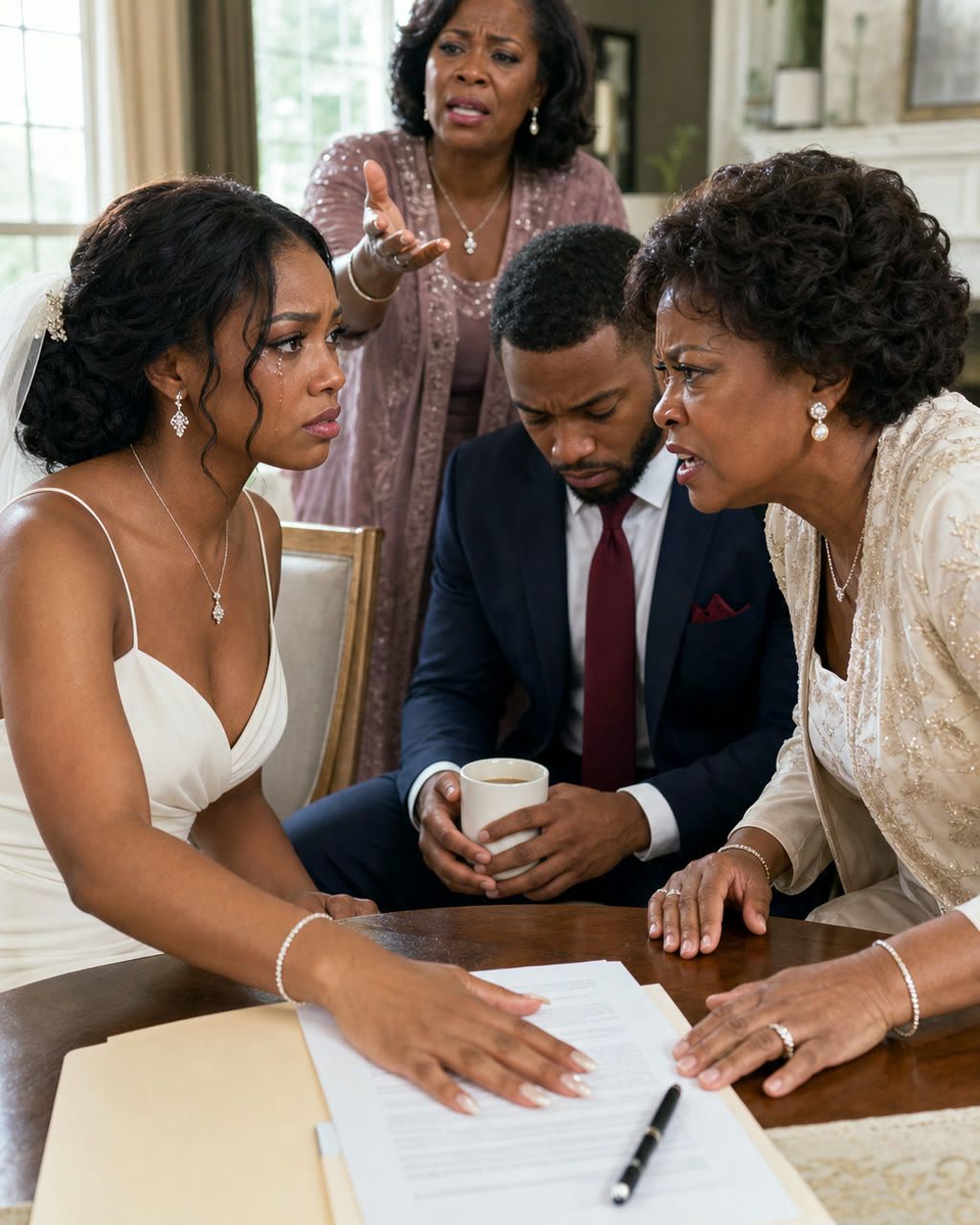
Three days after my wedding, my new mother-in-law slid a folder across her kitchen table and asked me to sign my apartment over to the family "for the good of everyone." I was still wearing the little gold band. I hadn't even changed my last name yet.
Chapter 1
My mama used to say a home is the one thing nobody can talk you out of, as long as you hold the paper.
I didn't understand what she meant until I was twenty-nine, sitting at Loretta Dukes' kitchen table with a folder in front of me and a wedding ring that still felt like it belonged to a stranger.
Three days. That's how long I'd been married when they sat me down.
Let me back all the way up, because you should know who these people are before you decide how I acted.
My name is Nia. I married Marcus Dukes on a Saturday in June, in a small church on the south side, forty guests and a sheet cake with real buttercream, not the fake kind.
Marcus was gentle when I met him. That's the honest truth, and I won't lie about it to make my ending look smarter. He held doors. He remembered how I took my coffee. He cried during his own vows and had to stop and breathe.
I was a labor and delivery nurse. I spent my days catching babies and holding hands that gripped mine hard enough to leave marks.
Marcus managed the parts department at a car dealership out on the county line. We weren't rich. But we were steady, and steady felt like a miracle to a girl who grew up without it.
I did grow up without it. My mama raised me alone in a one-bedroom apartment on Callahan Street, and she worked two jobs to keep the lights in it.
Days at the hospital laundry. Nights cleaning offices downtown. I'd fall asleep to the sound of her keys and wake up to the smell of her coffee, and in between she'd be a shape on the couch, resting for two hours before the next shift.
When she passed, four years before my wedding, she left me that apartment. Paid off. In my name, and only my name. She'd made sure of it before the cancer took her voice.
It wasn't much of a place. Third floor. A radiator that clanked like it was mad at you. A balcony barely big enough for two folding chairs and a coffee can of dirt where she grew tomatoes that never got bigger than marbles.
But on that balcony, pressed into the concrete from when the building was redone in 1994, was her handprint. She'd knelt down while the cement was still wet, pushed her whole palm in, and scratched her initials beside it with a stick. D.T. Dorothy Turner.
I used to sit out there in the evenings and fit my own hand into the shape of hers. My fingers were longer than her fingers now. That small fact could put a lump in my throat any day of the week.
So when I tell you that apartment was the only thing I had left of my mother, I don't mean it in a soft, sentimental way. I mean it was the only thing. There was no house, no jewelry, no savings. There was a handprint and a deed.
Marcus knew all of this. He'd sat on that balcony with me on our second date, drinking sweet tea out of jelly jars. He'd fit his own big hand into her print and said, real quiet, "She'd have liked me, I think."
That's why what happened cut the way it did. He knew exactly what he was helping them reach for.
Here's the part I'm ashamed of. Before the wedding, his family started making little suggestions. Nothing you could point at. Nothing you could fight.
Miss Loretta, my mother-in-law, ran the whole family. Everybody called her Miss Loretta, even her own sisters, even the ones older than her.
She had a way of asking for things that never once sounded like asking. "It just makes sense," she'd say, and smile, and pat your hand. "A married couple ought to be under one roof, saving money, building something."
The roof she meant was hers. A big old house on Delmar with four bedrooms and a finished basement, where half the family already lived or floated through between jobs and troubles.
Miss Loretta's strength was that she could make you feel loved and cornered in the exact same breath. Her weakness was that she believed in her own goodness so completely she truly could not see her own cruelty. She thought she was generous while she took.
Her memorable detail was her hands. She always had lotion on them, a big pump bottle of it by the sink, and she was forever rubbing them slow, one over the other, like she was warming up to something you couldn't see yet.
So a month before the wedding, they talked me into giving up my lease. Not the apartment I owned. The little rental I'd moved into so Marcus and I could be together before the wedding.
"Why pay rent," Miss Loretta said, spreading her hands like the answer was obvious, "when there's a whole floor of my house sitting empty? Save that money for babies, baby."
And Marcus agreed with her. And I loved him. So I let them talk me out of my own front door.
I moved my things into the Delmar house the week before the wedding. My clothes in a borrowed guest closet. My mama's photographs in a cardboard box that I slid under a bed that wasn't mine.
The apartment on Callahan sat empty across town. I'd been meaning to put a tenant in it, use the rent, be smart about it. I just hadn't gotten around to it yet.
I told myself it was temporary. I told myself a whole lot of things that month. Brides tell themselves things.
The wedding was beautiful. I won't let anybody take that from me, not even them. I danced with Marcus's grandmother, Odessa, who was ninety and sharp as a tack and still wore heels.
Odessa held onto me tight during that dance. She smelled like peppermint and face powder. And she said something into my ear that I didn't understand at the time.
"You keep your own key, baby," she whispered. "This family loves hard, and it takes even harder. Don't you let them hold all your keys."
I laughed it off. I thought she was just being an old woman saying old-woman things. I squeezed her hand and I spun her one more time and I forgot it by the end of the song.
Three days later I understood every single word.
It was a Tuesday. Marcus had the day off. Miss Loretta made a big breakfast, grits and salmon croquettes and biscuits from scratch, and I remember standing in that kitchen thinking how nice it was to finally belong to something bigger than just me.
After we ate, she didn't clear the plates. That was the first strange thing, and it landed on me before I even knew why. Miss Loretta always cleared plates the second a fork went down. She'd snatch a plate you weren't done with.
But that morning the plates just sat there with the grease going cold, and she went to the sideboard and came back with a manila folder.
Marcus's aunt Cheryl was there too. Cheryl was Miss Loretta's younger sister. Loud, funny, the kind of woman who'd hype you all the way up and cut you all the way down inside the same conversation.
Cheryl had been staying in the basement "just till she got back on her feet." She'd been getting back on her feet for two years and counting.
Cheryl's strength was that people liked her the instant they met her. Her weakness was that no one had ever told her no and meant it, so she'd stopped believing no was a real word. Her memorable detail was a gold tooth, upper left, that caught the light when she smiled, which was often, and which was rarely as kind as it looked.
So there we were. Me, Marcus, Miss Loretta, and Cheryl, at that kitchen table with the breakfast plates still sitting out and the coffee going lukewarm.
Miss Loretta set the folder down in front of me and smoothed it flat with both of her lotioned hands.
"Nia, baby," she said. "We need to talk to you about something as a family. Now that you're one of us."
I said okay. My stomach hadn't caught up yet. I honestly thought maybe it was money for a honeymoon, or a family trip everybody was chipping in on.
She opened the folder. Inside were papers covered in small print, and a line at the very bottom with a little sticker arrow pointing at exactly where a person should sign.
"It's about the Callahan property," she said.
My stomach caught up then. It dropped clean out of me. But I didn't move a muscle. Something in me knew to go still.
"That apartment's just sitting over there empty," Cheryl jumped in, before Miss Loretta could keep going. "Doing nothing for nobody. Meanwhile I'm sleeping in a basement like a raccoon in a crawlspace."
Miss Loretta shot her a look, sharp, then smoothed her own face back over and turned to me soft again.
"What Cheryl's trying to say," she went on, "is that we're a family now, and family shares what it has. We think it would be best for everyone if that property was held in the family name. All together. Protected. For the good of everyone."
I looked at Marcus. He was turning his coffee mug in slow circles on the table, around and around, watching it like it might do something.
"In the family name," I repeated back to her. "You mean, not in my name."
"In all our names," she said. "So there's no fighting later. So nobody can ever come between us over money. So it's protected."
"Protected from who?" I asked.
Nobody at that table answered me.
Cheryl leaned back and crossed her arms over her chest. "See. This is exactly what I said would happen. She's gonna make it hard."
I turned to my husband. "Marcus. Did you know about this?"
He didn't look up from the mug. His voice came out small and reasonable, the voice you use when you already know you're wrong. "Ma just thinks it's smart, Nia. That's all it is. It's just paperwork."
Just paperwork. My mother's handprint in the concrete. Her tomatoes the size of marbles. Just paperwork.
Miss Loretta slid the folder an inch closer to me across the table. She'd already set a pen on top of it. A nice pen, heavy, gold-colored, the kind you'd want to sign something important with so it felt like an occasion.
"We already had my cousin Reggie draw it all up," she said. "He does paralegal work. It's all legal, all clean. You just put your name right there on the line, and none of us ever has to worry about it again."
I sat there and I did the math in my head, cold and fast, the way I'd calculate a medication dose in an emergency.
I had given up my lease. Everything I owned was in this house, in boxes, under beds that weren't mine. My name was on nothing here. Not the deed, not a bill, not a mailbox.
If I said no, I understood in that moment, I would not be welcome under this roof for very long.
And if I said yes, I would hand over the last piece of my mother to a woman who rubbed lotion into her hands while she reached for the only thing I had.
I looked at that gold pen sitting on my mama's whole life.
And I picked it up.
Chapter 2
I want to tell you I threw that pen across the room and stormed out with my head high. That would make a better story to sit and tell.
But I didn't grow up with the kind of money that lets a person storm out of anywhere. I grew up watching my mama swallow whole insults from bosses and landlords so that we could keep eating and keep the heat on.
You don't unlearn that in three days of marriage. So I held the pen, and I looked down at the line with the little sticker arrow, and I thought about her palm pressed into the wet cement.
"Can I read it first?" I asked.
Cheryl made a sound in her throat, half a laugh. Miss Loretta reached over and put her hand on top of mine, warm and slick with lotion.
"Baby, you don't need to be reading all that," she said, gentle as anything. "It's just family paperwork. Reggie's a professional. It's not the kind of thing you sit and study."
And that, right there, was the moment something turned inside me. Not loud. Not dramatic. Just a small, quiet click, like a lock finally finding its groove.
Because a person who is handing you something good does not tell you to sign it without reading it.
Only a person who is taking something tells you that.
I slid my hand out from under hers, gentle, no drama. "I always read what I sign," I said. "My mama taught me that before she taught me to ride a bike."
The kitchen changed temperature. I can't explain it any better than that. The warm went out of the room and something colder took its place, and everybody felt it, and everybody pretended they didn't.
I started to read. It was hard to focus with three sets of eyes crawling all over me, but I'm a nurse. I read charts in the middle of chaos for a living. I made my eyes slow down and take it in line by line.
It was a quitclaim deed. I knew what that was, only because a patient's family had once fought over one right in the middle of my unit, and I'd asked our social worker afterward to break it down for me in plain words.
That social worker's name was Bev. She'd sat with me on a break and drawn it out on the back of a lab slip. "Quitclaim is the fast one," she'd said. "No lawyer has to bless it. No title company has to check it. It's the one families use on each other, because it moves quiet." I hadn't thought about Bev in two years. Sitting at that table, I could have hugged her neck.
A quitclaim deed means you give up every claim you have to a piece of property. It's fast. It's clean. And it is permanent. There is no undoing it once it's recorded. That's the whole point of it.
I made myself read the legal description in the middle. Lot and block numbers. The little map coordinates that meant nothing to anybody but a surveyor. But I recognized the street address buried in all that language, and seeing it there, typed out cold in a stranger's document, did something to me. Somebody had gone and looked my mother's home up in the county records. Somebody had sat down and typed it into a form on purpose. This wasn't a warm idea that happened over breakfast. This had been prepared.
I read down to where it named the new owners. Loretta Dukes. Cheryl Simmons. Marcus Dukes.
Not me. My name was nowhere in the list of owners. My name only showed up on the line at the bottom, the line where a person signs everything away.
I read that part twice, then a third time, to be dead sure I wasn't confused.
"I'm not even on here," I said. Quiet.
"You're my daughter now," Miss Loretta said. "It's the same thing, baby. What's mine is yours."
"It's not the same thing," I said. "If I sign this, I own nothing. You three own my apartment, and I own the ink."
Cheryl's gold tooth flashed as she smiled without any warmth in it. "Girl, it's not your apartment. It's a family asset. You act like somebody's stealing from you."
I looked straight at her. "Somebody is stealing from me."
I didn't yell it. I said it plain and level, the way you read a temperature off a monitor. A fact in the room.
Marcus finally lifted his head. "Nia. Don't disrespect my mother in her own house."
And there it was, laid out on the table next to the deed. In her own house. Reminding me exactly whose roof was over me. Reminding me I had given mine away and had nowhere left to go.
I set the pen down on the folder, careful, like it was hot.
"I'd like some time to think about it," I said.
Miss Loretta's face did something complicated then. Several feelings crossed it and lost. She pulled the folder back toward herself, slow, and closed it, and set her hands flat on top of it.
"Of course, baby," she said. "You take all the time you need. Family doesn't rush family."
But her voice had gone flat as a table, and her hands had stopped their rubbing. They just lay there on the folder like two things she'd set down.
That night, the house was different around me. Doors closed a little harder than they needed to. The TV went quiet when I came into a room. Nobody offered me a plate at dinner, and I didn't ask for one.
Cheryl passed me in the hall on my way to wash up. She didn't move over to let me by. I had to turn my shoulder to get past her, close enough to smell her perfume, and she watched me do it with that gold tooth just barely showing.
"You gonna learn," she said, real soft, almost pleasant. "One way or the other. Everybody does around here."
I didn't answer her. I'd learned that from my mama too. You don't hand an angry person the argument they're fishing for. You just keep walking to the bathroom and you close the door and you run the water.
I stood at that sink a long time with the water running, looking at my own face in a mirror that wasn't mine, in a house that wasn't mine, with a name on my finger that wasn't even fully mine yet.
I lay next to Marcus in the dark, both of us on our backs, not touching.
"Why isn't my name on that deed?" I asked the ceiling.
He let out a long sigh, the kind you let out when someone is being a chore. "Ma set it all up, Nia. I didn't read every line of it."
"You didn't read the paper that gives away my mother's home," I said. "You sat there next to me and you didn't read it."
He rolled over, putting his back to me. "It's not that deep. It's about keeping the peace in this family. You'll see. Give it time and you'll see I was right."
I lay awake for a long, long time after his breathing went even and slow.
I thought about Odessa at the wedding, peppermint and powder, her mouth at my ear. Keep your own key, baby. This family takes even harder.
The next morning I told them I'd been called in to cover a shift. It wasn't true. I just needed a reason to get out of that house and be a person again where nobody was watching my hands.
I drove all the way across town to Callahan Street. I let myself into my own empty apartment with my own key.
The radiator wasn't clanking because the heat was off. My footsteps echoed on the bare floor. There was still a rectangle of clean paint on the living room wall where my mama's couch had blocked the sun for twenty years.
I went straight through to the balcony and I knelt down and I put my hand in my mama's print, and I let myself sit with it for a while.
The tomato can was still out there. Empty now, the dirt gone dry and cracked. I remembered her out here in a housecoat before her second shift, poking at those little marble tomatoes, telling me they'd get big one day if we were patient. They never did. But she kept planting them, every spring, until the last one.
I thought about how she'd say things sideways. She never said "protect yourself." She said "read what you sign." She never said "people will use you." She said "keep your own key." I was starting to understand that everything my mother ever taught me, she'd taught me for a Tuesday like this one.
Then I did the thing they never once imagined I would do.
I made phone calls.
First I called the county recorder's office. A woman named Patrice picked up, sounding tired and kind at the same time, the way people sound at the end of a long public-service morning.
I asked her a plain question. Could a person put my property into other people's names without my signature on anything?
"No, ma'am," Patrice said. "Not legally. A deed has to be signed by the current owner and it has to be notarized. Is somebody pressuring you, hon? You sound like somebody's pressuring you."
I didn't answer that. I asked her instead to pull up the record for the Callahan address and tell me exactly whose name sat on it right that minute.
I heard her keyboard clicking. "All right. Property transferred from Dorothy Turner, deceased, to Nia Turner. That you?"
"That's me."
"Then it's yours, baby. Free and clear. Nobody's name is on this but yours. Whatever paper somebody's waving around at you doesn't mean one thing until you sign it and get it stamped by a notary. And even then, you'd want to be real careful about who's standing over you when you do."
I thanked her. My hands were steady while I wrote it all down, and this time the steadiness felt like it belonged to me, like it was mine and not just leftover from being raised to hold still.
Then I called a lawyer. Not a fancy one downtown. A woman named Renata Boyd who ran an estate practice out of a strip mall next to a nail salon, recommended by a charge nurse I trusted with my life.
Renata listened to the entire thing without interrupting me one time. When I finished, she said one sentence I stopped and wrote down word for word.
"A quitclaim deed, signed under pressure, by a woman who just gave up her own lease and moved into the home of the very people pressuring her, is exactly the kind of document a court throws in the trash. But it is far better," she said, "to simply never sign it at all."
She told me to come see her that week. She told me to bring the folder if I could get it, and if I couldn't, to at least take pictures of every page.
And she told me one more thing, slow, so I'd hear it.
"Do not sign anything in that house. Not a birthday card. Not a package receipt. Not a permission slip. If those people get your real signature onto any piece of paper, some of them will try to lift it or trace it onto that deed. Sign nothing under that roof. Nothing."
I sat on my mama's balcony a while longer with all of that in my chest.
I didn't have a full plan yet. But I had something better than a plan. I had the truth on paper, and I had a lawyer's number in my pocket, and I had my own key in my own hand.
I drove back to Delmar as the sun was going down.
When I walked in the door, they were all sitting in the living room waiting on me. Miss Loretta. Cheryl. Marcus. And a man I'd never met, older, heavyset, a laptop open on his knees.
Cousin Reggie. The paralegal. He had the manila folder on the coffee table next to his laptop.
And sitting right there beside the folder, catching the lamplight, was a rubber notary stamp and an ink pad.
They'd called a notary to the house. There was a quiet woman I didn't know sitting off by the door with a bag in her lap. They were ready to make it real tonight, while I was gone, before I could think another thought.
Miss Loretta looked up and smiled at me, the warm one, the cornering one.
"There she is," she said. "We were all just waiting on you, baby. Cousin Reggie drove all the way across the river to help us out. Come sit down. Let's just get this little thing done and go on about being a family."
I looked at that stamp on the coffee table. I looked at Marcus, who looked at the carpet.
And I felt that cold, quiet thing come back and settle in my chest, and this time it went all the way to the bottom and stayed.
I smiled back at her. I put my purse strap over my shoulder and held it close.
"Okay," I said. "Let's talk about it. All of it. Right now, in front of everybody."
Chapter 3
I sat down in the chair across from all of them and I set my purse in my lap and kept my hand resting on it.
Inside that purse my phone was recording. Renata had told me my state let a person record a conversation they were part of. I checked twice on the drive over. I checked once more standing on the porch before I opened the door.
I'm not proud of every single thing I did that night. But I am not sorry for one minute of it, either. There's a difference between shame and regret, and I only carry the first one, and just a little.
I looked around that living room before anybody spoke, and I really saw it for the first time. The plastic runner on the carpet so nobody wore a path in it. The framed photos on the wall, Marcus at every age, in a cap and gown, in a little league uniform, always with Miss Loretta's hand on his shoulder. Not one photo without her hand somewhere on him.
There was a picture of Marcus's daddy up there too, a big man in a wide collar, faded. I'd never met him. Marcus said he passed when Marcus was nine. Nobody in this family said much about him at all, and I was starting to understand why. A man in this house was a thing that got shaped or got gone.
Reggie turned his laptop around so the screen faced me, all business. "So this here's real simple," he started. "Quitclaim deed, three grantees, standard boilerplate language. Nothing fancy about it."
"Reggie," I said. "Can I ask you something? As a paralegal?"
He sat up a little, pleased to be treated like the expert in the room. "Sure. Go ahead."
"Whose name is on the deed to that apartment right now? Today? This minute?"
His eyes flicked over to Miss Loretta before they came back to me. "Well. Right now it's yours. But the whole point of the document is to move it into the family, see, so that—"
"So it's mine," I said. "I just want everybody sitting in this room to hear it out of your mouth, plain. The apartment on Callahan Street is mine. Only mine. Legally. Today. Yes or no."
He hesitated. Then, because he was a man who liked being accurate more than he liked being loyal, he said it. "Yes. Legally, today, it's yours."
"Thank you," I said.
I let his answer sit in the room. I wanted every person there to have heard the family paralegal, the man they'd driven across the river to bless this, say the word yes about whose apartment it was. If this ever went anywhere but this living room, I wanted his own voice on it.
Cheryl rolled her eyes so hard I thought she'd hurt herself. "Lord. Here we go with the technicalities."
"It's not a technicality," I said, keeping my voice even and low. "It's just true. And I've noticed that everybody in this room keeps stepping around it."
Miss Loretta leaned forward, and she brought the warmth back into her face, thick as syrup. "Baby. Nobody is saying it's not yours. We are saying that family holds things together, that's all. What if something was to happen to you, God forbid? Wouldn't you want it protected? Wouldn't you want us to have it handled?"
"If something happened to me," I said, "it would go to my husband. To Marcus. That's how marriage works. That's how it already works, without a single one of these papers." I let that sit a second. "So tell me. Why are your name and Cheryl's name and Reggie's name on this deed, and my husband's, but not mine? If this is really about protecting me and Marcus, why am I the only person in this family who ends up owning nothing?"
I want you to understand, I wasn't guessing when I asked that. I already knew the answer. I'd read the deed twice at that kitchen table and once more on Renata's advice, sitting in my car with the pictures on my phone. I asked it out loud anyway, slow, because a question you already know the answer to is the strongest thing you can bring into a room full of people who thought you were simple. Let them hear themselves not answer it.
The room went still, and this time I didn't rush to fill it. I let the quiet do the work. I'd learned that from Odessa without even knowing I'd learned it.
Marcus shifted in his seat. "Nia—"
"No," I said, soft, holding up one finger. "Let me finish. Then you can all talk as much as you want."
I looked around at every one of them.
"I called the county yesterday," I said. "And I called a lawyer."
Cheryl's gold tooth disappeared behind a mouth that closed all the way up.
"The county told me the apartment is mine, free and clear, and that no paper any of you wave at me means a thing until I sign it and a notary stamps it. That's why there's a notary sitting by that door, isn't it. So the stamp is ready the second you get my name down."
Nobody answered.
"And the lawyer," I went on, "told me that a quitclaim signed under pressure, by a woman who just gave up her lease and moved into the house of the people pressuring her, three days after her wedding, gets thrown out of court so fast it makes a sound. She said it looks like exactly what it is."
I watched something move behind Reggie's eyes when I said the word lawyer. He was the only one in that room who dealt in paper for a living, and he knew, better than any of them, what a recording and an estate attorney could do to a quitclaim deed obtained like this one. His loyalty had a ceiling, and I'd just found it.
Reggie closed his laptop halfway, careful. "Now, hold on a minute. This is a legitimate legal document. I drew it up correct."
"It might be a legitimate form, Reggie," I said. "I believe you filled it out right. But a legitimate form used to take a dead woman's home away from her only daughter, three days after that daughter's wedding, is still theft. It just has cleaner handwriting than most."
Miss Loretta's hands had gone flat and still on her knees. She wasn't rubbing them together anymore. They just sat there.
"You called a lawyer," she said, slow, tasting the words like they'd gone bad. "On your own family."
"You called a notary," I said. "On me."
For a second, nobody in that room had anything at all to say.
Then Cheryl stood straight up out of her chair. "You know what? I knew it. I knew from the jump she thought she was better than us. Sitting up in our house, eating our food, sleeping under our roof—"
"You've been eating in this house for two years, Cheryl," I said, still quiet, still level. "I've been here for six days. If eating a family's food and sleeping under their roof makes a person indebted, you owe this family a whole apartment building."
Her mouth came open. Nothing came out of it. The gold tooth stayed hidden.
And I understood, watching her stand there with nothing to say, that this whole plan had been hers first. The basement. The two years of "getting on her feet." She needed somewhere to land, and my empty apartment across town was the softest place in reach, and I was the newest, quietest person in the family. Miss Loretta ran the house, but Cheryl had lit the match. It was her they were really trying to move into my mama's second bedroom. That thought made something in me go from cold to something harder than cold.
Miss Loretta raised one hand, just lifted it a few inches off her knee, and Cheryl sat back down like a scolded girl. That one small gesture told me everything about how this family really ran. Forty years of a raised hand, and everybody at this table trained to it, even the loud ones. Even the grown ones.
I understood, watching it, that Miss Loretta had done this before. Not this exact thing, maybe. But the shape of it. The warm breakfast, the folder, the cousin with the laptop, the raised hand. She was good at it because she'd practiced. And practiced people get careless, because they've never once been caught.
Then Miss Loretta turned to me, and now the warmth was completely gone, drained out, and I finally got to see what had been underneath it the whole time.
"Nia," she said, and her voice had dropped low and hard. "Let me tell you exactly how this is going to go. This is my home. My family. My son. You can choose to be part of it, or you can find out real, real fast what it means to be a woman alone in this city with nothing to her name and nowhere to go. You gave up your lease. You've got two suitcases. Think about that before you say your next word to me."
There it was. The whole thing. The thing that had been living under all that lotion.
I turned and looked at Marcus.
This was his moment. His mother had just threatened his wife across her own coffee table, in front of the whole family. This was where a husband stands up out of his chair. This was where he says one sentence and ends it forever.
He looked down at his hands. He didn't have a mug this time, so he had nothing to turn in slow circles, and I watched him realize that, and reach for the arm of the chair instead. His thumb rubbed at the wood, back and forth, the way it had rubbed at that coffee mug all through breakfast the day this started.
I looked at that thumb going back and forth and I thought, plain as day: I married a man who soothes himself instead of standing up. I hadn't seen it before because before, there'd been nothing to stand up against. Nobody ever knows what a man is made of until they watch him decide whether to protect you or protect himself.
"Ma's just upset," he mumbled toward the floor. "Nia. Come on. Can't you just meet everybody halfway on this?"
Halfway. Halfway on my mother's grave. Halfway on the handprint.
And something in me that had been holding on tight for six days finally opened its fingers and let go. And what was underneath it wasn't grief, and it wasn't fear. It was the clearest I have ever felt in my whole life.
"Marcus," I said. "I'm going to ask you one thing, one time, out loud, in front of your entire family. And I want you to look at me while I do it."
He made himself look up at me. It cost him something to do it.
"Is that apartment mine to keep? Yes or no. Say it's mine, and this whole thing is over, and you and me walk out of here tonight and go be married somewhere that isn't this room. Or don't say it. But you choose right now, in front of all of them, because I am going to remember for the rest of my life which one you pick."
The whole room turned and looked at him. His mother. His aunt. His cousin. The stranger by the door with the stamp in her bag. Me.
For a moment he didn't say anything at all. I watched his eyes go from me to his mother and back. I watched him weigh a marriage that was three days old against a woman who had run his whole life for thirty-two years. I could see the scale in his face. I could see it come down.
I already knew, before he spoke, which way it would fall. I think I'd known since the coffee mug on the first morning. But there's knowing a thing in your gut, and there's hearing it out loud in front of witnesses, and they are not the same weight to carry.
Marcus opened his mouth.
And what he said, I did not see coming, and I will carry it with me until I am as old as Odessa.
Chapter 4
"Ma raised me," Marcus said. "You just got here."
Six words. I heard every single one of them land, one after another, like coins dropped on a table.
I did not cry. I need you to know that, because it matters to me. I sat in that chair very still, and I felt myself go clear, the way water goes clear once you stop stirring it and let all the mud sink to the bottom.
His mother looked satisfied. That's the part I'll remember longest. She looked like a woman who had just won.
I reached into my purse. I did not stop the recording. I let it run.
The notary's own business card was sitting right there on the coffee table where she'd set it down. I picked it up and I read the name off of it, out loud, into the room.
"Denise Alcott. Commissioned notary public."
Then I turned and looked at the quiet woman sitting by the door with the bag in her lap, who had been watching all of this with a face like a locked door.
"Ms. Alcott," I said. "You just heard a threat. You heard a pressure campaign to get me to sign a deed I don't want to sign, in a house I don't own, three days after my wedding. You are an officer of the state. If you put your stamp on that document tonight, you are notarizing a signature taken under duress. And I have every word of it recorded. Do you want your commission and your name attached to this, in front of a lawyer, later?"
Denise Alcott had already heard more than enough. She was reaching for her bag before I even finished.
"I'm not notarizing anything tonight," she said, standing up. "This isn't clean. I shouldn't have been called out here for this." And she walked to the door, and the screen door clapped shut behind her, and her car started up out front a moment later.
Reggie started packing his laptop into its bag with quick, embarrassed hands, mumbling that he didn't want any part of a lawsuit, that he'd only done a favor, that nobody had told him it was going to be like this. He avoided Miss Loretta's eyes on his way out. He was out the door within two minutes.
"Reggie," Miss Loretta called after him, sharp. "Reginald."
He didn't turn around. The front door shut. So much for family holding together. The first real breeze, and they scatter like leaves off a porch.
That left the three of them. Miss Loretta. Cheryl. And Marcus.
Miss Loretta stood up to her full height, and she was still formidable, I'll give her that. "You think you're clever," she said. "You think a little recording on your phone makes you safe. You've got no home now, and no husband who'll pick you, and you've just made an enemy out of the only people in this city who took you in."
"You didn't take me in," I said. I stood up too. My knees were steady, and I noticed it, and I was grateful for it, because I'd half expected them not to be. "You moved me in so you could reach the one thing I had. That is not the same as being taken in, Miss Loretta. I understand the difference now. It only took me six days and a folder to learn it."
I picked up my purse and looped the strap over my shoulder.
"I'm going to say a few things," I said, "and then I'm going to walk out of here, and none of you are ever going to see that apartment, or me, again. So you might as well listen."
Nobody moved to stop me. I think, honestly, they were curious now. People get curious when the soft one they've been squeezing suddenly turns out not to be soft at all.
"Cheryl," I said, and she flinched at her own name. "You're going to be down in that basement until the day you die, because you have built an entire life out of taking, and people who only ever take never build a single thing solid enough to stand on. That's not me cursing you. That's just arithmetic. You'll see."
Her gold tooth stayed hidden. For the first time since I'd met her, she looked small in her own body.
"Miss Loretta," I said, and I made my voice as gentle as I could, because gentle was going to hurt her worse than shouting. "You raised a son who won't protect his own wife. You. You did that, on purpose, over forty years. You needed him to choose you forever, so you made sure he could never learn how to choose anyone else. And so this, right here, is the only love you are ever going to get. A grown man who sits at your table because he's too afraid to figure out the door. I hope he's worth what you paid for him."
Her lotioned hands hung down at her sides. Very still. She didn't have anything ready for that one.
"And Marcus," I said. I turned to him last, and I made myself hold his eyes. "You said your mama raised you and I just got here. And you're right. So you can stay right here, with her, in her house, at her table, for the rest of your natural life. Because I am not going to spend my one and only life waiting on a man to grow back the spine his mother spent four decades filing down to nothing. You picked her. So go on and have her."
I turned around and I walked back to the guest room. I packed my two suitcases, which held every single thing I owned in that house. I laid my mother's photographs on top of my folded clothes, careful, face up, so nothing would crease them.
My hands were slow and even the whole time. I folded like I was doing laundry on an ordinary day. I think part of me had been packed for six days without knowing it.
As I zipped the second case, the door opened behind me. It was Marcus. He stood in the doorway with his hands hanging.
"Nia," he said. "You don't have to do all this. Sleep on it. Everybody says things."
I looked at him standing there in the door of a room in his mother's house, asking me to sleep on the fact that he'd chosen her over me out loud in front of witnesses.
"I'm not mad at you, Marcus," I said, and I meant it, which surprised us both. "You told me the truth for the first time all week. That's the kindest thing you did for me tonight. Now move, please. You're standing in front of my bag."
He moved. That, at least, he could do.
Nobody else followed me down the hall. From the living room I could hear Miss Loretta start to say something to her son, low and urgent, and I could hear Marcus not answer her, and that silence was the whole rest of their lives together, right there, playing early.
I called Renata Boyd from the car before I even pulled off the curb.
She filed for an annulment. The grounds were that the marriage had been entered into as part of a scheme to obtain my property. Three days in, with a recording of the whole thing, that is not a hard case to make. It's about the easiest one there is.
She also sent a formal letter, on real letterhead, to Miss Loretta, to Cheryl, to Reggie, and to Marcus. It informed all of them that any future attempt to record a deed on the Callahan property would be treated as attempted fraud, with an audio recording already in evidence.
They never tried again. Cowards always move along to an easier mark. There's a certain freedom in learning that, once you learn it for good.
Cheryl is still in the basement, last I heard. Somebody from the wedding told me she'd tried the same folder trick on a boyfriend with a truck and a small house, and it went about how you'd guess. The gold tooth doesn't work on everybody.
Marcus called me twice in the first month. The first time he was sorry. The second time he was angry that I'd made him look bad in front of his family. I let both calls go to voicemail and I listened to them standing on my mama's balcony, and then I blocked the number, and I felt the wind come up off the street and I felt fine. Not happy yet. But fine, all the way through, which was more than I'd felt in his mother's house any of those six days.
Here is the part I didn't see coming.
About a month later, my phone rang from a number I didn't recognize. I almost let it go.
It was Odessa. Ninety years old. Marcus's grandmother. The woman who'd held me tight at my own wedding and told me to keep my own key.
"I heard what they did to you, baby," she said. Her voice was thin over the phone but the steel was still in it. "And I heard what you did right back. Word travels in a family like this one."
She was quiet a second.
"I have been trying to get out from under that woman's roof since nineteen eighty-eight," she said. "Since before your mama probably even had you. You did it in six days flat. Six days. I'm proud of you, girl. Somebody in that family finally had the sense God gave a goose."
That's when I finally cried. Not for Marcus. I was done crying for Marcus before I hit the highway. I cried for that old woman who'd tried to warn me across a dance floor, and I cried for the girl I used to be, the one who'd picked up that gold pen and almost, almost signed.
She started calling me most Sundays after that. Just to talk. She told me stories about my mother-in-law as a young woman that explained a lot, and stories about her own husband, gone thirty years, that explained the rest. She told me once that the cruelest people she'd ever known were always the ones most sure they were good. I wrote that one down too.
I moved back into the apartment on Callahan Street. My apartment. The radiator still clanks like it's mad at the world. I have never in my life been so glad to hear a thing complain.
The first night back, I slept on the bare floor because my mama's couch was long gone and I hadn't bought a bed yet. I slept better on that hard floor, in my own place, with my own key on the counter, than I had for six nights in a soft guest bed in a house that was waiting to take from me. I woke up when the sun came through the window that no couch had blocked in years, and for a minute I didn't remember any of it, and then I did, and I was still glad.
I put a tenant in the second bedroom. A young woman in nursing school, a single mother, behind on everything, running two jobs, the exact way my mama once ran. I charge her almost nothing. She thinks I'm the one doing her the favor. She has it backwards, and I'll never tell her.
Some evenings we sit out on the balcony together after her little girl's had her bath. The baby crawls over and slaps her tiny hand down into the print in the concrete and shrieks at how cold it stays, even in July.
Dorothy Turner. D.T. My mother's handprint, still pressed into that balcony. Still mine. Still hers. Ours.
I put my hand in it every single night before I go to bed. My fingers are longer than hers were. That still puts a lump in my throat, most nights.
But I finally understand what she was trying to teach me, all those years, working herself down to a shape on the couch, swallowing things whole so I could eat.
She wasn't only leaving me an apartment.
She was leaving me the paper. And the paper is the one thing on this earth that nobody can talk you out of, no matter how warm their hands are when they reach for it.
You may also like
The Silent Truth Behind My Daughter's Accident
The call came at 11:47 at night.…
Read the full story →The Night Evelyn Harper Took Back Her Power
My husband's mistress openly mocked me while my husband smiled… While they laughed at my pain, they never realized that I was the one in control. The moment I whispered, "Everythin…
Read the full story →He Fired the "Cleaning Lady" in Front of the Whole Office — Nine Minutes Before the Board Handed Her the Company
My name is Eleanor Reyes, and for eighteen months the people at Meridian Textiles thought my name was "hey" or "the cleaning lady" or, on a good day, "Ellie, could you get the brea…
Read the full story →